
市场多元化

Search documents
9月进出口数据解读:为何进出口数据再超预期?
Yin He Zheng Quan· 2025-10-13 09:22
Group 1: Import and Export Data Overview - In September, total exports reached 328.6 billion, with a growth rate of 8.3% year-on-year, while imports were 238.1 billion, growing by 7.4%[1] - The rebound in export growth is supported by global economic recovery and market diversification, alongside a low base effect from the previous year[1] - The global manufacturing PMI remained above the neutral line, with September's PMI at 50.8%[1] Group 2: Factors Influencing Export Growth - Market diversification continues to support export growth, with significant increases in exports to regions like APEC (up 56.4%) and ASEAN (up 25.9%) in September[1] - The low base effect from last year contributed to the improved export figures, with September 2022 showing a decline of 2.3%[1] Group 3: Import Dynamics - Import growth exceeded historical levels, driven by improved demand and China's proactive opening-up policies[1] - In September, imports from Africa, ASEAN, and the EU showed significant increases, while imports from the US saw a reduced decline[1] - The low base effect also played a role in the recovery of import figures, with September 2022 showing a decline of 0.13%[1] Group 4: Future Outlook and Risks - The export outlook may face pressure due to potential trade friction and a forecasted global economic slowdown, with BIMCO projecting a growth rate of only 1.6% for 2025-2026[1] - The possibility of marginal increases in tariff levels between China and the US post-November could further impact export dynamics[1]
“三季报”出炉 中国外贸韧性不减
Zhong Guo Xin Wen Wang· 2025-10-13 07:33
东方金诚研究发展部执行总监冯琳分析指出,当前中国贸易多元化正在对外部经贸环境波动形成重要缓 冲。 另一方面,外贸主体活跃度上升,企业预期更加稳定。官方透露,前三季度,中国有进出口实绩的外贸 经营主体首次达到70万家,已超过去年全年总量。中国海关贸易景气调查最新结果显示,出口企业信心 指数连续5个月回升,进口企业也连续3个月回升。 作为稳定外贸的"主力军",截至今年三季度,民营企业进出口已连续22个季度同比增长,前三季度拉动 中国外贸增长4.3个百分点,占外贸总值比重达57%。 从产品看,出口产品结构优化,外贸增长动能更新。前三季度,中国出口工业机器人同比增长54.9%, 中国制造机器人走俏国际市场。中国出口风力发电机组及零件同比增长23.9%,风电出海跑出"加速 度"。 前三季度中国外贸数据13日公布,这份"成绩单"显示中国外贸韧性不减。 据官方数据,今年前三季度,中国货物贸易进出口总值达33.61万亿元(人民币,下同),同比增长4%。 值得注意的是,在贸易冲突等外部压力有增无减的情况下,中国进出口增速逐季加快。今年一、二季度 中国进出口同比分别增长1.3%和4.5%,三季度同比增长6%,已连续8个季度同比增 ...
33.61万亿元!
Zhong Guo Ji Jin Bao· 2025-10-13 03:31
Core Insights - China's goods trade import and export reached 33.61 trillion yuan in the first three quarters of this year, with a year-on-year growth of 4% [1] - Exports totaled 19.95 trillion yuan, increasing by 7.1%, while imports were 13.66 trillion yuan, showing a slight decline of 0.2% [1] Group 1: Import and Export Growth - The growth rate of imports and exports accelerated quarter by quarter, with increases of 1.3%, 4.5%, and 6% in the first, second, and third quarters respectively, marking eight consecutive quarters of year-on-year growth [2] Group 2: Market Diversification - In the first three quarters, trade with countries involved in the Belt and Road Initiative reached 17.37 trillion yuan, growing by 6.2% and accounting for 51.7% of total trade value, an increase of 1.1 percentage points [3] - Trade with ASEAN, Latin America, Africa, and Central Asia grew by 9.6%, 3.9%, 19.5%, and 16.7% respectively, while trade with other APEC economies increased by 2% [3] Group 3: Export Product Quality - Exports of electromechanical products reached 12.07 trillion yuan, growing by 9.6% and making up 60.5% of total exports, an increase of 1.4 percentage points [4] - High-tech products such as electronic information, high-end equipment, and instruments saw growth rates of 8.1%, 22.4%, and 15.2% respectively, with "new three samples" and green products like railway electric locomotives also achieving double-digit growth [4] Group 4: Import Growth Recovery - With effective release of domestic demand potential, imports grew by 0.3% in the second quarter and accelerated to 4.7% in the third quarter [5] - In the third quarter, imports of crude oil and metal ores increased by 4.9% and 10.1% respectively, while the import value of measuring and testing instruments, computers, and communication equipment grew by 9.3% and 8.9% [5] Group 5: Active Foreign Trade Entities - The number of foreign trade enterprises with import and export performance reached 700,000 in the first three quarters, an increase of 52,000 year-on-year [6] - Among these, private enterprises numbered 613,000, with a total import and export value of 19.16 trillion yuan, growing by 7.8%, while foreign-invested enterprises totaled 80,000, with a value of 9.82 trillion yuan, growing by 3.1% [6]
33.61万亿元!
中国基金报· 2025-10-13 03:29
Core Viewpoint - China's goods trade import and export reached 33.61 trillion yuan in the first three quarters of this year, with a year-on-year growth of 4% [2] Group 1: Import and Export Growth - The growth rate of imports and exports has accelerated quarter by quarter, with increases of 1.3%, 4.5%, and 6% in the first, second, and third quarters respectively, marking eight consecutive quarters of year-on-year growth [3] Group 2: Market Diversification - In the first three quarters, imports and exports to countries involved in the Belt and Road Initiative reached 17.37 trillion yuan, growing by 6.2% and accounting for 51.7% of total imports and exports, an increase of 1.1 percentage points [4] Group 3: Export Product Quality Improvement - Exports of electromechanical products reached 12.07 trillion yuan, growing by 9.6% and accounting for 60.5% of total exports, an increase of 1.4 percentage points. High-tech products such as electronic information, high-end equipment, and instruments grew by 8.1%, 22.4%, and 15.2% respectively [5] Group 4: Import Growth Recovery - With effective release of domestic demand, imports grew by 0.3% in the second quarter and further accelerated to 4.7% in the third quarter. Notably, imports of crude oil and metal ores increased by 4.9% and 10.1% year-on-year [6] Group 5: Active Foreign Trade Entities - The number of foreign trade enterprises with import and export performance reached 700,000 in the first three quarters, an increase of 52,000 year-on-year. Among them, private enterprises accounted for 613,000, with imports and exports totaling 19.16 trillion yuan, a growth of 7.8% [7]


今年前三季度我国货物贸易进出口33.61万亿元
Zhong Guo Xin Wen Wang· 2025-10-13 03:10
Core Points - China's goods trade import and export reached 33.61 trillion yuan in the first three quarters of this year, with a year-on-year growth of 4% [1] - Exports totaled 19.95 trillion yuan, increasing by 7.1%, while imports were 13.66 trillion yuan, showing a slight decline of 0.2% [1] Group 1: Import and Export Growth - The growth rate of imports and exports has accelerated quarter by quarter, with increases of 1.3%, 4.5%, and 6% in the first, second, and third quarters respectively, marking eight consecutive quarters of year-on-year growth [1] - In September alone, the total import and export value reached 4.04 trillion yuan, reflecting an 8% increase [1] Group 2: Market Diversification - Trade with countries involved in the Belt and Road Initiative reached 17.37 trillion yuan, growing by 6.2% and accounting for 51.7% of total trade, an increase of 1.1 percentage points [1] - Exports to ASEAN, Latin America, Africa, and Central Asia grew by 9.6%, 3.9%, 19.5%, and 16.7% respectively, while trade with other APEC economies increased by 2% [1] Group 3: Export Product Quality - Exports of electromechanical products reached 12.07 trillion yuan, up by 9.6%, making up 60.5% of total exports, an increase of 1.4 percentage points [2] - High-tech products such as electronic information, high-end equipment, and instruments saw growth rates of 8.1%, 22.4%, and 15.2% respectively, with "new three samples" and green products like electric locomotives also achieving double-digit growth [2] Group 4: Import Recovery - Imports began to recover gradually, with a 0.3% year-on-year increase in the second quarter and a further acceleration to 4.7% in the third quarter [2] - In the third quarter, the import volumes of crude oil and metal ores increased by 4.9% and 10.1% respectively, while the import values of measuring instruments and computers grew by 9.3% and 8.9% [2] Group 5: Active Foreign Trade Entities - The number of foreign trade enterprises with import and export performance reached 700,000, an increase of 52,000 year-on-year [2] - Among these, private enterprises accounted for 613,000, with a total import and export value of 19.16 trillion yuan, growing by 7.8%, while foreign-invested enterprises numbered 80,000, with a total value of 9.82 trillion yuan, increasing by 3.1% [2]
关税税率频繁变化下,中国依旧是全球最具竞争力的小家电生产基地
Di Yi Cai Jing· 2025-10-13 01:13
Core Insights - Despite fluctuating tariff rates in the US over the past six months, Chinese small appliance exporters are seeking ways to adapt and remain competitive, with many concluding that China remains the most competitive production base globally [1][4] Group 1: Company Strategies - Some small appliance companies, like Letu Electric, have paused plans to establish factories in Southeast Asia due to rising costs and insufficient local infrastructure [1] - Letu Electric's general manager noted that labor costs in Malaysia have increased by 7%-8% over the past six months, making manufacturing costs approximately 15% higher than in China [1] - Companies that do not heavily rely on the US market are less inclined to set up overseas factories, with many preferring to explore alternative markets instead [3] Group 2: Industry Trends - Leading companies in the appliance sector, such as Xinbao, have already established overseas operations to mitigate external uncertainties, with Xinbao's Indonesian factory showing growth in exports [4] - Data indicates a decline in exports of various small appliances from China to the US, highlighting the impact of changing tariffs on kitchen appliance exports [4] - Industry experts suggest that in a complex trade environment, appliance exporters should focus on innovation and diversifying markets, especially for small enterprises facing challenges in global expansion [4]

今年1至8月份韩出口持续增长
Shang Wu Bu Wang Zhan· 2025-10-09 16:55
Core Insights - Despite the impact of U.S. tariff policies, South Korea's export value increased by 0.9% year-on-year from January to August, reaching $453.8 billion [1] Export Trends - Among the 15 major export categories, six categories including semiconductors (+16%), automobiles (+1%), and biopharmaceuticals (+6%) saw an increase in exports, while steel (-7%), petroleum products (-15%), and petrochemicals (-12%) experienced declines [1] - The semiconductor sector achieved record highs due to surging demand from artificial intelligence and data centers, along with a rebound in memory prices [1] - The automotive sector faced a decline in exports to the U.S. due to tariffs but managed to achieve overall growth by expanding into markets such as the EU and CIS [1] - The steel industry declined due to sluggish industrial demand and an increase in U.S. tariffs to 50%, while petroleum products and petrochemicals continued to decrease due to falling international oil prices and slowing global demand [1] Future Outlook - The Ministry of Trade, Industry and Energy anticipates a 13.5% year-on-year increase in exports for the first 20 days of September, with strong performance expected from semiconductors, automobiles, and biopharmaceuticals, potentially leading to four consecutive months of export growth [1] - The Trade and Investment Office Director emphasized that the positive export growth amidst uncertainties like U.S. tariffs is attributed to corporate competitiveness and market diversification efforts [1] - The government plans to support export momentum in the fourth quarter based on recently announced measures following U.S. tariff negotiations [1]
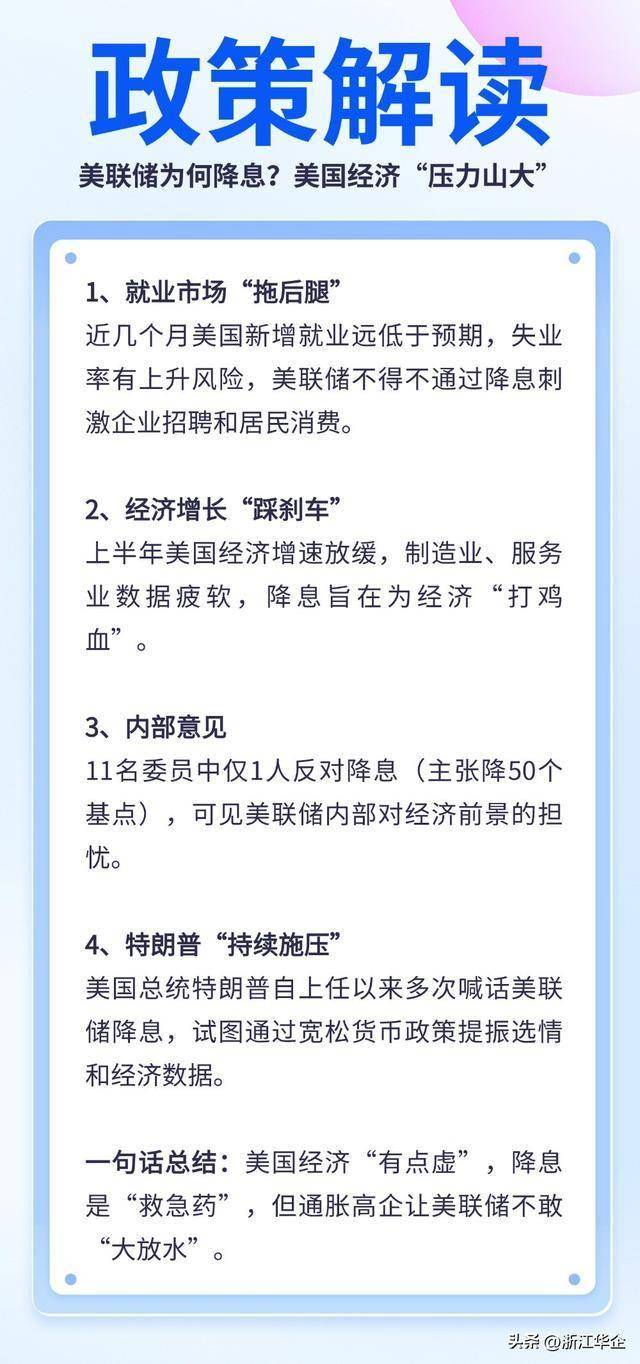
美联储降息,对中国外贸出口企业影响几何?
Sou Hu Cai Jing· 2025-09-25 09:24
Core Viewpoint - The Federal Reserve's decision to lower the federal funds rate by 25 basis points to a target range of 4.00%-4.25% reflects a response to economic slowdown and political pressure, presenting both challenges and opportunities for Chinese export enterprises and cross-border e-commerce [1]. Direct Impact: Exchange Rate Fluctuations and Cost Restructuring - The depreciation of the US dollar typically leads to the appreciation of the RMB, impacting the competitiveness of export prices. For instance, the USD/RMB exchange rate fell from 7.3 to around 7.1, potentially causing a profit decline of 0.5%-1% for the textile industry with every 1% appreciation of the RMB [7][8]. - The appreciation of the RMB reduces import costs for raw materials and consumer goods, allowing cross-border e-commerce companies to optimize procurement strategies, particularly in categories like 3C electronics and beauty products [8]. - Increased exchange rate volatility raises the risk of foreign exchange losses for enterprises, with some exporters experiencing losses exceeding 5% of net profit in a single quarter due to unhedged positions [9]. Indirect Impact: Capital Flows and Market Segmentation - The Fed's rate cut encourages capital flow to emerging markets, reducing financing costs for Chinese export enterprises. For example, the dollar loan interest rate decreased from 5% to 4%, alleviating financial pressure [10]. - While US consumer spending may be stimulated by lower rates, high inflation could weaken actual purchasing power, leading to mixed demand for Chinese exports, with some categories like home appliances and clothing seeing moderate growth [12]. Long-term Trends: Industrial Upgrading and Restructuring - Traditional export sectors face pressure to upgrade due to RMB appreciation and rising labor costs, prompting a shift of low-end production to Southeast Asia. Companies are encouraged to innovate and build brands to enhance value [15]. - High-tech products and flexible supply chains are becoming central to cross-border e-commerce, with high-tech exports projected to account for 35% of total exports by 2024 [16]. - Diversification into regional markets through agreements like RCEP is essential for reducing reliance on the US market, with exports to ASEAN expected to rise to 16% by 2024 [17]. Corporate Response Strategies: From Passive Adaptation to Active Transformation - Traditional export enterprises should implement dynamic hedging strategies, diversify settlement currencies, and enhance product and market upgrades through increased R&D and brand development [18][20]. - Cross-border e-commerce companies are advised to optimize supply chains through localized procurement and flexible production, while also adjusting operational strategies to reduce dependency on third-party platforms [22][24]. Conclusion - The Fed's rate cut may intensify short-term risks for Chinese export enterprises and cross-border e-commerce, but it also compels a shift towards high-tech and high-value-added operations, necessitating a robust competitive framework for sustainable growth [29].
摩洛哥汽车业与服务外包业过度依赖欧洲市场
Shang Wu Bu Wang Zhan· 2025-09-24 05:49
Core Insights - Morocco's economy is growing, but key industries like automotive and outsourcing face structural challenges due to over-reliance on the European market [1][2] - The Moroccan government is focusing on market diversification and accelerating industrial transformation to address these challenges [1] Automotive Industry - In 2024, Morocco's industrial exports are projected to reach nearly $40 billion, accounting for 88% of total exports, with the automotive sector contributing approximately $16 billion [1] - The automotive sector has created 200,000 jobs, but has seen a decline in exports, with a 12.7% year-on-year decrease from January to July, amounting to a loss of $510 million [1] - The EU's ban on fuel vehicle sales by 2035 is intensifying market pressures, prompting Morocco to accelerate its focus on electric vehicles and battery production [1] - The Moroccan Competition Council predicts a 40% growth in the automotive industry by 2027, with the African internal market expected to exceed $42 billion [1] Outsourcing Industry - The outsourcing sector is also facing challenges, particularly with France's new regulation banning unsolicited telemarketing calls, which could result in a revenue loss of $107 million and nearly 10,000 job reductions [2] - Currently, the outsourcing industry generates $1.8 billion in annual revenue and employs 90,000 people [2] - Economists emphasize the need for Morocco to strengthen local supply chains and enhance market diversification and localization capabilities to mitigate international risk impacts [2]
迎战三重考验,中国外贸人求变突围进行时
Zheng Quan Shi Bao· 2025-09-22 00:35
Core Viewpoint - Despite challenges such as trade protectionism and fluctuating tariff policies, China's foreign trade has shown resilience, with a reported 3.5% year-on-year growth in import and export value for the first eight months of the year [1][2]. Group 1: Trade Performance - In August, China's goods exports reached 2.3 trillion yuan, marking a 4.8% year-on-year increase, with exports to the U.S. accounting for 30% of total exports [2][5]. - The overall export value increased by 32% despite a 25% decline in exports to the U.S. during the first half of the year due to tariffs [2][3]. - For the first eight months, trade with ASEAN countries grew by 9.7%, while trade with the EU increased by 4.3% [3][8]. Group 2: Challenges Faced - The foreign trade sector is facing significant challenges, including unclear tariff policies, increasing order fragmentation, and intensified market competition [4][5]. - Exports to the U.S. have seen a 33.1% year-on-year decline in August, raising concerns about the impact of potential future tariffs [5][6]. - The shift towards smaller, fragmented orders has led to increased production costs and inefficiencies for many companies [6][7]. Group 3: Strategic Responses - Companies are diversifying their production bases to mitigate risks associated with tariffs, with some establishing factories in countries like Bangladesh, Vietnam, and Cambodia [3][7]. - A market diversification strategy is being adopted, with companies increasing their presence in emerging markets such as Southeast Asia and Latin America [3][8]. - Firms are investing in digital transformation and smart manufacturing to enhance flexibility and responsiveness to market demands [6][8]. Group 4: Future Outlook - There is optimism among foreign trade enterprises regarding future growth, particularly in markets where Chinese products are competitively priced [9]. - Companies are focusing on product diversification and high value-added offerings to strengthen their competitive edge [8][9].