
智能经济

Search documents
影响未来消费的八大经济模式
Sou Hu Cai Jing· 2025-09-15 13:52
Core Insights - The global retail consumption market is projected to double by 2035, reaching $110-120 trillion, with China expected to contribute $18-26 trillion, becoming a key growth engine [8][10] - Eight economic models are identified as drivers of this growth, including creator economy, new family economy, new silver economy, big health economy, healing and self-care economy, population migration economy, sustainable economy, and smart economy [10][12] Economic Models - **Creator Economy**: Characterized by independence and extraordinary creativity, where consumers become producers and sellers, driven by advanced production tools and digital platforms [10][16] - **New Family Economy**: Reflects the diversification of family structures beyond the traditional "nuclear family," leading to unique consumption needs [37][39] - **New Silver Economy**: Focuses on the changing perceptions of the elderly, who are expected to maintain active lifestyles and diverse consumption patterns [57][59] - **Big Health Economy**: Emphasizes the rising health consciousness among consumers, leading to increased demand for preventive healthcare and wellness products [12][13] - **Healing and Self-Care Economy**: Addresses the growing need for emotional support and community connection among consumers facing loneliness and mental health issues [13][14] - **Population Migration Economy**: Driven by cultural integration and consumption migration due to demographic shifts and urbanization [14][15] - **Sustainable Economy**: Reflects the increasing environmental awareness among consumers and the rise of sustainable business practices [14][15] - **Smart Economy**: Involves the integration of AI and big data into daily life, enhancing efficiency and decision-making in consumption [14][15] Market Opportunities - Companies must adapt their strategies according to the four-layer framework of "setting tone, clarifying direction, building advantages, and strengthening capabilities" to succeed in the evolving consumption landscape [10][12] - The creator economy is expected to grow at a compound annual growth rate (CAGR) of 10.5%, reaching a market size of $5.8 trillion by 2035, driven by lower barriers to entry and diverse monetization channels [32][33] - The new family economy presents opportunities for products and services tailored to various family structures, such as single-person households and multi-generational families [51][52] - The new silver economy offers potential for businesses to cater to the needs of an aging population, focusing on both care and lifestyle enhancement [68][69]

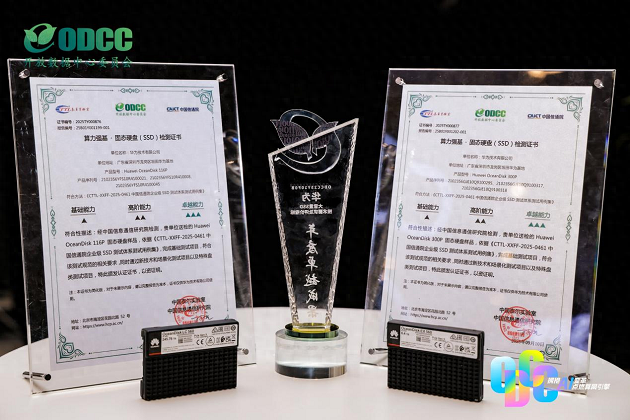
ODCC 2025 | 华为SSD斩获年度卓越成果奖,全新AI SSD系列新品惊艳亮相引行业热议
Huan Qiu Wang· 2025-09-12 05:40
Core Insights - Huawei's "Large Capacity SSD Technology Requirements and Evaluation Standards" won the ODCC 2025 Annual Excellence Achievement Award, promoting industry standardization and development [1][3] - Huawei's OceanDisk 116P and OceanDisk 300P received the "Computing Power Foundation · Enterprise-level SSD Excellence Product" title from the China Academy of Information and Communications Technology, highlighting their performance, reliability, and durability [3] - The newly launched AI SSD series addresses the increasing demands for performance and capacity in data storage, providing comprehensive storage solutions for AI training and inference scenarios [3][5] Product Innovations - The AI SSD series includes extreme performance disks, high-performance disks, and large-capacity disks, designed to meet the rigorous requirements of AI applications [3] - The OceanDisk LC 560 features the industry's highest single-disk physical capacity of 245TB, utilizing innovative water-separation chamber technology to enhance reliability and durability by 100% [5] - The AI SSD significantly reduces storage space and energy consumption for original corpora in cluster training, achieving a 6-fold improvement in data preprocessing read efficiency [5] Industry Impact - The launch of Huawei's AI SSD series not only supports AI training and inference but also propels the smart economy from concept to reality, establishing Huawei's leading position in the AI storage sector [7] - As AI technology continues to evolve, the importance of storage devices as a foundation for the smart economy is increasingly recognized, with Huawei's innovations setting new industry benchmarks [8] - Huawei aims to continue exploring new boundaries in storage technology, contributing to the high-quality development of the smart economy with superior products and services [8]
广东加速落地行业智能体 剑指万亿级智能经济
2 1 Shi Ji Jing Ji Bao Dao· 2025-09-11 15:13
Group 1 - The core viewpoint is that artificial intelligence (AI) is at a critical turning point from technological breakthroughs to value realization, with significant advancements in large model technology and a growing range of application scenarios across various industries [1] - The Chinese government has issued the "Opinions on Deepening the Implementation of the 'Artificial Intelligence+' Action," aiming to promote the application of intelligent agents and bridge the gap in value realization through deep restructuring of production factors [1] - Intelligent agents, which are AI systems capable of perceiving environments, planning tasks, and executing autonomously, are becoming a key focus for AI development institutions [1] Group 2 - Pointing to the rapid development of intelligent agents, companies from startups to tech giants are accelerating their layouts, with policies in cities like Beijing and Shanghai injecting new momentum into the sector [1] - Guangdong enterprises are making strides in foundational and cutting-edge technologies related to intelligent agents, targeting typical scenarios to advance industrial applications [1] - The establishment of a joint laboratory between Hong Kong University of Science and Technology (Guangzhou) and Guangzhou Diandong Information Technology Co., Ltd. aims to focus on cutting-edge technology research in the field of intelligent agents [2] Group 3 - Diandong Technology's chairman, Chen Kebin, emphasizes that the company has built an ecosystem of "computing power resources + scenario-based applications + entrepreneurial incubation" since its AI infrastructure layout in 2022 [2] - The joint laboratory will focus on three strategic topics: quantitative finance, digital entertainment, and intelligent scheduling, leveraging the university's innovative advantages to accelerate core technology breakthroughs and industrial transformation [2] - The establishment of the laboratory signifies a solid step towards integrating research and practice, reflecting a commitment to interdisciplinary collaboration [2]
广东加速落地行业智能体,剑指万亿级智能经济
2 1 Shi Ji Jing Ji Bao Dao· 2025-09-11 14:48
Group 1 - The core viewpoint of the articles highlights the critical turning point for artificial intelligence (AI) as it transitions from technological breakthroughs to value realization, with a focus on the implementation of AI in various industries [1][2] - The Chinese government has issued the "Opinions on Deepening the Implementation of the 'Artificial Intelligence+' Action," aiming to promote the application of intelligent agents and bridge the gap in value realization through AI [1] - Intelligent agents, capable of perceiving environments and autonomously executing tasks, are becoming a key focus for AI development institutions, with significant advancements in large model technology [1] Group 2 - Pointing Technology has established an ecosystem combining computing resources, scenario-based applications, and entrepreneurial incubation since its AI infrastructure layout in 2022, and is collaborating with Hong Kong University of Science and Technology (Guangzhou) to create a joint laboratory for intelligent agents [2] - The joint laboratory will focus on three strategic topics: quantitative finance, digital entertainment, and intelligent scheduling, leveraging the innovative advantages of Hong Kong University of Science and Technology (Guangzhou) [2] - Guangdong has launched multiple industry-specific intelligent agents this year, including a government service model in April and a wireless fault intelligent agent solution in June, indicating a strong push towards practical applications of AI [2]
“人工智能+”加速释放强劲动能——透视我国智能经济发展新趋势
Xin Hua Wang· 2025-09-11 12:14
Core Insights - The 2025 World Intelligent Industry Expo showcased advancements in artificial intelligence, including flying cars and humanoid robots, highlighting the rapid integration of AI technologies into various sectors [3][4][6] - The Chinese government is promoting the "AI+" initiative to foster a new intelligent economy and society, emphasizing human-machine collaboration and cross-industry integration [3][10] Group 1: Technological Innovations - The flying car "EH216-S" from Changan Automobile features an intelligent driving system and has received certification from the Civil Aviation Administration of China for urban air traffic [6][10] - The speed of technological development is accelerating, with companies like DJI significantly enhancing drone capabilities, such as increasing flight height and payload capacity [8][10] - The number of AI companies in China has surged from over 1,400 to more than 5,000 in five years, indicating rapid growth in the sector [8][10] Group 2: Industry Applications - AI applications are expanding across various fields, including healthcare, social security, and education, with initiatives like "AI+ County Medical Community" and "AI+ Human Resources" being implemented [14][20] - Smart home products are becoming increasingly sophisticated, enhancing the quality of life for consumers through interconnected devices [11][12] Group 3: International Cooperation - The expo featured international participation, with Singapore showcasing innovations in smart city governance and AI-driven healthcare solutions, highlighting the potential for global collaboration in AI [18][20] - China is actively engaging in international AI cooperation, promoting initiatives that aim for inclusive and beneficial AI development for all nations [22][24]

新华全媒头条|“人工智能+”加速释放强劲动能——透视我国智能经济发展新趋势
Xin Hua She· 2025-09-11 10:15
Group 1 - The article highlights the rapid development and integration of artificial intelligence (AI) in various industries, showcasing innovations such as flying cars and humanoid robots at the 2025 World Intelligent Industry Expo [1][2] - The Chinese government has issued a directive to accelerate the formation of a new intelligent economy and society through human-machine collaboration and cross-industry integration [1][3] - The number of AI companies in China has surged from over 1,400 to more than 5,000 in five years, indicating a significant growth rate of approximately 11 companies emerging every 11 hours [2][3] Group 2 - The foundation of the intelligent industry in China is strengthening, with over 35,000 basic-level and 6,300 advanced-level smart factories established, alongside 11 national AI innovation application pilot zones [3][4] - A national AI industry investment fund with a total scale of 60 billion yuan has been established, and over 240 standards in core AI technology have been developed to enhance the industry ecosystem [3][4] - AI applications are increasingly penetrating daily life, with innovations in healthcare, social security, and education, such as AI-assisted medical diagnostics and smart educational solutions [4][5] Group 3 - International cooperation in AI is being emphasized, with countries like Singapore showcasing their innovations at the expo and seeking collaborative opportunities in various sectors [6][7] - China is actively promoting AI as a global public good, with initiatives like the Global AI Governance Initiative and the establishment of cooperation centers to enhance collaboration in AI technology and applications [6][7] - Successful case studies of AI applications in other countries, such as smart farming in Cambodia and intelligent power grid management in Brazil, demonstrate the global impact of Chinese AI technology [7]
中国最大支柱产业,要变了
首席商业评论· 2025-09-06 05:08
Core Viewpoint - The article emphasizes the significance of the "Artificial Intelligence +" initiative as a pivotal strategy for China's economic transformation, aiming for AI to become a major growth driver by 2030 and fully integrated into society by 2035 [4][6][8]. Group 1: AI Development Goals - The Chinese government has set a three-step plan for AI development, targeting over 70% application penetration by 2027 and over 90% by 2030, with the goal of establishing a smart economy as a key growth engine [4][6]. - By 2030, the core AI industry is projected to exceed 1 trillion yuan, driving related industries to surpass 10 trillion yuan, indicating a massive economic shift [6][8]. Group 2: Economic Transition - The transition from a real estate-driven economy to a smart economy signifies a comprehensive restructuring of pillar industries, with AI expected to play a crucial role in this transformation [6][7]. - The article highlights that AI represents a new paradigm of production factors, with data being termed the "fourth production factor," contrasting with traditional reliance on land in real estate [7][8]. Group 3: Global AI Competition - The article discusses the global race in AI, with major economies prioritizing AI in their strategic frameworks, including the U.S. and the EU, while China aims to leverage its "Artificial Intelligence +" initiative to gain a competitive edge [10][11]. - China's AI strategy has evolved from being a follower in previous tech revolutions to taking a leading role in the current AI revolution, with significant advancements in core technologies [12][11]. Group 4: Application and Market Potential - The success of the "Artificial Intelligence +" initiative hinges on large-scale applications, with the potential to create a market worth tens of trillions, driven by diverse sectors such as education, healthcare, and urban governance [13][15]. - The article outlines six key action areas for AI application, including enhancing scientific research, industrial development, consumer quality, public welfare, governance capabilities, and global cooperation [14][15]. Group 5: Investment and Economic Impact - AI investments are projected to reach hundreds of billions, with significant capital expenditures from major Chinese tech firms like Alibaba, Tencent, and Huawei, indicating a robust growth trajectory for the AI sector [21][19]. - The article predicts that by 2028, global AI spending will surge from over $200 billion to more than $600 billion, reflecting a compound annual growth rate of 28% [19][21]. Group 6: Future Prospects and Strategic Positioning - The article suggests that companies and regions that position themselves as leaders in AI will be better equipped to convert policy advantages into market success, emphasizing the importance of a complete ecosystem from computing power to application [27][28]. - The focus on self-reliance and core technology development is deemed essential for long-term success in the AI landscape, with companies encouraged to innovate independently to avoid dependency on external technologies [28][27].




【数说经济】智能经济时代加速到来
Jing Ji Ri Bao· 2025-09-05 00:22
Core Viewpoint - The implementation of the "Artificial Intelligence +" initiative marks a significant shift in integrating artificial intelligence with economic and social development, aiming to enhance industrial dynamics, reshape economic structures, and improve governance efficiency [3][4]. Group 1: Industry Development - China's industrial system is comprehensive, with abundant data resources and extensive application scenarios, creating a natural testing ground for the smart economy through a positive cycle of "demand-data-technology iteration" [2][4]. - By September 1, 2023, Beijing has completed the filing of 158 generative artificial intelligence services, indicating rapid advancements in the field [2]. - The State Council's opinion outlines a roadmap for AI integration across six key areas by 2027, with the goal of achieving over 70% penetration of new intelligent terminals and agents by 2030, and over 90% by 2035 [2]. Group 2: Economic Transformation - The evolution from information economy to digital economy and now to smart economy illustrates a progressive integration where AI will reshape the allocation of production factors and drive industries from digitalization to intelligentization [3]. - AI is expected to significantly enhance total factor productivity, shifting the economy from a focus on quantity to quality, thereby creating sustained endogenous growth momentum [3]. Group 3: Global Competition - Artificial intelligence is becoming a new focal point of competition among countries, with China's large-scale market and robust industrial framework providing a competitive edge in the global arena [4]. Group 4: Societal Impact - The transformation towards a smart economy will lead to profound changes in daily life, with AI becoming an omnipresent service, personalizing experiences in home, travel, and health management [5]. - Challenges such as data privacy, algorithm fairness, and the definition of human-machine responsibility need to be addressed as AI development progresses [5].

中经评论:智能经济时代加速到来
Jing Ji Ri Bao· 2025-09-05 00:03
Group 1 - The core viewpoint of the articles emphasizes the rapid integration of artificial intelligence (AI) into various sectors of the economy and society in China, with a significant focus on policy support and educational initiatives [1][2] - As of September 1, 2023, China holds 60% of the global AI patent count, indicating a strong position in AI innovation and development [1] - The "Artificial Intelligence+" initiative aims for deep integration of AI with six key sectors by 2027, with a target of over 70% application penetration of new intelligent terminals and agents by that year [1] Group 2 - The transition from information economy to digital economy and now to intelligent economy is highlighted, where AI is expected to reshape production factor allocation and drive industries from digitalization to intelligentization [2] - AI is projected to enhance productivity across various industries, such as manufacturing and agriculture, by enabling dynamic resource allocation and optimizing processes based on data [2] - China's comprehensive industrial system, rich data resources, and vast application scenarios provide a natural testing ground for the intelligent economy, fostering a positive cycle of demand, data, and technology iteration [2] Group 3 - The transformation towards an intelligent economy will lead to highly personalized services in daily life, such as tailored health recommendations and real-time traffic management [3] - Challenges accompanying this transformation include data privacy, algorithm fairness, and the definition of human-machine responsibility, necessitating a balance between technological innovation and ethical governance [3] - The relationship between government and market is crucial, requiring effective government guidance while also stimulating innovation from business entities to create a synergistic development environment [3]
智能经济时代加速到来
Jing Ji Ri Bao· 2025-09-04 22:01
Core Insights - The "Artificial Intelligence +" initiative signifies China's transition of AI from a technical concept to a stage of deep integration with the economy and society, aiming to activate industrial momentum, reshape economic structure, and enhance governance efficiency [2][3] - China's AI patent count accounts for 60% of the global total, with significant advancements in humanoid robots and smart terminals, indicating a robust foundation for the smart economy [1][3] - The government has set a roadmap for AI integration across six key sectors by 2027, with the aim of achieving over 70% penetration of new intelligent terminals and agents by 2030, and transitioning to a smart economy by 2035 [1][2] Industry Developments - The initiative is expected to enhance productivity across various sectors, including manufacturing and agriculture, by enabling dynamic resource allocation and optimizing processes through AI [2][3] - The integration of AI into daily life is anticipated to lead to highly personalized services in areas such as home management, transportation, and health care, making AI a ubiquitous service akin to electricity and water [3] Policy and Governance - Recent policies from multiple provinces support AI development, indicating a coordinated effort to foster an environment conducive to innovation [1] - The relationship between technology and ethics, innovation and safety, as well as government and market dynamics, will be crucial in ensuring that AI development aligns with societal progress and safety [3]