
零碳工厂

Search documents
利好来了,五部门联合发布
中国基金报· 2026-01-19 06:23
Core Viewpoint - The article discusses the release of the "Guiding Opinions on the Construction of Zero Carbon Factories" by five Chinese government departments, emphasizing the importance of reducing carbon emissions in industrial sectors and promoting green transformation through zero carbon factory initiatives [2][3]. Group 1: Overall Requirements - The initiative is guided by Xi Jinping's thoughts on ecological civilization and aims to enhance industrial efficiency and promote green transformation across the entire industrial chain [7]. - The construction of zero carbon factories will follow principles such as tailored strategies for different industries, innovation-driven approaches, continuous improvement, and transparency in carbon emissions reporting [8][9]. Group 2: Main Goals - The plan includes a phased approach, starting with industries that have urgent decarbonization needs and are primarily electricity consumers, with a goal to select a batch of zero carbon factories by 2026 [10]. - By 2027, the initiative aims to establish zero carbon factories in sectors like automotive, lithium batteries, photovoltaics, electronics, light industry, machinery, and computing facilities, with further expansion to high carbon intensity industries by 2030 [10]. Group 3: Construction Pathways - Establishing a carbon emission accounting management system is crucial for accurate data support in zero carbon factory construction [11]. - Transitioning to a green and low-carbon energy structure is essential, encouraging the use of renewable energy sources and technologies such as distributed solar and wind power [12]. - Improving energy efficiency through systematic optimization of production processes and adopting advanced technologies is a key focus [13]. - Promoting zero carbon supply chain management and conducting carbon footprint analysis for key products will drive collaborative decarbonization across the industry [14]. - Enhancing digital and intelligent management capabilities will facilitate precise measurement and control of energy consumption and carbon emissions [14]. - Carbon offsetting and information disclosure are necessary to achieve and maintain near-zero carbon emissions [14]. Group 4: Work Requirements - Local industrial and information departments are encouraged to develop specific implementation plans for zero carbon factory construction, promoting collaboration among government, enterprises, and markets [15]. - A comprehensive standard system for zero carbon factories is to be established, providing scientific and practical guidelines for management and evaluation [16]. - The promotion of comprehensive services for energy saving and carbon reduction is essential, including technology transfer and international cooperation [17].

重磅!工信部、国家发改委、国家能源局等5部门发布
中国能源报· 2026-01-19 04:27
Core Viewpoint - The article discusses the guidance issued by the Ministry of Industry and Information Technology and other departments in China regarding the construction of zero-carbon factories, aiming to enhance low-carbon competitiveness and adapt to international trade rules by 2030 [1][3]. Group 1: Overall Requirements - The initiative is guided by Xi Jinping's thoughts on ecological civilization and aims to promote green and low-carbon transformation in key industries, enhancing productivity and achieving carbon peak and neutrality goals [4][5]. - The construction of zero-carbon factories will follow principles such as tailored strategies, innovation-driven approaches, and systematic promotion to ensure effective low-carbon transitions [6][7]. Group 2: Main Goals - From 2026, a selection of zero-carbon factories will be established as benchmarks, with a focus on industries like automotive, lithium batteries, photovoltaics, electronics, light industry, machinery, and computing facilities by 2027 [8][9]. - By 2030, the initiative will expand to include industries such as steel, non-ferrous metals, petrochemicals, building materials, and textiles, exploring new decarbonization pathways [9][10]. Group 3: Construction Pathways - A carbon emission accounting management system will be established to provide accurate data for zero-carbon factory construction, including direct and indirect emissions [11]. - The initiative encourages the transition to green and low-carbon energy structures, promoting the use of renewable energy sources and technologies [12]. - Energy efficiency will be significantly improved through systematic optimization of production processes and the adoption of advanced technologies [13]. - The analysis of carbon footprints for key products will be promoted to drive collaborative decarbonization across the supply chain [14]. - Digitalization and smart technologies will be leveraged to enhance carbon management and operational efficiency [15]. - Carbon offsetting and information disclosure will be implemented to maintain near-zero emissions and improve sustainability reporting [16]. Group 4: Work Requirements - Local authorities are encouraged to develop specific implementation plans for zero-carbon factory construction, promoting collaboration among government, enterprises, and markets [16][18]. - A standard system will be established to support zero-carbon factory management and evaluation, ensuring alignment with international standards [18]. - The promotion of comprehensive services for energy saving and carbon reduction will be encouraged, facilitating technology transfer and market services [18].
关于开展零碳工厂建设工作 五部门联合印发指导意见
Jing Ji Guan Cha Wang· 2026-01-19 04:20
Core Viewpoint - The joint issuance of the "Guiding Opinions on the Construction of Zero Carbon Factories" aims to enhance energy conservation and carbon reduction in the industrial and information sectors, promoting green and low-carbon transformation in key industries and fostering new productive forces [1]. Group 1: Definition and Concept - Zero carbon factory construction refers to the process of continuously reducing carbon dioxide emissions through technological innovation, structural adjustments, and management optimization, aiming for near-zero emissions rather than absolute zero [2]. Group 2: Implementation Phases - The guiding opinions outline a phased approach for cultivating zero carbon factories, starting with the selection of benchmark factories in 2026, followed by the establishment of zero carbon factories in sectors such as automotive, lithium batteries, photovoltaics, and electronics by 2027, and expanding to traditional high-energy industries like steel and petrochemicals by 2030 [3]. Group 3: Construction Pathways - Six major directions for construction are proposed, including establishing a carbon accounting system, optimizing energy structure for source reduction, enhancing energy efficiency for process decarbonization, conducting carbon footprint analysis for collaborative reduction, leveraging digitalization for intelligent carbon control, and implementing carbon offsetting and information disclosure for continuous improvement [4]. Group 4: Work Requirements - The guiding opinions also outline work requirements focusing on organizational implementation, improving standard systems, and promoting comprehensive energy-saving and carbon reduction services. Some regions have already initiated near-zero carbon factory pilot projects, with over 30 related group standards established to lay the foundation for nationwide promotion [5].
五部门:到2027年在汽车、锂电池、光伏、算力设施等行业领域培育建设一批零碳工厂
Jin Rong Jie· 2026-01-19 04:07
Core Viewpoint - The Ministry of Industry and Information Technology, along with other governmental bodies, has issued guidelines for the construction of zero-carbon factories, aiming to enhance energy efficiency and promote green transformation in key industries, thereby supporting carbon peak and carbon neutrality goals [1][4]. Group 1: Guidelines and Principles - The construction of zero-carbon factories will follow four principles: tailored strategies for different industries, systematic advancement, innovation-driven and technology-enabled approaches, and a commitment to transparency and standardization [2]. - A phased approach will be implemented, prioritizing industries with urgent decarbonization needs and lower decarbonization difficulties, with a gradual expansion to more challenging sectors [2][9]. Group 2: Goals and Timeline - By 2026, a selection of zero-carbon factories will be identified to serve as benchmarks, with a target to establish a number of such factories in sectors like automotive, lithium batteries, photovoltaics, electronics, light industry, machinery, and computing facilities by 2027 [2][9]. - By 2030, the initiative aims to extend to high-energy-consuming industries such as steel, non-ferrous metals, petrochemicals, building materials, and textiles, exploring new decarbonization pathways [2][9]. Group 3: Construction Pathways - Key pathways for zero-carbon factory construction include establishing a carbon emission accounting management system, enhancing the green and low-carbon transformation of energy structures, improving energy efficiency, conducting carbon footprint analyses, advancing digitalization, and implementing carbon offsetting and information disclosure [3][9]. Group 4: Implementation and Support - The Ministry of Industry and Information Technology will collaborate with other departments to ensure the effective implementation of the guidelines, encouraging local governments to develop specific plans for zero-carbon factory construction [11][12]. - There will be a focus on developing a standard system for zero-carbon factories and promoting comprehensive energy-saving and carbon-reduction services through collaboration with industry associations and research institutions [12].
工信部:聚焦冶金、化工、轻工、纺织、机械、船舶等领域 研究制定改造提升方案
Jin Rong Jie· 2026-01-13 12:26
Group 1 - The Ministry of Industry and Information Technology, led by Minister Li Lecheng, will implement a traditional industry revitalization action plan focusing on sectors such as metallurgy, chemicals, light industry, textiles, machinery, and shipbuilding [1] - The plan includes developing tailored transformation and upgrading schemes for each industry and implementing the "Artificial Intelligence +" initiative to promote smart manufacturing and green manufacturing [1] - The goal is to explore the creation of a number of zero-carbon factories and zero-carbon parks, allowing traditional industries to "sprout new buds" [1]
李乐成:加快建设现代化产业体系
Ren Min Ri Bao· 2026-01-13 03:15
Core Viewpoint - The interview with Li Lecheng, Minister of Industry and Information Technology, emphasizes the importance of implementing the spirit of the Central Economic Work Conference to ensure a strong start for the "14th Five-Year Plan" by focusing on innovation-driven development and building a modern industrial system with international competitiveness [2][3]. Group 1: Industrial Economic Stability - The industrial economy in China is expected to maintain stability and growth, with a focus on four key areas: stabilizing growth in key industries and regions, expanding effective demand, promoting value creation, and enhancing the vitality of business entities [3][4]. - Key industries and regions account for 80% of the total industrial output, necessitating targeted support and policy measures to ensure their growth [3]. Group 2: Modernization of the Industrial System - The "14th Five-Year Plan" aims to accelerate the modernization of the industrial system by promoting intelligent, green, and integrated development in manufacturing [5][6]. - Traditional industries will undergo renewal through the implementation of targeted upgrade plans, while new industries will be developed to create new growth drivers [5][6]. Group 3: Technological Innovation - The Ministry plans to enhance the integration of technological and industrial innovation, focusing on high-quality technological supply and the establishment of national manufacturing innovation centers [8][9]. - There will be an emphasis on increasing the participation of enterprises in major national technology projects and enhancing their innovation capabilities [8]. Group 4: Digital Transformation - The Ministry will promote the digital transformation of manufacturing through the large-scale application of industrial internet and artificial intelligence technologies [10][11]. - Efforts will be made to improve data quality and facilitate the digital transition of enterprises, particularly small and medium-sized enterprises [10][11].
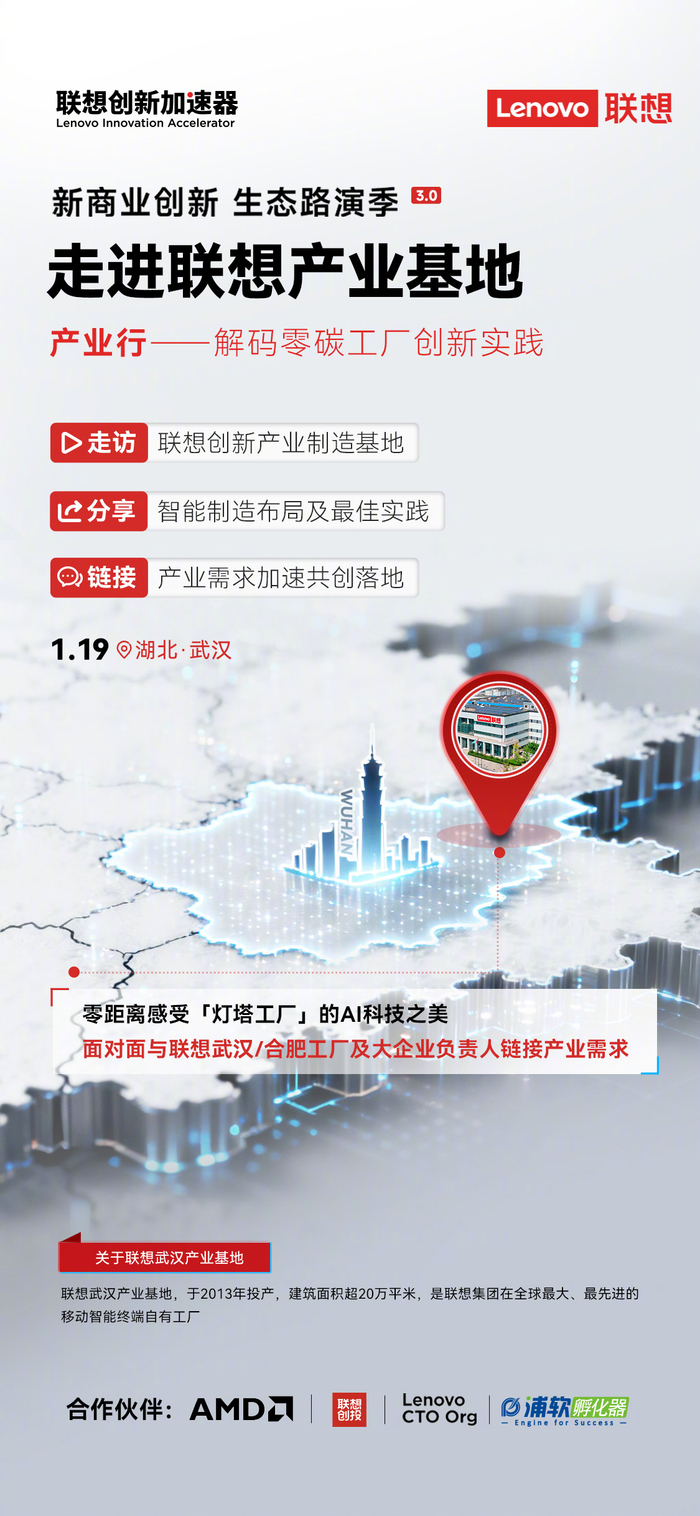
联想武汉产业基地开放走访,探秘全球领先零碳工厂
3 6 Ke· 2026-01-12 06:34
Group 1 - The core viewpoint of the news highlights Lenovo's advanced manufacturing capabilities at its Wuhan industrial base, showcasing it as a leading "zero-carbon factory" with a production capacity exceeding 140,000 units per day, producing one device every 0.6 seconds [1] - The facility features the industry's first 5G+IoT automated production line, named "Quantum Line," which allows for flexible manufacturing processes that can be restructured in just four hours [1] - The Wuhan industrial base, operational since 2013, spans over 200,000 square meters, making it Lenovo's largest and most advanced self-owned factory for mobile smart terminals globally [4] Group 2 - The event provides opportunities for industry stakeholders to connect with Lenovo's experts from the Wuhan and Hefei bases to explore smart manufacturing solutions [3] - The initiative aims to link Lenovo's global market resources across 160 countries, facilitating the acceleration of product and technology deployment for participating enterprises [1]

工信部部长李乐成:将实施传统产业焕新行动,分行业研究制定改造提升方案
Xin Lang Cai Jing· 2026-01-12 03:35
工业和信息化部党组书记、部长李乐成在接受采访时表示,传统产业是现代化产业体系的基底。我们将 实施传统产业焕新行动,分行业研究制定改造提升方案。实施"人工智能+"行动,探索创建一批零碳工 厂和零碳园区。(新华社) ...
河南新增一批零碳工厂超级能效工厂
He Nan Ri Bao· 2026-01-08 23:53
河南绿色制造再提速。1月8日,记者从省工业和信息化厅获悉,2025年度河南省零碳工厂、超级能效工 厂名单公布,郑州煤矿机械集团、人民电缆集团等24家企业被确定为2025年度河南省零碳工厂,河南明 泰铝业股份有限公司、登封市嵩基水泥有限公司等14家企业被确定为2025年度河南省超级能效工厂。 近日印发的《河南省加快推动制造业绿色低碳发展的若干政策措施》提出,要持续培育绿色制造标杆, 发挥零碳工厂、超级能效工厂的示范引领作用。根据计划,今年我省将再培育零碳工厂10家、超级能效 工厂10家,争取绿色工厂产值占制造业总产值比重达30%以上。(记者 陈辉) 责任编辑: 何山 所谓零碳工厂,可视为绿色工厂的升级版,其通过节能减排技术应用、可再生能源替代及负碳技术,最 大程度实现"应减尽减",企业在生产制造过程中温室气体排放通过碳减排与碳抵消等措施,达到碳排放 综合为零的状态。 此次入选我省零碳工厂、超级能效工厂的企业各有绝招,包括能源替代、工艺革新、碳捕集与封存以及 全生命周期碳管理等多种手段。比如河南卫华重型机械股份有限公司,其能源优先采用可再生能源,企 业构建的"绿色微电网"以6MWp屋顶光伏电站为核心电源,实现"光 ...
工业大省这样加快推进绿色转型
Xin Lang Cai Jing· 2025-12-21 22:46
Core Viewpoint - Jiangsu province has made significant progress in implementing its "dual carbon" strategy, focusing on high-quality development through innovative reforms and precise policies to achieve green transformation in its industrial sector [1][4]. Group 1: Energy Consumption Reduction - During the first four years of the 14th Five-Year Plan, Jiangsu's energy consumption intensity per unit of GDP decreased by 13.0%, and the energy consumption intensity per unit of industrial added value for above-scale industries fell by 13.2% [3][4]. - In the first three quarters of 2025, these two indicators further declined by 5.6% and 6.1% year-on-year, respectively, laying a solid foundation for achieving the energy consumption reduction targets of the 14th Five-Year Plan [3][4]. Group 2: Green Manufacturing Initiatives - Jiangsu has introduced a "standard-led, unlimited quota" application mechanism for green factories, resulting in 901 new provincial-level green factories in 2025, bringing the total to 2,550 [1][5]. - The province has also cultivated 30 zero-carbon (near-zero carbon) factories, leading the nation at the provincial level [1][6]. Group 3: Resource Recycling and Utilization - Jiangsu has advanced the comprehensive utilization of industrial solid waste, with 126 enterprises now recognized for their recycling capabilities, and has established a comprehensive network for the collection of used batteries [1][7]. - The province's recycling of used power batteries has exceeded the national average, with 7 recognized enterprises recovering 13,300 tons of used batteries this year [7]. Group 4: Policy and Management Framework - The Jiangsu provincial government has implemented a top-level design for industrial green development, establishing clear goals for energy consumption reduction and deploying special actions to facilitate low-carbon transitions [4][5]. - A robust energy consumption management system has been established, with strict accountability measures for regions that fail to meet energy intensity reduction targets [4][5]. Group 5: Future Directions - The province aims to continue promoting high-quality development with a focus on carbon peak and carbon neutrality, enhancing green manufacturing and fostering new growth drivers in the green economy [10].