具身智能

Search documents
创新“新特区”,AWE2026上海新国际博览中心W3馆创新科技展区正式亮相
3 6 Ke· 2026-02-27 03:37
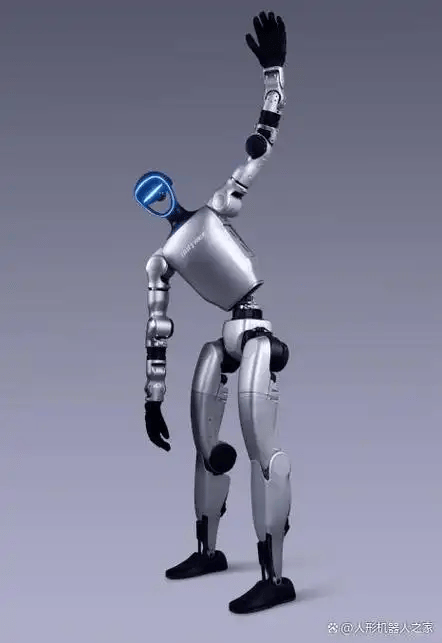
Core Viewpoint - The AWE2026 event is set to showcase a new "Innovation Technology Exhibition Area" in Shanghai, responding to the demand for new growth momentum in the home appliance and consumer electronics industry, which is undergoing structural upgrades and technological transitions [1][3]. Industry Overview - The home appliance and consumer electronics industry in China is solidifying its scale advantages and is at a critical juncture for structural upgrades and technological leaps [1]. - The Innovation Technology Exhibition Area will cover approximately 5,000 square meters, focusing on high-growth potential new technologies, products, and companies [3]. Exhibition Highlights - The Innovation Technology Exhibition Area will feature advancements in embodied intelligence and robotics, AI hardware, new human-computer interaction, and cutting-edge audio-visual and smart entertainment technologies [3][4]. - Key exhibitors include companies like Unitree Technology, MagicLab, and others, showcasing products that are rapidly moving towards application and commercialization [3][4]. Company Profiles - **Unitree Technology**: A leading global company in civil robotics, known for its high-performance quadruped robots and significant R&D capabilities, with over 180 patents [5][7]. - **MagicLab**: A global pioneer in general humanoid robots, focusing on comprehensive R&D with a high percentage of self-developed hardware and software [8][10]. - **LeXiang Technology**: A leader in consumer-grade embodied intelligence, targeting home, elderly care, education, and pet scenarios, achieving significant commercial milestones [11][13]. - **ZhiShen Technology**: An all-industry chain technology service provider in embodied intelligence, with a strong focus on R&D and practical applications in various sectors [14][16]. Product Innovations - The exhibition will showcase various innovative products, including: - Unitree's G1 humanoid robot, capable of complex movements and continuous evolution through deep reinforcement learning [7]. - MagicLab's MagicBot series, featuring high-performance humanoid robots designed for commercial applications [10]. - LeXiang's M1 robot, the first consumer-grade robot utilizing reinforcement learning for control, aimed at various essential scenarios [13]. - ZhiShen's ZSL-1 robot, known for its unique capabilities in challenging environments [16]. AI Hardware and Entertainment - The exhibition will also highlight AI hardware and audio-visual entertainment, exploring how AI can redefine human-technology interactions [17]. - Notable products include the Qwen AI glasses from Alibaba, designed to serve as a personal AI assistant with advanced multi-modal capabilities [18]. - Future Intelligent's AI conference headphones, which have achieved significant sales and feature advanced language translation and transcription capabilities [20][22]. Conclusion - The Innovation Technology Exhibition Area at AWE2026 is expected to be a vibrant hub of technological advancements, potentially leading to the next generation of consumer and lifestyle innovations [27].

表彰具身智能产业破局者!第三届LeadeRobot具身智能与人形机器人行业评选进行中,诚邀领航者共塑未来
机器人大讲堂· 2026-02-27 03:10
Core Insights - The industry of embodied intelligence and humanoid robots is experiencing unprecedented growth opportunities, with financing in this sector increasing by over 150% year-on-year since 2025, and nearly a hundred companies entering the market [2] - The application scenarios are rapidly extending from industrial manufacturing to healthcare, home services, and specialized operations, transforming futuristic concepts into present realities [2] - The industry is advancing along a clear path of technological breakthroughs and application implementations, with significant improvements in data quality, core performance metrics, and production capabilities [2][3] Group 1: Industry Development - The industry maintains a strong momentum of forward development, with various stakeholders including algorithm teams, manufacturing companies, core component manufacturers, and service organizations collaborating to address technical challenges and refine applications [3] - The third LeadeRobot evaluation aims to discover industry benchmarks, promote innovative achievements, and build cooperative bridges to inject strong momentum into the high-quality development of the embodied intelligence and humanoid robot industry [3][4] Group 2: Evaluation Focus - The evaluation will focus on three core directions: technological innovation, commercial value, and industrial collaboration, aiming to provide a clear development path for the industry and help quality enterprises stand out [5] - The awards will recognize companies that have achieved significant technological breakthroughs, sustainable business models, and collaborative development across the industry chain [5] Group 3: Award Categories - The evaluation consists of five major award categories, covering "technology-product-application-industry chain," with a total of 16 sub-awards and three major lists to ensure comprehensiveness and professionalism [6] - The embodied intelligence series awards will focus on technological innovation and application implementation, while the humanoid robot series awards will emphasize product performance and commercialization achievements [7][8] Group 4: Key Awards - The embodied intelligence series includes awards for industry application benchmarks, data collection contributions, large model architecture engines, and standard system construction [7] - The humanoid robot series includes awards for commercial landing pioneers, performance excellence, scene exploration, and mass production breakthroughs [8][9] Group 5: Service Institutions and Industry Lists - The service institution series awards will recognize outstanding contributions from institutions that support industry development through technological breakthroughs, standard formulation, and talent cultivation [11] - Three major industry lists will be established to select leading enterprises, industry chain pioneers, and influential individuals in the field of embodied intelligence and humanoid robots [13][20]

谷歌新模型Nano Banana 2来了;手机厂商或集中涨价
2 1 Shi Ji Jing Ji Bao Dao· 2026-02-27 02:34
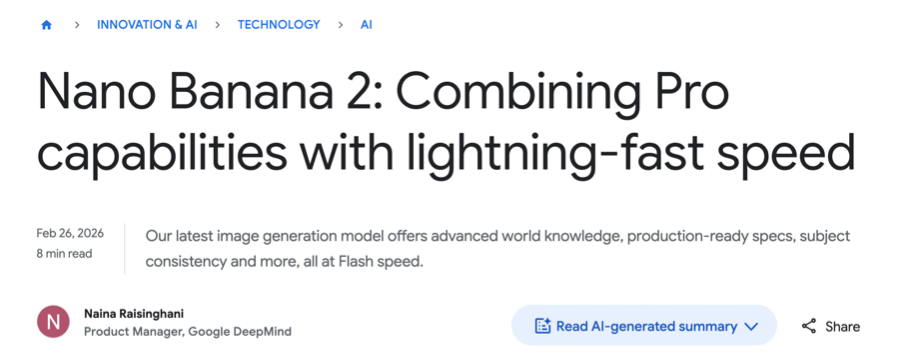
Group 1: Technology Developments - Google launched the next-generation image generation model Nano Banana 2, featuring improvements in subject consistency, instruction adherence, and the ability to produce high-quality materials across various resolutions from 512 pixels to 4K [2] - Anthropic acquired Seattle-based AI startup Vercept to enhance its AI model Claude with visual capabilities, allowing it to perform complex tasks by interacting with computer interfaces [4] - Huawei Cloud released the public beta of its CodeArts code AI, integrating large code models and supporting various coding processes to improve developer efficiency [5] Group 2: Market Trends - In February 2026, China's AI model API usage surged by 127%, surpassing the US for the first time, with four out of the top five models globally coming from Chinese companies, contributing to 85.7% of the total usage [6] - Major smartphone manufacturers are planning to raise prices due to an over 80% increase in storage chip procurement costs compared to the previous year, marking the largest collective price adjustment in five years [11] Group 3: Corporate Actions - Shanghai AI startup Jieyue Xingchen is reportedly planning an IPO in Hong Kong, aiming to raise approximately $500 million, with a potential filing timeline in the first half of the year [12] - NIO's chip subsidiary, Anhui Shenji Technology, completed its first round of financing exceeding 2.2 billion yuan, which will support its long-term plans in autonomous driving and intelligent systems [12] - Ruixin Technology plans to acquire a 51% stake in Deheng Equipment through a combination of stock issuance and cash payment, focusing on automotive parts and intelligent equipment solutions [13]
融资22亿,安徽冲出一家AI芯片独角兽,蔚来李斌是背后老板
3 6 Ke· 2026-02-27 02:29
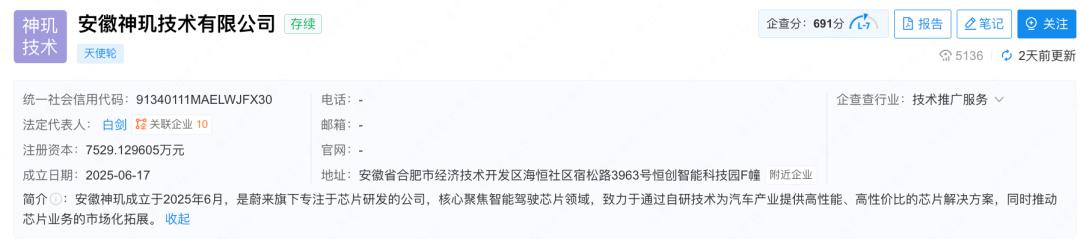
Core Viewpoint - NIO's chip subsidiary, Anhui Shenji, has completed its first round of equity financing, raising over 2.2 billion yuan, with a post-financing valuation nearing 10 billion yuan, supported by various investors [1]. Group 1: Financing and Valuation - Anhui Shenji's first round of financing exceeded 2.2 billion yuan, with a post-financing valuation close to 10 billion yuan [1]. - Investors in this round include Hefei Guotou, Hefei Haiheng, IDG Capital, and others [1]. Group 2: Company Overview - Anhui Shenji, established in June 2025, is the first company in China to develop 5nm automotive-grade chips and achieve large-scale commercialization [1][2]. - The company focuses on high-performance, cost-effective chip solutions for the automotive industry, particularly in smart driving [2]. Group 3: Leadership and Expertise - Key personnel include Chairman Li Bin, General Manager Bai Jian, and Chip Design Head Zhang Danyu, all of whom have significant experience in the tech and automotive sectors [3]. - Li Bin is the founder and CEO of NIO, while Bai Jian has a background in hardware management at OPPO and Xiaomi [3]. Group 4: Product Development - The self-developed smart driving chip, Shenji NX9031, has successfully completed its tape-out and is based on 5nm technology, featuring over 50 billion transistors and a 32-core CPU [5]. - Since its production in 2024, over 150,000 units of the NX9031 chip have been shipped and deployed across NIO's entire vehicle lineup [6]. Group 5: Future Plans - Following this financing, Anhui Shenji plans to launch next-generation high-performance chips and expand into emerging fields such as embodied robotics and AGI solutions [6].

给宇树做“大脑”的具身智能公司,融资数亿元,红杉中国投了
3 6 Ke· 2026-02-27 02:12
Core Insights - The article discusses the recent developments of Zhongke Fifth Epoch, including its recognition as a "core ecological partner" of Yushu Technology and successful fundraising rounds totaling several hundred million yuan [1][2] - The company emphasizes a shift in investor focus from general-purpose robots to those that can effectively operate in specific vertical scenarios, highlighting the importance of commercial viability and customer retention [1][13] Group 1: Partnership and Collaboration - Zhongke Fifth Epoch has been recognized as a "core ecological partner" of Yushu Technology, integrating its embodied intelligence models with Yushu's high-performance robotic platforms [8] - The collaboration has been ongoing since 2025, focusing on testing and validating applications in power inspection and industrial scenarios [2] Group 2: Funding and Market Perception - The company completed Pre-A and Pre-A+ funding rounds within a month, with investments led by Sequoia China and other notable firms, indicating a growing market interest in practical robotic solutions [1] - CEO Liu Nianfeng notes that the current market is more pragmatic, favoring robots that can deliver specific tasks over those with broad capabilities [1][13] Group 3: Technological Advancements - The core technology team consists of members from the Chinese Academy of Sciences, focusing on developing a few-shot learning model called the FAM series, which allows robots to learn new tasks with as few as 3 to 5 real-world examples [5][21] - The FAM model utilizes a "heatmap" approach to prioritize key operational features, enhancing the robot's ability to perform tasks despite variations in object appearance [20][18] Group 4: Commercial Strategy - Zhongke Fifth Epoch aims to provide both software and hardware solutions, charging clients based on the complexity of tasks and the number of licenses required for their robotic systems [26] - The company is positioning itself as a comprehensive provider of integrated robotic solutions, emphasizing the importance of operational capabilities over mere hardware design [27]
未知机构:浙商大制造周艺轩上海沿浦关节模组首条自动化产线即将落地持续推荐-20260227
未知机构· 2026-02-27 02:10
Company and Industry Summary Company: 浙商大制造 (Zhejiang Merchants Manufacturing) Key Events - The company is set to launch its first automated production line for joint modules, marking a significant milestone in its operations [1] - The registration of the robotics subsidiary, XinaTech, has been completed, indicating the commencement of industrialization in the robotics sector [1] Robotics Business - XinaTech, in which the company holds a 51% stake, will focus on the research and production of core components for humanoid robots, complete robots, and embodied intelligent robots for manufacturing and retail industries [1] - The company has obtained the business license for XinaTech as of October 9, 2025, signaling progress in its robotics business [1] - The collaboration with Shanghai Electric Science and Technology Research Institute (上电科) is noteworthy, as it is a recognized authority in the robotics field and is involved in the CR certification system [1] - The Shanghai Electric Science and Technology Research Institute is tasked with establishing national standards for robot testing and quality inspection [1] Seating Business - The company has achieved small-scale deliveries of high-speed rail seating, with plans to extend this technical expertise to automotive seating, indicating a nearing inflection point [2] - The company is directly engaging with original equipment manufacturers (OEMs), and its platform capabilities are gradually being realized [2] Performance Insights - The company has shown signs of a performance inflection point in Q2 2025, with the robotics business beginning to take shape and automotive seating expansion ongoing [2] - The joint venture's first automated production line is expected to be operational soon, with both parties committed to advancing technology iterations and industry standards [2] Risk Considerations - Potential risks include delays in the progress of the seating and humanoid robotics businesses, which could impact overall performance [2]

宇树科技供应商中科第五纪已完成六轮融资
Cai Jing Wang· 2026-02-27 02:07
中科第五纪成立于2024年9月,核心团队来自中科院自动化所和清华大学,设计研发了业内首创的超少 样本具身操作大模型(FAM模型),是宇树科技001号大脑供应商。 "去年,投资人更倾向通用的具身智能叙事,比如偏好'既能搬箱子、又能收拾桌子、还能叠衣服'的机 器人。但现在则更看重能不能先扎进垂类场景,并且让客户愿意复购。这关系到商业化能力,也关系到 能不能用数据飞轮突破真机数据不足的瓶颈。"中科第五纪创始人兼CEO刘年丰在接受媒体采访时表 示。 近期,具身大脑企业中科第五纪在接连完成Pre-A及Pre-A+轮融资,规模达数亿元。其中,Pre-A轮由红 杉中国领投,东方富海跟投;Pre-A+轮由芯能创投、优山资本联合领投,清控金信跟投。 ...
上海电气与浦东新区政府签署战略合作协议
Xin Lang Cai Jing· 2026-02-27 02:05
Core Viewpoint - Shanghai Electric and the Pudong New Area government have signed a strategic cooperation agreement focusing on the innovation application of embodied intelligent robots in R&D design, manufacturing, and supply chain management [1] Group 1: Strategic Cooperation - The agreement aims to leverage the policy advantages of Shanghai and Pudong New Area alongside Shanghai Electric's technological expertise in high-end equipment manufacturing [1] - The collaboration will enhance the implementation of "AI + manufacturing" industrial scenarios in Shanghai Electric [1] Group 2: Innovation and Development - The partnership will promote the independent R&D and industrialization of core components for embodied intelligent robots [1] - The initiative seeks to tackle common challenges in the high-end equipment industry [1]

高新区(滨江)创新深化“数智融合”,提速建设具身智能产业集群
Hang Zhou Ri Bao· 2026-02-27 02:03
创新的力量,正在定义区域发展的新坐标。 2026年,高新区(滨江)将继续打造人工智能创新高地,推动"数据、算力、算法"要素一体化发 展,持续优化人工智能产业生态。比如,推进杭州人工智能计算中心扩容,构建国产AI训练和验证环 境;推动垂类模型首试首用,加快形成以用促研、百花齐放的行业大模型矩阵。高新区(滨江)也将建 立常态化场景发布机制,推动在消费、金融、安全、制造等领域打造一批示范性强、带动性广的人工智 能应用场景项目。 2月26日下午,正在访华的德国总理默茨在杭州率团参访宇树科技。这既是对高新区(滨江)创新 实力的国际认可,更是该区开年即冲刺、实干开新局的有力见证。同日召开的高新区(滨江)"新春第 一会"上,该区发出"实干开局、实绩争先"1+7主题攻坚活动动员令,以树立和践行正确政绩观为主题主 线,牵引推进创新能级聚变、产业集群领航、内外联动跃升等7项重点工程,动员全区上下真抓实干拼 开局、拿出实绩勇争先。 在推动具身智能产业创新发展方面,该区将推进人工智能与机器人融通发展,深化"数智融合",打 造机器人应用场景不少于10个;加快推动杭州国家人工智能应用中试基地(消费领域具身智能方向)落 地和建设,推动机器 ...
机器人对未来有什么影响?
Sou Hu Cai Jing· 2026-02-27 02:02
Core Insights - The article emphasizes the transformative impact of robotics technology on society, projecting a global market size exceeding $68 billion in 2024 and growing at a compound annual growth rate (CAGR) of 18.5% to reach $80.5 billion by 2025, with robots performing increasingly complex tasks by 2026 [1][3]. Group 1: Evolution of Robotics - Robotics is transitioning from being mere automated tools to becoming intelligent partners, driven by breakthroughs in embodied AI, which allows for natural language interaction and complex task reasoning [3][4]. - The performance of robots, such as the "Xiao Gai" showcased during the Spring Festival, illustrates their ability to autonomously recognize environments and make decisions, marking a significant step towards self-evolution [4]. Group 2: Labor Market Transformation - Robotics is fundamentally reshaping the global labor structure, particularly in manufacturing, logistics, and hazardous industries, where robots are taking over high-risk tasks, significantly reducing human casualties [6]. - The service industry is witnessing a democratization of robotics, with over 1.2 million humanoid robots shipped globally in 2025, addressing labor shortages in elder care and healthcare through emotional interaction capabilities [7]. - A new paradigm of "human-robot collaboration" is emerging, creating new job roles such as robot trainers and ethics reviewers, shifting the focus from human versus machine to human plus machine [8]. Group 3: Ethical and Social Challenges - The rapid advancement of robotics raises significant ethical and social challenges, including privacy and security risks associated with data collection by robots equipped with multimodal perception systems [10]. - Algorithmic bias and decision-making responsibility are critical issues, especially when autonomous robots make choices in emergencies, necessitating a transparent ethical framework for algorithm accountability [10]. - The proliferation of robotics may exacerbate the digital divide, with wealthier individuals and nations benefiting first, highlighting the need for equitable technology distribution mechanisms [10]. Group 4: Future Outlook - Looking ahead to 2026-2030, three core trends in robotics are anticipated: self-evolution of embodied intelligence, decentralized group collaboration through blockchain, and deep integration of brain-machine interfaces [11]. - Future cities are envisioned as "robot-friendly," where multiple humanoid robots collaborate on large-scale tasks, while in homes, robots will evolve into intelligent companions that understand human needs [11].