
全国统一大市场

Search documents
比2024年提前37天 我国快递年业务量再次突破1500亿件
Shang Hai Zheng Quan Bao· 2025-10-12 17:08
Core Insights - The express delivery business volume in China has surpassed 150 billion pieces as of October 11, 2025, 37 days earlier than in 2024 [1] - The growth of the express delivery sector reflects a stable growth in the consumer market and a positive economic development trend in China [1] - The express delivery industry plays a crucial role in supporting the construction of a unified national market and will continue to drive high-quality development through technological innovation [1] Industry Overview - The express delivery network effectively connects production, distribution, circulation, and consumption, providing solid support for the smooth operation of the national economy [1] - The postal and express industry is recognized as an important component of the modern circulation system, especially during the current economic transformation and upgrading phase [1] - The industry aims to foster new productive forces and contribute significantly to the establishment of a unified national market [1]
“小包裹”映照经济“大棋局” 透过1500亿件快递看高质量发展“新脉动”
Yang Shi Wang· 2025-10-12 05:38
Core Insights - The express delivery industry in China has seen significant growth, with the volume surpassing 1.5 trillion packages by October 11, 2023, which is 37 days earlier than last year [1][3] - The expansion of express services is supported by technological innovations and improved logistics infrastructure, enhancing online consumption [5][7] Group 1: Market Growth - The express delivery market continues to grow, with a focus on enhancing service levels and fostering new productive forces through technological innovation [7] - In the first eight months of the year, regions such as Shaanxi, Xinjiang, Guizhou, and Qinghai experienced over 30% growth in express delivery volume [3] Group 2: Infrastructure Development - A total of 1,300 large-scale mail and express processing centers and over 400 professional logistics parks have been established nationwide, with 420,000 rural delivery service stations achieving full coverage of urban and rural areas [5] - The integration of distribution centers, express outlets, and intelligent scheduling systems has created a leading smart logistics network [5] Group 3: Technological Innovation - Thousands of unmanned vehicles and over 300 drones are in operation, with drone deliveries reaching nearly 3 million packages [5] - The implementation of smart logistics solutions, such as automated warehouses, is addressing the challenges of precise delivery in manufacturing [8][10] Group 4: Industry Integration - The express delivery service has become deeply embedded in the supply chain, enhancing efficiency across various industries, including automotive and electronics [12] - The postal and express industry is characterized by strong connectivity and integration, facilitating deeper cooperation in production and reducing circulation costs [14]

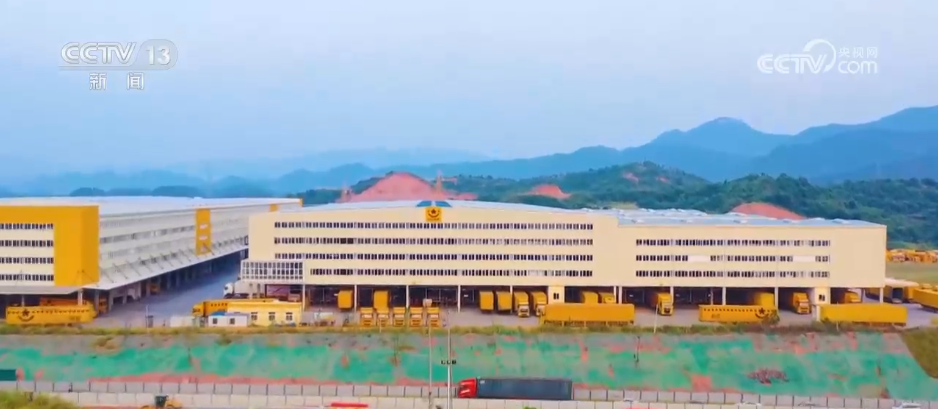
今年我国快递业务量已突破1500亿件 比去年提前37天
Zhong Guo Xin Wen Wang· 2025-10-12 01:22
Core Insights - The express delivery business in China has surpassed 150 billion packages as of October 11, 2023, indicating a stable growth in the consumer market and the economy, and highlighting the role of the postal and express industry in building a unified national market [1][2] Group 1: Market Development - The express delivery industry is crucial for expanding rural market consumption, with improvements in logistics systems in regions like Xinjiang, Guizhou, and Yunnan facilitating the delivery of various goods to rural areas [1] - The establishment of a three-tier logistics system (county, township, village) is helping to bridge the gap in consumption patterns and service experiences between urban and rural residents [1] Group 2: Regional Coordination - New mail and express processing centers in regions like Qinghai and Gansu have significantly increased capacity, while standardized construction of distribution centers in Sichuan and Shaanxi is accelerating due to policy support and funding [2] - In the first half of 2025, the express delivery business revenue and volume in central and western China are expected to grow by 13.6% and 25.5% year-on-year, respectively, outpacing the national average [2] Group 3: Efficient Flow of Production Factors - In Zhejiang, a new mechanism integrating passenger and cargo services is addressing delivery challenges in remote mountainous areas, enhancing the two-way logistics channel between urban and rural areas [2] - In Shandong, the exploration of smart logistics and supply chain applications in the industrial sector is providing digital solutions for pre-production logistics, facilitating rapid coordination between production and logistics [2]
今年全国快递业务量突破1500亿件!有你几件?
Ren Min Ri Bao· 2025-10-12 01:00
国家邮政局监测数据显示,截至10月11日,今年我国快递业务量已突破1500亿件,比2024年提前了37 天,既彰显出我国消费市场平稳增长、经济稳中有进的发展态势,也体现了邮政快递业在服务构建全国 统一大市场中发挥的重要作用。 在新疆喀什,新型县、乡、村三级物流体系不断健全,冰箱、洗衣机、按摩椅等越来越多地被送往各个 乡镇;在贵州六盘水,多家快递资源整合,"源头直播+物流联动"机制保障猕猴桃快速送达全国……今 年以来,邮政快递业持续加强农村寄递物流体系建设,构建县、乡、村三级物流体系,城乡居民消费模 式和服务体验的差距逐渐消弭。 在青海、甘肃等地,新投产的邮件快件处理中心能力得到大幅度提高;在四川、陕西等地,通过政策扶 持和资金投入,市级分拨中心、县级配送中心、乡镇服务站等标准化建设不断加快。今年以来,邮政快 递业加强中西部基础设施建设,促进商品和资源向欠发达地区流动。今年上半年,我国中西部地区快递 业务收入和业务量同比分别增长13.6%和25.5%,增速明显高于全国平均水平。 国家邮政局相关负责人表示,邮政快递业通过覆盖全国、通达全球的网络体系,有效打通了生产、分 配、流通、消费各环节,为畅通国民经济循环提供 ...
9月投资手记:估值驱动是上涨主导力量,后续关注盈利变化 重点五条主线
Sou Hu Cai Jing· 2025-10-10 10:58
Market Overview - The market experienced high-level fluctuations in September, with significant gains in the Sci-Tech Innovation Board, reaching new highs in the current market cycle, while other major indices mainly oscillated [1] - Technology growth sectors such as electric equipment, electronics, and media performed well due to industrial catalysts and benefits from the Federal Reserve's interest rate cuts, whereas military, finance, and consumer sectors showed relatively weaker performance [1] Economic Indicators - Economic data for August showed a continued slowdown, with investment, consumption, and production all underperforming market expectations, indicating increasing economic pressure [1] - Fixed asset investment growth turned negative for two consecutive months, primarily due to declines in real estate, manufacturing, and infrastructure investments [1] - Retail sales growth slowed, and the effectiveness of the "trade-in" policy weakened, while industrial value-added and service production indices maintained over 5% growth, albeit with a deceleration [1] Policy Impact - The recent article by Xi Jinping emphasized the need to address low-price disorder in competition, reinforcing anti-involution policies [1] - The rapid decline in manufacturing investment growth since Q3 reflects the phase of anti-involution, aiming to regulate local government behavior and raise industry thresholds, which may suppress inefficient investments and reduce some demand [1] - While short-term effects may lead to economic contraction, the foundation for price recovery is expected to strengthen, potentially reversing the supply-demand imbalance in the medium to long term [1] Valuation and Market Dynamics - Valuation-driven growth has been the primary force behind the stock market's rise over the past year, with A-share market valuations recovering to high levels [2] - The overall performance growth of A-shares remains low, with valuation increases contributing significantly to market gains, while the divergence between valuation and fundamental expectations poses long-term risks [2] - Future focus should be on improvements in corporate earnings, as the ongoing deepening of anti-involution policies is expected to enhance fundamental market drivers [2] Investment Strategy - The market still has upward potential relative to historical levels, supported by indicators such as stock-bond yield ratios and total market capitalization to GDP [3] - The diversification of household excess savings is gradually unfolding, and the onset of the Federal Reserve's interest rate cuts is likely to rebalance global capital flows, benefiting the domestic market [3] - Five key investment themes are highlighted: service consumption with supply advantages, breakthroughs in pharmaceuticals, early-stage growth in artificial intelligence, cyclical leaders benefiting from Fed rate cuts, and consumer goods with strong earnings elasticity [3]
奋进的河南 决胜“十四五”·郑州篇丨 融入大市场,有多少条新路
He Nan Ri Bao· 2025-10-10 02:10
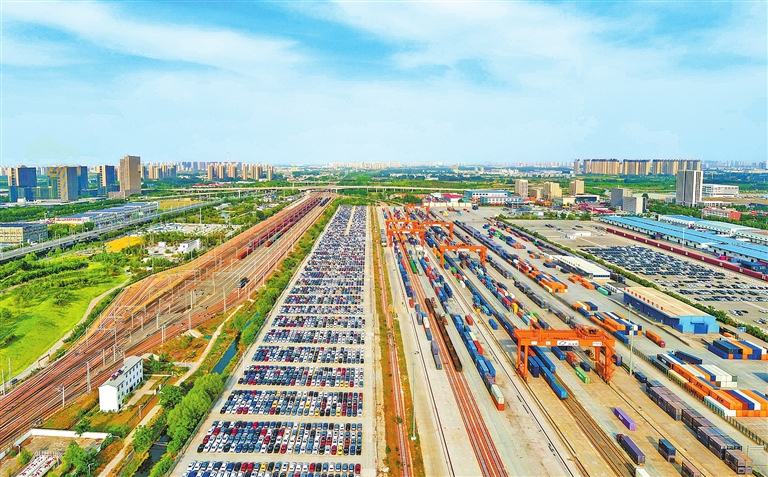
郑州机场。 货运繁忙的中铁联集郑州中心站。 今年1月—8月,郑州市外贸进出口累计完成3634.9亿元,总量、增速均领跑中部城市。 站在中国开放的新坐标上眺望,一个生动的景象正在显现:不沿边、不靠海的郑州,正从传统意义上的陆地 深处,大步走向新时代的开放前沿。 从高空俯瞰郑州—— 这里是承东启西的"中国十字路口"、汇通全球的"世界会客厅"——来自五大洲的货物在此集散,全球先进要 素在此交融,一条条国际物流大通道让不沿边不靠海的内陆城市,一跃成为服务全国、链接全球的开放新潮 地。 这里也是"空中丝绸之路"的重要枢纽,与卢森堡携手打造的"双枢纽"模式,让每一条航迹都是跨越山海的握 手,每一次起降都是联通世界的约定。条条"丝路"拧成一股开放的绳,拉起郑州与世界对话的手。 今,郑卢航线网络覆盖欧美亚三大洲24个国家200多个城市,带动郑州机场年货运量突破80万吨……豫卢相隔 万里,但依托一条"天路",使各自的市场成为彼此的机遇。这一模式还落地马来西亚,正式搭建起郑州与吉 隆坡之间稳定、高效的货运桥梁。 陆上丝路,经贸纽带扎得更深更牢。截至目前,中欧班列(郑州)已累计开行近1.6万列,构建起"26个境外 直达站点、9个出 ...
奋进的河南 决胜“十四五”·郑州篇丨融入大市场,有多少条新路
He Nan Ri Bao· 2025-10-09 23:40
货运繁忙的中铁联集郑州中心站。 记者 聂冬晗 摄 郑州机场。 资料图片 聂冬晗 靳晰 摄 今年1月—8月,郑州市外贸进出口累计完成3634.9亿元,总量、增速均领跑中部城市。 站在中国开放的新坐标上眺望,一个生动的景象正在显现:不沿边、不靠海的郑州,正从传统意义上的陆地 深处,大步走向新时代的开放前沿。 从高空俯瞰郑州—— 这里是承东启西的"中国十字路口"、汇通全球的"世界会客厅"——来自五大洲的货物在此集散,全球先进要 素在此交融,一条条国际物流大通道让不沿边不靠海的内陆城市,一跃成为服务全国、链接全球的开放新潮 地。 这里也是"空中丝绸之路"的重要枢纽,与卢森堡携手打造的"双枢纽"模式,让每一条航迹都是跨越山海的握 手,每一次起降都是联通世界的约定。条条"丝路"拧成一股开放的绳,拉起郑州与世界对话的手。 近年来,郑州对欧盟、东盟等重点市场贸易规模持续攀升,国际消费中心城市建设稳步推进,国际顶奢品牌 相继落子,汇聚万商的气象日益恢宏。 大道笃行,新程广阔。"十四五"以来,郑州市牢记习近平总书记殷殷嘱托,聚焦高质量发展首要任务,抢抓 扩大高水平对外开放机遇,积极融入高质量共建"一带一路"发展主题,以制度型开放 ...
筑牢全国统一大市场法治根基
Jing Ji Ri Bao· 2025-10-09 22:18
Core Viewpoint - The construction of a unified national market in China has made positive progress, but there are still significant challenges that need to be addressed to ensure fair competition and effective regulation [1][2]. Group 1: Policy and Regulation - There is a strong demand from businesses for unified regulations in areas such as fair competition and social credit, as issues like arbitrary fees, fines, and inspections persist [1]. - Recent improvements in market foundational systems include the enhancement of laws related to property rights, market access, and fair competition, but there is a need for more detailed implementation guidelines [2]. - The revision of laws such as the Anti-Unfair Competition Law and the Anti-Monopoly Law aims to reduce policies that exclude or limit competition [2]. Group 2: Enforcement and Compliance - Efforts are being made to enhance the enforcement of regulations and address various law enforcement irregularities, with a focus on clarifying the boundaries between government and market roles [3]. - A total of 86 penalty items have been canceled or adjusted by relevant authorities to streamline administrative regulations [3]. - The introduction of innovative enforcement methods, such as non-intrusive inspections, has led to a 30% decrease in administrative checks and a 16% increase in problem detection rates in the first eight months of the year [3]. Group 3: Legal Framework and Market Environment - The integration of legal construction throughout the process of building a unified national market is essential for creating a fair and vibrant market environment [4]. - Establishing clear boundaries for government actions will enhance the effectiveness of market operations and encourage investment and entrepreneurship [4].
公平无偏差 市场添效能(评论员观察)——“差距”之中育新机③
Huan Qiu Wang· 2025-10-09 05:40
Group 1 - The construction of a unified national market requires continuous efforts in improving institutional rules, unblocking factor markets, and eliminating local protectionism and market segmentation to provide a stable, efficient, and predictable development environment for various business entities [1][2] - The shift in government investment attraction and enterprise investment strategies reflects a need for new approaches, moving away from traditional methods like low land prices and tax reductions [1][2] - The promotion of fair competition is essential for market vitality, as past practices of creating "policy lowlands" and local protectionism have hindered fair competition [1][2] Group 2 - The introduction of the "Fair Competition Review Regulations" at the national level aims to eliminate practices that obstruct a unified market and ensure equal participation for all business entities [2] - Local innovations, such as integrated service reforms and streamlined documentation processes, are enhancing the business environment and shifting the focus from competing on policies to providing high-quality services [2] - The establishment of a fair competition review mechanism in Jiangxi has demonstrated that removing local protection can enhance market competitiveness and lead to increased revenue for businesses [3] Group 3 - A well-regulated, fair, and open unified national market serves as fertile ground for societal creativity and vitality, improving resource allocation efficiency and unlocking market potential [3] - Identifying roles and comparative advantages within the unified national market is crucial for enhancing government services and contributing to high-quality economic development [3]
公平无偏差 市场添效能
Ren Min Ri Bao· 2025-10-09 05:27
Group 1 - The construction of a nationwide unified market requires continuous efforts in improving institutional rules, breaking down factor markets, and eliminating local protectionism and market segmentation to provide a stable, efficient, and predictable development environment for various business entities [1][2] - The shift in government investment attraction and enterprise investment strategies reflects a need for new approaches, moving away from traditional methods like low land prices and tax reductions [1][2] - The promotion of fair competition is essential for market vitality, as past practices of creating "policy lowlands" and local protectionism have hindered fair competition [1][2] Group 2 - The introduction of the "Fair Competition Review Regulations" at the national level aims to eliminate practices that hinder a unified market and ensure equal access to production factors for all business entities [2] - Local innovations, such as lifecycle service lists and integrated service reforms, are being implemented to optimize the business environment, shifting focus from competing on "policy lowlands" to creating "service highlands" [2] - The establishment of a fair competition review mechanism in Jiangxi has demonstrated that removing local protection can enhance market competition and increase the competitiveness of local enterprises [3] Group 3 - A well-regulated, fair, and fully open nationwide unified market is seen as a fertile ground for societal creativity and vitality, leading to improved resource allocation efficiency and market potential [3] - Identifying roles and comparative advantages within the nationwide unified market is crucial for enhancing government services and contributing to high-quality economic development in China [3]