
专精特新

Search documents
八亿时空涨2.13%,成交额4488.72万元,主力资金净流入238.91万元
Xin Lang Cai Jing· 2025-11-11 03:26
Group 1 - The core viewpoint of the news is that Ba Yi Shi Kong's stock has shown fluctuations in price and trading volume, with a current market capitalization of 4.578 billion yuan and a recent increase of 2.13% in stock price [1] - As of September 30, 2025, Ba Yi Shi Kong reported a revenue of 645 million yuan, representing a year-on-year growth of 17.60%, while the net profit attributable to shareholders decreased by 26.06% to 45.5688 million yuan [2] - The company has distributed a total of 128 million yuan in dividends since its A-share listing, with 41.2998 million yuan distributed over the past three years [3] Group 2 - The company is primarily engaged in the research, development, production, and sales of display liquid crystal materials, with its main business revenue composition being 90.87% from mixed liquid crystals [1] - As of September 30, 2025, the number of shareholders increased by 27.07% to 12,200, while the average circulating shares per person decreased by 21.30% to 11,027 shares [2] - The company is categorized under the electronic industry, specifically in optical optoelectronics and panels, and is associated with concepts such as photoresists, innovative drugs, LEDs, advanced packaging, and specialized new [1]

微电生理跌2.05%,成交额7290.98万元,主力资金净流出869.12万元
Xin Lang Cai Jing· 2025-11-11 03:26
Core Viewpoint - The stock of Microelectrophysiology has experienced fluctuations, with a recent decline of 2.05% and a year-to-date increase of 25.53% [1][2]. Company Overview - Shanghai Microelectrophysiology Medical Technology Co., Ltd. was established on August 31, 2010, and went public on August 31, 2022. The company specializes in innovative medical devices for electrophysiological intervention and ablation treatment [2]. - The revenue composition of the company includes catheter products (71.77%), other products (20.22%), equipment (7.24%), and leasing services (0.77%) [2]. Financial Performance - For the period from January to September 2025, the company achieved a revenue of 336 million yuan, representing a year-on-year growth of 15.65%. The net profit attributable to the parent company was 41.92 million yuan, with a slight increase of 0.46% year-on-year [2]. Stockholder Information - As of September 30, 2025, the number of shareholders increased to 9,580, while the average circulating shares per person decreased by 8.26% to 13,033 shares [2]. - The top circulating shareholders include: - Huatai-PineBridge Innovation Medicine Mixed A (006113) as the largest shareholder with 4.7284 million shares, an increase of 308,600 shares from the previous period [3]. - Huatai-PineBridge Medical Service Flexible Allocation Mixed A (001417) as the second-largest shareholder with 4.2609 million shares, a decrease of 298,360 shares [3]. - Hong Kong Central Clearing Limited entered as a new shareholder with 1.8701 million shares [3].

中科海讯跌2.01%,成交额6177.59万元,主力资金净流出578.75万元
Xin Lang Cai Jing· 2025-11-11 03:23
Core Viewpoint - Zhongke Haixun's stock price has experienced significant fluctuations, with a year-to-date increase of 110.36%, but recent declines in the short term indicate potential volatility in investor sentiment [1][2]. Financial Performance - For the period from January to September 2025, Zhongke Haixun reported operating revenue of 145 million yuan, a year-on-year decrease of 0.41%, while the net profit attributable to shareholders was -76.92 million yuan, reflecting a year-on-year increase of 16.27% [2]. Stock Market Activity - As of November 11, Zhongke Haixun's stock price was 40.41 yuan per share, with a market capitalization of 4.77 billion yuan. The stock has seen a net outflow of 5.79 million yuan in principal funds, with significant selling pressure in the last trading days [1]. - The company has appeared on the "Dragon and Tiger List" six times this year, with the most recent instance on August 19, where it recorded a net purchase of approximately 39.99 million yuan [1]. Shareholder Information - As of October 31, Zhongke Haixun had 22,200 shareholders, a decrease of 1.18% from the previous period, with an average of 5,136 circulating shares per shareholder, an increase of 1.19% [2]. - The top ten circulating shareholders include several new entrants, indicating changes in institutional holdings [3].

康隆达涨2.06%,成交额3421.25万元,主力资金净流出254.83万元
Xin Lang Cai Jing· 2025-11-11 02:58
Core Viewpoint - 康隆达 has shown significant stock performance with a year-to-date increase of 99.72%, indicating strong market interest and potential growth opportunities [1][2]. Financial Performance - For the period of January to September 2025, 康隆达 achieved a revenue of 1.056 billion yuan, representing a year-on-year growth of 7.11% [2]. - The net profit attributable to shareholders for the same period was 133 million yuan, reflecting a substantial increase of 307.75% year-on-year [2]. Stock Market Activity - As of November 11, 康隆达's stock price was 28.20 yuan per share, with a market capitalization of 4.543 billion yuan [1]. - The stock has experienced a recent trading volume of 34.21 million yuan, with a turnover rate of 0.77% [1]. - The stock has been on the龙虎榜 once this year, with the last appearance on June 10, where it recorded a net buy of -21.05 million yuan [1]. Shareholder Information - As of September 30, 康隆达 had 6,697 shareholders, a decrease of 5.81% from the previous period [2]. - The average number of circulating shares per shareholder increased by 6.17% to 23,916 shares [2]. Business Overview - 康隆达 specializes in the research, production, and sales of special and ordinary labor protective gloves, with functional gloves accounting for 68.87% of its revenue [1]. - The company is categorized under the textile and apparel industry, with additional involvement in lithium battery and specialized technology sectors [2].

道恩股份跌2.05%,成交额4936.61万元,主力资金净流出783.95万元
Xin Lang Zheng Quan· 2025-11-11 02:53
Core Viewpoint - Daon Co., Ltd. has experienced a significant stock price increase of 108.53% year-to-date, despite a recent decline in trading performance and net outflow of funds [1][2]. Group 1: Company Overview - Daon Co., Ltd. is located in Longkou City, Shandong Province, and was established on December 6, 2002, with its stock listed on January 6, 2017 [2]. - The company specializes in the research, production, and sales of thermoplastic elastomers, modified plastics, color masterbatches, and biodegradable materials, with modified plastics accounting for 73.88% of its revenue [2]. - As of September 30, 2025, Daon Co., Ltd. had 23,400 shareholders, a decrease of 13.95% from the previous period, with an average of 17,947 circulating shares per shareholder, an increase of 16.22% [2]. Group 2: Financial Performance - For the period from January to September 2025, Daon Co., Ltd. achieved a revenue of 4.456 billion yuan, representing a year-on-year growth of 18.23%, and a net profit attributable to shareholders of 131 million yuan, up 32.96% year-on-year [2]. - The company has distributed a total of 441 million yuan in dividends since its A-share listing, with 120 million yuan distributed over the past three years [3]. Group 3: Stock Performance and Trading Activity - On November 11, Daon Co., Ltd.'s stock price fell by 2.05% to 24.36 yuan per share, with a trading volume of 49.3661 million yuan and a turnover rate of 0.48%, resulting in a total market capitalization of 11.654 billion yuan [1]. - The stock has appeared on the "Dragon and Tiger List" once this year, with the most recent occurrence on October 30, where it recorded a net purchase of 568,800 yuan [1].

瑜欣电子涨2.04%,成交额1707.28万元,主力资金净流入90.35万元
Xin Lang Cai Jing· 2025-11-11 02:45
Core Viewpoint - Yuxin Electronics has shown a significant stock price increase of 62.17% year-to-date, despite recent fluctuations in the short term [2]. Group 1: Stock Performance - On November 11, Yuxin Electronics' stock rose by 2.04%, reaching 28.96 CNY per share, with a trading volume of 17.07 million CNY and a turnover rate of 1.00% [1]. - The stock has experienced a 0.42% increase over the last five trading days, a 4.45% decrease over the last 20 days, and a 10.67% decrease over the last 60 days [2]. Group 2: Financial Performance - For the period from January to September 2025, Yuxin Electronics reported a revenue of 572 million CNY, representing a year-on-year growth of 40.97%, and a net profit attributable to shareholders of 73.39 million CNY, up 60.21% year-on-year [2]. - The company has distributed a total of 120 million CNY in dividends since its A-share listing [3]. Group 3: Shareholder Information - As of September 30, 2025, the number of shareholders for Yuxin Electronics was 8,113, a decrease of 11.22% from the previous period, while the average circulating shares per person increased by 11.93% to 7,297 shares [2]. - Notable institutional shareholders include Dazhong Zhongzheng 360 Internet + Index A and Huaxia Zhisheng Pioneer Stock A, with the latter being a new shareholder [3].
美的、格力撑起公司八成营收,精密机械领先企业今日申购丨打新早知道
2 1 Shi Ji Jing Ji Bao Dao· 2025-11-10 23:12
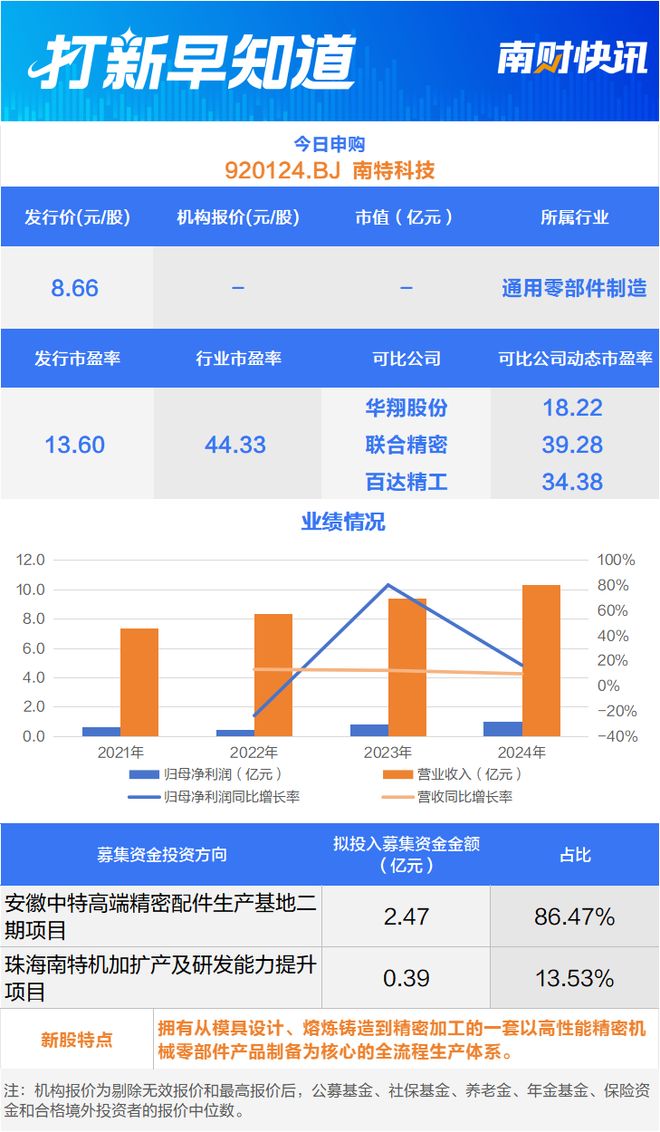
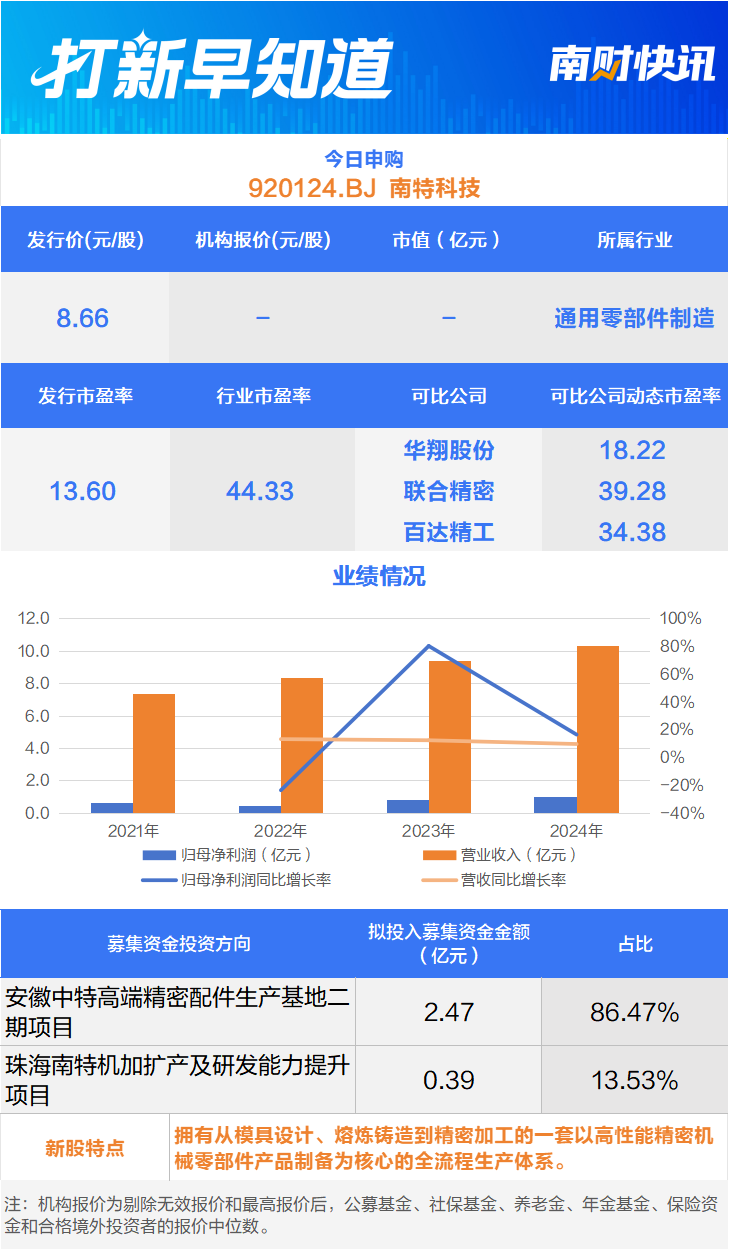
Core Viewpoint - Nantong Technology (920124.BJ) is set to be available for subscription on the Beijing Stock Exchange, focusing on the research, production, and sales of precision mechanical components, primarily for compressors and automotive parts [1] Group 1: Company Overview - Nantong Technology has received multiple honors, including being recognized as a specialized and innovative small and medium-sized enterprise in Guangdong Province and a national high-tech enterprise [1] - The company has established a comprehensive production system for high-performance precision mechanical components, capable of rapid production and delivery to meet diverse customer needs [4] Group 2: Financial Performance - From 2022 to 2024, Nantong Technology achieved revenues of 834 million yuan, 938 million yuan, and 1.031 billion yuan, with net profits of 47 million yuan, 84 million yuan, and 98 million yuan respectively [4] - In the first half of 2025, the company reported revenues of 573 million yuan and a net profit of 67 million yuan [4] Group 3: Market Position - Nantong Technology holds a 13.28% market share in the compressor component market, indicating a competitive advantage within the industry [4] - The company has established stable long-term partnerships with well-known enterprises such as Midea Group, Gree Electric, and Panasonic, receiving multiple supplier awards [4] Group 4: Investment Direction - The company plans to invest 2.47 billion yuan (86.47%) in the Anhui Zhongte high-end precision parts production base phase II project and 390 million yuan (13.53%) in the expansion and R&D capabilities of Zhuhai Nantong Machinery [3] Group 5: Risks - Nantong Technology faces risks related to a single product structure, as a significant portion of its revenue and profit is derived from sales to compressor manufacturers [5] - Although the company has the capability to produce for other downstream applications, these products have not yet gained substantial market share [5]

美的、格力撑起公司八成营收 精密机械领先企业今日申购丨打新早知道
2 1 Shi Ji Jing Ji Bao Dao· 2025-11-10 23:06
Core Viewpoint - Nantong Technology (920124.BJ) is set to be available for subscription on the Beijing Stock Exchange, focusing on the research, production, and sales of precision mechanical components, particularly for compressors and automotive parts [1] Group 1: Company Overview - Nantong Technology has established a comprehensive production system centered on high-performance precision mechanical components, covering mold design, melting, casting, and precision processing [5] - The company has received multiple honors, including being recognized as a "National High-tech Enterprise" and a "Specialized and Innovative Small and Medium-sized Enterprise" in Guangdong Province [1] Group 2: Financial Performance - The company achieved revenues of 834 million yuan, 938 million yuan, and 1.031 billion yuan from 2022 to 2024, with net profits of 47 million yuan, 84 million yuan, and 98 million yuan respectively [5] - In the first half of 2025, Nantong Technology reported revenues of 573 million yuan and net profits of 67 million yuan [5] Group 3: Market Position - Nantong Technology holds a market share of 13.28% in the compressor component market, indicating a competitive advantage within the industry [5] - The company has established stable long-term partnerships with well-known enterprises such as Midea Group, Gree Electric, and Panasonic, contributing to over 80% of total revenue from sales to Midea and Gree in the first half of the year [5] Group 4: Risks - The company faces risks related to a single product structure, as its revenue and profits are primarily derived from sales to compressor manufacturers [6] - Although Nantong Technology has the capability to produce components for other downstream applications, these products have not yet gained significant market share [6]
企业规模小更得专而精
Sou Hu Cai Jing· 2025-11-10 22:56
迈向专精特新,中小企业首先要重视核心优势的培育,找准市场需求与自身长处最匹配的结合点。比 如,瞄准技术空白,将资源集中于创新研发和技术升级,在细分领域持续迭代产品,塑造人无我有、人 有我优的优势。企业应围绕核心竞争优势制定长期规划,以"一招鲜"赢市场,以专注铸专长,谨慎对 待"大而全"的诱惑,确保"专而精"路径的持续性、连贯性。 中小企业数量超过6000万家,广泛分布于各行各业,是创新的重要源泉和经济活力的"毛细血管"。对中 小企业来说,走专精特新之路意味着更高的利润率、更强的市场话语权。从更大视角看,则意味着产业 链升级、经济结构优化的微观基础更加牢固。 中小企业走专精特新之路有明显优势。比如,灵活性、敏捷度高,由于组织结构简单、决策链条短,能 快速响应市场变化和技术趋势,及时调整战略;主业特色鲜明,使其能在大型企业难以覆盖的细分领域 形成技术护城河。也应看到,中小企业向专精特新发展还面临资金短缺、人才匮乏、资源整合能力弱等 不足,以及融资渠道有限、政策落地"最后一公里"问题等难点。 当前,政策与市场正带来双重红利,各类培育计划和财政资金支持降低了经营成本,市场需求升级带来 新的契机,链主"发榜"机制提高了 ...
合肥专精特新培育再突破 国家级“小巨人”再添71家
Zhong Guo Fa Zhan Wang· 2025-11-10 06:49
中国发展网讯记者华铭张海帝报道工业和信息化部近日公示第七批专精特新"小巨人"企业名单,合肥市 新增71户企业成功入围,较2024年增长18.3%,新增数量居全国城市第11位。截至目前,合肥市"小巨 人"企业总数达312户,位列全国第14位,新增数量、入选率、全国占比三项指标均创新高。 亮眼的成绩得益于合肥市精心构建的全方位、多层次培育体系。通过实施精准育苗,2025年以来,该市 新成立科技企业超1000户,为专精特新企业队伍储备了充足的后备力量。同时,建立完善的专精特新企 业培育库,引入优质服务资源,邀请国内顶尖智库专家,对照"小巨人"企业认定标准,为120余户企业 开展诊断辅导,帮助企业精准找差距、明方向。市县两级还开展专项对接活动360余场,服务企业超 7000户次,助力企业加速成长。 在创新驱动方面,合肥市不断强化创新核心地位,着力提升企业研发能级。2025年以来,推动130户专 精特新中小企业建立省级及以上企业技术中心、企业研发中心等研发平台,支持6户企业参与省、市创 新联合体建设。通过"揭榜挂帅"机制,征集企业省制造业技术需求超240个,支持企业参与市科技攻关 项目37个,研发省级"三首"产品、"新 ...