人民币国际化

Search documents
我国外储规模保持在3.3万亿美元之上
Zhong Guo Zheng Quan Bao· 2025-11-07 20:11
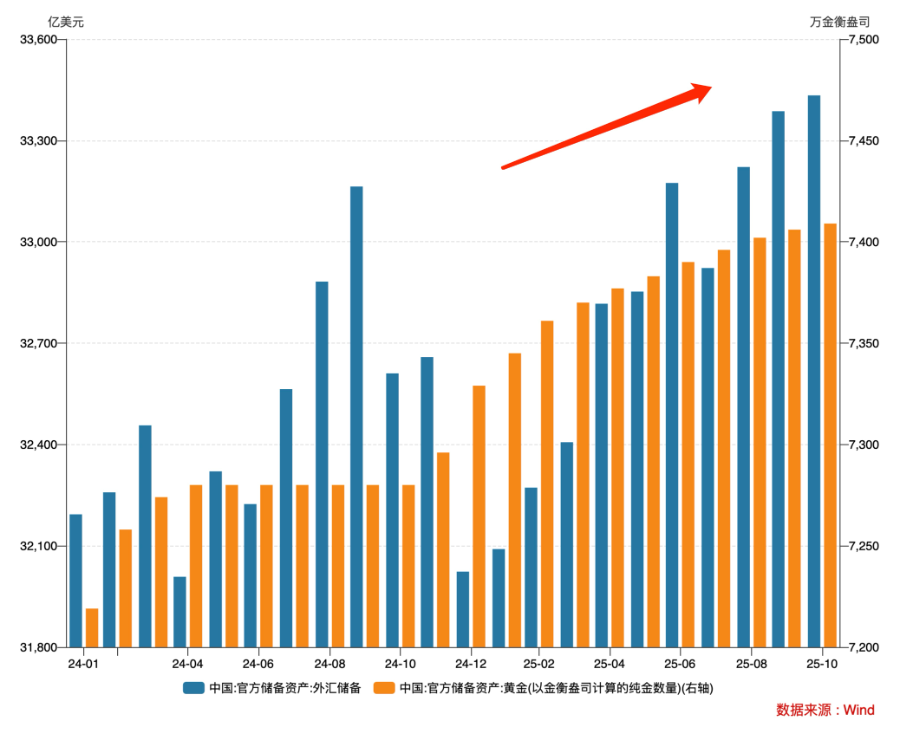
Core Insights - As of the end of October, China's foreign exchange reserves reached $33,433 billion, an increase of $47 billion from the end of September, marking a rise of 0.14% [1] - The increase in reserves is attributed to factors such as major economies' monetary policies, macroeconomic data, and the rise in the US dollar index, which has led to an overall increase in global financial asset prices [1] - China's foreign exchange reserves have remained above $3.3 trillion for three consecutive months, the highest level since December 2015 [1] Group 1 - The current foreign exchange reserve level is considered moderately sufficient, providing important support for maintaining the RMB exchange rate at a reasonable equilibrium [1] - The stability of foreign exchange reserves is expected to be maintained due to China's strong economic fundamentals, advantages, resilience, and potential for long-term growth [1] - As of the end of October, China's gold reserves stood at 74.09 million ounces, with an increase of 30,000 ounces, marking the central bank's 12th consecutive month of gold accumulation [1] Group 2 - The central bank's strategy of diversifying international reserves and dynamically adjusting gold reserves will continue, supporting the cautious advancement of RMB internationalization [2] - The combination of a certain scale of gold reserves is seen as beneficial for promoting the internationalization of the RMB [2]
中国在港发行40亿美债,再动美元根基?华尔街:金融地震来了!
Sou Hu Cai Jing· 2025-11-07 18:30
Core Insights - On November 3, 2025, China issued $4 billion in U.S. dollar sovereign bonds in Hong Kong, signaling a strategic move in the global capital market [1][3] - The issuance is perceived as a demonstration of China's creditworthiness rather than a sign of financial distress, aiming to attract global capital [3][6] - The bonds were oversubscribed, with interest rates approximately 25 to 30 basis points higher than comparable U.S. Treasury bonds, indicating a favorable risk-return profile for investors [3][8] Group 1 - The issuance of bonds serves multiple purposes, including providing liquidity support to countries in need of U.S. dollars, particularly in Latin America and the Middle East [5] - This move is also part of a broader strategy to promote the internationalization of the Renminbi, gradually integrating it into global transactions [5][10] - The choice of Hong Kong as the issuance location is strategic, leveraging its status as a hub for offshore U.S. dollar and Renminbi transactions, ensuring ample liquidity and diverse investor participation [8][10] Group 2 - The timing of the bond issuance aligns with changing global interest rates, geopolitical dynamics, and capital flows, reflecting a calculated approach to market opportunities [10][12] - The bond structure, with both three-year and five-year maturities, caters to different investor preferences, balancing short-term and medium-term investment strategies [12] - The gradual capital flow adjustments post-issuance suggest a long-term impact on asset allocation habits among global investors, indicating a shift in capital dynamics [14]

黄金加税背后的战略!很多人都没读懂!
Sou Hu Cai Jing· 2025-11-07 17:44
Core Viewpoint - The recent announcement regarding tax policy adjustments on gold trading in China aims to regulate the market, prevent tax evasion, and support the country's gold reserves and the internationalization of the Renminbi [2][3][14]. Tax Policy Changes - The new tax policy introduces changes in the invoicing and deduction rules for certain gold transactions, shifting from a 13% VAT special invoice (deductible) to a 6% ordinary invoice (non-deductible) [4][5]. - This change increases the cost for merchants, which is expected to be passed on to consumers, leading to higher prices for retail gold purchases [6][7]. Market Impact - The policy divides the gold market into two segments: investment gold transactions remain unaffected by the new tax, while consumer gold purchases face increased taxation [9][10]. - Retail gold companies like Lao Feng Xiang and Chow Tai Fook have seen their stock prices drop, while prices in the Shenzhen market surged to compensate for the new tax [2][10]. Strategic Intent - The government aims to close loopholes in tax collection and guide the market from gold consumption to investment, thereby enhancing the management of gold reserves and supporting the internationalization of the Renminbi [13][14][20]. - The policy addresses past issues of tax evasion where businesses disguised consumer gold as investment gold to avoid taxes, leading to significant revenue losses for the state [15][16]. Future Implications - The new regulations are expected to encourage individuals to invest in gold through more formal channels like banks and ETFs, rather than holding physical gold [19][24]. - This shift is seen as a way to centralize gold reserves, making them easier to manage and providing a stronger backing for the Renminbi's international status [20][25].


为什么美国不敢把中国逼到绝路?三点说透大国制衡博弈的秘密
Sou Hu Cai Jing· 2025-11-07 15:44
Group 1 - The core truth of US-China relations is that the US does not want China to collapse, as it would create greater problems for the US itself [1][14] - The US-China competition is characterized by a "strange balance" that does not resemble traditional warfare or cold war dynamics, but rather a mix of confrontation and cooperation [3][14] - The tariff war initiated during Trump's presidency serves as an example of how the US and China can engage in economic battles while ultimately protecting their own interests and avoiding direct conflict [4][7] Group 2 - The case of Iran illustrates the new rules of US-China competition, where neither side is willing to fully embrace the other, leading to a complex geopolitical situation [7][9] - The ongoing Russia-Ukraine war demonstrates how the US maintains its hegemony while China benefits from the situation by expanding its market presence in Russia and enhancing its own industrial capabilities [10][13] - The current geopolitical landscape indicates that both the US and China have mutual interests in maintaining a balance, where the US needs China to remain stable and China seeks to leverage this relationship for its own development [14][16]
央行,连续出手!10月外汇储备继续环比上升
券商中国· 2025-11-07 15:20
Core Viewpoint - As of October 2025, China's foreign exchange reserves reached $33,433 billion, marking a $47 billion increase from September, the highest level since December 2015, with reserves stabilizing above $3.3 trillion for three consecutive months [1][2]. Group 1: Foreign Exchange Reserves - The increase in foreign exchange reserves in October was influenced by major economies' monetary policies, macroeconomic data, and a rising U.S. dollar index, which saw a 1.95% increase over the month [2][3]. - The rise in global financial asset prices, supported by a strong performance in global stock and bond markets, contributed to the increase in China's foreign exchange reserves [3]. Group 2: Gold Reserves - As of October, China's official gold reserves stood at 7.409 million ounces, with a monthly increase of 30,000 ounces, the lowest growth rate since the resumption of gold purchases in November 2024 [4]. - The People's Bank of China has been gradually increasing gold reserves since March, with monthly increments below 100,000 ounces, signaling a strategy to optimize international reserves [4][5]. Group 3: Market Outlook - The outlook for foreign exchange reserves remains stable due to China's strong economic fundamentals, resilience, and potential for growth, which are expected to support the stability of reserves [3]. - In the short term, gold demand may slow down due to easing geopolitical risks and trade tensions, while long-term demand is expected to remain strong as central banks continue to diversify their reserves [5].

外储连续三月站稳3.3万亿美元,未来增持黄金仍是大方向
第一财经· 2025-11-07 14:57
2025.11. 07 本文字数:2169,阅读时长大约4分钟 作者 | 第一财经 杜川 中国外汇储备余额继续增加,延续了此前两个月的升势。 11月7日,国家外汇管理局统计公布数据显示,截至2025年10月末,我国外汇储备规模为33433亿 美元,较9月末上升47亿美元,升幅为0.14%。值得注意的是,10月末我国外储规模已连续三个月 升至3.3万亿美元之上,较上年末也大幅增加1409.9亿美元。 中银证券全球首席经济学家管涛认为,这是受主要经济体货币政策及预期、宏观经济数据等因素影 响,美元指数走强,非美元货币总体下跌,但全球金融资产价格总体上涨带来的正估值效应。当月, 美元指数震荡上行,累计上涨2.1%至99.8,创8月份以来新高。 同期央行数据显示,10月末黄金储备为7409万盎司,较上月末增加3万盎司。 外储环比上涨47亿美元 受资产价格变化与汇率波动综合影响,10月末外储环比上涨47亿美元至33433亿美元。 由于外储以美元计价,非美货币贬值会降低经汇率折算后的外汇储备规模。 汇率方面,10月份美元指数上涨2.1%至99.8。中国民生银行首席经济学家温彬表示,美联储降息的 同时美元逆势上涨,主要有三 ...

聚焦汇率中性 赋能跨境远航 上海银行汇率风险中性宣讲会为甬企发展注入“金融动能”
Feng Huang Wang Cai Jing· 2025-11-07 13:51
Core Insights - Shanghai Bank Ningbo Branch held a seminar focused on "exchange rate neutrality" to address the cross-border financial needs of export-oriented enterprises in Ningbo, providing a comprehensive financial service platform for over 40 companies [1][2] - The seminar featured key speakers from the People's Bank of China Ningbo Branch and Shanghai Bank, emphasizing the importance of collaboration among government, banks, and enterprises to promote stable foreign trade in Ningbo [1][2] Group 1: Seminar Highlights - The seminar provided insights into the advantages of cross-border RMB settlement and practical applications for small and medium-sized enterprises [2] - Detailed explanations were given on exchange rate risk management, foreign trade enterprise subsidy policies, and key policies for overseas direct investment and lending [2] - Shanghai Bank showcased real case studies to illustrate the application of risk management tools and promoted a diverse range of financial products tailored to cross-border business needs [2] Group 2: Future Directions - The bank's president stated a commitment to deepening engagement with Ningbo's export-oriented economy through precise policy interpretation, professional market analysis, and a rich product system [3] - The bank aims to enhance its cross-border financial services and strengthen collaboration among government, banks, and enterprises to support the high-quality development of Ningbo's foreign trade [3] - Future efforts will focus on integrating resources, expanding cooperation networks, and contributing to regional economic development, particularly in the context of the Belt and Road Initiative [3]

(第八届进博会)全球化智库副主任高志凯:建议在进博会框架下推动人民币跨境结算
Zhong Guo Xin Wen Wang· 2025-11-07 13:40
Core Viewpoint - The suggestion to promote cross-border settlement in Renminbi (RMB) within the framework of the China International Import Expo (CIIE) aims to enhance the use of RMB in international trade, which currently stands at only about 3% [1][2]. Group 1: Current Situation - The proportion of RMB in international settlements is approximately 3%, which is inconsistent with China's status as a major global trading nation [1]. - China's manufacturing sector accounts for about one-third of global production, yet the low percentage of RMB in international settlements highlights a significant mismatch [1]. Group 2: Recommendations - It is proposed to develop a roadmap to encourage the use of RMB for settlements at the CIIE, with a target to increase the RMB settlement ratio to 25% to 30% in a relatively short time [1]. - The CIIE could focus on key commodity sectors, such as allowing transactions for Norwegian salmon to be settled in RMB [1]. Group 3: Integration with Digital Currency - The integration of RMB internationalization with the development of digital RMB is suggested, emphasizing the need to combine efforts for both import and export payments using RMB [1]. - The gradual exploration of these initiatives is expected to enhance trade facilitation and help RMB evolve into an international transaction, payment, and reserve currency [2].
外储连续三月站稳3.3万亿美元,未来增持黄金仍是大方向
Di Yi Cai Jing· 2025-11-07 13:09
Core Viewpoint - China's foreign exchange reserves continue to increase, reaching $33,433 billion by the end of October 2025, marking a rise of $47 billion from September, and a significant increase of $1,409.9 billion from the end of the previous year [1] Foreign Exchange Reserves - As of October 2025, China's foreign exchange reserves have risen for three consecutive months, remaining above $3.3 trillion [1] - The increase in reserves is attributed to the impact of asset price changes and exchange rate fluctuations, with a month-on-month rise of $47 billion [1] - The dollar index rose by 2.1% to 99.8 in October, influenced by stronger-than-expected U.S. economic growth and a decline in non-dollar currencies [2] Gold Reserves - China's gold reserves increased by 30,000 ounces (approximately 0.93 tons) to 7,409 million ounces by the end of October, marking the 12th consecutive month of gold accumulation [5] - The increase in gold reserves is seen as a strategy to optimize the structure of foreign exchange reserves and mitigate risks associated with a high proportion of dollar assets [5][8] - Global demand for gold from central banks remains high, with gold surpassing the euro as the second-largest reserve asset [6] Economic Analysis - The current level of foreign exchange reserves is considered moderately sufficient, providing support for maintaining the RMB exchange rate at a reasonable equilibrium [3] - The ongoing geopolitical risks and inflation concerns enhance the investment demand for gold, which is viewed as a hedge against such uncertainties [5][8] - The Chinese economy's stability and potential are fundamental supports for maintaining the foreign exchange reserve scale [8]
外储连续三月超3.3万亿美元 央行购金节奏放缓
2 1 Shi Ji Jing Ji Bao Dao· 2025-11-07 12:48
21世纪经济报道记者 唐婧 全球资产价格上涨支撑外储 11月7日,国家外汇管理局统计数据显示,截至2025年10月末,我国外汇储备规模为33433亿美元,较9月末上升47亿美元,升幅 为0.14%。这是我国外汇储备连续三月站上3.3万亿美元大关,创2015年12月以来最高。黄金储备方面,央行连续第12个月增持 黄金。同日,央行公布数据显示,10月末黄金储备报7409万盎司(约2304.457吨),环比增加3万盎司(约0.93吨)。 国家外汇局表示,2025年10月,受主要经济体货币政策及预期、宏观经济数据等因素影响,美元指数上涨,全球金融资产价格 总体上涨。汇率折算和资产价格变化等因素综合作用,当月外汇储备规模上升。我国经济基础稳、优势多、韧性强、潜能大, 长期向好的支撑条件和基本趋势没有变,有利于外汇储备规模保持基本稳定。 东方金诚首席宏观分析师王青告诉记者,汇率和资产价格变化带来的估值效应形成对冲,是10月外汇储备小幅回升的主因。一 方面,10月美元指数上涨1.9%。这会导致我国外汇储备中非美元资产贬值,导致外汇储备规模下降。另一方面,10月以日经225 指数为代表的全球主要股指普遍出现较大幅度上涨,其中 ...