人机交互

Search documents
机器人读博士“能武”更要“能文”
Zheng Quan Shi Bao· 2025-07-29 18:50
Core Viewpoint - The emergence of the first robot doctoral student in China signifies a shift in the robotics industry towards enhancing robots' understanding of human behavior, not just their physical capabilities [1][2]. Group 1: Robot Development - The humanoid robot "Xueba 01" has been admitted to Shanghai Theatre Academy as a full-time doctoral student, marking a significant milestone in robotics education [1]. - "Xueba 01" is a successor to "Xingzhe No. 2," which won third place in a robot marathon, showcasing its advanced motion control and sensory technology [1]. Group 2: Understanding Human Behavior - The ability to "understand humans" is becoming a new imperative in the robotics industry, as future robots need to enhance their comprehension of human actions to operate effectively in various environments [2]. - In retail, robots that can analyze customer behavior can recommend suitable products, while in elder care, they can assess health conditions through expressions [2]. Group 3: Future Applications and Challenges - Despite advancements, robots are still some distance from widespread adoption in retail, elder care, and education, with industrial manufacturing expected to be the first major application area [2]. - The current focus is on overcoming technical challenges in precise motion control, but the industry's future growth will depend on robots' ability to understand human interactions [2].

阿里曝光自研AI眼镜 AI To C战略攻入硬件领域
Zhong Guo Jing Ying Bao· 2025-07-27 04:46
Core Viewpoint - Alibaba's entry into the AI glasses market signifies its commitment to the AI To C strategy, integrating hardware with its existing ecosystem to enhance user experience and functionality [1][2]. Group 1: Product Development and Features - Alibaba's AI glasses, named "Quark AI Glasses," have completed development and are expected to be launched within the year [1]. - The glasses will integrate various Alibaba services, including navigation, payment, and shopping, leveraging the capabilities of the Quark team and the Alibaba ecosystem [1][5]. - Key features include a near-eye display navigation system developed in collaboration with Gaode Map, direct payment via Alipay, and product search and comparison through Taobao [6]. Group 2: Market Context and Competition - The AI glasses market is becoming increasingly competitive, with various players, including consumer electronics giants and specialized AR manufacturers, entering the space [2]. - Industry experts believe that AI glasses will become a crucial product form in smart wearables, acting as an extension of human perception [2]. - The Chinese smart glasses market is projected to reach 2.9 million units by 2025, with Xiaomi already pricing its AI glasses at 1,999 yuan, indicating a trend towards lower product costs [8]. Group 3: User Experience and Challenges - Current challenges for AI glasses include issues with comfort, battery life, and overall user experience, which need to be addressed for widespread adoption [7]. - Alibaba aims to overcome these challenges by collaborating with leading eyewear brands and integrating technology, channels, and services to enhance user experience [7]. - The success of Quark AI Glasses will depend on improving comfort and usability while also considering competitive pricing strategies [8].

Meta发布“意念操控”腕带,研究登Nature,要抢马斯克生意?
3 6 Ke· 2025-07-26 02:15
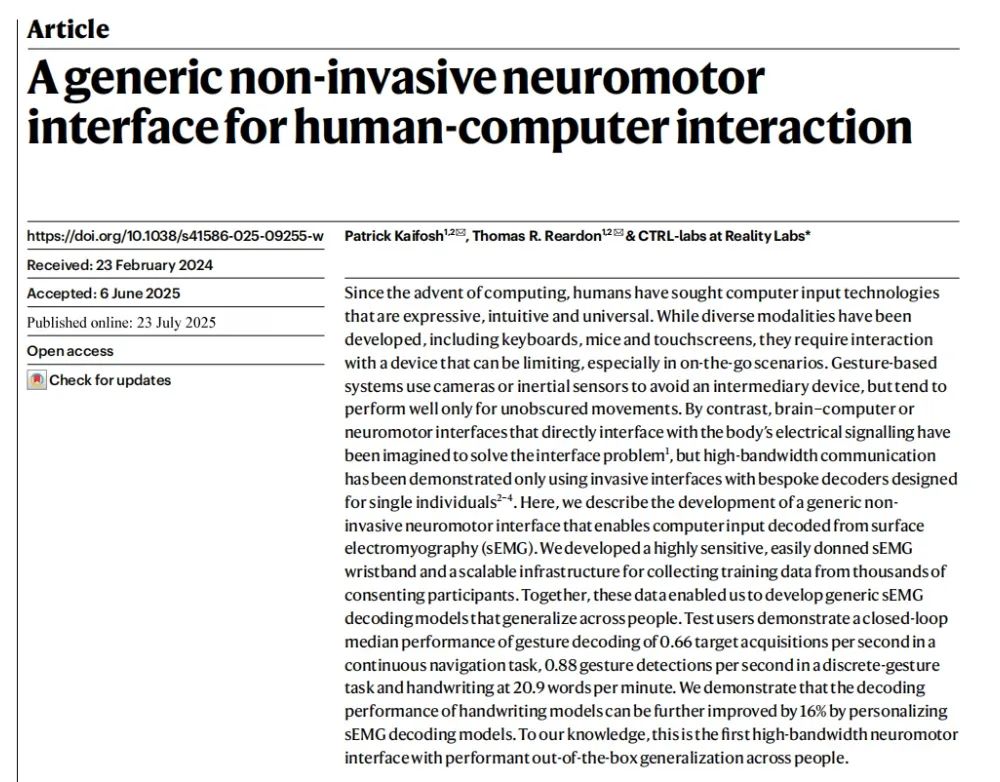
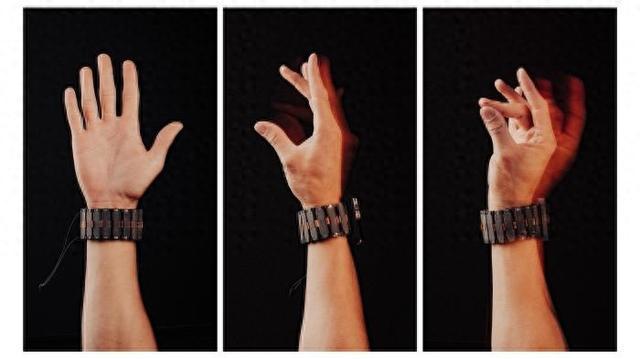
Core Insights - Meta's Reality Labs has introduced a non-invasive neuromotor interface for human-computer interaction, utilizing surface electromyography (sEMG) technology [1][3][16] - The interface, designed as a wristband, captures neural signals from the wrist to recognize various gestures without the need for invasive procedures [1][3] Hardware Development - The research team developed a high-sensitivity, easy-to-wear sEMG wristband (sEMG-RD) with a sampling rate of 2kHz and a noise level of 2.46μVrms, featuring a battery life of over 4 hours [4][6] - The wristband is designed to accommodate different wrist sizes and can accurately capture electrical signals from muscles in the wrist, hand, and forearm [4][6] Model Training and Data Collection - The team built a scalable data collection infrastructure, gathering training data from thousands of participants to develop a universal sEMG decoding model [6][12] - Advanced deep learning architectures were employed, including LSTM layers and Conformer architecture, to enhance the model's adaptability to various interaction scenarios [6][12] Performance Metrics - The sEMG interface achieved a median performance of 0.66 gestures per second during continuous navigation tasks, significantly improving operational efficiency [7][9] - In discrete gesture tasks, the detection rate reached 0.88 gestures per second, with handwriting input speeds of 20.9 words per minute [9][12] Application Potential - The technology has broad applications in daily interactions with mobile devices, allowing for seamless input without reliance on traditional methods [13][14] - It offers new interaction methods for individuals with mobility impairments, enabling them to control devices through subtle muscle movements [13][14] Future Prospects - The interface could be utilized in clinical diagnostics and rehabilitation, providing insights into muscle activity and aiding in personalized recovery plans [14][15] - It may redefine human-computer interaction paradigms, potentially becoming a standard for general electronic devices [16][17]


为何把脑类器官芯片“送上天”(趣科普)
Ren Min Ri Bao· 2025-07-25 22:02
Core Viewpoint - The article discusses the significance of the brain organ chip, which was sent to space aboard the Tianzhou-9 cargo spacecraft, marking the first time such technology has been utilized in a space environment for life sciences research [1][3]. Group 1: Brain Organ Chip Overview - The brain organ chip is a 3D micro-brain model constructed from human pluripotent stem cells, designed to simulate physiological and pathological responses of brain organs [3]. - This chip contains a complex network of brain microvessels, nerve cells, and immune cells, allowing it to mimic certain structures and functions of the human brain, providing a new tool for disease modeling, mechanism research, and drug screening [3]. Group 2: Purpose of Sending to Space - The primary goal of sending the brain organ chip to the space station is to explore the effects of the space environment on human brain health, particularly the impacts of microgravity and radiation on the nervous system [4]. - Research indicates that astronauts often experience symptoms like dizziness, sleep disturbances, and attention deficits, and exposing the brain organ chip to these conditions may help identify underlying mechanisms and potential solutions [4]. Group 3: Broader Implications - The research has implications beyond space, as the unique environment in space can accelerate the onset of aging or functional decline in organisms, providing a unique "accelerated window" for studying diseases that typically take months or years to manifest on Earth [5]. - This could enhance research on neurodegenerative diseases such as Alzheimer's and Parkinson's, facilitating early diagnosis and innovative treatment evaluation methods [5]. Group 4: Distinction from Brain-Machine Interfaces - While both brain organ chips and brain-machine interfaces relate to brain function, they serve different purposes; the former focuses on simulating brain structures and functions for research, while the latter is a technology system for interaction between the brain and devices [6]. - Brain organ chips are aimed at understanding brain development, disease research, and drug screening, whereas brain-machine interfaces are designed for human-device interaction, such as controlling prosthetics with thoughts [6].

Nature:Meta公司开发非侵入式神经运动接口,实现丝滑人机交互
生物世界· 2025-07-24 07:31
Core Viewpoint - The article discusses a groundbreaking non-invasive neuromotor interface developed by Meta's Reality Labs, which allows users to interact with computers through wrist-worn devices that translate muscle signals into computer commands, enhancing human-computer interaction, especially in mobile scenarios [2][3][5]. Group 1: Technology Overview - The research presents a wrist-worn device that enables users to interact with computers through hand gestures, converting muscle-generated electrical signals into computer instructions without the need for personalized calibration or invasive procedures [3][5]. - The device utilizes Bluetooth communication to recognize real-time gestures, facilitating various computer interactions, including virtual navigation and text input at a speed of 20.9 words per minute, compared to an average of 36 words per minute on mobile keyboards [6]. Group 2: Research and Development - The Reality Labs team developed a highly sensitive wristband using training data from thousands of subjects, creating a generic decoding model that accurately translates user inputs without individual calibration, demonstrating performance improvements with increased model size and data [5]. - The research indicates that personalized data can further enhance the performance of the decoding model, suggesting a pathway for creating high-performance biosignal decoders with broad applications [5]. Group 3: Accessibility and Applications - This neuromotor interface offers a wearable communication method for individuals with varying physical abilities, making it suitable for further research into accessibility applications for those with mobility impairments, muscle weakness, amputations, or paralysis [8]. - To promote future research on surface electromyography (sEMG) and its applications, the team has publicly released a database containing over 100 hours of sEMG recordings from 300 subjects across three tasks [9].

助力人机交互更丝滑!国际最新研发手环能将手势转换成计算机指令
Huan Qiu Wang Zi Xun· 2025-07-24 04:12
Core Insights - A new wearable device developed by researchers allows users to interact with computers through hand gestures, converting muscle signals into computer commands without the need for personalized calibration or invasive procedures [1][3] Group 1: Technology Development - The device, a wrist-worn band, utilizes high-sensitivity sensors to detect electrical signals from wrist muscles and translate them into computer signals [3] - A generic decoding model was created using deep learning, which can accurately interpret user inputs without individual calibration, demonstrating performance improvements with increased model size and data [3][4] - The device can communicate with computers via Bluetooth, enabling real-time gesture recognition for various computer interactions, including virtual navigation and text input at a rate of 20.9 words per minute [3] Group 2: Accessibility and Applications - The neural motion interface offers a communication method for individuals with diverse physical abilities, potentially benefiting those with mobility impairments, muscle weakness, amputations, or paralysis [4] - The research team has released a database containing over 100 hours of surface electromyography (sEMG) recordings from 300 subjects, aimed at facilitating further research on the accessibility of this technology [4]
神经运动手环通过手势实现人机交互
news flash· 2025-07-23 22:19
Core Insights - Meta has launched a new neural motion bracelet that allows users to interact with computers through gestures like handwriting [1] - The device converts electrical signals generated by muscle movements in the wrist into computer commands without the need for personalized calibration or invasive surgery [1] - This development marks a significant advancement in the application of high-performance biosignal decoders, enhancing the fluidity of human-computer interaction and expanding accessibility [1]
具身数采方案一览!遥操作和动捕的方式、难点和挑战(2w字干货分享)
具身智能之心· 2025-07-09 14:38
Core Viewpoint - The discussion focuses on the concept of remote operation (遥操作) in the context of embodied intelligence, exploring its significance, advancements, and future potential in robotics and human-machine interaction [2][15][66]. Group 1: Definition and Importance of Remote Operation - Remote operation is not a new concept; it has historical roots in military and aerospace applications, but its relevance has surged with the rise of embodied intelligence [5][15]. - The emergence of embodied intelligence has made remote operation crucial for data collection and human-robot interaction, transforming it into a mainstream approach [17][66]. - The concept of remote operation is evolving, with discussions on how it can enhance human capabilities and provide a more intuitive interface for controlling robots [15][66]. Group 2: Experiences and Challenges in Remote Operation - Various types of remote operation experiences were shared, including surgical robots and remote-controlled excavators, highlighting the diversity of applications [6][21]. - The challenges of remote operation include latency issues, the complexity of control, and the need for intuitive human-machine interfaces [34][69]. - The discussion emphasized the importance of minimizing latency in remote operation systems to enhance user experience and operational efficiency [34][56]. Group 3: Future Directions and Innovations - The future of remote operation may involve a combination of virtual and physical solutions, such as using exoskeletons for realistic feedback and pure visual systems for ease of use [38][40]. - Innovations like the ALOHA system are prompting the industry to rethink robot design and operational frameworks, potentially leading to significant advancements in remote operation technology [103][106]. - The integration of brain-machine interfaces could represent the ultimate solution for overcoming current limitations in remote operation, allowing for seamless communication between humans and machines [37][99].

Science Advances发表!南洋理工大学推出头发丝薄度传感器FMEIS,让机器秒懂肌肉「微表情」
机器人大讲堂· 2025-07-06 05:23
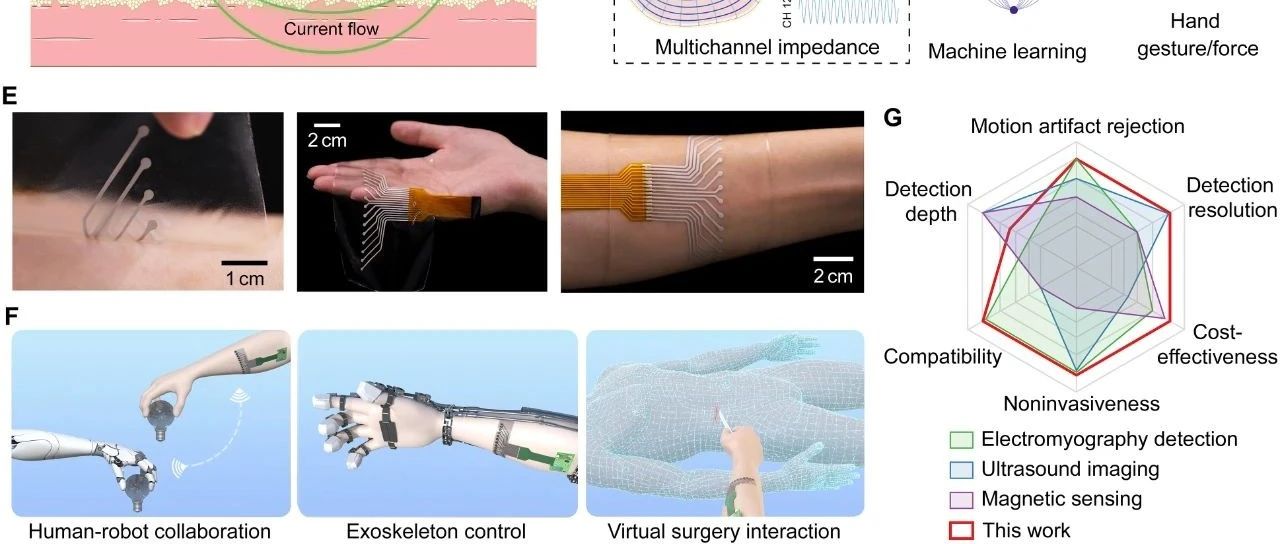
Core Viewpoint - The article discusses the development of a flexible multichannel muscle impedance sensor (FMEIS) by a research team from Nanyang Technological University, which addresses the limitations of traditional muscle monitoring tools and enhances human-machine interaction capabilities [2][4][24]. Group 1: FMEIS Development and Features - FMEIS is a flexible sensor with a thickness of only 220 μm and an elastic modulus of 212.8 kPa, closely matching human skin's elasticity [4][6]. - The sensor demonstrates high performance, achieving an accuracy of 98.49% in gesture classification and a determination coefficient (R²) of 0.98 in muscle strength prediction [4][10]. - Unlike traditional electromyography (EMG), FMEIS can detect impedance changes in deep muscle tissues, allowing for accurate readings even without significant body movements [4][10][17]. Group 2: Technical Specifications - The FMEIS system consists of a lightweight 4g sensor pad and a 53g control unit [6]. - The sensor pad utilizes a safe alternating current of 50 kHz and 0.4 mA for multi-channel signal injection and collection, ensuring stability during extensive movements [7]. - The design incorporates a modified polydimethylsiloxane substrate and conductive hydrogel electrodes, enhancing adhesion and signal quality over prolonged use [7][24]. Group 3: Performance Validation - FMEIS outperformed traditional EMG sensors in detecting both active and passive muscle movements, with a maximum detection depth of approximately 30 mm [17][24]. - In tests involving three participants, FMEIS achieved an average gesture classification accuracy of 98.49% and an average R² value of 0.98 for muscle strength regression, indicating strong robustness against variations in skin impedance and fat tissue thickness [16][24]. Group 4: Application Scenarios - FMEIS has shown potential in various applications, including human-robot collaboration, exoskeleton control, and virtual surgery [18][24]. - In human-robot collaboration, FMEIS enables natural interaction by interpreting muscle signals to drive robotic actions without visible hand movements, enhancing efficiency and safety [19][24]. - For exoskeleton control, FMEIS demonstrated a response delay of only 756 milliseconds, significantly improving grip strength by 65% during tests [21][24]. - In virtual surgery, FMEIS serves as a bridge between the operator and VR systems, allowing for precise feedback and control of surgical tools based on muscle force predictions [23][24].
3巨头押注下一个十亿级入口:当小米、字节、华为盯上 AI 眼镜,争的不是硬件是交互主权
Xi Niu Cai Jing· 2025-06-30 06:51
Core Viewpoint - Xiaomi's AI glasses are positioned as a personal AI device and a lightweight entry point to the digital world, marking a significant step in the competition for the next generation of computing platforms [2][3]. Product Features - The AI glasses weigh only 40 grams and feature a Qualcomm Snapdragon AR1 chip and a 12-megapixel camera with a Sony IMX681 sensor, achieving a battery life of 8.6 hours, surpassing Meta's Ray-Ban glasses [3][4]. - The product incorporates a dual-chip architecture for enhanced performance and is designed with a focus on user comfort, aiming for "all-day wearability" [3][4]. - Xiaomi's proprietary "Super Xiao Ai" AI assistant enables multimodal interaction, cross-device operation, and personalized memory services [3]. Market Strategy - Xiaomi has set a conservative internal sales target of over 300,000 units, which is significantly lower than Meta's Ray-Ban glasses' global sales of 2 million units [5]. - The company collaborates with 400 optical stores to provide fitting services, addressing the high myopia rate among Chinese youth, which stands at 52.7% [6]. Industry Context - The global smart glasses market has seen significant growth, with a 135% year-on-year increase in shipments expected by 2025, particularly in China, which is projected to lead with 2.75 million units [9]. - The competitive landscape is intensifying, with major tech companies vying for dominance in the AI glasses market, emphasizing the strategic importance of these devices as the next human-computer interaction interface [10][12]. Supply Chain and Economic Impact - Approximately 70% of the components for the AI glasses are domestically sourced, with optical module costs expected to decrease by 30% compared to 2024 [4]. - Companies like GoerTek and OFILM are positioned to benefit from the AI glasses market, with potential revenue growth of over 15% for GoerTek if sales exceed 300,000 units [11].