
通胀对冲

Search documents
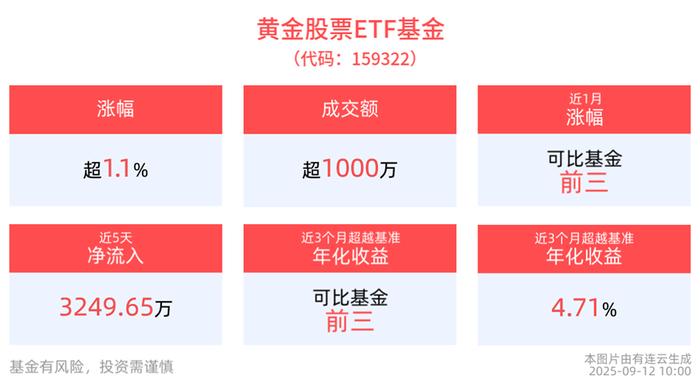
涨超2%!黄金股票ETF基金(159322)持续上行!
Xin Lang Cai Jing· 2025-09-12 02:22
Group 1 - The gold market has been performing exceptionally well, with prices reaching historical highs, driven by factors such as doubts about the Federal Reserve's independence and rising expectations for interest rate cuts [1][2] - As of September 11, over 100 billion yuan has been attracted to gold futures, with an increase of more than 17 billion yuan in September alone [1] - The recent surge in gold prices has led several banks, including Bank of China and Agricultural Bank of China, to adjust their precious metals business, including increasing investment thresholds and modifying trading rules [2] Group 2 - Gold prices have risen approximately 5% in September, reaching a record high of $3,674.27, surpassing inflation-adjusted records from 1980 [2] - The gold stock ETF has seen a net value increase of 52.47% over the past six months, ranking in the top 1.80% among comparable funds [5] - The gold stock ETF closely tracks the CSI Hong Kong and Shanghai Gold Industry Index, which includes 50 major companies involved in gold mining, refining, and sales [6]

突破1980年通胀调整峰值,现货黄金再创历史新高
Di Yi Cai Jing· 2025-09-12 01:21
Group 1 - Gold prices reached a historic high of $3,674.27 per ounce, surpassing the inflation-adjusted peak of $850 per ounce from January 1980, with a cumulative increase of approximately 5% in September and nearly 40% year-to-date [1] - The rise in gold prices is attributed to macroeconomic uncertainties, with significant factors including a surge in initial jobless claims to 263,000, the highest in three years, and a core CPI increase of 0.3% [1] - Analysts suggest that despite some short-term buyer fatigue, the outlook for gold remains constructive with limited room for significant pullbacks in the coming months [1] Group 2 - Recent economic data indicates a cooling U.S. economy, with the August CPI rising by 2.9%, the largest increase in seven months, and non-farm payrolls adding only 22,000 jobs, leading to a rise in the unemployment rate to 4.3% [2] - The market is increasingly concerned about stagflation, with traders fully pricing in a 25 basis point rate cut by the Federal Reserve in the near future [2] - The combination of a weakening labor market and persistent inflation signals a shift in monetary policy expectations, with a gradual resumption of rate cuts anticipated [2] Group 3 - Factors such as tax cuts and tariffs from the Trump administration, along with challenges to the independence of the Federal Reserve, have diminished the attractiveness of the U.S. dollar and Treasury bonds, driving investment into gold [3] - Gold is viewed as a unique hedge against inflation and currency devaluation, with historical precedence reinforcing its role as a safe haven during economic uncertainty [3] - The volatility of gold prices has decreased compared to the sharp spikes seen in 1980, attributed to enhanced market liquidity and the accessibility of gold through ETFs [3] Group 4 - Central banks are diversifying their foreign reserves, with gold's share in reserves increasing since the Russia-Ukraine conflict, now surpassing the euro to become the second-largest reserve asset globally [4] - The future trajectory of gold prices will depend on the Federal Reserve's policy direction and global risk events, with historical trends indicating that rate cuts typically enhance gold's appeal [4] - The ongoing gold market rally is supported by a broad investor base and policy uncertainties, positioning gold as both an inflation hedge and a beneficiary of global asset reallocation [4]
纽约金价11日小幅下跌
Xin Hua Cai Jing· 2025-09-12 00:57
Group 1 - The core viewpoint of the articles indicates a decline in gold prices, with the December 2025 gold futures price dropping by 0.23% to $3673.40 per ounce, influenced by an unexpected rise in initial jobless claims and a slight increase in the consumer price index (CPI) in the U.S. [1] - The U.S. Department of Labor reported an increase of 27,000 in initial jobless claims, reaching 263,000, which was above market expectations of 235,000, suggesting a dovish stance on monetary policy [1] - The CPI for August showed a year-on-year increase of 2.9%, up from 2.7% in the previous month, while the core CPI, excluding volatile food and energy prices, rose by 3.1% [1] Group 2 - The European Central Bank decided to maintain interest rates during its monetary policy meeting [1] - Gold prices have increased by over 38% this year, while silver prices have risen by more than 42%, indicating a strong performance in precious metals amid uncertainty [1] - Morgan Stanley predicts a further increase in gold prices by approximately 5%, expecting the price to reach $3800 per ounce by the end of 2025 [1]
金价突破1980年通胀调整峰值
Di Yi Cai Jing Zi Xun· 2025-09-12 00:32
Core Insights - Gold prices reached a historic high of $3,674.27 per ounce, surpassing the previous peak of $850 per ounce (adjusted for inflation) from January 1980, with a year-to-date increase of nearly 40% [2] - The recent surge in gold prices is attributed to macroeconomic uncertainties and a shift in investor sentiment towards gold as a safe-haven asset [2][4] - Economic indicators suggest a cooling U.S. economy, with rising unemployment and inflation concerns, leading to expectations of potential interest rate cuts by the Federal Reserve [3][5] Economic Indicators - The U.S. Consumer Price Index (CPI) rose by 2.9% year-on-year in August, marking the largest increase in seven months, while the Producer Price Index (PPI) unexpectedly declined [3] - Non-farm payrolls added only 22,000 jobs in August, with the unemployment rate rising to 4.3%, indicating a weakening labor market [3] - The Federal Reserve is expected to initiate a gradual rate-cutting cycle after pausing monetary easing earlier this year [3] Factors Driving Gold Prices - The Trump administration's tax and tariff policies have diminished the attractiveness of the U.S. dollar and Treasury bonds, leading to increased investment in gold [4] - Historical perspectives highlight gold's role as a hedge against inflation and currency devaluation, a sentiment echoed by economists [4] - Enhanced market liquidity and the availability of gold through ETFs have contributed to reduced volatility in gold prices compared to past surges [4] Central Bank Trends - Central banks have been diversifying their foreign reserves, with gold's share in reserves increasing since the Russia-Ukraine conflict, now surpassing the euro [5] - The ongoing demand from central banks and private investors, coupled with a decline in trust in dollar assets, is expected to support gold prices in the long term [5] - Historical trends indicate that periods of interest rate cuts typically enhance gold's appeal as an investment [5]
金价突破1980年通胀调整峰值
第一财经· 2025-09-12 00:24
Core Viewpoint - The article highlights the recent surge in gold prices, reaching a historical high of $3674.27 per ounce, driven by macroeconomic uncertainties and inflation concerns, reinforcing gold's status as a safe-haven asset [3][4]. Economic Slowdown and Monetary Easing Expectations - Recent data indicates a cooling U.S. economy, with the August Consumer Price Index (CPI) rising by 2.9%, the largest increase in seven months, while the Producer Price Index (PPI) unexpectedly declined [5]. - Non-farm payrolls added only 22,000 jobs in August, with the unemployment rate rising to 4.3%, and the annual employment data was revised down by 911,000 jobs [5]. - These signals of a weakening labor market alongside persistent inflation have heightened concerns about stagflation, leading traders to fully price in a 25 basis point rate cut by the Federal Reserve [5]. Multiple Factors Driving Gold Prices - Policies from the Trump administration, including tax cuts and tariffs, have diminished the attractiveness of the U.S. dollar and Treasury bonds, accelerating capital inflow into gold [6]. - Gold has historically served as a hedge against inflation and currency devaluation, a role that is being reinforced amid current economic conditions [6]. - Analysts note that unlike the volatile spikes in gold prices seen in 1980, the current price increase is characterized by reduced volatility due to enhanced market liquidity and the accessibility of gold through ETFs [6][7]. - Goldman Sachs projects that gold prices could reach $3700 by the end of 2025 and potentially exceed $4000 by mid-2026, with scenarios suggesting prices could touch $4500 to $5000 if there is a significant outflow from dollar assets [7]. Central Bank Diversification and Long-term Support for Gold - Since the onset of the Russia-Ukraine conflict, the proportion of gold in central bank reserves has increased, surpassing that of the euro, making gold the second-largest reserve asset globally [8]. - Future gold price movements are expected to depend on the Federal Reserve's policy direction and global risk events, with historical trends indicating that rate-cutting cycles tend to enhance gold's appeal [8]. Broader Investor Base and Policy Uncertainty - The sustainability of the current gold market is attributed to a broad base of investors and ongoing policy uncertainties, positioning gold not only as an inflation hedge but also as a beneficiary of global asset reallocation [9].

美联储遭遇独立危机,A股热点要变!
Sou Hu Cai Jing· 2025-09-05 08:19
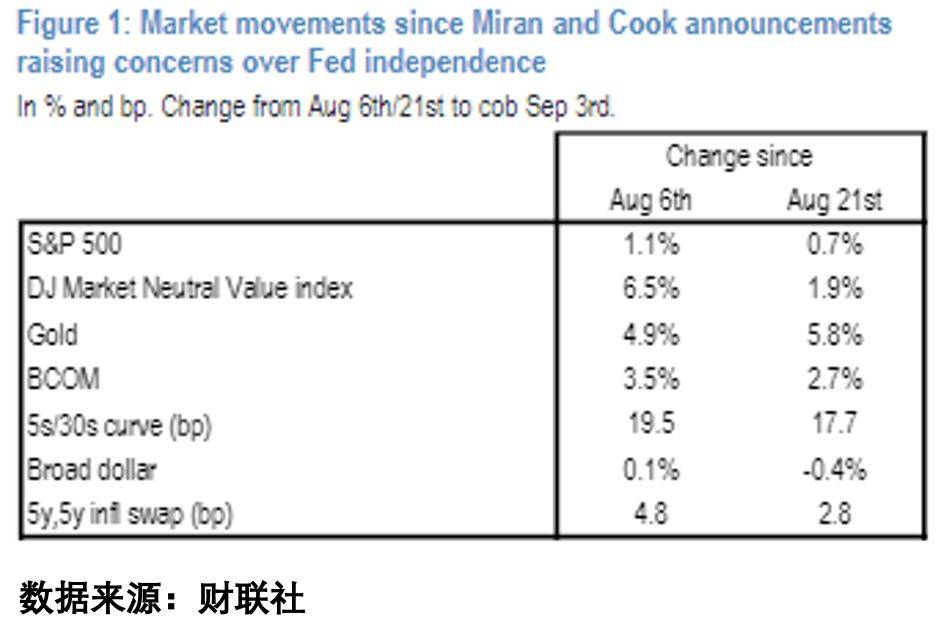
Group 1 - The recent market fluctuations are attributed to concerns over the independence of the Federal Reserve, leading to increases in gold, commodities, and value stocks [1][2] - The S&P 500 increased by 1.1%, the DJ Market Neutral Value index rose by 6.5%, gold prices went up by 4.9%, and the Bloomberg Commodity Index increased by 3.5% during the period from August 6 to September 3 [1][4] - The yield curve between 5-year and 30-year Treasury bonds steepened by 19.5 basis points, indicating market expectations of a more dovish policy from the Federal Reserve if its independence is compromised [2] Group 2 - The article emphasizes the lagging nature of news and the market's tendency to "run ahead," suggesting that traders often react to anticipated news rather than waiting for confirmation [3][7] - The concept of "buy the rumor, sell the news" is highlighted as a common trading strategy, particularly in the context of the U.S. stock market, where new positive information is quickly reflected in stock prices [7] - The article discusses the importance of understanding trading behaviors and the role of institutional investors in shaping market movements, particularly during periods of volatility [9][12] Group 3 - The article suggests that retail investors often misinterpret market signals and may fall victim to "chasing highs" without understanding the underlying trading dynamics [9][13] - It introduces the idea of using quantitative analysis to better understand market movements and trading behaviors, which can help retail investors avoid losses [14][15] - The conclusion emphasizes that true market success comes from understanding trading behaviors rather than merely reacting to news [15]
u200b金价创历史新高突破3500美元,央行购金与降息预期助推涨势
Shang Wu Bu Wang Zhan· 2025-09-04 16:51
Core Viewpoint - The article discusses the recent surge in gold prices driven by a weaker US dollar and market expectations of an interest rate cut by the Federal Reserve, highlighting the growing demand for gold as a hedge against inflation and economic uncertainty [1] Group 1: Gold Price Movement - Spot gold prices reached a high of $3,508.70 per ounce during Asian trading on September 2, surpassing the previous high set during the Trump administration's tariff policy [1] - Gold closed at $3,497 per ounce, marking a daily increase of 0.9% [1] Group 2: Market Influences - Concerns over the independence of the Federal Reserve, exacerbated by President Trump's pressure on Chairman Jerome Powell and attempts to remove Governor Lisa Cook, have contributed to rising gold prices [1] - David Wilson, head of commodity strategy at BNP Paribas, noted that increasing economic uncertainty makes gold more attractive, creating favorable conditions for price increases [1] Group 3: Demand Dynamics - Goldman Sachs reported that inflows into gold ETFs have become a significant source of demand supporting gold prices, predicting that spot gold could reach $4,000 per ounce by mid-2024 [1] - According to the World Gold Council, global central banks have been increasing their gold holdings since the beginning of 2023, nearly doubling gold prices [1] Group 4: Central Bank Trends - In 2024, gold has replaced the euro as the second-largest reserve asset held by central banks, following the US dollar, accounting for 20% of global official reserves [1] - Major gold purchasing countries include India, China, Turkey, and Poland, indicating a continuing trend of de-dollarization among multiple central banks [1]
黄金大涨突破新高:十年走势与驱动因素深度解析
Sou Hu Cai Jing· 2025-09-04 03:59
Group 1 - The core viewpoint is that the gold market has experienced a significant upward trend over the past decade, driven by various economic and geopolitical factors [1][2][4] - From 2015 to 2018, gold prices were suppressed by the Federal Reserve's interest rate hikes, but geopolitical events like Brexit led to a rebound in gold prices [1][2] - The period from 2019 to 2020 saw a surge in gold prices due to the COVID-19 pandemic and subsequent monetary easing, with gold reaching a historical high of $2070 [1][2] Group 2 - From 2021 to 2025, geopolitical conflicts and the trend of "de-dollarization" are expected to push gold prices higher, with projections indicating gold could exceed $3000 by 2025 [2][3] - Geopolitical risks, such as the Russia-Ukraine conflict and tensions in the Middle East, are driving increased demand for gold as a safe-haven asset [3] - The supply-demand dynamics are shifting, with global gold reserves dwindling and production costs rising, leading to a structural support for gold prices [3] Group 3 - Inflation hedging and asset allocation needs are increasing, with gold being favored in high inflation environments, showing a significant relative performance compared to equities [3] - The future outlook suggests that gold will continue to serve as a crucial risk hedging tool amid market volatility, with the potential for further price increases [4]
【UNFX课堂】黄金的「新黄金时代」:多重力量推动下的避险资产狂潮与金融格局重塑
Sou Hu Cai Jing· 2025-09-04 01:30
Group 1: Core Insights - The current surge in gold prices is driven by a combination of macroeconomic, geopolitical, and monetary policy factors, marking a significant strengthening of gold's status as a safe-haven asset [1] - Analysts predict that gold prices may reach $4,000 in the coming years, indicating a potential long-term bullish trend in the gold market [1][10] Group 2: Monetary Policy and Dollar Dynamics - The anticipated shift in the Federal Reserve's monetary policy, particularly the potential for interest rate cuts, is closely linked to the rising gold prices, as lower rates reduce the opportunity cost of holding non-yielding assets like gold [2] - The U.S. dollar has declined nearly 11% since January, making gold more attractive to investors holding other currencies, thereby boosting global demand for gold [2] Group 3: Geopolitical Risks - Ongoing geopolitical tensions, including conflicts in the Middle East and the Russia-Ukraine war, contribute to increased demand for gold as a hedge against uncertainty and risk [4][5] - The transition from a unipolar to a multipolar world is leading to a decline in trust between nations, which may sustain the demand for gold as a safe-haven asset [5] Group 4: Central Bank Strategies - Central banks, particularly in developing countries, are strategically increasing their gold reserves while reducing reliance on the U.S. dollar, reflecting a broader trend of "de-dollarization" [6][7] - The World Gold Council indicates that central banks plan to increase the proportion of gold in their reserves over the next five years, signaling a long-term commitment to gold [7] Group 5: Investor Sentiment and Market Outlook - There is a notable increase in interest in gold among both institutional and retail investors, as evidenced by the rising holdings in the SPDR Gold Trust, reflecting strong market demand [8] - The market outlook for gold remains optimistic, with expectations of prices fluctuating between $3,600 and $3,900 in the short to medium term, and the possibility of testing $4,000 by 2026 if current uncertainties persist [8] Group 6: Broader Financial Market Implications - The strong performance of gold is expected to have profound implications for global financial markets, including potential re-evaluations of asset allocation strategies by investors [9] - The ongoing rise in gold prices, coupled with concerns over the independence of the Federal Reserve, may challenge the long-term dominance of the U.S. dollar as a global reserve currency [9]
黄金市场展望 - 从过剩到稀缺-Gold market outlook-From excess to scarcity
2025-09-03 01:22
Asia Pacific LM Strategy 2-Sep-25 Gold market outlook From excess to scarcity Emerging Markets Strategy Michael Loh AC michael.loh@jpmorgan.com JP Morgan Chase Bank, N.A., Singapore Branch See the end pages of this presentation for analyst certification and important disclosures, including non-US analyst disclosures. J.P. Morgan does and seeks to do business with companies covered in its research reports. As a result, investors should be aware that the firm may have a conflict of interest that could affect ...