
可控核聚变

Search documents
全球能源转型分化 坤元资产FOF伙伴以“智慧”答卷回应绿色发展
Cai Fu Zai Xian· 2025-12-03 02:11
Core Viewpoint - The global energy landscape is undergoing significant transformation, with developing countries leading the clean energy trend, particularly China, which is set to surpass coal as the largest source of electricity by mid-2025 [1] Group 1: Strategic Divergence between the US and China - The US is restructuring its energy strategy by focusing on traditional fossil fuels and nuclear energy in response to the AI-driven electricity demand, which has strained its aging power grid [2] - The US Department of Energy plans to procure up to 10 new large nuclear reactors to ensure stable power supply, despite previously supporting a $2 trillion clean energy market [2] - In contrast, China is proactively developing a new energy system with a target of over 180 million kilowatts of new energy storage capacity by the end of 2027, aiming to address the stability issues of high renewable energy integration [3] Group 2: Investment Strategies of Kun Yuan Asset FOF Ecosystem Partners - Kun Yuan Asset's partners are employing a "layered response strategy" to adapt to the changing energy landscape, focusing on immediate certainty, mid-term competitive advantages, and long-term visionary investments [4] - Canadian Solar (Artes) is optimizing its global supply chain and expanding from solar module manufacturing to integrated solar + storage solutions, achieving a 120.9% year-on-year increase in operating cash flow to approximately 5.5 billion yuan [6] - Zhongxin Innovation is transitioning from a follower to a market leader by building a dual-driven model of "power + storage," with total assets projected to exceed 130 billion yuan by mid-2025 [7] Group 3: Technological Innovations and Future Outlook - Star Ring Fusion is pioneering controlled nuclear fusion technology with a cost-effective approach, aiming to achieve commercial viability by the early 2030s while maintaining strong self-sustaining capabilities through intermediate technology sales [8] - The energy revolution and technological advancements are converging, with Kun Yuan Asset focusing on long-term investments in companies that can navigate through cycles and define future energy landscapes [9] - The company aims to activate dual engines of green and digital transformation, collaborating with global partners to create a sustainable future while supporting China's carbon neutrality goals [10][11]
《流浪地球》科幻名场面要成真了?人造太阳点亮万亿赛道
Huan Qiu Wang Zi Xun· 2025-12-02 23:58
Core Viewpoint - The development of a "planetary engine" akin to the one depicted in the film "The Wandering Earth" is progressing towards reality, with the BEST compact fusion device in Hefei aiming to achieve fusion energy generation by 2027 [3] Industry Summary - The BEST compact fusion device has entered the assembly phase, targeting to generate fusion energy at temperatures exceeding one million degrees Celsius [3] - The device utilizes superconducting magnet confinement technology and can withstand fuel ball temperatures of 1620°C, boasting a domestic production rate of 93.4% [3] - Over 660 world-first devices have been developed, with plans to reach 100% domestic production during the 14th Five-Year Plan period [3] Market Dynamics - The nuclear fusion sector has seen over 10 billion yuan in financing in the primary market this year, with key developments in Shanghai, Anhui, and Sichuan, while Hebei and Zhejiang are accelerating their involvement [3] - Experts predict that the 14th Five-Year Plan period will unlock a market space worth trillions [3] - China is collaborating with over 50 countries and more than 140 institutions globally, positioning controllable nuclear fusion as a significant pillar of international cooperation for carbon neutrality [3]
浙商证券浙商早知道-20251203
ZHESHANG SECURITIES· 2025-12-02 23:30
Market Overview - On December 2, the Shanghai Composite Index fell by 0.42%, the CSI 300 decreased by 0.48%, the STAR 50 dropped by 1.24%, the CSI 1000 declined by 1%, and the ChiNext Index decreased by 0.69%. In contrast, the Hang Seng Index rose by 0.24% [4] - The best-performing industries on December 2 were Oil & Petrochemicals (+0.71%), Light Industry Manufacturing (+0.55%), Home Appliances (+0.43%), Building Materials (+0.32%), and Communications (+0.27%). The worst-performing industries were Media (-1.75%), Nonferrous Metals (-1.36%), Computers (-1.34%), Pharmaceuticals & Biology (-1.23%), and Electric Equipment (-1.18%) [4] - The total trading volume of the A-share market on December 2 was 1,607.3 billion yuan, with net inflow of southbound funds amounting to 4.101 billion HKD [4] Important Recommendations Silver Wheel Co., Ltd. (002126) - The company is a leader in automotive thermal management, expanding into AI liquid cooling and robotics, which presents new growth opportunities. The company is expected to benefit from increased penetration of new energy vehicles and recovery in commercial vehicles [5] - Revenue forecasts for 2025-2027 are 15,210.97 million yuan, 17,951.52 million yuan, and 20,977.59 million yuan, with growth rates of 19.75%, 18.02%, and 16.86% respectively. Net profit forecasts are 973.05 million yuan, 1,254.89 million yuan, and 1,577.07 million yuan, with growth rates of 24.19%, 28.97%, and 25.67% respectively [5] Hangyang Co., Ltd. (002430) - The company is a leading player in the industrial gas sector in China, positioned for both cyclical and growth opportunities. The gas industry is at a cyclical low, with potential for upward performance in the future [6] - Revenue forecasts for 2025-2027 are 15,053 million yuan, 17,137 million yuan, and 19,561 million yuan, with growth rates of 10%, 14%, and 14% respectively. Net profit forecasts are 1,067 million yuan, 1,298 million yuan, and 1,513 million yuan, with growth rates of 16%, 22%, and 17% respectively [8] Key Insights Energy Metals Industry - The lithium industry is expected to enter a supply-demand tight state after 2026, with lithium prices likely to rise significantly, potentially exceeding 100,000 yuan. Investment opportunities in the lithium sector are recommended [9] Green Computing - The report emphasizes the importance of green computing from three dimensions: hardware efficiency, energy efficiency, and application synergy. Short-term focus should be on liquid cooling technology and high-density servers, while long-term attention should be on integrated systems and collaborative platforms [10][11] - The demand for AI model training is driving the need for green transformation, with significant cost pressures on data center operations due to high electricity costs [12]
【公告全知道】商业航天+可控核聚变+芯片+CPO+航空发动机!公司在商业航天领域合作企业有蓝箭航天
财联社· 2025-12-02 15:19
Group 1 - The article highlights significant announcements in the stock market, including suspensions, investments, acquisitions, and performance reports, aimed at helping investors identify potential opportunities and risks [1] - A company is collaborating in the commercial aerospace sector with Blue Arrow Aerospace, focusing on products applicable to rocket engines [1] - Another company is investing 12.5 billion yuan in a project suitable for the storage chip sector [1] - A company has acquired a business to expand its liquid cooling product line for over 2 billion yuan, indicating growth in robotics, energy storage, and lithium battery sectors [1]


杭氧股份(002430):点评报告:中国工业气体龙头:“周期+成长”,核聚变打开空间
ZHESHANG SECURITIES· 2025-12-02 07:25
Investment Rating - The investment rating for the company is "Buy" (maintained) [6] Core Views - The company is a leading player in the Chinese industrial gas sector, characterized by both "cyclical and growth" attributes, with a potential upward inflection in performance as the gas industry is at the bottom of the cycle. The acceleration into controllable nuclear fusion opens a second growth curve [1] - The market perceives uncertainty in the company's performance growth due to macroeconomic pressures, but the report anticipates a recovery in gas prices by 2025, with significant potential for performance elasticity if the macro economy rebounds [1][2] - The company is expected to benefit from stable growth in pipeline gas, which is less affected by macroeconomic fluctuations, and has a solid foundation for future growth with a projected cumulative signing volume of 3.5 million Nm³/h in 2024, an increase of 8.6% year-on-year [2] - Retail gas is viewed as an offensive attribute, with current gas prices at historical lows, and potential for significant performance elasticity if the economy recovers. The company is also developing new growth points in electronic specialty gases [3] - The controllable nuclear fusion equipment market presents a large future market space, with the company already winning bids for low-temperature nitrogen systems, showcasing its technical strength [3] Summary by Relevant Sections Pipeline Gas - The company's pipeline gas segment is characterized by its defensive nature, showing stable growth with minimal impact from macroeconomic fluctuations. The projected signing volume for 2024 is 3.5 million Nm³/h, reflecting an 8.6% year-on-year increase, ensuring steady growth in pipeline gas volume [2] Retail Gas - The retail gas segment is seen as an aggressive growth area, with current gas prices at 469 RMB/ton, a 1.5% year-on-year increase, but down 76% from the peak in 2021. If the macro economy recovers, retail gas could provide substantial performance elasticity [3] Controllable Nuclear Fusion Equipment - The controllable nuclear fusion equipment sector is expected to open a second growth avenue for the company, with significant market potential. The company has already secured contracts for low-temperature nitrogen systems, indicating strong technical capabilities [3][17] Financial Forecasts - The company is projected to achieve net profits of 1.067 billion RMB, 1.298 billion RMB, and 1.513 billion RMB for the years 2025, 2026, and 2027, respectively, with year-on-year growth rates of 16%, 22%, and 17% [10][12]

皖仪科技(688600):深度研究报告:皖仪科技(688600):科学仪器朝阳产业,切入核聚变检漏市场催生未来增量潜力——可控核聚变系列研究(四)
Huachuang Securities· 2025-12-01 11:43
Investment Rating - The report maintains a "Strong Buy" rating for the company [1][12]. Core Insights - The company is positioned in the precision scientific instrument sector, focusing on helium mass spectrometry leak detectors, which are critical for vacuum leak detection in nuclear fusion devices. This market is expected to see significant growth due to increasing capital expenditures in the controlled nuclear fusion sector from 2025 to 2028, with projected investments in major nuclear fusion projects in China reaching 146 billion yuan [2][11][48]. Summary by Sections Company Overview - The company specializes in precision scientific instruments and solutions, with a business structure that includes industrial detection instruments (61% of revenue), online monitoring instruments (27%), and laboratory analysis instruments (6%) [6][19]. Industrial Detection Instruments - The core business remains stable, with growth driven by demand in the new energy sector, semiconductors, and 3C products. The share of new energy clients increased from 36.88% in 2017 to 43.64% in 2019. The company has also seen rapid growth in overseas business, with revenue from international markets reaching 21 million yuan in 2024, a year-on-year increase of 447.23% [6][10][36]. Controlled Nuclear Fusion Market - The company has entered the controlled nuclear fusion leak detection field, which is expected to generate future growth potential. The helium mass spectrometry leak detector is a mainstream method for vacuum leak detection in Tokamak devices, which are crucial for nuclear fusion technology [2][11][57]. Laboratory Analysis Instruments - This segment is seen as a sunrise industry with significant potential for domestic substitution. The market for mass spectrometry, chromatography, and spectroscopy instruments exceeds 50 billion yuan, with low penetration rates for domestic products [7][11]. Financial Projections - The report adjusts the projected net profits for 2025 to 2027 to 53 million, 99 million, and 143 million yuan, respectively, reflecting year-on-year growth rates of 266%, 87%, and 45%. The target price is set at 36.2 yuan, indicating a 61% upside from the current price [12][8].

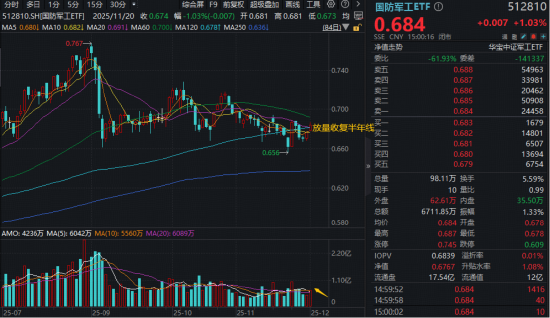
10万亿新蓝海!商业航天概念起飞,航天发展12天8板,512810放量突破多根均线
Xin Lang Ji Jin· 2025-12-01 11:34
Core Viewpoint - The commercial aerospace sector is experiencing a resurgence, positively impacting the defense and military industry, as evidenced by the performance of the representative defense and military ETF (512810) which rose by 1.03% on December 1st, marking two consecutive days of gains [1] Group 1: Market Performance - The defense and military ETF (512810) has recovered key moving averages, including the 5-day, 20-day, and 6-month lines, with a trading volume of 67.12 million yuan, an increase of over 40% compared to the previous period [1] - Notable stocks in the commercial aerospace sector include Guangqi Technology, which saw a 10.01% increase, and Aerospace Development, which rose by 9.99%, with total market capitalizations of 107 billion yuan and 23.8 billion yuan respectively [2] Group 2: Regulatory Developments - The establishment of the "Commercial Aerospace Department" by the National Space Administration aims to oversee the management of the commercial aerospace industry, including launch approvals and operational licenses [3] - The "High-Quality and Safe Development Action Plan for Commercial Aerospace (2025-2027)" outlines the integration of commercial aerospace into the national aerospace framework, targeting a market size of approximately 2.3 trillion yuan by 2024, with a compound annual growth rate of about 22% since 2015 [3] Group 3: Investment Opportunities - The defense and military ETF (512810) serves as an efficient investment tool for core assets in the defense and military sector, covering themes such as commercial aerospace, low-altitude economy, and military AI [4] - The commercial aerospace sector is expected to benefit from increased demand for satellite and rocket capabilities, particularly with the planned construction of a space data center system in the 700-800 km orbit [3]

航天智装:核工业及特殊环境自动化产品可应用于核电领域
Ge Long Hui· 2025-12-01 09:13
Group 1 - The company Aerospace Intelligent Equipment (300455.SZ) has indicated that its automation products for the nuclear industry and special environments can be applied in the nuclear power sector [1] - Currently, these products have not been applied in the field of controllable nuclear fusion [1]

航天智装(300455.SZ):核工业及特殊环境自动化产品可应用于核电领域
Ge Long Hui· 2025-12-01 09:13
Core Viewpoint - Aerospace Intelligence (300455.SZ) has indicated that its nuclear industry and special environment automation products can be applied in the nuclear power sector, but they have not yet been utilized in the controlled nuclear fusion field [1] Group 1 - The company specializes in automation products for the nuclear industry [1] - Current applications of the company's products are limited to the nuclear power sector [1] - There is potential for future applications in controlled nuclear fusion, although this has not yet been realized [1]
雪人集团(002639.SZ):生产的“兆瓦级”大型氦气压缩机组主要用于创造并维持低温实验环境
Ge Long Hui· 2025-12-01 08:28
Core Viewpoint - The company, Xue Ren Group, has developed a "megawatt-level" large helium compressor unit that is primarily used to create and maintain low-temperature experimental environments, with applications in various advanced scientific fields [1] Group 1 - The helium compressor technology can be widely applied in aerospace, controlled nuclear fusion, quantum computing, clean energy, nuclear waste treatment, and cancer treatment [1]
