双循环

Search documents
【有本好书送给你】中国制造业“内卷式”现象是如何形成的?
重阳投资· 2025-12-03 07:33
重阳说 查理·芒格先生有一句广为流传的话:"我这一生当中,未曾见过不读书就智慧满满的人。没有。一个都没 有。沃伦(巴菲特)的阅读量之大可能会让你感到吃惊。我和他一样。我的孩子们打趣我说,我就是一 本长着两条腿的书。" 熟悉重阳的朋友们一定知道,阅读,一直是我们非常推崇的成长路径。 现在,我们希望和你一起,把阅读这件事坚持下去。 每一期专栏,我们依旧聊书,可能是书评、书单或者书摘。 每一期会有一个交流主题,希望你通过留言与我们互动。 我们精选优质好书,根据留言质量不定量送出。 世界莽莽,时间荒荒,阅读生出思考的力量,愿你感受到自己的思想有厚度且有方向,四通八达,尽情 徜徉。 【好书】第311期:《 读懂"十五五":高质量发展新征程 》 张军扩 蔡昉 朱克力 著 中信出版集团 推荐人 编辑 张璇 互动话题: 结合本书, 请就"中国制造业内卷式现象是如何形成"的发表你的看法 。 留言时间:2024年12月3 日 - 2025年 12月10日 (鼓励原创,只要你的内容足够优秀,期期选中也有可能哦) 筛选及书籍(单本)寄送:2025年12月11日后 (选中会收到提交寄送地址的私聊,逾期未提交/信息不全视为放弃,参与期间 ...


江苏国际纺织服装供应链博览会在宁启幕
Xin Hua Ri Bao· 2025-12-02 21:05
Core Viewpoint - The Jiangsu International Textile and Apparel Supply Chain Expo aims to support the transformation and development of the textile and apparel industry by providing a platform for technology exchange, trade connections, and brand promotion, featuring over 600 quality exhibitors from across the country [1] Industry Overview - Jiangsu's textile and apparel industry is robust, with an annual output value exceeding 1 trillion yuan, fostering leading enterprises such as Hengli, Shenghong, and Bosideng, and forming a collaborative industrial pattern of "trillion-level industry and billion-level enterprises" [1] - The expo showcases the entire industrial chain of textiles and apparel, highlighting innovative products such as functional fabrics and smart wearable technologies [1] Event Highlights - The Jiangsu International Textile and Apparel Supply Chain Conference was held concurrently, where the Jiangsu Provincial Modern Sports Industry Research Service Center initiated the establishment of the Yangtze River Delta Advanced Manufacturing Alliance for Outdoor Sports Apparel Fabrics, aiming to create an industrial cluster [1] - The Jiangsu Sports Bureau launched the "Pioneer Assistance Enterprise. Industry Energy Gathering" party-building brand, with multiple local industry associations initiating joint efforts in the Jiangsu textile and apparel supply chain [1] Future Outlook - The expo is expected to further stimulate innovation in the industry, promoting the development of the textile and apparel sector towards high-end, intelligent, and green directions, thereby providing solid industrial support for the construction of a new development pattern of "dual circulation" [1]
以进一步深化改革融通江苏发展新动能
Xin Hua Ri Bao· 2025-12-02 05:48
Group 1 - The core viewpoint emphasizes that Jiangsu must leverage reform as a key driver for high-quality development, focusing on "integration" to break down institutional barriers and enhance the flow of critical elements such as talent, technology, capital, and data [1] - The "14th Five-Year Plan" period requires Jiangsu to address existing barriers between technology, education, and talent through reform practices, enhancing their interaction to support industrial upgrades and future development [2] - Establishing a dual-channel mechanism for industry professors and technology vice presidents aims to integrate academic and industry expertise, enhancing the practical application of research in enterprises [3] Group 2 - The emphasis on regional collaboration highlights the need for Jiangsu to create a complementary and high-quality regional economic layout, leveraging its strategic position in the Yangtze River Delta [5] - The "1+3" functional area reform is identified as a key strategy to address development imbalances and enhance overall competitiveness within Jiangsu [5] - The proposal to optimize the "flying economy" and establish a shared benefits mechanism aims to stimulate cooperation between regions and enhance innovation [6] Group 3 - The focus on market system construction aims to eliminate obstacles to the establishment of a unified national market, enhancing supply and demand dynamics through institutional reforms [8] - Jiangsu's strong supply capacity for intermediate products necessitates reforms to elevate its position in the value chain, promoting high-value-added segments [8] - The introduction of a public demand-driven technology iteration mechanism aims to address challenges in urban governance, healthcare, and environmental protection [9] Group 4 - Jiangsu's large population of 85 million presents an opportunity to convert its market potential into effective demand, driving high-quality supply [10] - The exploration of new consumption incentives linked to sustainable behaviors aims to create a circular consumption market [10] - The establishment of a skills-based compensation guideline is intended to ensure that skill enhancements directly reflect in income growth [10] Group 5 - The need for a platform-driven approach to enhance the market-oriented allocation of factors is emphasized, promoting the integration of technology, data, and governance [11] - The establishment of a data aggregation hub aims to clarify rights and responsibilities in data development and usage, ensuring equitable benefit sharing [11] - The introduction of a collaborative and efficient system for assessment will shift focus from GDP to indicators of factor integration, linking results to resource allocation [12]
从前海出发,中国—东盟经济合作跃升“3.0时代”
2 1 Shi Ji Jing Ji Bao Dao· 2025-12-02 03:37
21世纪经济报道记者 陈思琦 深圳报道 40多年前,"中国制造"的服装和玩具,以香港为通道走入东南亚寻常百姓家;近十余年,共建"一带一 路"倡议推动高铁、电站等基建项目走出去,成为中国与东盟产能合作的新名片。 而今,随着中国—东盟自贸区3.0版升级议定书正式签署,全面拓展数字经济、绿色经济等新兴领域互 利合作,中企出海东盟也迎来崭新的"3.0时代"。 11月27日至28日,2025大湾区—东盟经济合作(前海)论坛举行。 AI元素成最大亮点:现场不仅集中展示AI眼镜、AI玩具、具身智能机器人等前沿产品,全球首个AI伦 理治理跨境实验室、中国—东盟新兴产业协同创新示范基地、"深圳出海e站通"系列项目等签约落地, 标志着双方合作正从"1.0"制成品出口、"2.0"产能出口升级至"3.0"技术方案赋能与规则标准"软联通"。 海关数据显示,2024年广东对东盟进出口1.45万亿元,占广东进出口总值15.9%。其中,前海与东盟进 出口1434.6亿元,猛增50%,前海企业已在东盟投资项目70个,总投资额11.2亿美元。 "人工智能正成为双方新一轮合作的重大机遇。"中国—东盟中心秘书长史忠俊谈到,望以论坛、以前海 为平台, ...

读懂中国“十五五”规划,中国式现代化彰显共享发展机遇承诺
2 1 Shi Ji Jing Ji Bao Dao· 2025-12-01 12:00
Core Insights - The "Understanding China" International Conference is being held for the 12th year, focusing on the theme of "New Layout, New Development, New Choices - Chinese-style Modernization and the New Global Governance Pattern" [1] - The conference aims to discuss the significance of the 14th Five-Year Plan and its implications for global governance, emphasizing China's role in providing new opportunities for developing countries [2][3] Group 1: Conference Themes and Objectives - The conference introduces two new topics: understanding the 14th Five-Year Plan and the four global initiatives, including the Global Governance Initiative [2] - The 14th Five-Year Plan is seen as a departure from the notion that modernization equals Westernization, offering new choices for developing countries [2][6] - The conference serves as a platform for global South countries to learn from China's modernization experience and to promote the concept of a community with a shared future for mankind [3][7] Group 2: International Cooperation and China's Role - Former Italian Prime Minister Romano Prodi highlights China's increasing importance in international cooperation, contrasting it with the past U.S.-led initiatives [2] - The conference emphasizes the need for collaboration among nations, particularly in the context of global challenges [2][4] - The participation of representatives from 72 countries, with a significant portion from the global South, indicates the growing influence of the conference [3] Group 3: Economic Strategies and Development Plans - The 14th Five-Year Plan focuses on domestic demand and international cooperation as core components of China's modernization strategy [3][6] - The plan aims to integrate economic growth with global cooperation, emphasizing shared opportunities and mutual development [6][7] - The plan includes innovative strategies for technology and industry, aiming to establish new economic growth points [8][9] Group 4: Regional Development and Innovation - The conference discusses the development experiences of the Guangdong-Hong Kong-Macao Greater Bay Area and Hainan Free Trade Port, highlighting their roles in China's modernization [12][13] - The Greater Bay Area is viewed as a vibrant region with significant potential for economic development and innovation [12] - The Hainan Free Trade Port is set to enhance international trade and cooperation, marking a new phase of China's high-level opening up [13]
中金珠宝国际公司成立
Sou Hu Cai Jing· 2025-12-01 07:58
Core Viewpoint - China Gold Group Jewelry Co., Ltd. has established a wholly-owned subsidiary, International Company, as a key part of its internationalization strategy, aiming to integrate into the national "dual circulation" development pattern and promote the "Belt and Road" initiative [1][3] Group 1 - The International Company will leverage Hainan's "zero tariff, low tax rate, and simplified tax system" to create a comprehensive platform for cross-border supply chain management, duty-free business expansion, and cultural outreach [3] - The strategic layout of the International Company is characterized by deep cross-border cooperation and regional collaboration, with a focus on the Hainan Free Trade Port and the Guangdong-Hong Kong-Macao Greater Bay Area [3] - The establishment of the International Company is supported by efficient negotiations with local governments, banks, and regulatory bodies regarding cross-border capital flow and operational frameworks [3] Group 2 - Following its establishment, the International Company will initiate deep cooperation with strategic partners such as China Duty Free Group and Macau Nanguang Group in areas like channel development, cultural product innovation, and cross-border event marketing [5] - The International Company aims to create culturally innovative jewelry products with an international perspective and leverage large cultural and sports events in the Greater Bay Area to promote Chinese craftsmanship globally [5] - The International Company is positioned as an "innovation engine" for China Gold to integrate into the global jewelry industry chain and explore new cross-border cooperation models based on regional characteristics [5]


筑巢引凤 扬帆启程 宁夏机场以“拓”破局打造内陆开放新高地
Zhong Guo Min Hang Wang· 2025-12-01 03:55
Core Viewpoint - Ningxia Airport Company is leveraging its strategic position as a hub for western China's opening-up, enhancing its role in the "Belt and Road" initiative by developing a modern comprehensive transportation network and increasing its operational scale and efficiency [1][2]. Group 1: Strategic Development - The company is focusing on building a modern aviation network that connects the eastern and western regions of China, with 27 airlines operating in Ningxia and 81 cities connected, resulting in a total of 116 flight routes [2]. - The "Air Silk Road" function is being strengthened, with a comprehensive transportation system integrating air-to-air transfers, air-rail intermodal transport, and ground transportation, leading to an annual passenger throughput of approximately 800,000, which accounts for 8.1% of the total [2][3]. Group 2: Transportation Integration - Strategic breakthroughs in air-rail intermodal transport have been achieved, with daily train services at Yinchuan Hedong Airport increasing from 2 to 32 during peak periods, transporting over one million intermodal passengers [3]. - A dense ground transportation network has been established, covering the entire Ningxia region and extending to neighboring areas, significantly improving passenger transfer efficiency [3]. Group 3: Transformation to Comprehensive Hub - The company is transforming from a "single airport" to a "comprehensive hub," creating a value system that integrates resources, policies, and industries [5]. - Collaborations with airlines and local governments have been established to enhance strategic partnerships and implement policies that attract passengers to Ningxia [5][6]. Group 4: Market Expansion and Performance - The domestic market has seen the establishment of 20 key routes connecting major cities and tourist destinations, significantly improving business travel efficiency [6]. - International routes are gradually recovering, with six routes to destinations like Dubai and Hong Kong, facilitating trade connections with countries along the "Belt and Road" [6]. - The company has achieved a cumulative transport takeoff of 330,000 flights and a passenger throughput of 38.94 million over five years, with annual growth rates of 3.4% and 6.9% respectively [8]. Group 5: Marketing and Tourism Integration - The company is innovating its marketing strategies to promote dual circulation in air transport, developing 12 unique aviation tourism products and engaging in promotional activities that have attracted over 100,000 participants [10]. - Collaborative tourism products have been launched, integrating flights with local cultural resources to enhance the visibility of Ningxia's aviation tourism [10]. Group 6: Future Outlook - The company aims to strengthen its core aviation business, optimize hub functions, and expand its open structure, contributing to Ningxia's high-quality economic and social development [11].
快递业加速迈向智能化 市场规模稳居全球第一
Jing Ji Ri Bao· 2025-12-01 00:30
Core Insights - The express delivery industry in China has shown significant growth, with a total business volume of 1,626.8 billion packages completed in the first ten months of the year, representing a year-on-year increase of 16.1% [1] - The peak daily business volume reached 777 million packages in October, setting a new record, indicating the industry's seasonal characteristics and its role in supporting economic growth [1][2] - The express delivery sector is transitioning from rapid growth to high-quality development, emphasizing the importance of technological innovation and efficiency improvements [1][4] Industry Performance - The express delivery market in China has maintained its position as the largest globally, with a projected business volume of 1,750.8 billion packages in 2024, reflecting a year-on-year growth of 21.5% [3] - The global express package business volume is expected to reach approximately 2,679 billion packages in 2024, with a growth rate of 17.49% [3] - China's express delivery market accounts for 65% of the global package business volume, highlighting its critical role in the global market expansion [2] Technological Advancements - The industry is increasingly adopting smart devices and technologies to enhance service efficiency and quality during peak seasons [4] - Companies like Zhongtong Express are implementing smart sorting equipment and unmanned delivery vehicles, significantly improving operational efficiency and reducing costs [4][5] - The use of drones for last-mile delivery has been introduced, drastically reducing delivery times in remote areas [5][7] Integration and Collaboration - The express delivery sector is integrating deeply with manufacturing industries, creating new growth opportunities by offering tailored logistics solutions [8] - Initiatives to improve rural logistics and enhance the delivery of agricultural products are being implemented, supporting rural revitalization and market integration [7][8] - The industry is focusing on enhancing cross-border logistics capabilities to support international trade and supply chain stability [8]
商务部将推进汽车流通消费改革试点 激活全链条消费
Zheng Quan Ri Bao Wang· 2025-11-29 04:11
Group 1 - The core viewpoint of the news is the introduction of a policy aimed at enhancing the adaptability of supply and demand in consumer goods, particularly focusing on the automotive sector to stimulate consumption and economic growth [1][2] - The retail volume of passenger cars increased by 7.9% from January to October this year, indicating a robust growth trend in major consumer goods such as automobiles, home appliances, and furniture [1] - The policy marks a shift from merely stimulating product sales to fostering an entire consumption ecosystem, emphasizing the transition from "selling products" to "selling products + services" [2][3] Group 2 - The automotive industry is identified as a key driver for stabilizing economic growth due to its extensive supply chain and strong multiplier effect, linking over a hundred upstream and downstream industries [3] - The policy is expected to activate demand and broaden market scenarios, particularly benefiting the automotive parts industry by increasing the need for aftermarket services and components as the second-hand car market expands [4][5] - The expansion of the automotive modification market is anticipated to drive innovation and upgrade the automotive parts sector from functional replacements to personalized customizations, enhancing overall market capacity and efficiency [5]
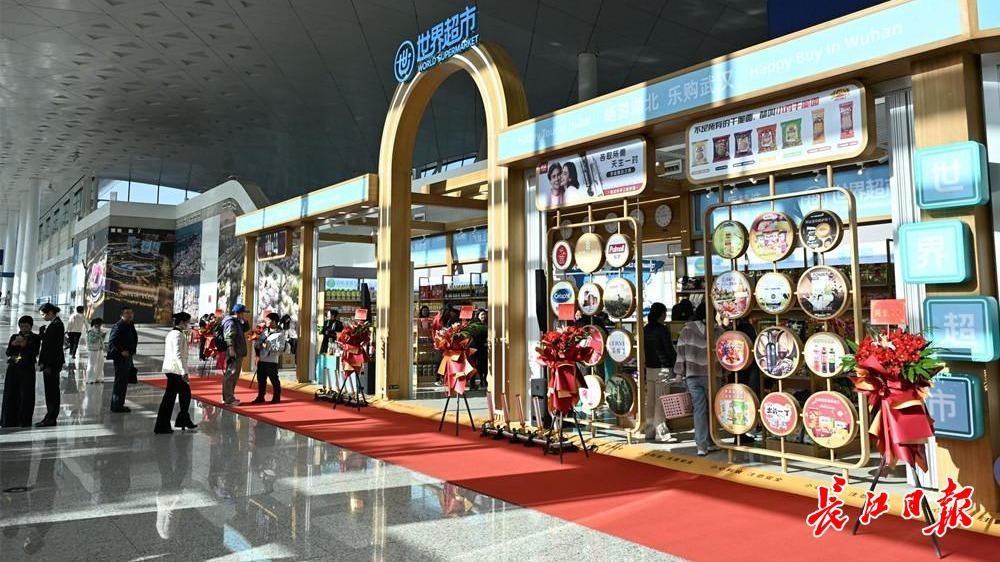
“世界超市”亮相武汉天河机场,源头直采供应30多个国家400多款商品
Chang Jiang Ri Bao· 2025-11-28 11:25
Core Points - Wuhan Tianhe International Airport has officially opened a global shopping destination called "World Supermarket," featuring over 400 products from more than 30 countries [1][4]. Group 1: Overview of the "World Supermarket" - The "World Supermarket" is located in the corridor between Terminal 2 and Terminal 3 of Tianhe Airport, covering an area of over 100 square meters [2]. - The supermarket offers a diverse range of products, including Polish oats, Sri Lankan tea, Singaporean noodles, Indonesian snacks, German beer, and British whiskey, providing a multicultural shopping experience for travelers [2][3]. - The theme of the supermarket is "Global Delicacies, Ready to Go," focusing on core consumer categories and selecting over 400 high-quality products from a pool of tens of thousands available globally [3]. Group 2: Business Model and Operations - The products are sourced directly through a global supply chain, with over 50 items being represented for the first time in Hubei, often at prices lower than online platforms [5]. - On the opening day, the supermarket achieved sales of 70,000 RMB within three hours, with alcoholic beverages being the most popular items, leading to immediate restocking [5][6]. - The initiative is part of Hubei Airport Group's strategy to enhance global supply chain capabilities and support the development of Wuhan as an international consumption center [7].