
汽车后市场

Search documents
途虎-W(09690):2025年报点评:规模不断提升,汽车后市场龙头稳健前行
Western Securities· 2026-03-26 07:56
Investment Rating - The report maintains a "Buy" rating for the company [4] Core Insights - The company achieved total revenue of 16.462 billion yuan in 2025, representing a year-on-year growth of 11.54%, while the net profit attributable to the parent company was 420 million yuan, a decrease of 13.10% year-on-year [4][2] - In the second half of 2025, revenue reached 8.585 billion yuan, with a year-on-year increase of 12.47%, and the net profit attributable to the parent company was 113 million yuan [4] - The company has established itself as the largest automotive service platform globally, with a total of 8,008 stores by the end of 2025, marking a 16.5% increase year-on-year [1][2] User Growth and Engagement - By the end of 2025, the registered user base reached 162 million, a year-on-year increase of 16.9%, with 28.4 million active transaction users, up 17.7% year-on-year [2] - User retention has improved significantly, with the annual repurchase rate increasing by 2.7 percentage points to 65.0% [2] Supply Chain and Technology - The company has enhanced its supply chain efficiency with 31 regional warehouses and 738 front warehouses, utilizing smart inventory algorithms [2] - The implementation of AI technology has improved the conversion rate of intelligent product recommendations by 10% year-on-year [2] Financial Forecast - Projected revenues for 2026-2028 are 18.151 billion yuan, 20.013 billion yuan, and 22.022 billion yuan, respectively, with net profits expected to be 470 million yuan, 610 million yuan, and 770 million yuan [2][3]
买车用车能否更轻松?
Xin Lang Cai Jing· 2026-02-24 18:20
Core Viewpoint - The article discusses the ongoing policy changes in China's automotive sector aimed at stimulating consumer demand and facilitating the growth of the industry through the removal of unreasonable restrictions on vehicle purchases and transactions [4][10]. Group 1: Policy Changes - The Chinese government is implementing a series of measures to eliminate "invisible barriers" that hinder consumer spending in the automotive sector, focusing on the entire lifecycle of vehicles, including purchase, use, and exchange [6]. - The "Special Action Plan to Boost Consumption" aims to shift from purchase management to usage management, with specific measures such as issuing additional new energy vehicle purchase quotas for carless families in major cities like Beijing and Guangdong [6][10]. - The second-hand car market is undergoing significant reforms, with the removal of migration restrictions for small non-operational vehicles meeting the National V standard, promoting easier transactions and cross-regional operations [6][7]. Group 2: Market Dynamics - The second-hand car market is projected to exceed 20 million transactions in 2025, marking a historical high, driven by the easing of restrictions and improved transaction processes [11]. - The automotive industry in China achieved production and sales of 34.53 million and 34.40 million vehicles in 2025, respectively, reflecting year-on-year growth of 10.4% and 9.4%, maintaining its position as the world's largest automotive market for 17 consecutive years [11]. - The simplification of second-hand car transaction processes has significantly reduced transaction costs and improved efficiency, benefiting both consumers and businesses, particularly small and medium-sized enterprises [11]. Group 3: Consumer Experience and Market Expansion - The automotive sector is evolving from merely a transportation tool to a lifestyle choice, with opportunities in the automotive modification market and new consumption scenarios such as car events and self-driving tourism [8][10]. - The government is promoting the development of smart connected vehicles, with policies facilitating testing and demonstration on various road types, indicating a shift towards mass production and application of autonomous driving technologies [9][12]. - The article highlights the need for improved data sharing and transparency in the second-hand car market to address information asymmetry, which is crucial for enhancing consumer trust and transaction efficiency [13]. Group 4: Future Challenges and Opportunities - Despite the positive developments, the automotive consumption chain still faces deep-rooted challenges, including fragmented information on vehicle history and a lack of standardized inspection systems [13]. - The article suggests that expanding automotive services, such as rentals and modifications, can create a comprehensive consumption ecosystem that enhances consumer experiences and drives industry growth [14].

国贵科技北交所IPO获受理,参股企业为特斯拉车主提供服务
Xin Jing Bao· 2025-12-28 06:03
Core Viewpoint - On December 26, the Beijing Stock Exchange (BSE) received the highest number of IPO applications in December, with five companies, including GuoGui Technology, being accepted for listing [1] Company Overview - GuoGui Technology, established in April 2006, is recognized as a national-level "specialized and innovative" small giant and a "hidden champion" enterprise in Chongqing, focusing on the research of overseas modified vehicle products and culture [1] - The company specializes in the automotive aftermarket, dedicating nearly two decades to the R&D, production, and sales of high-performance automotive parts, including suspension systems and powertrain components [1] - GuoGui Technology has developed a market-influential brand, MAXPEEDINGRODS, serving over 4 million users through platforms like eBay and Amazon, targeting markets in the US and Europe [1] Financial Performance - For the fiscal years 2022 to 2025 (first half), GuoGui Technology reported revenues of approximately CNY 749 million, CNY 640 million, CNY 690 million, and CNY 445 million, respectively [2] - The net profit attributable to the parent company for the same periods was approximately CNY 85.88 million, CNY 61.61 million, CNY 51.12 million, and CNY 46.73 million [2] - The gross profit margins for the main business during these periods were 43.32%, 43.38%, 42.11%, and 42.81%, aligning closely with industry averages [2] - The R&D expense ratios were 2.18%, 2.61%, 4.25%, and 2.98%, also comparable to industry peers [2] IPO Details - GuoGui Technology aims to raise approximately CNY 456 million through its IPO, with funds allocated for projects including intelligent manufacturing of suspension upgrade parts, R&D testing center and information technology construction, brand building and marketing, and working capital [3] - The company has chosen the first set of listing standards on the BSE, requiring a market value of no less than CNY 200 million and specific net profit and return on equity criteria [2][3]
IPO雷达|国贵科技闯关北交所:存货占比超54%、近三年增收不增利、毛利率呈下降趋势
Sou Hu Cai Jing· 2025-12-27 15:21
Core Viewpoint - Chongqing Guogui Racing Technology Co., Ltd. (referred to as "Guogui Technology") has had its IPO application accepted by the Beijing Stock Exchange, aiming to raise 456 million yuan through the issuance of up to 21.483 million shares, primarily focusing on high-performance automotive modification parts under the "MAXPEEDINGRODS" brand, with 99% of its revenue coming from overseas markets. However, the company faces significant challenges including high inventory levels, currency fluctuations, and reliance on specific platforms for sales [1][2]. Financial Performance - The company's revenue for the reporting period (2022 to 2024) was 749 million yuan, 640 million yuan, and 690 million yuan, showing year-on-year changes of -14.47% and 7.63% respectively. Net profit figures were 85.88 million yuan, 66.16 million yuan, and 51.12 million yuan, with year-on-year declines of -22.96% and -22.73%. The operating cash flow was 53.66 million yuan, 120 million yuan, and 47.44 million yuan, with a significant increase of 122.69% in the first year but a decline of -60.31% in the last year. The gross profit margin decreased from 43.25% to 41.91%, while the net profit margin fell from 11.46% to 7.41% [2]. Inventory Concerns - The company's inventory accounted for over 54% of total assets, with values of 325 million yuan, 317 million yuan, 355 million yuan, and 403 million yuan from 2022 to the first half of 2025. This is significantly higher than the industry average of 35%. The company acknowledged that if products do not sell or prices drop, it may need to recognize substantial impairment losses, which could severely impact profits [3]. Currency Fluctuation Impact - With over 98% of revenue coming from exports, the company primarily deals in USD and EUR. In 2023, a strong dollar led to a foreign exchange loss of 2.259 million yuan. In the first half of 2025, a depreciation of the RMB resulted in a foreign exchange gain of 11.966 million yuan, accounting for 25.6% of net profit. The company warned that future fluctuations in exchange rates could compress profit margins [4]. Platform Dependency Risks - Sales from eBay and Amazon accounted for 78.6%, 77.3%, 75.1%, and 77.4% of total revenue from 2022 to the first half of 2025. Increased commission rates on eBay, account suspensions on Amazon, and changes in e-commerce tax policies in Europe and the US could raise operational costs. Additionally, a recent increase in import tariffs on certain Chinese goods could adversely affect profitability, especially since nearly 58% of revenue comes from the US market [5]. Shareholder Buyback Pressure - Certain shareholders have conditional buyback rights, which could pressure the company's cash flow and equity structure if the IPO is not completed by December 31, 2026, or if it is rejected. This clause has been suspended but can be reinstated, indicating potential financial strain if the IPO fails [6].
金固股份涨2.01%,成交额2.66亿元,主力资金净流入320.60万元
Xin Lang Zheng Quan· 2025-12-25 05:31
Group 1 - The core viewpoint of the news is that Jingu Co., Ltd. has experienced fluctuations in its stock price, with a recent increase of 2.01% to 8.63 CNY per share, while the company has seen a year-to-date decline of 17.26% [1] - As of December 10, the number of shareholders for Jingu Co., Ltd. increased by 19.44% to 50,400, while the average circulating shares per person decreased by 16.27% to 18,238 shares [2] - The company operates primarily in the automotive sector, focusing on the research, production, and sales of automotive wheels, with revenue composition being 65.51% from automotive parts manufacturing, 27.18% from steel trading, and 7.31% from other sources [1] Group 2 - For the period from January to September 2025, Jingu Co., Ltd. achieved a revenue of 3.086 billion CNY, representing a year-on-year growth of 6.91%, and a net profit attributable to shareholders of 42.007 million CNY, reflecting a growth of 29.77% [2] - The company has distributed a total of 339 million CNY in dividends since its A-share listing, with 21.7912 million CNY distributed over the past three years [3]

【忠阳车评】有效释放新能源汽车消费潜力
Zhong Guo Jing Ji Wang· 2025-12-19 22:53
Group 1 - The core viewpoint is that despite entering a 'high sales, low growth' phase, China's new energy vehicle (NEV) ownership ratio is expected to rise rapidly, with sales projected to exceed 20 million units next year [2] - The automotive industry is a strategic pillar of the national economy, contributing 10.65 trillion yuan in revenue last year, which accounted for 10% of the manufacturing sector [2] - NEVs have become a significant driver for economic growth, with over 200 billion yuan in vehicle consumption last year, positively impacting the entire industry chain and contributing to high-quality economic development [2] Group 2 - There is significant growth potential in rural areas for NEVs, as the penetration rate is currently only half that of urban areas, indicating a substantial market opportunity [3] - The "old-for-new" policy has generated new market space, with over 11.2 million vehicles replaced this year, leading to over 100 billion yuan in related sales [3] - Optimizing existing subsidy policies can enhance consumer enthusiasm for replacing old vehicles, thereby promoting the consumption of more advanced and intelligent NEVs [3] Group 3 - The automotive consumption landscape is shifting towards a balance between product and service consumption, with the automotive aftermarket becoming increasingly important [4] - New service forms such as digital services, software upgrades, and energy management are rapidly developing, with the smart connected NEV aftermarket projected to reach 5 trillion yuan by 2030 [4] - The automotive aftermarket is seen as a significant growth avenue, referred to as the "second growth curve" of the industry [4] Group 4 - Some major cities have implemented restrictions on vehicle purchases through lotteries or bidding, which may limit consumer access to vehicles [5] - The transition from purchase management to usage management in urban areas, facilitated by advancements in smart transportation systems, could help release the consumption potential of NEVs [5]

有效释放新能源汽车消费潜力
Jing Ji Ri Bao· 2025-12-19 22:02
Group 1 - The domestic automotive market has entered a "high sales, low growth" phase, but the proportion of new energy vehicles (NEVs) is expected to rise rapidly, with sales projected to exceed 20 million units next year [2] - The automotive industry is a strategic pillar of the national economy, contributing 10.65 trillion yuan in revenue last year, accounting for 10% of the manufacturing sector [2] - NEVs have become a significant driver for economic growth, with over 2 trillion yuan in consumption last year, positively impacting the entire industry chain and contributing to high-quality economic development [2] Group 2 - There is significant growth potential for NEVs in rural areas, where the penetration rate is currently only half that of urban areas, indicating a need for increased product supply and tailored models for rural consumers [3] - The "old-for-new" policy has generated new market opportunities, with over 11.2 million vehicles replaced this year, leading to over 100 billion yuan in related sales, although there are challenges that need to be addressed to enhance consumer participation [3] - The automotive aftermarket is evolving, with a shift towards service consumption alongside product consumption, and the market for smart connected NEVs is projected to reach 5 trillion yuan by 2030, representing a significant growth opportunity [4] Group 3 - Some major cities have implemented restrictions on vehicle purchases through lotteries or bidding, which may need to be reassessed as smart transportation systems develop, allowing for a shift from purchase management to usage management [5]

车市消费更趋理性
Jing Ji Ri Bao· 2025-12-18 09:37
Core Viewpoint - The adjustment of the purchase tax policy for new energy vehicles (NEVs) is expected to stimulate short-term demand while shifting the market focus from policy-driven to value-driven in the long term [2][3][4]. Group 1: Policy Changes and Market Impact - Starting January 1, the purchase tax exemption for NEVs will be halved, reducing the maximum tax exemption from 30,000 yuan to 15,000 yuan per vehicle [2]. - In November, NEV production and sales reached 1.88 million and 1.823 million units, respectively, with NEVs accounting for 53.2% of total new car sales, indicating a growing market share [2]. - Experts predict a "last train effect" before the tax policy change, leading to a surge in NEV purchases [2]. Group 2: Recommendations for Automotive Companies - Companies should leverage policies effectively to promote higher technology, energy efficiency, and intelligent consumption [3]. - There is a need for improved cost control and product quality, as the new tax policy ties tax benefits to technical standards, prompting industry consolidation and quality upgrades [3]. - Companies are encouraged to align product offerings with consumer demand, particularly in the smart and connected vehicle segment, which is identified as a key growth area [3]. Group 3: Consumer Behavior and Charging Infrastructure - Consumers are expected to become more rational, focusing on product quality, technical performance, and service experience rather than solely on policy incentives [4]. - Charging infrastructure is critical for consumer confidence, with the government aiming to double the service capacity of charging facilities by 2027, targeting 28 million charging points and over 300 million kilowatts of public charging capacity [5]. - The automotive aftermarket is also highlighted as a vital area for expanding consumption, with initiatives to enhance the second-hand car market and other automotive services [5].
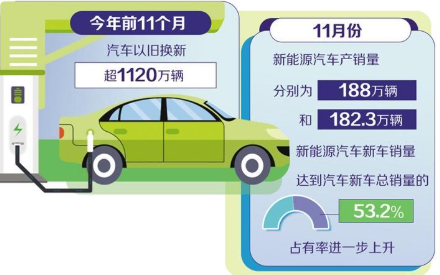
从11月份汽车产量“创新高”看国产车“汽”势如虹动能释放
Yang Shi Wang· 2025-12-11 09:22
Group 1 - In November, China's automotive production and sales continued to show strong performance, with monthly production exceeding 3.5 million units for the first time, setting a historical record [1] - For the first 11 months of the year, both production and sales of automobiles in China surpassed 31 million units, with a year-on-year growth of over 10% [1] - The strong performance of the automotive industry is attributed to proactive macro policies implemented this year, which have positively impacted the sector's development [1] Group 2 - New energy vehicles (NEVs) have shown robust growth, with production and sales nearing 15 million units from January to November, reflecting a year-on-year increase of over 30% [1] - NEV exports reached 2.315 million units, marking a year-on-year growth of 100% [1] - The automotive market is expected to achieve record production and sales for the year, driven by effective policy measures and resilient foreign trade [1] Group 3 - A recent implementation plan by six departments, including the Ministry of Industry and Information Technology, aims to enhance the adaptability of supply and demand in consumer goods, fostering a trillion-level market for smart connected vehicles [2] - The plan also seeks to expand automotive aftermarket consumption, including vehicle modifications, RV camping, and automotive events, laying a solid foundation for a strong start to the 14th Five-Year Plan [2]
商务部将推进汽车流通消费改革试点 激活全链条消费
Zheng Quan Ri Bao Wang· 2025-11-29 04:11
Group 1 - The core viewpoint of the news is the introduction of a policy aimed at enhancing the adaptability of supply and demand in consumer goods, particularly focusing on the automotive sector to stimulate consumption and economic growth [1][2] - The retail volume of passenger cars increased by 7.9% from January to October this year, indicating a robust growth trend in major consumer goods such as automobiles, home appliances, and furniture [1] - The policy marks a shift from merely stimulating product sales to fostering an entire consumption ecosystem, emphasizing the transition from "selling products" to "selling products + services" [2][3] Group 2 - The automotive industry is identified as a key driver for stabilizing economic growth due to its extensive supply chain and strong multiplier effect, linking over a hundred upstream and downstream industries [3] - The policy is expected to activate demand and broaden market scenarios, particularly benefiting the automotive parts industry by increasing the need for aftermarket services and components as the second-hand car market expands [4][5] - The expansion of the automotive modification market is anticipated to drive innovation and upgrade the automotive parts sector from functional replacements to personalized customizations, enhancing overall market capacity and efficiency [5]