
电动汽车

Search documents
金银抢占头条后,铜或成2026年大黑马?
Jin Shi Shu Ju· 2025-12-29 03:55
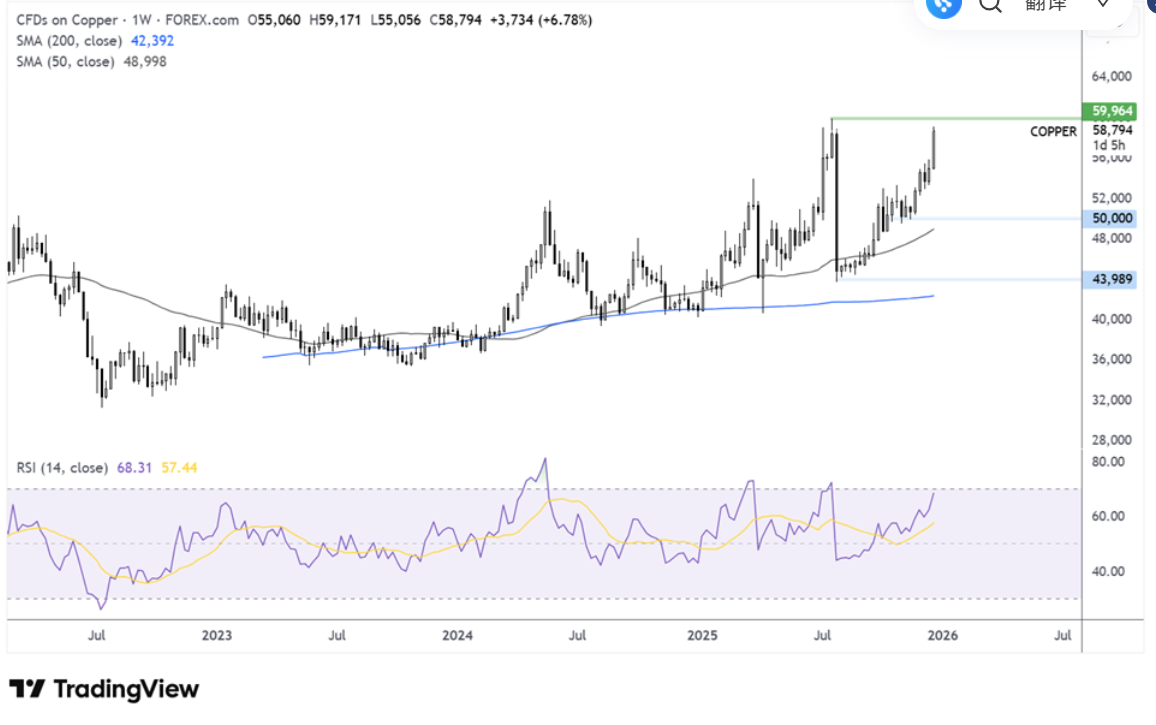
Core Viewpoint - Copper prices are experiencing significant growth, driven by supply constraints, structural demand changes, and increased investment, with expectations for continued upward momentum into 2026 [1][2]. Group 1: Price Trends - Copper prices on the New York Mercantile Exchange (Comex) have risen over 30% this year, reaching a five-month high of $5.90 per pound, while prices on the London Metal Exchange (LME) have surpassed $12,000 per ton, marking a 42% increase year-to-date [1]. - The copper-to-gold ratio has fallen to its lowest level in 50 years, indicating potential for valuation recovery in the future [4]. Group 2: Demand Drivers - The demand for copper is surging due to its critical role in artificial intelligence (AI) and electric vehicle (EV) industries, with AI infrastructure alone driving unprecedented demand levels [2]. - The energy transition is expected to double copper demand in the next 20 years, further solidifying its importance in the global economy [2]. Group 3: Supply Constraints - Supply disruptions in major producing countries like Chile, Indonesia, and Peru are exacerbating market tensions, with forecasts indicating a potential global copper shortfall of 19 million pounds over the next 25 years if new mines are not developed [2]. Group 4: Technical Analysis - A long-term bullish trend for copper prices has been established, with prices rebounding from a summer low of $4.38 per pound to $5.91 per pound, supported by upward-sloping moving averages [5]. - Key resistance is identified at $5.99 per pound, with a target of $6.50 per pound, while psychological support is noted at $5.00 per pound [5].

“银色狂想曲”进入高波动章节? 白银火速跳水 创84美元历史最高位后急跌超3%
Zhi Tong Cai Jing· 2025-12-29 01:13
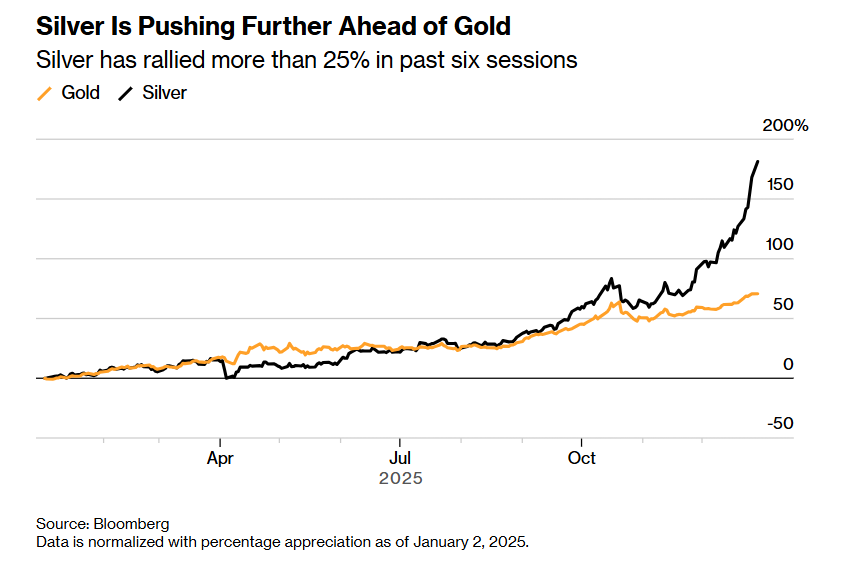
Core Viewpoint - Silver prices have surged to record highs, surpassing $80 per ounce for the first time, driven by speculative trading and supply shortages, with a notable increase of 165% year-to-date [1][4]. Group 1: Price Movements and Market Dynamics - Silver reached an all-time high of $84 per ounce before experiencing a sharp decline, highlighting the volatility driven by profit-taking among speculative investors [1]. - The recent six-day rally in silver prices has resulted in a cumulative increase of approximately 25%, marking the largest six-day gain since 1950 [1]. - The price of silver has been influenced by significant inflows of speculative funds and a supply mismatch in global commodity markets [1]. Group 2: Supply and Demand Factors - The silver market has been in a structural deficit for five consecutive years, with physical inventories rapidly depleting, leading to a supply squeeze [7]. - In 2025, global silver demand is projected to reach 1.24 billion ounces, while supply is expected to be only 1.01 billion ounces, resulting in a supply gap of 100 to 250 million ounces [7]. - The primary reason for the supply constraints is the rigid nature of global mining supply, as silver is often a byproduct of copper and zinc mining, and new mines take over a decade to develop [7]. Group 3: Investment Sentiment and Future Projections - Analysts suggest that the current surge in silver prices is driven by macroeconomic factors, including expectations of further interest rate cuts by the Federal Reserve, tight supply conditions, and strong industrial demand narratives [8]. - The World Silver Association highlights that the growth in demand for silver is supported by trends in AI data centers, electrification, and the transition to electric vehicles, with significant growth rates projected for these sectors [8][9]. - Some analysts predict that silver could reach $100 per ounce, driven by ongoing industrial demand and investment flows, with expectations of continued price increases until at least 2026 [10].
柯尼赛格跑车创始人:柴油混动是电动汽车“完美的替代方案”
Xin Lang Cai Jing· 2025-12-26 01:22
Core Viewpoint - The founder and CEO of Koenigsegg, Christian von Koenigsegg, believes that diesel hybrid technology is the "perfect alternative" to electric vehicles, particularly addressing the challenges of reducing fossil fuel dependency in the automotive industry [1][5]. Group 1: Diesel Hybrid Technology - Diesel hybrid vehicles can operate on battery power for most short trips and only activate the diesel engine for long-distance travel, significantly reducing overall emissions if renewable fuels are used [4][7]. - In urban areas where diesel is banned, these vehicles can run entirely on electric power, while renewable diesel can be utilized for occasional long trips. If diesel usage is limited to about 5%, the battery size can be significantly reduced, leading to a weight reduction of approximately 300 kg compared to larger battery electric vehicles, making it more environmentally friendly [4][7]. Group 2: Industry Challenges - The automotive industry has been hesitant to adopt diesel hybrid technology due to high costs, complex structures, and the sensitivity of diesel engines to temperature conditions, which complicates frequent start-stop operations. In contrast, pure electric platforms are simpler in engineering and product design [4][7]. - Koenigsegg disagrees with the industry's reluctance, arguing that reducing battery size and combining internal combustion engines with renewable diesel could be a more optimal solution, provided that the diesel usage ratio is strictly controlled [4][7].

鸿华先进7.876亿新台币全资收购纳智捷,16年品牌将退出市场
Ju Chao Zi Xun· 2025-12-25 04:09
Group 1 - Foxtron Vehicle Technologies Co., Ltd., a joint venture between Hon Hai Group and Yulon Group, has announced the full acquisition of Luxgen Motor Co., Ltd. for NT$787.6 million (approximately RMB 176 million) [2] - Following the acquisition, the Luxgen brand will gradually exit the market, and future vehicles will be sold under the Foxtron brand [2] - Established in November 2020, Foxtron is positioned as a benchmark in Taiwan's electric vehicle sector, with a projected revenue of NT$8.521 billion in 2024 and plans to list on the Taiwan Stock Exchange on November 20, 2023 [2] Group 2 - Foxtron's core business includes electric vehicle technology R&D, vehicle and component manufacturing management, sales and technical services, and overseas market expansion, leveraging Yulon's vehicle development experience and Hon Hai's ICT industry advantages [3] - Luxgen was established by Yulon Group in May 2008, originally focusing on luxury and smart vehicles, and had a significant presence in both Taiwan and mainland China at its peak [3] - Luxgen's early commitment to electric vehicle development included the launch of the LuxgenEV+ series, with the first electric vehicle, Luxgen 7 MPV EV+, released in 2009 [4] Group 3 - The acquisition of Luxgen is a strategic move for Foxtron to enhance its sales network and channel layout, officially introducing the Foxtron brand in the Taiwan market with the first model based on the Model B, named Bria [4] - Foxtron aims to position itself as an "enabler" in the market, providing comprehensive lifecycle solutions and strengthening its global ecological impact [5] - Since its establishment, Foxtron has achieved key milestones, including the foundation of an open EV platform and the delivery of commercial and passenger electric vehicles [5]
非洲媒体:中国为非洲发展提供重要机遇
人民网-国际频道 原创稿· 2025-12-25 01:20
Group 1 - The core viewpoint of the articles highlights China's significant achievements during the "14th Five-Year Plan" and the strategic blueprint provided by the "15th Five-Year Plan" for future development, which offers valuable opportunities and experiences for Africa [1][2][3] Group 2 - During the first four years of the "14th Five-Year Plan," China's average economic growth rate reached 5.5%, contributing approximately 30% to global economic growth [2] - By 2025, China's GDP is projected to reach 140 trillion RMB, indicating robust economic performance [2] - The share of renewable energy generation capacity in China increased from 40% to around 60%, establishing China as the world's largest and most dynamic renewable energy producer [2] Group 3 - The "15th Five-Year Plan" emphasizes advanced technology development in areas such as artificial intelligence, renewable energy, biotechnology, and electric vehicles, creating opportunities for industrial transformation and local capacity building in countries like the Republic of Congo [3] - The plan promotes open cooperation and mutual benefit, enhancing financing channels for countries like the Republic of Congo to integrate more deeply into the global economic network [3] Group 4 - The long-term and systematic nature of China's five-year plans can enhance resilience against external shocks, particularly during global economic turbulence, inflation, or supply chain crises [2] - African leaders are encouraged to draw lessons from China's strategic determination and patience to explore their own modernization paths and achieve continental integration and industrialization [2]
西陇科学(002584.SZ):公司目前磷酸铁锂正极材料主要用于电动汽车和储能电池领域
Ge Long Hui· 2025-12-24 07:02
格隆汇12月24日丨西陇科学(002584.SZ)在投资者互动平台表示,公司目前磷酸铁锂正极材料主要用于 电动汽车和储能电池领域。 (原标题:西陇科学(002584.SZ):公司目前磷酸铁锂正极材料主要用于电动汽车和储能电池领域) ...

汽车早餐 | 极氪完成私有化;沃尔沃中国回应“换帅”;启境首款车型开启全国路测
Zhong Guo Qi Che Bao Wang· 2025-12-24 01:47
Group 1: Electric Vehicle Infrastructure - As of the end of November, China's electric vehicle charging infrastructure reached 19.322 million units, a year-on-year increase of 52.0% [2] - Public charging facilities accounted for 4.625 million units, growing by 36.0%, while private charging facilities reached 14.697 million units, with a growth of 57.8% [2] - By 2026, China plans to build over 10,000 charging units in national highway service areas, with at least 25% being high-power chargers [5] Group 2: Autonomous Driving and Vehicle Technology - Beijing issued the first L3-level highway autonomous vehicle special license plates, marking a significant milestone in the mass production of autonomous vehicles in China [4] - Samsung SDI announced a partnership with KG Mobility to develop advanced battery pack technology for electric vehicles, focusing on safety and durability [6] Group 3: Automotive Industry Developments - The "Yue Che Nan Xia" policy allows private cars from four cities in Guangdong to enter Hong Kong, with a maximum stay of three days [3] - Geely Auto completed the privatization of Zeekr, which is now a wholly-owned subsidiary, and management adjustments have been finalized [10] - Volvo China clarified that recent changes in legal representation are administrative and do not affect the management team or daily operations [11] Group 4: Market Trends and Regulatory Issues - European new car sales increased for the fifth consecutive month in November, driven by rising electric vehicle registrations in Germany, Italy, and Spain [9] - Concerns over electric vehicle door handle designs have led to safety reviews by regulators across three continents, impacting companies like Tesla [7] - Mercedes-Benz reached a $120 million settlement with multiple U.S. states regarding emissions cheating allegations [8] Group 5: Company Innovations and Projects - EVE Energy launched a project for sodium-ion batteries and AI robotics, aiming to fill market gaps and promote large-scale applications in energy storage and automation [13] - Qijun Automotive announced the nationwide road testing of its first model, a hunting-style coupe, set to launch in June 2026 [14]


关税预期与矿山停产“共振”,伦铜首次突破1.2万美元再创历史新高
Hua Er Jie Jian Wen· 2025-12-23 11:16
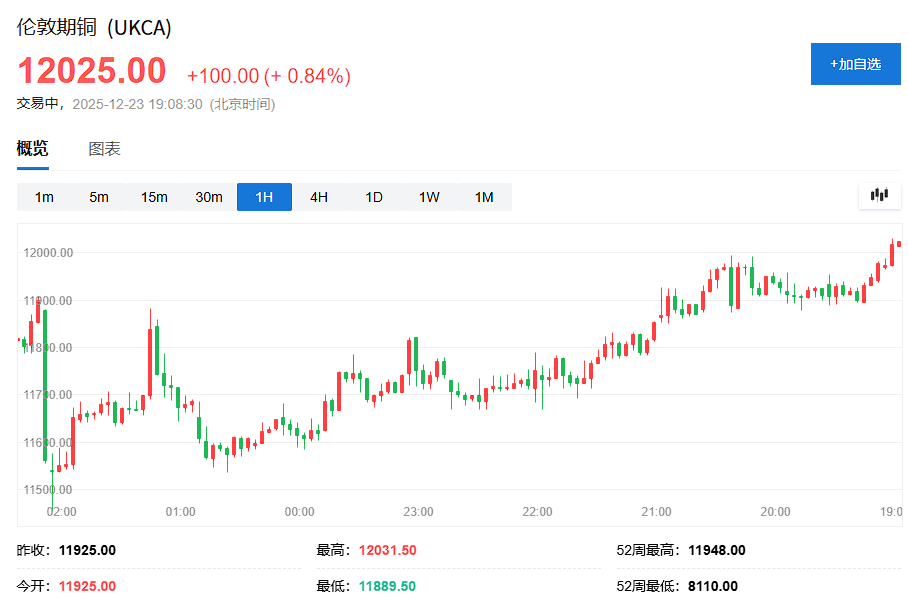
Core Viewpoint - Copper prices have reached a historic high of over $12,000 per ton due to supply disruptions and tariff threats, marking a 37% increase this year and potentially the largest annual gain since 2009 [1][4]. Group 1: Market Dynamics - The expectation of potential tariffs under the Trump administration has become a core factor driving copper prices higher, leading traders to rush shipments to the U.S. and significantly increasing U.S. imports [4][5]. - This "front-running" behavior has disrupted the market balance, forcing manufacturers outside the U.S. to engage in competitive bidding, which has further elevated global benchmark prices [5][6]. Group 2: Supply Challenges - The supply side is facing severe challenges, with major mining operations in the Americas, Africa, and Asia experiencing shutdowns, leading to a significant supply deficit [4][6]. - Deutsche Bank analysts predict a 3% decline in production from the world's largest mining companies this year, with further declines expected by 2026 due to operational disruptions [6]. Group 3: Future Price Predictions - Wall Street analysts have differing views on copper price forecasts; Goldman Sachs warns that the current price surge is driven by speculative bets rather than actual supply-demand conditions, yet still lists copper as a preferred industrial metal with a price target of $11,400 per ton for next year [8]. - In contrast, Citigroup offers a more aggressive outlook, suggesting that under bullish scenarios, copper prices could rise to $15,000 per ton due to a weaker dollar and increased investor interest [8].
LME期铜首破12000大关!花旗预警:牛市情景下可能触及15000美元
Jin Shi Shu Ju· 2025-12-23 11:16
Group 1 - Copper prices have reached a historic high, surpassing $12,000 per ton, driven by severe mine shutdowns and trade disruptions related to President Trump's tariff agenda [1] - The price of copper has increased approximately 37% this year, with expectations for the largest annual gain since 2009 [1] - Supply disruptions from mines in the Americas, Africa, and Asia have raised warnings of a significant supply shortage, contributing to the price surge [1] Group 2 - Analysts predict that 2025 will be a year of severe supply constraints due to operational challenges at several large mines, indicating a clear state of supply shortage in the market [2] - Demand from high-growth sectors such as electric vehicles, renewable energy, and artificial intelligence is expected to surge, further supporting bullish forecasts for copper prices [2] - Citigroup suggests that under a "bull market scenario," copper prices could reach $15,000, attracting more aggressive investment [2]
碳酸锂期货日报-20251223
Jian Xin Qi Huo· 2025-12-23 07:22
Group 1: General Information - Report title: Carbonate Lithium Futures Daily Report [1] - Date: December 23, 2025 [2] - Researcher: Zhang Ping, Yu Feifei, Peng Jinglin [3][4] Group 2: Market Review and Operational Suggestions - Carbonate lithium futures reached a new high this year, with total positions increasing by 26,408 lots, and the 05 - 01 spread widening to 1,900. Spot electric carbon rose 1,350 to 99,000. The trade market's premium/discount to the main contract was reported at (-3,500, -1,500). Australian ore rose 50 to 1,385, lithium mica ore rose 85 to 2,920, ternary materials rose 500 - 1,000, iron - lithium rose 315 - 330, and electrolyte remained flat [9]. - The slowdown in demand at the end of the year was obvious. The weekly production of power lithium batteries, ternary, and iron - lithium all slowed down last week, and the weekly de - stocking volume slowed down for three consecutive weeks [9]. - Overall, there was an expected difference on the supply side of carbonate lithium, and demand slowed down slightly. It was expected that the de - stocking intensity of carbonate lithium would stop falling and rise, and carbonate lithium futures were prone to rise and difficult to fall [9]. Group 3: Industry News - Over 60% of global key mineral demand was met through international trade, making the global supply chain vulnerable to geopolitical tensions, export controls, and refining bottlenecks. The supply - side vulnerability was increasing as the demand for major energy - transition minerals was expected to rise sharply by 2040. Copper and nickel markets might face shortages in the mid - 2030s, and lithium supply was concentrated in a few countries, with the concentration of the refining segment increasing from about 82% in 2020 to 86% in 2024. Governments had accelerated their responses, with the number of key mineral policies issued since 2020 nearly doubling that of the previous two decades [12]. - Battery metals such as lithium, nickel, and cobalt had faced a third difficult year, struggling to digest the supply wave after the 2022 price surge. However, the electric vehicle revolution continued, and the demand for batteries and battery - forming metals was still growing rapidly. Chinese companies were leading a technological revolution to develop more powerful batteries at lower costs. Not all battery metals would succeed in the intense competition. In the first 11 months of 2025, global electric vehicle sales increased by 21% year - on - year to 18.5 million. The Chinese electric vehicle market was mainly dominated by lithium iron phosphate (LFP) batteries, which were safer, cheaper, and had a narrowing performance gap compared to NCM batteries. In 2024, LFP batteries accounted for 48% of global electric vehicle batteries, and Macquarie Bank expected this proportion to rise to 65% by 2029 [13].