白酒行业深度调整

Search documents
飞天茅台零售利润仅50元/瓶,“普五”跌穿800元,一线白酒高价神话破灭?
Sou Hu Cai Jing· 2025-06-24 11:38
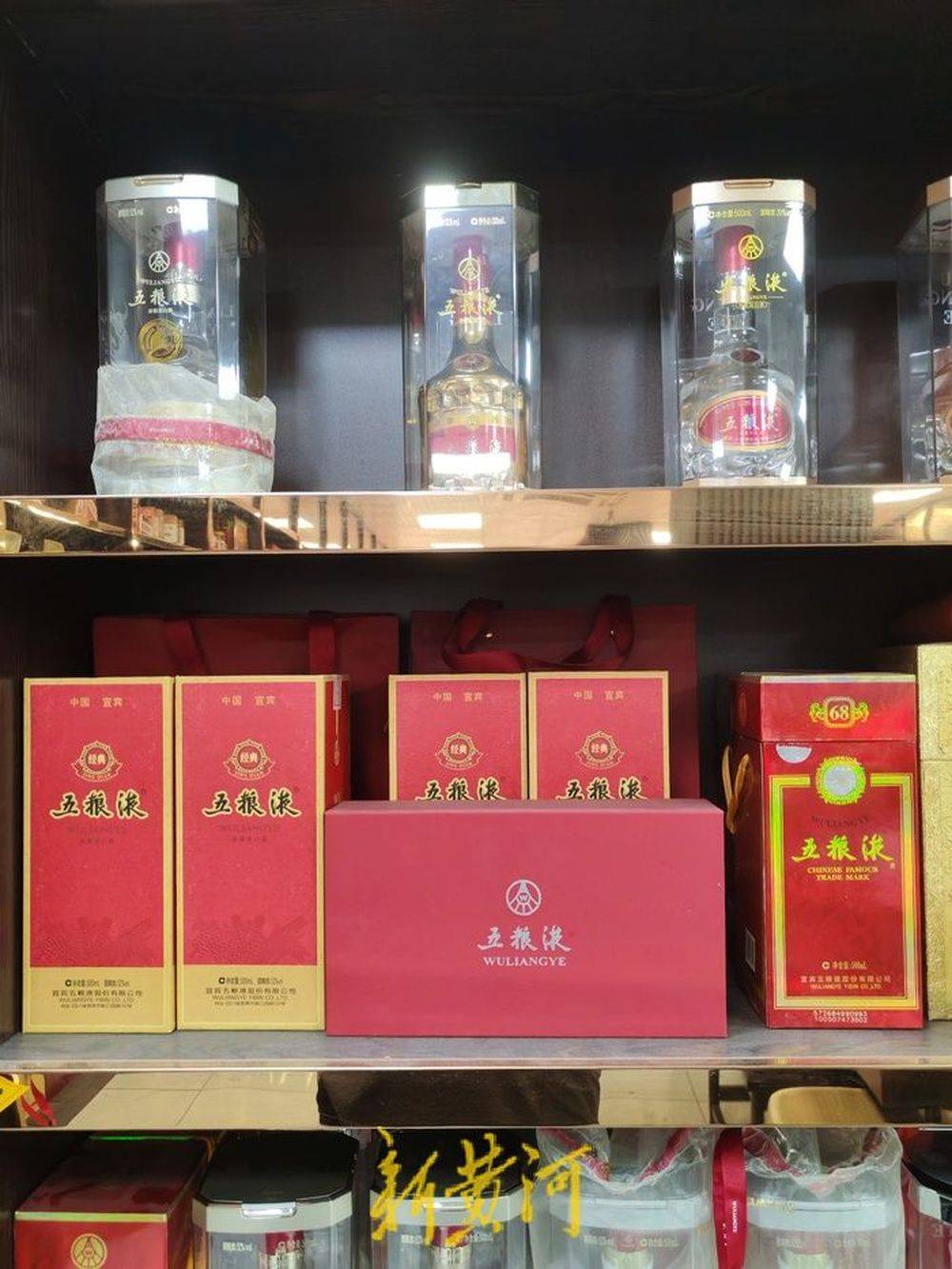
Group 1 - The core viewpoint of the articles indicates a significant decline in the prices of premium Chinese liquor brands, particularly Moutai and Wuliangye, leading to concerns about profitability and market stability [1][3][14] - Moutai's retail price for the 53-degree 500ml bottle has dropped below 2000 yuan, with reports of a profit margin of only 50 yuan per bottle, indicating a critical situation for distributors [1][5][6] - Wuliangye's flagship product, "Pu Wu," has also faced severe price declines, with online sales dropping to around 789 yuan, resulting in losses for distributors [9][10][11] Group 2 - The Chinese liquor market is experiencing a deep adjustment phase, with the price range of 800-1500 yuan showing the most significant discrepancies, leading to a challenging environment for high-end liquor brands [1][18] - The market is witnessing a shift in consumer behavior, with younger generations moving away from traditional consumption patterns, impacting sales of high-end liquor [17][20] - The industry is facing inventory pressures, with a notable increase in stock levels for major brands, indicating a mismatch between supply and demand [12][18][23] Group 3 - The Chinese liquor industry is undergoing a transformation, with new sales channels like instant retail and live streaming gaining traction, while traditional sales methods are declining [20][23] - The report from the China Alcoholic Drinks Association highlights that the era of blind expansion in the liquor industry is over, emphasizing the need for quality improvement and innovative marketing strategies [14][23] - The overall market sentiment is negative, with many distributors reporting cash flow issues and increased inventory pressure, leading to a challenging operating environment [18][20]



茅台,大跳水!
Sou Hu Cai Jing· 2025-06-23 08:03
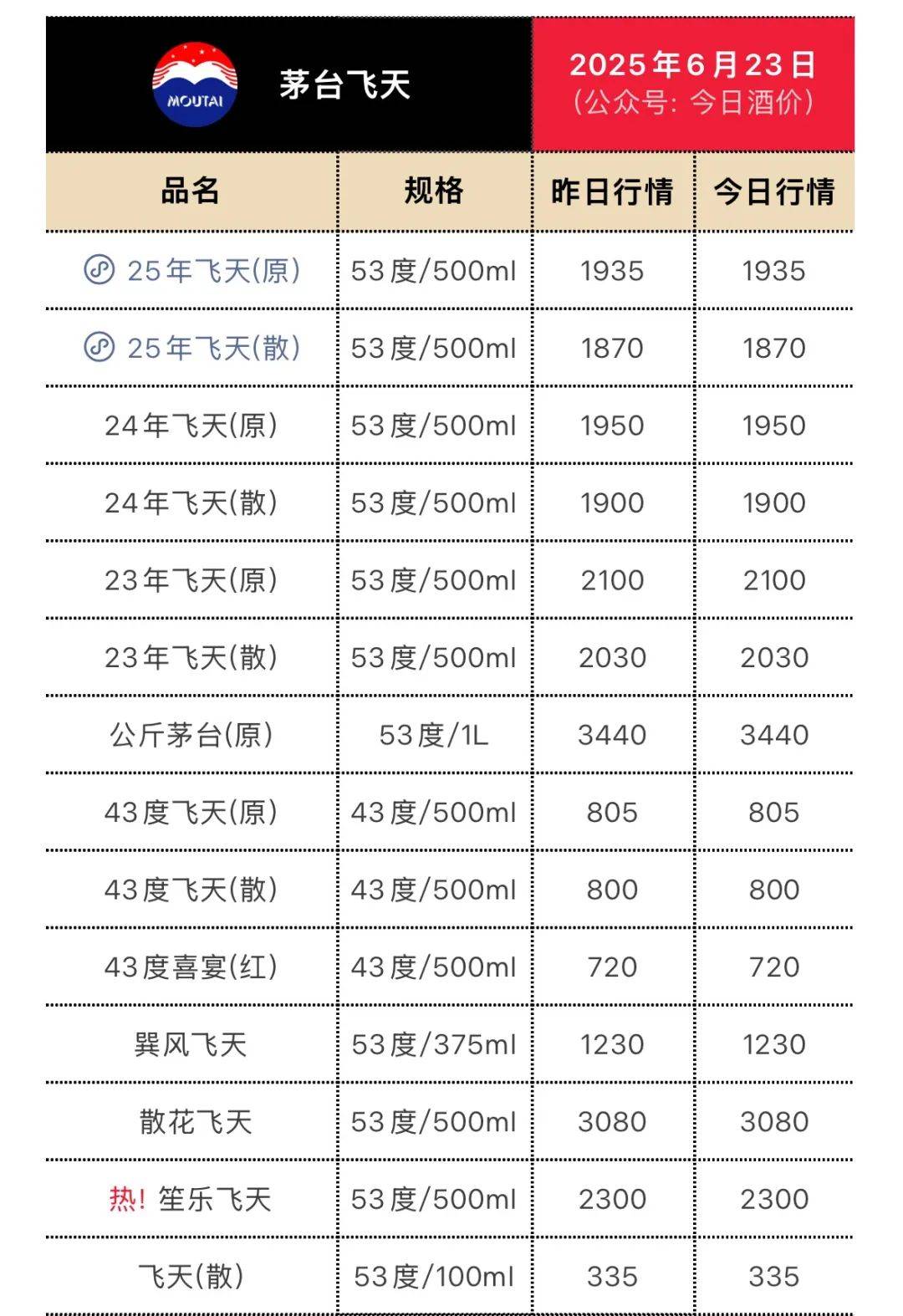
Core Viewpoint - The liquor industry, particularly the baijiu sector, is undergoing a deep adjustment period, with Kweichow Moutai's market dynamics significantly impacting the entire supply chain [1] Price Trends - In June, the wholesale prices of Kweichow Moutai showed a downward trend, with the price for the 25-year 53-degree 500ml original and bulk Moutai dropping to 1935 RMB and 1870 RMB respectively on June 23, down from 2020 RMB and 1970 RMB on June 17 [1][3][4] Sales Performance - From January to May, Kweichow Moutai's products experienced stable growth on major e-commerce platforms like JD.com and Tmall, with significant sales increases during the "6.18" shopping festival [5] - Feedback from distributors indicates that the overall market for Kweichow Moutai has shown strong resilience, maintaining stability despite price fluctuations [5] Stock Market Impact - The decline in Moutai's prices has led to a corresponding adjustment in its stock price, which is approaching the 1400 RMB mark, with a reported price of 1422.83 RMB per share on June 23, down 0.41% [6][7] Market Challenges - Analysts highlight that offline distributors are facing challenges due to price inversions and high inventory levels, which may lead to aggressive selling behaviors that could further depress product prices [8] - The overall baijiu market is experiencing a "volume and price decline" scenario, with a need for recovery anticipated around the upcoming consumption peaks during the Mid-Autumn Festival and National Day [8] Industry Dynamics - The Chinese liquor market is seeing increased concentration, with leading companies demonstrating strong resilience, while overall operational metrics are declining [9] - The industry is in a phase of "stock competition + structural upgrade," requiring companies to enhance quality and efficiency from the supply side while accurately reaching demand from the consumer side to reshape growth logic [9]
【直击五粮液股东大会】曾从钦:以长期主义应对挑战 营销改革激发新动能
Zheng Quan Shi Bao Wang· 2025-06-20 13:59
Core Viewpoint - The Chinese liquor industry is undergoing significant changes, with trends such as younger consumer demographics, daily consumption scenarios, quality enhancement, digital channels, and emotional value becoming increasingly prominent. The company aims to leverage its stable development to navigate external uncertainties [1][2]. Industry Overview - The overall growth rate of the Chinese liquor industry is slowing down, facing multiple challenges, and the differentiation among liquor companies is intensifying, leading to a "Matthew Effect" where regional concentration continues to rise [2]. - The industry has experienced various phases: a golden period (2003-2012), a deep adjustment period (2013-2015), a structural prosperity period (2016-2023), and is currently in another deep adjustment phase (2024 onwards) [2]. Company Performance - In 2024, the company achieved an operating revenue of 89.175 billion yuan, a year-on-year increase of 7.09%, and a net profit attributable to shareholders of 31.853 billion yuan, up 5.44%, marking ten consecutive years of stable growth [2]. - The company plans to implement a large-scale cash dividend of 10 billion yuan, alongside an annual dividend plan of 12.3 billion yuan, totaling 22.3 billion yuan for the year, with a dividend payout ratio of 70%, the highest in its history [3]. Strategic Initiatives - The company is focusing on enhancing its market-oriented thinking and promoting the professional transformation of its management team, including competitive recruitment for key positions and performance assessments for all employees [4]. - The company is actively reforming its marketing strategies to adapt to changing consumer demands, including establishing a liquor sales company and implementing a "quantity-price balance" strategy in major cities [5][6]. Future Plans - For 2025, the company will focus on market strategies, channel models, product planning, and mechanism guarantees to ensure performance growth, emphasizing a dynamic and flexible market response [6]. - The company aims to enhance its competitiveness in banquet activities, with a 24% year-on-year increase in banquet events and an improvement in the opening rate of banquet wines [7]. - Targeting the younger consumer demographic is a core strategy for future growth, with plans to launch new products that resonate with their tastes and preferences [7].
80后“本土派”,跻身茅台集团领导层
财联社· 2025-06-11 10:01
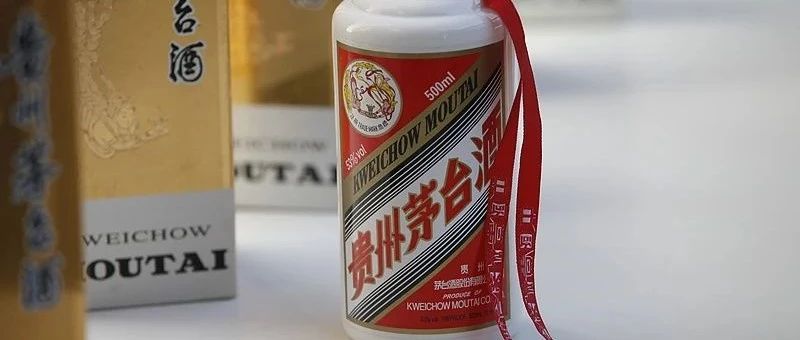
"贵州省有关方面非常重视提拔茅台本土派干部担任高管,避免'空降'党政干部到企业任职, 以免漫长适应调整期对企业正常市场经营的影响。这也让更多年轻茅台员工能看到职业发展的 希望。"中国酒业分析师肖竹青对财联社记者表示。 与张贵超和向平有接触的人士告诉财联社记者,其个人认为张贵超、向平二人作风比较务实, 且在销售体系摸爬滚打多年,具有较为丰富一线市场操作经验和营销管理经验。 " 张贵超是80后,比较能够接受新的事物。近期他就主导招募了饿了么、抖音和美团等新零售 运营商。 "上述知情人士表示,其目的是为7000家"茅台酱香 万家共享"主题终端店实施线上 线下引流,帮助线下终端向及时零售转型。 昨晚,贵州茅台官微发布消息,当日茅台集团召开干部领导大会和党委扩大会议,并宣布了贵 州省委有关任职决定。会议内容显示, 贵州茅台(600519.SH)党委委员、副总经理向平, 茅台酱香酒营销公司党委书记、董事长张贵超二人已正式出任茅台集团党委委员。 茅台集团官网显示,此前最年轻的领导层是集团党委委员、副总经理涂华彬,他出生于1975 年6月。如今, 80后的张贵超成为茅台集团最年轻的党委委员 。 据财联社记者了解,张贵超出生于 ...
业绩“急刹”,泸州老窖迎10年最冷财报
YOUNG财经 漾财经· 2025-05-20 11:11
业绩"急刹" ,泸州老窖迎10年最冷财报 王琳 在营收和净利连续多年保持高增长之后 , 2024 年 , 泸州老窖的业绩突然踩了急刹车 。 日前 , 泸州老窖发布 2024 年度报告显示 , 2024 年,公司实现营业收入 311.96 亿元,同比增长 3.19% , 实现归属于上市公司股东的净利润 134.73 亿元,同比增长 1.71% 。 泸州老窖 未完成董事会于年初提出的 "实现营业收入同比增长不低于 15% "的目标,这也是 近几 年首次未完成营收目标。 不仅如此 , 2024 年 , 泸州老窖的收入和净利 双双创下 2015 年以来最 低增速 。 进入 2025 年 , 泸州老窖依然保持低增速 。 数据显示 , 今年一季度,公司实现营收 93.52 亿 元,同比增长 1.78% , 实现归属于上市公司股东的净利润 45.9 3 亿元,同比增长 0. 41 % 。 业绩增速创 10 年新低 根据公开资料 , 自 1991 年有数据统计以来,泸州老窖营业收入一直位列上市白酒企业的 " 前三 甲 " ,但 到了 2010 年,泸州老窖被洋河股份反超,跌出前三。 2015 年 6 月刘淼上任泸州老窖董事长 ...

白酒行业深度调整期:资本跨界热潮消退 *ST 岩石触发新 “国九条” 财务退市指标
Xin Lang Zheng Quan· 2025-05-09 09:17
2024 年白酒行业年报披露季落下帷幕, *ST 岩石因全年营收 2.85 亿元、净亏损 2.17 亿元,触发新 "国 九条" 财务退市指标,自 4 月 23 日起被实施退市风险警示。与此同时,海南椰岛、ST 春天等多家酒企 亦因业绩不达标相继 "戴帽",行业洗牌加速的背后,是白酒行业深度调整期的阵痛与挑战。 *ST 岩石的跨界困境:从 "转型奇迹" 到退市边缘 当前白酒行业已进入 "挤泡沫" 阶段,中小酒企的退市风险既是压力也是机遇。*ST 岩石等企业的困境 警示:跨界转型需敬畏行业规律,资本热潮退去后,唯有专注品质、深耕市场的企业才能生存。 (注:本文系AI工具辅助创作完成,不构成投资建议。) *ST 岩石的困境并非孤例。2024 年成为白酒行业 "退市新规" 首个适用年度,海南椰岛、ST 春天、兰州 黄河等多家企业因营收低于 3 亿元且净利润为负被实施退市风险警示。其中,海南椰岛全年营收 1.75 亿元、净亏损 1.36 亿元,其多次保壳未果的背后,是多元化战略失败与历史债务拖累;兰州黄河则因 啤酒业务萎缩、股东内斗,营收同比下滑 12.73%,亏损规模扩大 113.76%。 更深层的危机来自行业结构性 ...
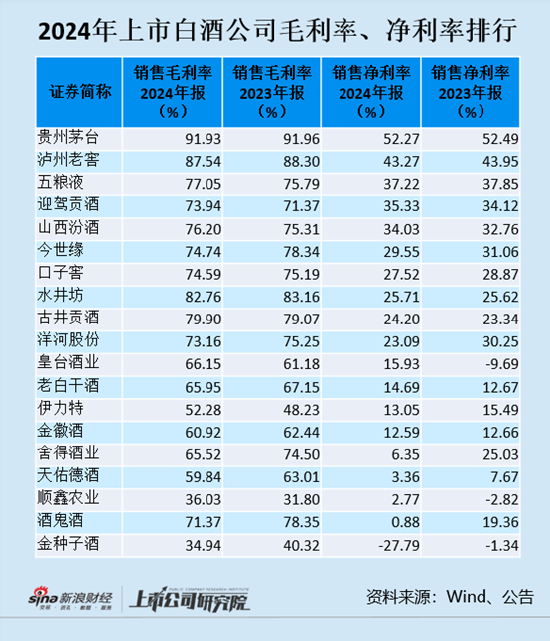
白酒年报|12家酒企毛利率下滑 舍得酒业、酒鬼酒最严重
Xin Lang Zheng Quan· 2025-05-09 07:23
Industry Overview - The Chinese liquor industry is undergoing a deep adjustment in 2024, characterized by a decline in both production and sales, a slowdown in terminal sales, shrinking consumption scenarios, and insufficient consumer confidence [1] - The number of liquor companies experiencing revenue decline has increased from 2 to 6 compared to the previous year, with companies like Jiu Gui Jiu and Shun Xin Agriculture facing significant revenue drops for two consecutive years [1] Company Performance - Guizhou Moutai leads the industry with a gross margin of 91.93%, followed by Luzhou Laojiao at 87.54% and Shui Jing Fang at 82.76%. Shui Jing Fang's high gross margin is attributed to the elimination of low-end products, focusing on high-end liquor [2] - The lowest gross margins are reported by Jin Zhong Zi Jiu and Shun Xin Agriculture, at 36.03% and 34.94% respectively. Jin Zhong Zi Jiu's gross margin has decreased by 5.38 percentage points, while Shun Xin Agriculture's margin increased by 4.23 percentage points, mainly due to its slaughtering business [2] Gross Margin Trends - In 2024, the median gross margin for 19 liquor companies is 73.16%, down by 2 percentage points from the previous year. 12 companies, accounting for 63%, reported a decline in gross margins, with She De Jiu Ye experiencing the most significant drop of nearly 9 percentage points [3] - Jiu Gui Jiu also saw a gross margin decline of nearly 7 percentage points, indicating that mid-range liquor brands are facing the most severe impacts in this industry adjustment [3] Net Profit Margin Analysis - Guizhou Moutai boasts a net profit margin of 52.27%, followed by Luzhou Laojiao and Wuliangye at 43.27% and 37.22% respectively, although all three companies experienced slight declines in net profit margins compared to the previous year [4] - The lowest net profit margins are found in Jin Zhong Zi Jiu, Jiu Gui Jiu, Shun Xin Agriculture, Tian You De Jiu, and She De Jiu Ye, all below 10%. The most significant declines in net profit margins were seen in She De Jiu Ye and Jiu Gui Jiu [5] Financial Summary - The financial performance of major liquor companies shows a trend of declining margins, with notable companies like Jiu Gui Jiu reporting a net profit margin as low as 0.88% [4][5] - The financial data indicates that while some companies have managed to improve their net profit margins, the overall trend in the industry is one of contraction and increased pressure on mid-range and low-end products [5][6]


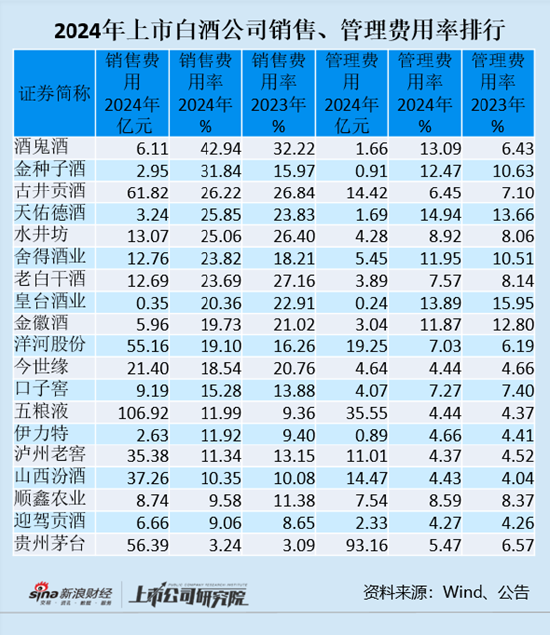
白酒年报|上市白酒公司销售费用同比增11% 五粮液以106.92亿元的销售费用排第一
Xin Lang Zheng Quan· 2025-05-09 07:14
Core Viewpoint - The Chinese liquor industry is experiencing a deep adjustment in 2024, characterized by declining production and sales, sluggish terminal movement, shrinking consumption scenarios, and insufficient consumer confidence, leading to price inversions for various products [1] Group 1: Industry Trends - The liquor industry is facing dual declines in production and sales, with a notable slowdown in revenue growth for liquor companies in 2024 [1] - The number of liquor companies experiencing revenue declines increased from 2 to 6 compared to the previous year, with brands like Jiu Gui Jiu and Shun Xin Agriculture facing significant downturns for two consecutive years [1] Group 2: Sales Expenses - The total sales expenses for 19 listed liquor companies reached 45.87 billion yuan in the previous year, marking an 11% year-on-year increase, which outpaced revenue growth [2] - The median sales expense ratio rose from 16.26% to 19.1%, indicating a growing burden on companies [2] - Notably, Wu Liang Ye had the highest sales expenses at 10.692 billion yuan, followed by Gu Qing Gong Jiu and Kweichow Moutai [2] Group 3: Management Expenses - The total management expenses for listed liquor companies amounted to 22.85 billion yuan, slightly up from 22.66 billion yuan the previous year, with a median management expense ratio of 7.27% [3] - Eleven companies reported an increase in management expenses, while eight companies saw a decline [3] - Companies like Shanxi Fen Jiu, Shui Jing Fang, and Tian You De Jiu experienced management expense growth exceeding 10% [3] Group 4: Expense Ratios - Jiu Gui Jiu had the highest sales expense ratio at 42.94%, followed by Jin Zhong Zi Jiu at 31.84% and Gu Qing Gong Jiu at 26.22% [4] - Kweichow Moutai had the lowest sales expense ratio at 3.24%, indicating efficient cost management [4] - The management expense ratios for Tian You De Jiu, Jiu Gui Jiu, and Jin Zhong Zi Jiu exceeded 10%, while companies like Wu Liang Ye and Kweichow Moutai maintained lower ratios [4]


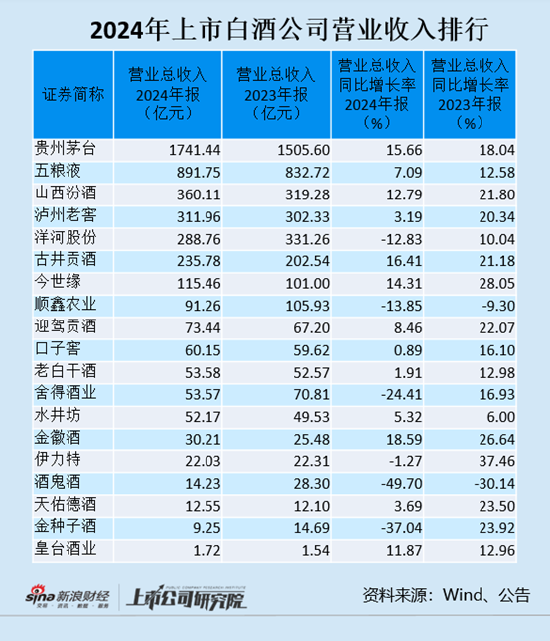
白酒年报|上市白酒公司收入增速大幅放缓 洋河掉出300亿阵营酒鬼酒收入持续萎缩
Xin Lang Zheng Quan· 2025-05-09 06:53
Core Viewpoint - The Chinese liquor industry is undergoing a deep adjustment in 2024, characterized by declining production and sales, sluggish terminal movement, shrinking consumption scenarios, and insufficient consumer confidence, leading to price inversions for many products [1] Group 1: Industry Overview - The liquor industry is facing significant challenges, with inventory issues becoming prominent and leading major companies to halt shipments to stabilize pricing [1] - The number of liquor companies experiencing revenue declines has increased from 2 in 2023 to 6 in 2024, indicating a growing divide between leading and smaller enterprises [2] Group 2: Revenue Performance - In 2024, 19 listed liquor companies achieved a total revenue of 441.94 billion yuan, reflecting a growth of 7.67% compared to 2023, but with a notable slowdown in revenue growth [2] - The median revenue growth rate for these companies dropped to 3.69% in 2024 from 18.04% in the previous year [2] - The top three companies with the highest revenue growth rates are Jinhuijiu (18.59%), Gujinggongjiu (16.41%), and Guizhou Moutai (15.66%) [2] Group 3: Company-Specific Insights - Guizhou Moutai generated revenue of 174.14 billion yuan in 2024, accounting for 39.4% of the total revenue of listed liquor companies, an increase of nearly 3 percentage points [2] - Yanghe's revenue fell by 12.83% to 28.88 billion yuan, causing it to drop out of the 30 billion yuan club [4] - Jiugui Jiu's revenue declined nearly 50% in 2024 after a 30% drop in 2023, highlighting severe channel issues [4] Group 4: Revenue Rankings - The revenue rankings for 2024 show Guizhou Moutai leading with 174.14 billion yuan, followed by Wuliangye with 89.18 billion yuan, and Shanxi Fenjiu with 36.01 billion yuan [5] - Companies like Jiugui Jiu and Jinzongzi Jiu are experiencing significant revenue declines, with Jiugui Jiu's revenue dropping to 1.42 billion yuan, a decrease of 49.70% [5]


观酒|年报后“上星”一季报扭亏,ST春天靠听花酒能走多远
Nan Fang Du Shi Bao· 2025-05-06 06:18
Core Viewpoint - ST Qinghai Spring (ST春天) faces significant challenges as it transitions to a *ST designation due to failing to meet the revenue threshold of 3 billion yuan, despite a 26.36% year-on-year revenue increase to 270 million yuan in 2024 [2][4]. Financial Performance - In 2024, ST Qinghai Spring reported a revenue of 270 million yuan, with a net loss of 198 million yuan after excluding non-core business income [2]. - The first quarter of 2024 showed a revenue of 83.56 million yuan, a slight decline of 1.11% year-on-year, but a net profit of 8.92 million yuan, indicating a turnaround [2][3]. Revenue Concerns - The company was criticized for a "last-minute revenue boost" in Q4 of the previous year, raising questions about the legitimacy of its revenue recognition practices [4][5]. - The fourth quarter revenue reportedly exceeded 100 million yuan, which was seen as an attempt to avoid delisting [4][6]. Market Strategy and Challenges - ST Qinghai Spring's flagship product, "Tinghua Wine," has struggled to regain market traction following a scandal involving false advertising, which led to significant penalties and a temporary market withdrawal [8][9]. - The company has shifted its marketing strategy to emphasize scarcity and high pricing, with plans to limit annual production to 30,000 tons [9][12]. Business Segmentation - The wine business accounted for approximately 17.53% of ST Qinghai Spring's total revenue, with a significant year-on-year decline of 44.05% in wine revenue [14][15]. - The company continues to rely on traditional products like Cordyceps for revenue stability, as the wine segment remains in its early stages of development [17]. Future Outlook - Analysts express skepticism about the wine segment's ability to significantly contribute to the company's financial recovery, given the current market conditions and the limited number of distributors [16][17]. - The company plans to introduce new products and enhance brand communication, but the success of these initiatives remains uncertain [16].