
创新药研发

Search documents
科创板“U”标药企进入分化时刻
Bei Jing Shang Bao· 2025-09-01 16:40
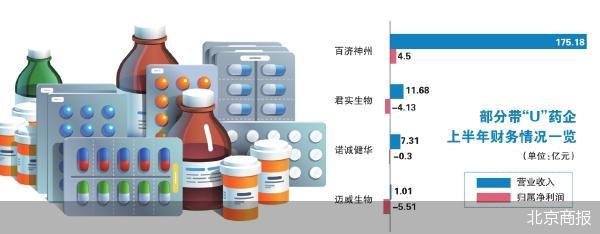
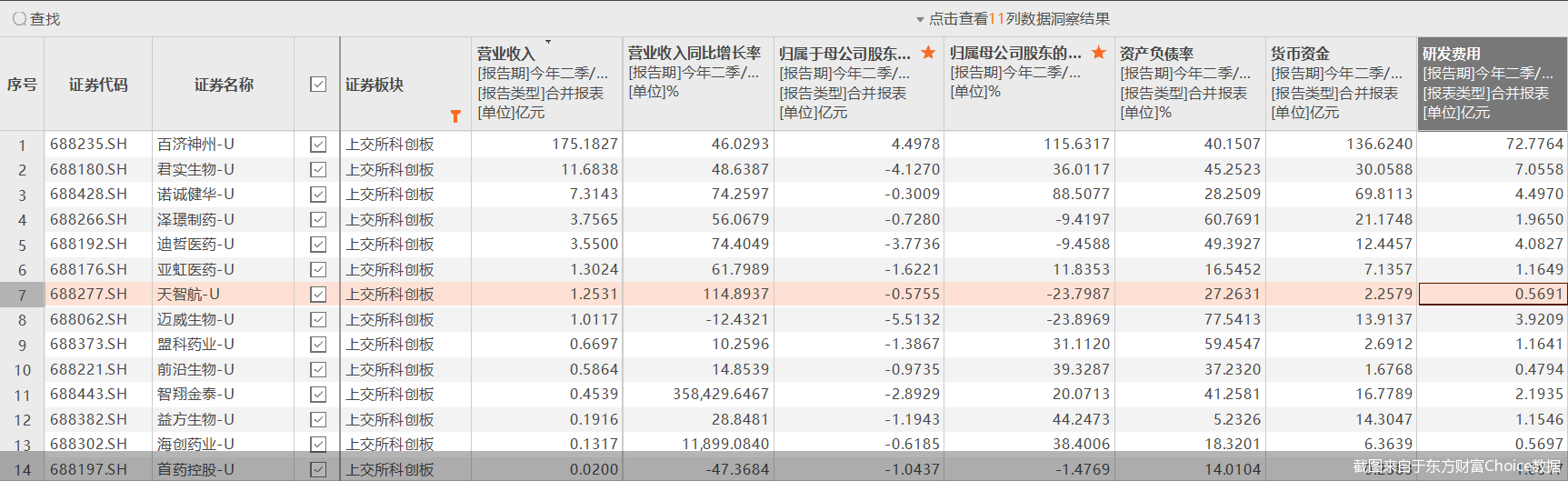
Core Viewpoint - The biotech companies listed on the STAR Market with "U" are entering a phase of differentiation, with varying performance in revenue and profitability, reflecting the changing valuation logic in the biotech sector [1][6]. Group 1: Revenue Performance - Among the 14 biotech companies with "U," 12 reported revenue growth in the first half of the year, accounting for approximately 85.71% [3]. - Baijia Shenzhou led with a revenue of approximately 17.518 billion yuan, a year-on-year increase of 46.03%, and was the only company to achieve profitability [3][4]. - Other companies like Junshi Biosciences and Nuo Cheng Jianhua also saw significant revenue increases, with Junshi reporting 1.168 billion yuan (up 48.64%) and Nuo Cheng reporting 731 million yuan (up 74.26%) [4]. Group 2: R&D Investment - The majority of the 14 companies continued to invest heavily in R&D, with 8 companies increasing their R&D expenses in the first half of the year [5]. - Baijia Shenzhou's R&D expenses reached 7.278 billion yuan, up from 6.628 billion yuan in the previous year [5]. - Other companies like Junshi, Nuo Cheng, and Dizhe Pharmaceuticals also reported increased R&D expenses, with figures of 706 million yuan, 450 million yuan, and 408 million yuan respectively [5]. Group 3: Financial Health and Funding - Many biotech companies are facing financial pressure, with several having asset-liability ratios exceeding 50%, including Maiwei Biotech at 77.54% [7]. - Baijia Shenzhou and Nuo Cheng Jianhua have relatively ample cash reserves, with 13.662 billion yuan and 6.981 billion yuan respectively [7]. - Companies are exploring various financing options, with Maiwei Biotech planning to list H-shares in Hong Kong to raise funds [7][8]. Group 4: Market Dynamics and Valuation - The market's valuation logic for biotech companies is shifting from focusing on pipeline quantity to emphasizing clinical data and commercialization potential [8]. - Analysts suggest that the ability to generate revenue is becoming a critical metric for evaluating biotech companies, moving away from merely assessing their cash burn rates [8].


8月份公募机构累计调研8338次 涉及771家公司
Zheng Quan Ri Bao· 2025-09-01 16:09
Group 1 - Since August, the A-share market has seen a significant increase in public fund research activity, with 163 public institutions participating in company research, covering 771 companies across 30 industries, and a total of 8,338 research instances, representing a month-on-month increase of 144.73% [1] Group 2 - The pharmaceutical and biotechnology sector was the most researched, with a total of 1,373 research instances covering 100 stocks, making it the highest focus area for public institutions in August; the electronics sector followed with 1,312 research instances covering 108 stocks [2] - Key companies in the pharmaceutical sector, such as Mindray Medical (300760), BeiGene, and Aibo Medical, were frequently researched, with a focus on innovative drug development, medical equipment updates, and the impact of centralized procurement policies [2] Group 3 - In the electronics sector, companies like Crystal Optoelectronics (002273), Unisoc (002049), and Industrial Fulian (601138) were core focuses due to their advancements in optical components and smart terminal manufacturing [2] - In the telecommunications sector, Tianfu Communication (300394) was the most researched company with 87 instances, focusing on the expansion of high-speed optical module capacity and the commercialization of silicon photonics technology [3] Group 4 - Public fund research activities showed a significant head effect, with 134 out of 163 participating institutions conducting more than 10 research instances, indicating a concentration of interest among top institutions [4] - Notable institutions included Bosera Fund with 200 research instances, followed by Harvest Fund (177 instances), Huaxia Fund (149 instances), and Guotai Fund (147 instances) [4] Group 5 - Research in August indicated a clear policy direction, with the pharmaceutical sector's rising interest linked to policy implementation, focusing on equipment updates and accelerated approval of innovative drugs [4] - The electronics sector maintained interest in cutting-edge fields such as optical technology and AI chips, despite a slight decrease in total research instances [4] - Increased research frequency in the machinery and power equipment sectors suggests institutional attention on inventory cycles bottoming out and a recovery in capital expenditure [4]





“医药一哥”,重磅消息!
中国基金报· 2025-09-01 16:03
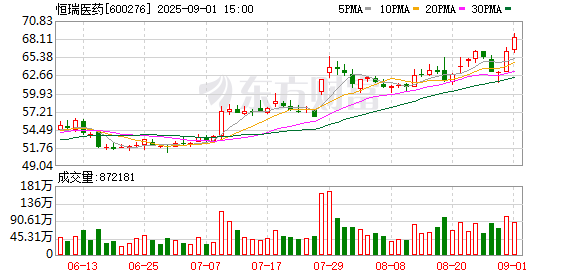
Core Viewpoint - Heng Rui Medicine's first self-developed EZH2 inhibitor, Ze Mei Tuo Si Ta Pian (SHR2554), has received conditional approval for market launch from the National Medical Products Administration (NMPA) in China, marking a significant milestone for the company as it is the first EZH2 inhibitor developed in China [2][7]. Group 1: Drug Development Progress - The conditional approval for Ze Mei Tuo Si Ta Pian is aimed at adult patients with relapsed or refractory peripheral T-cell lymphoma (R/R PTCL) who have received at least one line of systemic therapy [7]. - Peripheral T-cell lymphoma (PTCL) accounts for approximately 25% to 30% of non-Hodgkin lymphoma cases in China, with a median onset age of 52 years, indicating a relatively younger patient demographic [7]. - The total R&D investment for SHR2554 has reached approximately 21.3 million yuan [7]. Group 2: Additional Drug Approvals - Heng Rui Medicine's subsidiary, Fujian Shengdi Pharmaceutical Co., has received a notice from the NMPA regarding the acceptance of the drug listing application for HRS9531 injection, which is intended for long-term weight management in adults [4][7]. - HRS9531 is designed to regulate glucose and lipid metabolism, suppress appetite, and enhance insulin sensitivity, thereby improving blood sugar levels and aiding weight loss [7]. Group 3: Financial Performance - In the first half of 2025, Heng Rui Medicine reported a revenue of 15.761 billion yuan, representing a year-on-year growth of 15.88%, with a net profit of 4.450 billion yuan, up 29.67% [10]. - The company has maintained a high level of R&D investment, totaling 3.871 billion yuan during the same period, with 3.228 billion yuan classified as expensed R&D [10]. - Revenue from innovative drugs accounted for 60.66% of total revenue, with sales and licensing income from innovative drugs reaching 9.561 billion yuan [11]. Group 4: Market Position and Future Plans - Heng Rui Medicine is committed to developing innovative products and has established a strong and differentiated technology platform supported by 14 global R&D centers [11]. - The company is exploring both self-developed and potential acquisitions to enhance its product pipeline, particularly in oncology and metabolic disease areas [11]. - As of September 1, the stock price of Heng Rui Medicine was 68.65 yuan per share, reflecting a year-to-date increase of over 49% [11].


“医药一哥”,重磅消息!
Zhong Guo Ji Jin Bao· 2025-09-01 15:54
Core Viewpoint - Heng Rui Medicine has made significant progress with two new drug approvals, including the first domestically developed EZH2 inhibitor for treating relapsed or refractory peripheral T-cell lymphoma and a new injection for long-term weight management [2][7][10]. Group 1: Drug Approvals - Heng Rui Medicine received conditional approval from the National Medical Products Administration for its innovative drug SHR2554 (Zemaitoside), which is the first domestically developed EZH2 inhibitor in China [2][7]. - SHR2554 is intended for adult patients with relapsed or refractory peripheral T-cell lymphoma (R/R PTCL) who have previously undergone at least one line of systemic therapy [7]. - The company’s subsidiary, Fujian Shengdi Pharmaceutical, has had its application for HRS9531 injection accepted, which is aimed at adult long-term weight management [4][7]. Group 2: Market Context and Financials - Peripheral T-cell lymphoma (PTCL) accounts for approximately 25% to 30% of non-Hodgkin lymphoma cases in China, with a median onset age of 52 years, indicating a younger patient demographic [7]. - The total R&D investment for SHR2554 has reached approximately 213 million yuan [7]. - HRS9531 is designed to regulate glucose and lipid metabolism, suppress appetite, and enhance insulin sensitivity, thereby improving blood sugar levels and aiding weight loss [4][8]. Group 3: Financial Performance - In the first half of 2025, Heng Rui Medicine reported revenue of 15.76 billion yuan, a year-on-year increase of 15.88%, with a net profit of 4.45 billion yuan, up 29.67% [10][11]. - The revenue from innovative drug sales and licensing reached 9.56 billion yuan, accounting for 60.66% of total revenue, with innovative drug sales alone amounting to 7.57 billion yuan [11]. - The company continues to invest heavily in R&D, with total R&D expenditures of 3.87 billion yuan in the reporting period [10].
研发持续“烧钱”、业绩承压,迈威生物再闯港股IPO
Bei Ke Cai Jing· 2025-09-01 14:12
Core Viewpoint - Maiwei Biotech has re-submitted its application for H-share issuance and listing in Hong Kong, leading to a significant stock price increase of 20% on September 1, 2023, with a cumulative increase of 65.52% since its listing, resulting in a market capitalization of 23.017 billion yuan [1] Group 1: Company Overview - Established in 2017, Maiwei Biotech is an innovative biopharmaceutical company focusing on oncology and age-related diseases, with four commercialized products as of now [2] - The company has a pipeline of over ten products in various stages of clinical development [2] Group 2: Financial Performance - Despite high R&D investments, the company has incurred cumulative losses of 6.2714 billion yuan since its inception, with over 3.6 billion yuan in losses from 2022 to mid-2025 [3] - Revenue from 2022 to mid-2025 was only 457 million yuan, with a 12.43% year-on-year decline in revenue for the first half of 2023 [3] - The company reported a net profit attributable to shareholders of -552 million yuan for the first half of 2023 [3] Group 3: Market Competition - Maiwei Biotech faces intense competition in the market for its biosimilar products, particularly the adalimumab biosimilar, which saw a 66.61% decline in shipments in 2024 [4] - The company is also experiencing slow market access for its other biosimilar products, indicating a lack of competitive advantage [5] Group 4: Funding and Financial Strategy - The company relies heavily on external financing for operations, with a significant increase in debt ratio from 42.24% in 2023 to 77.54% in mid-2025 [7] - To address cash flow issues, the company plans to diversify its financing channels and maintain a high leverage ratio to support ongoing R&D investments [8] - Maiwei Biotech has also proposed to issue up to 500 million yuan in targeted debt financing tools to optimize its debt structure and reduce financial costs [11]

广生堂:广生中霖拟引入重要投资者 公司放弃优先权
Ge Long Hui· 2025-09-01 12:33
Core Viewpoint - Guangshentang (300436.SZ) is enhancing its innovative drug development funding and operational capital through a significant equity transfer and capital increase involving its subsidiary, Guangsheng Zhonglin, with a total transaction amount of 250 million yuan [1] Group 1 - The board of directors approved the proposal for the equity transfer and capital increase of Guangsheng Zhonglin, allowing the introduction of important investors while waiving the company's preferential rights [1] - The transaction includes an investment of 141.35 million yuan from Jinan Taishen Investment Partnership and 50 million yuan from Huaxin Shiheng, based on a pre-investment valuation of 2.5 billion yuan for Guangsheng Zhonglin [1] - After the transaction, Guangsheng Zhonglin's registered capital will increase from 388.5 million yuan to 418.236 million yuan, and the company's ownership stake will decrease from 81.08% to 75.32%, maintaining its status as a controlled subsidiary [2]

百济神州(688235):Q2业绩保持稳定增长
Dongguan Securities· 2025-09-01 12:21
Investment Rating - The report assigns an "Accumulate" rating to the company, indicating an expectation that the stock will outperform the market index by 5% to 15% over the next six months [2][9]. Core Insights - The company reported stable growth in Q2 2025, achieving revenue of 94.70 billion yuan, a year-on-year increase of 42.69% and a quarter-on-quarter increase of 17.68%. The net profit attributable to shareholders was 5.44 billion yuan [6]. - The growth in product revenue is primarily driven by the sales of self-developed products such as Baiyueze (Zebutinib Capsules) and the licensed product from Amgen, as well as Baizean (Trelatuzumab Injection) [6]. - Baiyueze® had global sales of 125.27 billion yuan in the first half of 2025, representing a 56.2% year-on-year increase, with U.S. sales reaching 89.58 billion yuan, up 51.7% [6]. - Baizean® sales totaled 26.43 billion yuan, a 20.6% increase year-on-year, benefiting from new indications approved for insurance coverage in China [6]. - The company is accelerating its R&D innovation, establishing a global clinical development capability with a team of over 3,700, allowing for faster and more cost-effective drug development [6]. - The company aims to achieve over 20 milestone advancements in its hematology and solid tumor pipelines within the next 18 months [6]. Financial Projections - The company is projected to achieve total revenue of 36,924 million yuan in 2025, with net profit expected to reach 770 million yuan, and EPS forecasted at 0.50 yuan [7]. - By 2026, total revenue is expected to grow to 45,612 million yuan, with net profit projected at 3,626 million yuan and EPS at 2.35 yuan [7].
A股公告精选 | 成都华微(688709.SH)发布新款ADC芯片 并已收到意向订单
智通财经网· 2025-09-01 12:10
Group 1: BYD Performance - BYD's August sales of new energy vehicles reached 373,600 units, nearly unchanged from 373,100 units in the same month last year [1] - Cumulative sales from January to August totaled 2.864 million units, representing a year-on-year growth of 23% [1] - BYD plans to export a total of 80,813 new energy vehicles by August 2025 [1] Group 2: Kweichow Moutai Shareholding - Kweichow Moutai's controlling shareholder, Moutai Group, increased its stake by 67,821 shares on September 1, 2025, accounting for 0.0054% of the total share capital [2] - The increase amounted to 100 million yuan and is part of a larger plan to buy back between 3 billion and 3.3 billion yuan worth of shares from September 1, 2025, to February 28, 2026 [2] Group 3: Chengdu Huamei Chip Development - Chengdu Huamei announced the successful launch of a 4-channel, 12-bit, 40G high-speed, high-precision RF direct sampling ADC chip [3] - The chip improves upon existing multi-channel high-speed ADCs, achieving international leading standards and filling a gap in similar products [3] - The company has received intention orders after sending samples to several clients [3] Group 4: Industrial Fulian Share Buyback - Industrial Fulian has repurchased a total of 7.6974 million shares, representing 0.04% of its total share capital, as of August 31, 2025 [6] - The highest repurchase price was 19.84 yuan per share, while the lowest was 18.40 yuan per share, with a total expenditure of 147 million yuan [6] Group 5: Innovative Drug Approval by Hengrui Medicine - Hengrui Medicine received conditional approval from the National Medical Products Administration for its innovative drug, SHR2554 tablets, aimed at adult patients with relapsed or refractory peripheral T-cell lymphoma [7] - This drug is noted as China's first independently developed EZH2 inhibitor [7] Group 6: Yonghui Supermarket Fundraising Adjustment - Yonghui Supermarket announced adjustments to its plan for issuing A-shares to specific investors, reducing the total fundraising amount from a maximum of 3.992 billion yuan to 3.114 billion yuan [8] - The adjustments primarily affect the funding amounts for store upgrades and working capital or bank loan repayments [8] Group 7: Automotive Sales Performance - SAIC Motor's vehicle sales in August reached 363,400 units, reflecting a year-on-year increase of 41.04% [9] - Great Wall Motors reported August sales of 115,600 units, marking a year-on-year growth of 22.33% [12] - Dong'an Power's engine sales in August increased by 3.44% year-on-year [12]



“烧钱”与“造血”角力,科创板“U”标药企进入分化时刻
Bei Jing Shang Bao· 2025-09-01 12:02
Core Viewpoint - The 2025 semi-annual report of "U" biotech companies on the Sci-Tech Innovation Board reflects the development trajectory of China's pharmaceutical industry, particularly innovative drug companies, which are entering a phase of differentiation [1] Group 1: Financial Performance - Among the 14 "U" biotech companies, 12 reported revenue growth in the first half of the year, accounting for approximately 85.71% [3] - BeiGene (百济神州) led with a revenue of approximately 17.52 billion yuan, a year-on-year increase of 46.03%, and was the only company to achieve profitability [3][4] - Other companies like Junshi Biosciences (君实生物) and Nuocheng Jianhua (诺诚健华) also reported significant revenue growth, with Junshi achieving 1.17 billion yuan (up 48.64%) and Nuocheng 731 million yuan (up 74.26%) [3][4] Group 2: R&D Investment - The majority of the 14 companies continued to invest heavily in R&D, with 11 companies reporting R&D expenses exceeding 100 million yuan [1][7] - BeiGene's R&D expenses were 7.28 billion yuan, up from 6.63 billion yuan in the previous year, indicating a strong commitment to R&D [7] - Companies like Junshi, Nuocheng, and Dizhi Pharmaceutical (迪哲医药) also saw increases in R&D expenses, reflecting ongoing investment in clinical trials and product development [7][8] Group 3: Market Dynamics - The valuation logic for biotech companies is undergoing significant changes, moving from a "story-driven" approach to one focused on clinical data and commercialization capabilities [1][9] - The market is increasingly prioritizing companies with proven commercial potential and clinical advancements, shifting away from merely counting pipeline projects [11] - Companies are exploring diverse fundraising methods to support their R&D and commercialization efforts, with some facing cash flow pressures due to high R&D costs [10][11]
广生堂控股子公司股权转让及增资扩股,引入重要投资者
Zheng Quan Shi Bao Wang· 2025-09-01 11:59
Core Viewpoint - Guangshentang (300436) announced a capital increase and equity transfer for its subsidiary Guangsheng Zhonglin to enhance funding for innovative drug development and operations [1][2] Group 1: Equity Transfer and Capital Increase - Guangsheng Zhonglin plans to introduce significant investors through a cash transaction totaling 250 million yuan, with Jinan Taishen and Huaxin Shiheng subscribing to new registered capital [1] - Jinan Taishen will acquire equity from existing shareholders, specifically from the core employee holding platforms, for a total transaction amount of approximately 58.65 million yuan [1][2] - Following the transaction, Guangsheng Zhonglin's registered capital will increase from 389 million yuan to 418 million yuan, and Guangshentang's ownership will decrease from 81.08% to 75.32% [1] Group 2: Innovative Drug Development - Guangsheng Zhonglin is developing innovative drugs for hepatitis treatment, with GST-HG131 and GST-HG141 included in the breakthrough therapy list by the National Medical Products Administration [2] - The ongoing clinical trials for GST-HG141 are in Phase III, while the combination therapy of GST-HG131 and GST-HG141 is in Phase II, indicating strong clinical potential [2] - The transaction is expected to enhance Guangsheng Zhonglin's capital strength, accelerate the development of innovative drugs, and improve talent attraction and research efficiency [3]