AI Agent

Search documents
当大模型把题库“刷爆”,红杉中国推出一套全新AI基准测试
Di Yi Cai Jing· 2025-05-26 05:30
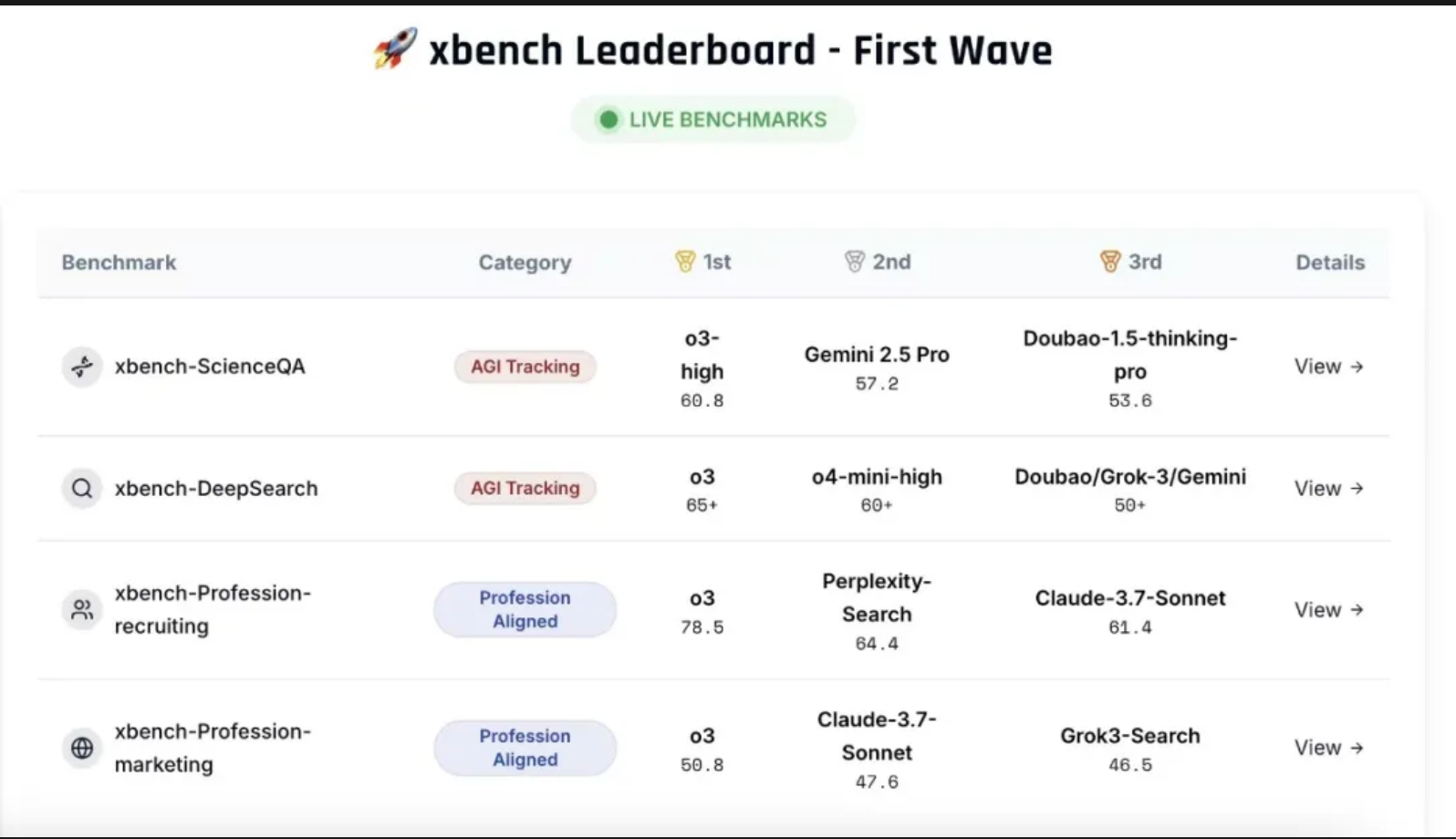
Group 1 - Sequoia China has launched a new AI benchmarking tool called xbench, developed in collaboration with over ten domestic and international universities and research institutions [3] - The dual-track evaluation system of xbench includes a multi-dimensional assessment dataset that tracks both the theoretical capabilities of models and the practical value of AI agents [3] - The long-term evaluation mechanism of xbench is designed to be dynamic and continuously updated, addressing concerns about static assessments and potential score manipulation [3][4] Group 2 - The rapid advancements in AI capabilities, particularly in long text processing, multi-modality, tool usage, and reasoning, have led to explosive growth in AI agents [4] - There is a consensus that valuable AI agent evaluations must be closely related to actual tasks, necessitating the construction of specific domain assessment sets that align with productivity and commercial value [4] - The characteristics of agents, including their rapid iteration and integration of new features, require testing tools to track the continuous growth of agent capabilities [4][5] Group 3 - xbench-DeepSearch will focus on evaluating multi-modal models with reasoning chains for their ability to generate commercially viable videos, the credibility of widely used MCP tools, and the effectiveness of GUI agents in utilizing dynamically updated or untrained applications [5]

Agent竞速之年,企业级SaaS软件商业模式求变
2 1 Shi Ji Jing Ji Bao Dao· 2025-05-26 03:49
Core Insights - The year 2025 is anticipated to be a pivotal year for the implementation of AI Agents, with both global giants like Microsoft and Google and domestic companies advancing their applications [1] - The enterprise-level SaaS software market is seen as a fertile ground for the transition to intelligent solutions due to its prior digitalization and industrialization efforts [1] - The introduction of AI capabilities into core business scenarios is accelerating among SaaS vendors, necessitating a transformation in business models [1][5] Group 1: AI Agent Development - Kingdee has launched five intelligent agents and the Cloud Sky Agent Platform 2.0, marking a significant shift from previous AI assistant models to result-oriented delivery [3][4] - The evolution of enterprise management software has undergone five major phases, culminating in the current AI era where natural language interaction and complex data processing are key features [2] - The new Agent 2.0 emphasizes integration with business scenarios, offering rich templates and tools while ensuring data security [4] Group 2: Business Model Transformation - Kingdee is transitioning from a functional fee model to a results-based pricing model, indicating a shift towards "Result as a Service" (RaaS) [5] - This new model requires a higher standard of service effectiveness, moving from delivering tools to delivering measurable outcomes [5][6] - The internal organization and development processes at Kingdee have also changed, focusing on complete teams dedicated to delivering results rather than modular solutions [6] Group 3: Challenges and Future Outlook - Despite the opportunities presented by AI models, challenges remain in the practical application and commercial model transformation [5][7] - The integration of AI capabilities into enterprise management is still in its early stages, with many companies exploring how to effectively utilize large models [7] - The future of enterprise management AI is envisioned as a collaborative ecosystem between humans and intelligent agents, expanding the market potential significantly [8]
两大算力龙头宣布重磅吸收合并交易,软件ETF(159852)震荡上涨,机构:AI Agent及算力依旧是最明确的投资方向
2 1 Shi Ji Jing Ji Bao Dao· 2025-05-26 02:21
Group 1 - The A-share market saw a collective low opening on May 26, with the Shanghai Composite Index rebounding into positive territory, while the CSI Software Service Index increased by 0.04% [1] - The Software ETF (159852) experienced a fluctuation with a rise of 0.52%, indicating active trading during the session. Notable constituent stocks included Zhongke Software, which rose over 4%, along with China Software, Shiji Information, Zhongke Chuangda, and Taiji Co., Ltd. [1] - The Software ETF (159852) closely tracks the CSI Software Service Index, which includes 30 listed companies involved in software development and services, reflecting the overall performance of the software service industry [1] Group 2 - The first "A swallow A" case emerged following new regulations, with Haiguang Information Technology Co., Ltd. planning to merge with Zhongke Shuguang through a share swap, marking the first absorption merger transaction since the revision of the Major Asset Restructuring Management Measures on May 16 [2] - Zhongke Shuguang is a leading company in the domestic information industry, with strong technical capabilities in high-end computing, storage, and cloud computing, while Haiguang Information focuses on the design and development of domestic architecture CPUs and DCUs [2] - According to Jiangyin International, investors should focus on technological development and transformation themes, particularly artificial intelligence, which is expected to be a key technological change in the near future [2] Group 3 - Western Securities emphasizes that AI Agents and computing power remain clear investment directions, anticipating accelerated commercialization of AI Agents in the second half of the year and a reevaluation of software company values due to MaaS [3] - The firm also highlights the acceleration of domestic innovation in the upstream chip sector within the computing power industry chain, suggesting opportunities for valuation recovery and new product anticipation in the subsequent supply chain companies [3]
深度|拿下3亿美元融资后,AI金融独角兽Airwallex全球首发支付AI代理金融
Z Potentials· 2025-05-26 02:10
Core Viewpoint - Airwallex, a global fintech unicorn, has successfully completed a $300 million Series F funding round, achieving a post-money valuation of $6.2 billion, despite a challenging investment climate in the primary market [1][2]. Group 1: Company Overview - Founded in 2015 by four Melbourne University alumni, Airwallex initially focused on low-cost foreign exchange and real-time cross-border payments to assist SMEs with cash flow issues [1]. - Over the past decade, Airwallex has raised over $1.2 billion across 11 funding rounds, attracting top-tier investors such as Tencent, Alibaba, Sequoia, and Hillhouse [1]. - As of March 2025, Airwallex's annualized revenue reached $720 million, with total revenue growing by 90% year-on-year [5]. Group 2: Business Strategy and AI Integration - Airwallex is integrating AI into its operations, developing "AI Agentic Finance" to automate financial workflows and enhance decision-making capabilities [3][4]. - The company aims to create AI agents that can perform financial tasks for clients, allowing businesses to focus on core operations while optimizing cash management [4]. - The shift towards AI is part of a broader trend in the industry, with significant investment in AI-related startups, indicating a growing market for AI applications in finance [3]. Group 3: Global Expansion and Market Position - Airwallex has established a global presence, holding over 60 financial licenses and operating in 37 countries, which provides a competitive edge in cross-border payments [6][8]. - The company's aggressive strategy includes prioritizing local compliance teams when entering new markets, creating a regulatory moat that is difficult for competitors to replicate [6]. - The fintech firm is positioned to capitalize on the growing demand for cross-border financial services, particularly for SMEs that have been underserved by traditional banks [11]. Group 4: Industry Disruption - Airwallex aims to disrupt traditional banking by providing embedded, automated financial services that align closely with business operations, addressing the inefficiencies of existing banking infrastructure [10]. - The company is targeting a significant market opportunity, with the potential market size for global financial services for businesses projected to reach $570 billion by 2027 [11]. - Airwallex's vision is to fill the gap left by traditional banks in serving SMEs, leveraging technology to offer competitive international payment and forex management solutions [11].

腾讯研究院AI速递 20250526
腾讯研究院· 2025-05-25 15:57
Group 1: Nvidia's Blackwell GPU - Nvidia's market share in China's AI chip market has plummeted from 95% to 50% due to U.S. export controls, allowing domestic chips to capture market share [1] - To address this issue, Nvidia has launched a new "stripped-down" version of the Blackwell GPU, priced between $6,500 and $8,000, significantly lower than the H20's price range of $10,000 to $12,000 [1] - The new chip utilizes GDDR7 memory technology with a memory bandwidth of approximately 1.7TB/s to comply with export control restrictions [1] Group 2: AI Developments and Innovations - Claude 4 employs a verifiable reward reinforcement learning (RLVR) paradigm, achieving breakthroughs in programming and mathematics where clear feedback signals exist [2] - The development of AI agents is currently limited by insufficient reliability, but it is expected that by next year, software engineering agents capable of independent work will emerge [2] - By the end of 2026, AI is predicted to possess sufficient "self-awareness" to execute complex tasks and assess its own capabilities [2] Group 3: Veo3 Video Generation Model - Google I/O introduced the Veo3 video generation model, which achieves smooth and realistic animation effects with synchronized audio, addressing physical logic issues [3] - Veo3 can accurately present complex scene details, including fluid dynamics, texture representation, and character movements, supporting various camera styles and effects [3] - As a creative tool, Veo3 has reached near-cinematic quality, supporting non-verbal sound effects and multilingual narration, raising discussions about the difficulty of distinguishing real from fake videos [3] Group 4: OpenAI o3 Model - The OpenAI o3 model discovered a remote 0-day vulnerability (CVE-2025-37899) in the Linux kernel's SMB implementation, outperforming Claude Sonnet 3.7 in benchmark tests [4] - In tests with 3,300 lines of code, o3 successfully identified known vulnerabilities 8 out of 100 times, with a false positive rate of approximately 1:4.5, demonstrating a reasonable signal-to-noise ratio [4] - o3 independently discovered a new UAF vulnerability and surpassed human experts in insight, indicating that large language models (LLMs) have reached practical levels in vulnerability research [5] Group 5: Byte's BAGEL Model - Byte has open-sourced the multimodal model BAGEL, which possesses GPT-4o-level image generation capabilities, integrating image understanding, generation, editing, and 3D generation into a single 7B parameter model [6] - BAGEL employs a MoT architecture, featuring two expert models and an independent visual encoder, showcasing a clear emergence of capabilities: multimodal understanding appears first, followed by complex editing abilities [6] - In various benchmark tests, BAGEL outperformed most open-source and closed-source models, supporting image reasoning, complex image editing, and perspective synthesis, and has been released under the Apache 2.0 license on Hugging Face [6] Group 6: Tencent's "Wild Friends Plan" - Tencent's SSV "Wild Friends Plan" mini-program has upgraded to include AI species recognition and intelligent Q&A interaction, capable of identifying biological species from user-uploaded photos and providing expert knowledge [7] - The new feature not only provides species names but also answers in-depth information about biological habits and migration patterns through natural language dialogue, translating technical terms into everyday language [7] - The "Shenzhen Biodiversity Puzzle" public participation activity has been launched, where user-uploaded images and interactive content will be used for model training, contributing to population surveys and habitat protection [7] Group 7: OpenAI's AI Hardware - OpenAI's first AI hardware, developed in collaboration with Jony Ive, is reported to be a neck-worn device resembling an iPod Shuffle, featuring no screen but equipped with a camera and microphone [8] - The new device aims to transcend screen limitations and provide more natural interactions, capable of connecting to smartphones and PCs, with mass production expected in 2027 [8] - Similar AI wearable devices are already on the market, but there are concerns among users regarding privacy and practicality, with some suggesting that AI glasses would be a better option [8] Group 8: AI Scientist Team's Breakthrough - The world's first AI scientist team discovered a new drug, Ripasudil, for treating dry age-related macular degeneration (dAMD) within 2.5 months, marking a significant scientific achievement [10] - The team developed the Robin multi-agent system, which automated the entire scientific discovery process, combining Crow, Falcon, and Finch agents for literature review, experimental design, and data analysis [10] - AI identified treatment pathways previously unconsidered by humans, fully dominating the research framework while humans only executed experiments, showcasing a new paradigm of AI-driven scientific discovery [10] Group 9: AI Product Development Insights - The best AI products often grow "bottom-up" rather than being planned, discovering potential through foundational experiments, reshaping product development paths [11] - As AI-generated content becomes mainstream, future core issues will shift from "whether AI generated" to content provenance, credibility, and verifiability [11] - AI has profoundly changed work methods, with 70% of Anthropic's internal code generated by Claude, leading to new challenges in efficiency bottlenecks in "non-engineering" areas [11] Group 10: Future of AI Applications - The best AI applications have yet to be invented, with the current state of the AI field likened to alchemy, where no one knows exactly what will work [12] - Generality and usability should develop in parallel rather than in opposition, with Character.AI focusing on building products that are both usable and highly general [12] - AI technology is expected to advance rapidly within 1-3 years, with the value of large language models lying in their ability to translate limited training into broad applications, with computational capacity being the key challenge rather than data scale [12]


让无人机自主思考!道通智能空地一体智慧方案亮相无人机大会
Nan Fang Du Shi Bao· 2025-05-25 07:52
Core Viewpoint - The 2025 Ninth World Drone Conference in Shenzhen highlights the emergence of a new era in the low-altitude economy, showcasing advancements in drone technology and applications across various industries [1] Group 1: Event Overview - The conference attracted 825 companies and showcased over 5,000 drone systems and equipment [1] - Shenzhen Daotong Intelligent Aviation Technology Co., Ltd. presented its flagship multi-rotor and tilt-rotor drones, along with digital solutions for the low-altitude economy [1] Group 2: Product Showcase - Daotong Intelligent's EVO Max series features advanced technologies such as autonomous flight, A-Mesh networking, and 720-degree omnidirectional obstacle avoidance, addressing operational challenges in complex environments [3] - The product lineup includes various models like Autel Alpha, Autel Titan, and EVO Lite 640T, catering to diverse user needs with an open SDK ecosystem [5] - The Daotong Longyu series combines vertical takeoff and landing with fixed-wing endurance, equipped with dual-frequency HD transmission for reliable communication in complex operations [5] Group 3: Solutions and Applications - Daotong Intelligent introduced integrated smart solutions for security, transportation, and energy sectors, enhancing efficiency in law enforcement, emergency rescue, and infrastructure inspections [7] - The company's multi-rotor drone nest enables automated operations, significantly reducing labor and material costs, while the Tianqiong command system allows remote operation for comprehensive situational awareness [8] - The upcoming multi-modal AI model will enhance decision-making capabilities, enabling autonomous operations and real-time situational awareness [9]


速递|OpenAI升级其Operator的底层模型,推理模型o3全面接棒GPT-4o
Z Potentials· 2025-05-25 04:37
Core Viewpoint - OpenAI is upgrading its AI agent Operator to utilize the new o3 model, which is expected to enhance its capabilities in web browsing and task execution [1][2]. Group 1: Model Upgrade - The Operator will transition from the customized GPT-4o model to the advanced o3 model, which is part of OpenAI's latest reasoning models [1][2]. - The API version of Operator will continue to use the GPT-4o model, indicating a phased approach to the upgrade [2]. Group 2: Performance and Capabilities - The o3 model has shown superior performance in benchmark tests, particularly in mathematical and reasoning tasks [2]. - OpenAI's report indicates that the o3 Operator model is less likely to refuse executing "illegal" activities or searching for sensitive personal data compared to the GPT-4o model [3]. - The o3 Operator has enhanced resistance to prompt injection attacks, showcasing improved security features [3]. Group 3: Safety and Security - The o3 Operator incorporates additional safety data fine-tuning specifically for computer usage scenarios, aimed at teaching the model decision boundaries for confirming or denying operations [2]. - It retains the multi-layered security mechanisms of the GPT-4o version, ensuring a robust safety framework [3].

深度|Anthropic首席产品官:从Claude到MCP,最好的AI产品不是计划出来的,是从底层自发长出来的
Z Potentials· 2025-05-25 04:37
Core Viewpoint - The future of AI-generated content will focus on trust and resonance rather than distinguishing between real and fake content, emphasizing the importance of content provenance and verification [3][7]. Group 1: AI Product Development - Successful AI products are not merely planned but often emerge organically from close interaction with models and iterative experimentation, shifting from a top-down to a bottom-up development approach [5][7]. - The development of the MCP protocol exemplifies this organic growth, originating from practical needs rather than a formalized top-down design [6][8]. Group 2: AI in Organizational Context - AI has significantly increased engineering efficiency, highlighting inefficiencies in non-engineering processes within organizations, which can become more apparent as AI optimizes technical workflows [11][12]. - The cultural shift within organizations is evident as non-technical teams begin to adopt AI tools, fostering a collaborative environment where AI is seen as a partner rather than a threat [13][12]. Group 3: Future Directions and Challenges - The focus is on developing AI agents capable of continuous operation and collaboration, which will form a new AI economic system [14][8]. - There are ongoing discussions about the balance between research and product development, ensuring that products leverage cutting-edge research effectively [18][19]. Group 4: User Experience and Accessibility - Current AI products are often perceived as difficult for newcomers, indicating a need for more intuitive user experiences that allow for seamless integration into workflows [16][17]. - The challenge lies in ensuring that AI capabilities are not just added as secondary features but are integrated as primary functionalities within products [20].

业界对 Agent 的最大误解:它能解决所有问题
AI前线· 2025-05-25 04:24
Core Viewpoint - The article emphasizes that AI Agents cannot solve all problems and not all problems require AI solutions. The focus should be on whether the technology can address real business issues, especially when integrated with core business functions [1][2]. Group 1: AI Agent Overview - AI Agents are a competitive focus for tech companies, with IBM launching the watsonx Orchestrate solution, which allows businesses to build their own AI Agents in five minutes and manage their lifecycle [1]. - The market is witnessing a surge in AI Agents, but there is a distinction between genuine AI Agents and traditional AI tools repackaged as AI Agents [4]. Group 2: Challenges in AI Agent Implementation - Building AI Agents is relatively easy, but scaling their application within enterprises poses challenges, including integration across different frameworks and applications, identifying high ROI scenarios, and managing the entire lifecycle [5][6]. - IBM's watsonx Orchestrate provides a structured approach to address these challenges, featuring a matrix of pre-built domain-specific AI Agents [8]. Group 3: Data and Automation - High-quality data is essential for AI applications, and enterprises must assess their data readiness, particularly focusing on non-structured data [12][18]. - The watsonx.data integration tool supports both structured and unstructured data, enhancing data governance and accessibility for AI Agents [17][19]. Group 4: Integration and Resource Management - Effective integration of AI Agents with existing enterprise systems is crucial, as many organizations have numerous applications that need to be connected [22][23]. - IBM emphasizes the importance of resource allocation and efficiency, with tools to monitor AI performance and optimize resource usage [25][26]. Group 5: Business-Centric AI Strategy - The essence of enterprise AI lies in business restructuring rather than mere technological advancement. Companies must focus on their specific pain points and ensure that AI solutions are tailored to their needs [30][29]. - IBM advocates for a methodical approach to deploying AI, starting with proof of concept (POC) to validate ROI before large-scale implementation [29].


2024年中国人工智能产业研究报告
艾瑞咨询· 2025-05-23 09:42
Core Viewpoint - The artificial intelligence (AI) industry is recognized as a key development direction by the government, with significant policies aimed at promoting innovation and enhancing regional economic competitiveness. The rise of open-source models like DeepSeek is accelerating the domestic AI ecosystem's openness and competitiveness, marking a significant event in China's AI industry development [1][4][25]. Summary by Sections Research Background - The AI industry is positioned as a core engine for the new technological revolution and industrial transformation, with the government emphasizing its strategic importance [1]. Macro Environment - In 2024, the national focus on AI development is evident, with local governments promoting research innovation and infrastructure. Despite a slowdown in GDP growth, AI technology shows vast potential for efficiency improvement and industrial upgrading, supported by government initiatives [4]. Industry Dynamics - The AI market size in China is projected to reach 269.7 billion yuan in 2024, with a growth rate of 26.2%, slightly below expectations due to high costs and unmet client needs in real business scenarios [6]. - The demand for computing power is shifting structurally, with increased utilization expected as open-source models drive application growth [6]. - The ecosystem of AI tools is improving, with advancements in distributed AI frameworks and LLMOps platforms facilitating model training and deployment [6]. - Commercialization is primarily project-based for enterprises, while consumer products often adopt a "free + subscription" model [6]. - Many companies are actively pursuing overseas markets to mitigate domestic competition [6]. Development Trends - AI Agents are evolving product applications from simple Q&A to complex task completion, with embodied intelligence becoming a strategic focus for future AI competition [8]. - The open-source movement led by DeepSeek is promoting equitable access to AI technology, enhancing its application in both industrial and consumer sectors [8]. Policy Environment - The government has integrated AI into national development strategies, with various cities launching initiatives to foster local AI industries [9]. Capital Environment - Investment in the AI sector is increasing, particularly in language and multimodal applications, with a notable rise in equity investment [12]. Technology Environment - The Transformer architecture is the foundation for current large model developments, with ongoing exploration in efficiency optimization and new attention mechanisms [16][18]. Market Size - The AI industry in China is expected to exceed 1 trillion yuan by 2029, with a compound annual growth rate of 32.1% from 2025 to 2029 [24][25]. Application Layer Insights - The application layer is seeing a competitive landscape where pricing and user engagement strategies are critical, with many companies adopting aggressive pricing tactics [34]. - B-end applications are primarily driven by state-owned enterprises, focusing on sectors like government, education, and energy [37]. C-end Product Ecosystem - C-end AI products are rapidly developing, but many still face challenges in user retention and monetization [39]. AI Agent Development - AI Agents are bridging the gap between model capabilities and application needs, with a growing ecosystem of diverse vendors driving innovation [45][76]. AI Hardware - AI capabilities are increasingly integrated into consumer hardware, with significant advancements in mobile devices and educational tools [47]. Voice Modality - Voice recognition and generation capabilities are improving, with a focus on end-to-end model architectures enhancing user interaction [50]. Visual Modality - The Transformer architecture continues to dominate visual model development, with ongoing advancements in generative models [56]. Language Modality - Language models are primarily driven by large enterprises, with a focus on enhancing user experience and functionality [66]. AI Product Commercialization - Current AI product monetization strategies are primarily project-based and subscription-based, with potential for new models emerging [69]. International Expansion - Many companies are looking to expand into international markets, with a focus on AI image/video and social applications [71][73].