
太空数据中心

Search documents
马斯克推进SpaceX明年7月前IPO,国内5家火箭企业竞速上市
Jin Rong Jie· 2026-01-22 05:29
埃隆·马斯克正积极推进旗下太空探索技术公司SpaceX的首次公开募股计划,目标在2026年7月之前完成 IPO。 声明:市场有风险,投资需谨慎。本文为AI基于第三方数据生成,仅供参考,不构成个人投资建议。 本文源自:市场资讯 作者:观察君 国内商业航天领域同样迎来IPO竞速热潮。截至2026年1月,蓝箭航天、中科宇航、星河动力、天兵科 技、星际荣耀五家主营运载火箭的商业航天企业均已启动IPO进程。其中蓝箭航天进度最快,2025年12 月31日IPO申请获上交所受理,目前正接受现场检查,若进展顺利有望成为国内"商业航天第一股"。中 科宇航紧随其后,辅导验收已完成,待正式申报IPO。星河动力、天兵科技均于2025年10月启动辅导, 计划2026年中提交IPO申请;星际荣耀2020年底启动辅导,目前仍在推进第19期辅导工作。 技术进展方面,国内首个海上液体火箭发射回收试验平台正在山东烟台海阳市加紧建设,计划于2月5日 左右完成建设并启动调试,春节前后将迎来国内主流商业液体火箭的首次海上发射回收试验,标志着国 内商业航天海上发射能力迈入液体火箭可回收复用新阶段。 全球太空资源竞争正不断加剧。美国FCC已批准Space ...
商业航天板块,大面积涨停
第一财经· 2026-01-22 03:13
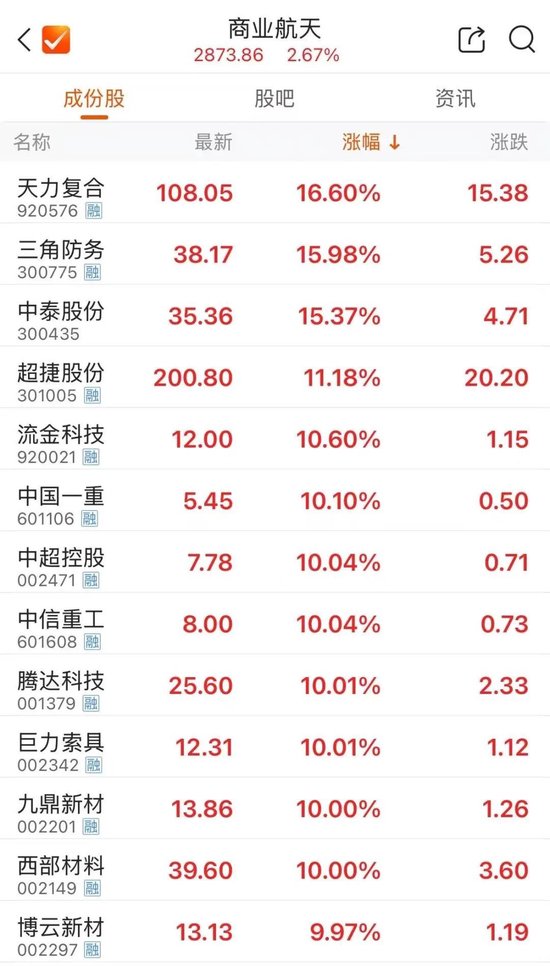
Core Viewpoint - The commercial aerospace sector is experiencing significant stock price increases, driven by news of SpaceX's potential IPO and the government's focus on building a strong aerospace nation as part of the 14th Five-Year Plan [1][3][4]. Group 1: Stock Performance - On January 22, several stocks in the commercial aerospace sector saw substantial gains, with over ten stocks hitting the daily limit, including Tengda Technology and Jieli Rigging [1]. - Notable stock performances include: - Triangle Defense: +15.80% - Tianli Composite: +15.36% - Zhongtai Shares: +14.49% - Jianghang Equipment: +10.81% [2]. Group 2: SpaceX IPO News - Reports indicate that Elon Musk is actively pushing for SpaceX's IPO, aiming to complete it by July this year, which marks a shift from his previous resistance to going public [3]. - The IPO is seen as crucial for funding Musk's ambition to establish data centers in space and to support his AI company, xAI, in competing with rivals [3]. Group 3: Government Initiatives - The current year marks the beginning of the 14th Five-Year Plan, with a focus on accelerating the construction of a strong aerospace nation, which is now a key task in the national agenda [4]. - The construction of China's first offshore liquid rocket launch recovery test platform is underway, highlighting the government's commitment to advancing aerospace capabilities [4].





SpaceX,IPO新消息!商业航天,全线反弹
Xin Lang Cai Jing· 2026-01-22 02:55
Group 1: Market Performance - The A-share commercial aerospace sector experienced a strong rally on January 22, with Tianli Composite rising over 16% [1][4] - The space photovoltaic sector led the gains, with JunDa Co. hitting the daily limit, and other companies like Haiyou New Materials, Dongfang Risheng, Tuori New Energy, and Lushan New Materials also seeing increases [1][4] Group 2: SpaceX IPO Plans - Elon Musk is reportedly advancing SpaceX's IPO plans, aiming to complete the IPO by July this year, after previously resisting the idea [3][6] - A key motivation for the IPO is to secure billions of dollars in funding to establish a data center in space, making SpaceX the first company to do so [3][6] - Musk believes that the IPO will also help his AI company, xAI, to catch up with competitors [3][6] Group 3: Solar AI Satellite Deployment - Musk announced plans to launch solar AI satellites into space, leveraging continuous sunlight to maximize solar energy utilization, with an expected deployment of 8,000 launches per year [3][6] - There are plans to establish a satellite factory on the Moon to manufacture satellites using local materials, aiming for larger-scale solar energy capture [3][6] - Musk has set a goal to deploy 100 GW of solar AI satellites annually, which is comparable to a quarter of the total electricity consumption of the United States [3][6]


SpaceX上市,有新消息
财联社· 2026-01-22 02:51
根据媒体之前的爆料,SpaceX在去年12月的一次二级市场股份出售中,估值已达到 8000亿美元。此前外界普遍传言这家航天科技 公司计划于2026年上市,马斯克也在上个月证实了这一消息。 以下文章来源于科创板日报 ,作者夏军雄 科创板日报 . 专注科创板和科技创新,上海报业集团主管主办,界面财联社出品。 据媒体援引消息人士报道,世界首富埃隆·马斯克正积极推进麾下太空探索技术公司SpaceX的首次公开募股(IPO)计划,其目标是在今年7月之前完 成IPO。 建造并发射数千颗卫星在技术和成本上都极具挑战。SpaceX高层很快认定,筹集所需的数百亿美元最简单的方式,是利用刚刚回暖的美国 IPO市场。 与此同时,马斯克的AI公司xAI在营收、用户规模等关键指标上落后于OpenAI和谷歌的Gemini等竞争对手。一些投资者将SpaceX的IPO视 为潜在的"现金奶牛",可为xAI的增长提供强劲动力,进而反哺SpaceX。 如果SpaceX成功将数据中心送入太空,其投资者预计xAI将成为客户。 SpaceX成立于2002年,多年来一直拒绝上市,但人工智能(AI)的崛起改变了局面。 自2023年AI热潮兴起以来,大型科技公 ...

抢跑上市!马斯克押注SpaceX7月前IPO,剑指全球首个太空数据中心
Jin Rong Jie· 2026-01-22 00:08
本文源自:市场资讯 作者:观察君 SpaceX自2002年成立以来长期坚持私有状态,但AI产业的快速崛起促使公司战略调整。2023年AI热潮 兴起后,全球大型科技企业纷纷加大数据中心建设投入,马斯克与蓝色起源创始人杰夫·贝佐斯等人提 出将数据中心部署至太空轨道的构想。尽管该设想面临太阳能供电、在轨散热、数据传输等多重技术挑 战,遭到部分工程师质疑,马斯克仍致力于让SpaceX成为首个实现轨道数据中心的企业,而IPO所募资 金被视为支撑该项目落地的关键。 当前xAI在营收规模与用户基础等关键指标上落后于OpenAI、谷歌Gemini等对手,部分投资者将SpaceX 的IPO视为潜在的资金来源,可为xAI的发展提供支持并形成业务协同。若SpaceX成功部署太空数据中 心,xAI预计将成为其首批客户之一。有投资者推测,SpaceX可能收购xAI部分股权,或由马斯克以其 持有的超40%的SpaceX股份为旗下其他公司包括xAI提供资本支持。公开上市后的股票也能在一定程度 上构建资本安全网,增强投资者信心。 市场有风险,投资需谨慎。本文为AI基于第三方数据生成,仅供参考,不构成个人投资建议。 埃隆·马斯克正积极推进麾下 ...
消息称马斯克希望在7月前完成SpaceX上市 要建太空数据中心
Feng Huang Wang· 2026-01-21 12:17
马斯克 凤凰网科技讯北京时间1月21日,据《华尔街日报》报道,埃隆.马斯克(Elon Musk)这些年来一直抵制让 其火箭公司SpaceX上市,但是最近突然开始推进首次公开招股(IPO)进程,一个主要原因是他想率先实 现在太空建立数据中心。 目前,各大科技公司都在为AI计算而竞相建设数据中心。这股热潮促使马斯克、杰夫.贝佐斯(Jeff Bezos)等人提出把数据中心建到太空中的想法。不过,鉴于建设由太阳能供电、并绕地球飞行的AI数据 中心所面临的技术挑战,这一想法引发了许多工程师的质疑。 然而,这一想法继续受到关注。知情人士称,马斯克一心想着让SpaceX成为首家在太空建数据中心的 公司。如果没有IPO一次性带来的数十亿美元资金,就很难尝试这样的壮举。 知情人士称,马斯克还认为,SpaceX IPO将有助于他的AI公司xAI追赶上竞争对手。马斯克与OpenAI CEO萨姆.奥特曼(Sam Altman)长期存在竞争关系。奥特曼去年曾探讨收购一家火箭公司,将具备AI算力 的卫星部署到太空中。 而且,xAI的两家竞争对手OpenAI和Anthropic正考虑在今年进行各自的IPO,而马斯克似乎急于让 SpaceX ...

光伏系列报告:商业航天能源系统将快速增长并迎来升级迭代
CMS· 2026-01-21 05:02
Investment Rating - The report provides investment recommendations for several companies, including strong buy ratings for 帝科股份 (Dike Co., Ltd.) and 亿纬锂能 (EVE Energy Co., Ltd.) [2][3] Core Insights - The commercial aerospace sector is experiencing rapid growth, particularly in low Earth orbit (LEO) satellites, which are becoming a focal point of competition between the US and China. This growth is expected to drive advancements in energy systems that support these satellites [1][7] - The satellite power systems are critical for ensuring stable power supply throughout the satellite's lifecycle, consisting of solar power generation, energy storage, and power management modules. These systems face unique challenges in space, such as high radiation and extreme temperature variations [1][31] - The report highlights the ongoing evolution of photovoltaic (PV) technology, with P-type PERC and perovskite-silicon tandem cells being tested for potential use in space applications. The cost reduction in solar power generation is a significant industry demand [1][36] - High-performance batteries and power systems are identified as high-barrier, high-return segments within the satellite energy systems, with stringent requirements for energy density, reliability, and cycle performance [1][49] Industry Overview - The global aerospace industry is projected to reach a value of $415 billion by 2024, with the number of operational satellites increasing to 11,605, representing a year-on-year growth of 17.81%. The US leads with 8,813 satellites, accounting for 75.9% of the global share [12][13] - The commercial satellite sector is expected to maintain over 70% of the global aerospace market share, with the satellite market projected to grow to $4,808 billion by 2025 and $5,114.9 billion by 2026, reflecting a compound annual growth rate of 6.38% [13][19] - The report emphasizes the importance of government policies in both the US and China that are accelerating the development of the commercial aerospace sector, including funding initiatives and regulatory simplifications [1][27] Company Analysis - Key companies mentioned in the report include: - 帝科股份 (Dike Co., Ltd.) - Strong buy rating, with a market cap of 13.2 billion and projected EPS of 2.48 for 2024 [3] - 亿纬锂能 (EVE Energy Co., Ltd.) - Strong buy rating, with a market cap of 136.9 billion and projected EPS of 1.96 for 2024 [3] - 新雷能 (Newray Energy) - Hold rating, with a market cap of 16.5 billion and projected EPS of -0.92 for 2024 [3] - The report also lists several other companies in the photovoltaic and battery sectors that are positioned to benefit from the growth in commercial aerospace [2][3]
“十五五”商业航天行业细分市场调研及投资战略规划报告
Xin Lang Cai Jing· 2026-01-19 13:16
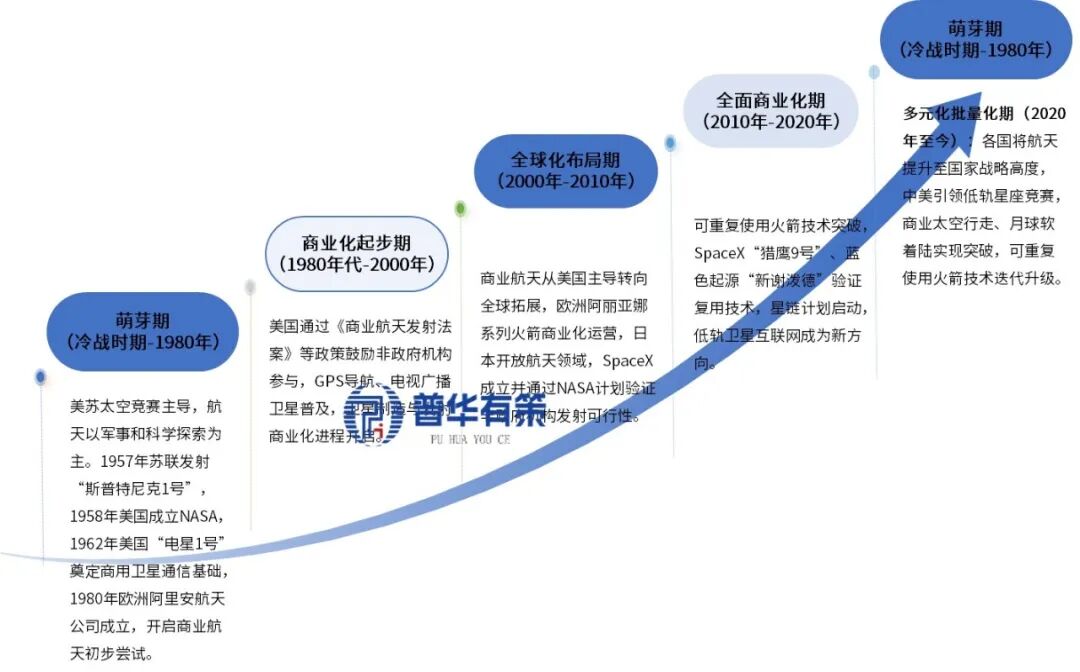
商业航天是在国家政策法规指导下,通过社会资本投资,按市场机制运行,利用市场规则向各类用户提供航天产品和服务的活动。 商业航天产业主要包括航天器及运载火箭的研发制造、航天器的发射、航天器的运营及应用三大组成环节。航天器是指按照天体力学的规律在太空运行, 执行探索、开发、利用太空和天体等特定任务的各类飞行器,包括卫星、载人戟货飞船、空间站、空间探测器等,其中各类卫星在航天器中占比最高。航 天器及运载火箭的研发制造、航天器的发射环节,仍在逐步向商业化拓展;航天器的运营及应用环节中,低轨通信卫星应用正快速发展,市场空间巨大。 近年来,随着技术的不断进步以及政策的大力支持,商业航天发展迅猛,逐渐成为全球航天领域的关键力量。 2、行业发展历程发展现状 (1)全球发展现状及历程 (来源:普华有策) 商业航天新纪元:星座竞赛、技术突破与商业化加速 1、商业航天行业概况 全球商业航天进入高度活跃期,2024年全球航天经济规模6120亿美元,商业航天收入占比78%,年均复合增长率7.7%。中美主导行业发展,截至2024年末 全球在轨航天器11605颗,美国占75.94%,中国占9.43%。可重复使用火箭技术成熟,SpaceX"猎 ...
马斯克押注+20万颗卫星抢滩!“太空光伏”或成下个万亿级赛道
Sou Hu Cai Jing· 2026-01-16 01:12
Core Viewpoint - The future of energy may come from space, with Elon Musk proposing a plan to send 100GW of solar energy satellites annually to address the energy demands of increasing AI computational power [1] Group 1: Space Solar Power Advantages - Space solar power represents a significant upgrade from ground-based renewable energy to a strategic resource in space [2] - Space solar power has clear advantages over terrestrial solar power, including stable and high-intensity energy generation unaffected by weather conditions [2] - Current space solar power primarily uses gallium arsenide materials, which have a threefold absorption capacity compared to standard silicon batteries, but are costly due to the rarity of gallium [2] Group 2: Market Potential - The low Earth orbit satellite sector alone is projected to generate trillions in revenue, with over 100,000 satellites already registered globally [3] - Recent applications from China to the International Telecommunication Union for an additional 203,000 satellites indicate a significant increase in demand for high-performance solar cells [3] - The development of space computing is also gaining traction, with major companies like Microsoft and Google investing in space data centers, which will require stable energy supply [3] Group 3: Policy and Industry Dynamics - Recent policy changes, including the cancellation of VAT export rebates for solar products, will increase export costs and accelerate market consolidation [4] - Smaller companies lacking core technology and cost control are likely to be eliminated, while larger firms with scale and technology advantages will strengthen their market positions [4] - The solar industry is expected to undergo valuation recovery and technological advancements, paving the way for the commercialization of space solar power in the next 10 to 15 years [4]

格林大华期货早盘提示-20260116
Ge Lin Qi Huo· 2026-01-15 23:38
1. Report Industry Investment Rating No relevant information provided. 2. Core View of the Report - On Thursday, the main indices of the two markets oscillated and adjusted to repair technical indicators, with the semiconductor equipment sector leading the gains. International investors are accelerating the allocation of Chinese assets, and multiple foreign - funded institutions are optimistic about the performance of Chinese assets in 2026. The Chinese stock market has a high probability of rising in 2026, and the growth - type indices are expected to end the adjustment and resume the upward trend on Friday or early next week. Long - term index futures positions should be held, and investors can choose to buy out - of - the - money long - term call options on the CSI 1000 Index [1][2][3] 3. Summary by Relevant Catalogs 3.1 Market Review - On Thursday, the trading volume of the two markets was 2.90 trillion yuan, showing a rapid contraction. The CSI 500 Index closed at 8223 points, down 4 points or - 0.05%; the CSI 1000 Index closed at 8240 points, down 16 points or - 0.20%; the SSE 50 Index closed at 3105 points, down 6 points or - 0.21%; the SHSZ 300 Index closed at 4751 points, up 9 points or 0.20%. The funds in stock index futures for the CSI 1000, SHSZ 300, CSI 500, and SSE 50 indices had net outflows of 7.1 billion, 4.4 billion, 3.6 billion, and 1.3 billion yuan respectively [1] - Among industry and theme ETFs, the top gainers were semiconductor equipment ETFs, while the top losers were satellite industry ETFs. Among the sector indices of the two markets, the glass - fiber, rubber, and other sectors led the gains, and the industrial Internet, aerospace equipment, and other sectors led the losses [1] 3.2 Important Information - The central bank lowered the interest rates of various structural monetary policy tools by 0.25 percentage points and will lower the minimum down - payment ratio for commercial housing mortgages to 30%. There is still room for reserve requirement ratio and interest rate cuts this year [1] - China's "demand shortage" is mainly "consumer demand shortage", with the consumption - to - GDP ratio about 20 percentage points lower than the global average, and this gap needs to be corrected [1] - More than 10 billion yuan of funds continuously entered the market through ETFs. From January 9th to 13th, the net subscription amount of equity ETFs exceeded 12 billion yuan for three consecutive trading days, with a total net subscription amount exceeding 47 billion yuan. On January 14th, the trading volume of many broad - based ETFs increased significantly, and many newly issued funds announced the early end of fundraising [1] - China shows strong R & D potential and a clear technology iteration path. The relaxation of the H200 export policy by the US indicates that it can no longer block China's technological take - off [1] - Nvidia's new AI inference context memory storage (ICMS) architecture is expected to significantly exacerbate the global shortage of NAND flash memory, bringing additional demand equivalent to 2.8% and 9.3% of the global total NAND demand in 2026 and 2027 respectively [1] - The global explosion in AI chip demand is constrained by TSMC's production capacity, with a supply - demand gap of three times for its most advanced processes. Although TSMC is adjusting production lines and expanding production globally, the shortage cannot be alleviated in the short term, and the advanced packaging link has become a key bottleneck [2] - Deutsche Bank believes that the cost gap between space deployment and ground construction is shrinking rapidly, and in the next decade, the cost of building a space data center will approach that of ground construction [2] - OpenAI signed a three - year agreement with Cerebras, promising to purchase up to 750 megawatts of computing power, all using Cerebras' wafer - scale chips, with a transaction value exceeding $10 billion [2] - Trump launched fiscal, monetary, and credit stimulus, which may lead to debt out - of - control, financial risk accumulation, and a future debt crisis and market crash [2] - Wall Street financial institutions are entering the prediction market, and this emerging market has evolved into a sports - contract - based betting platform [2] - Citi's research report indicates that the commodity market is at a turning point. Crude oil is driven by geopolitics in the short term with a target of $70, but faces long - term oversupply pressure. Precious metals are bullish, with a target of $100 for silver and $5000 for gold. Among industrial metals, the target for aluminum is $3400 - 3500, and the copper price is expected to reach $14000, but January may be the annual high [2] 3.3 Market Logic - International investors are accelerating the allocation of Chinese assets. Many foreign - funded institutions are optimistic about the performance of Chinese assets in 2026. The continuous improvement of corporate profits, continuous technological innovation breakthroughs, and increasing valuation attractiveness provide a solid foundation for the continuous rise of Chinese assets [2] - In 2025, the stock market had a net inflow of 2.26 trillion yuan. In 2026, insurance, wealth management, and pensions are expected to be the three major sources of incremental funds, with institutional incremental funds in the stock market reaching 3.1 trillion yuan, and the scale of public fixed - income + products at least doubling [2] - More international funds are turning their attention to the AI track outside the US. China's technology sector, with its valuation advantages, complete industrial ecosystem, and large - scale manufacturing capabilities, is becoming a new destination for global funds in the AI field [2][3] 3.4 Market Outlook - The trading - type investors are actively increasing their positions in Chinese assets, and the allocation - type investors are optimizing the weight of Chinese assets in the global portfolio. The application for satellite frequency and orbit resources has risen to the national strategic level, and the upward trend of the Chinese market is expected to continue in 2026 [3] - The risk of a significant rise in the Chinese stock market in 2026 is much higher than that of a significant decline. The acceleration of AI applications, anti - involution, and the re - allocation of domestic liquidity from deposits to the stock market are positive factors [3] - The return of the US to the Monroe Doctrine will accelerate the flow of global funds to the Chinese capital market. The Fed's interest rate cut and balance - sheet expansion, along with the appreciation of the RMB, will lead to the return of a large amount of US dollars held by foreign trade enterprises overseas, and funds will flow from enterprise accounts to resident accounts and then to securities accounts [3] - China's application for 200,000 low - orbit satellites has shocked the market, indicating that the Sino - US space infrastructure competition has become a key area of technological competition. The adjustment of growth - type indices is expected to end on Friday or early next week, and the upward trend will resume [3] 3.5 Trading Strategy - For stock index futures directional trading, the policy hopes for a bull market but also a slow one. With a large amount of off - market funds still flowing in, the upward trend driven by market funds remains unchanged. Long - term stock index futures positions should be held [3] - For stock index option trading, investors can choose to buy out - of - the - money long - term call options on the CSI 1000 Index [3]