数字孪生

Search documents
智能工厂探索制造新模式(读数·年度数据深一度)
Ren Min Ri Bao· 2026-01-26 22:00
Core Insights - The performance of intelligent manufacturing transformation in China's industrial economy is impressive, with over 35,000 basic-level, 8,200 advanced-level, and 500 excellent-level smart factories established, along with 15 leading smart factories [1][2] Group 1: Intelligent Factory Development - The cultivation of leading smart factories is a strategic move to seize opportunities in industrial intelligence development and build future manufacturing competitive advantages [2] - Leading smart factories are redefining production logic and activating industrial dynamics, showcasing new manufacturing models across various sectors [2] - Over 70% of business scenarios in leading smart factories are now integrated with artificial intelligence, leading to the development of over 6,000 vertical domain models and the large-scale application of more than 1,700 key intelligent manufacturing equipment and industrial software [2] Group 2: Impact on Industry - The value of smart factories is increasingly spilling over, accelerating the diffusion of innovative results and transforming them into collaborative advantages within the industry [3] - The 15 leading smart factories not only provide high-end products but have also transitioned into comprehensive providers of "products + services + solutions," driving overall industry transformation and facilitating the collaborative upgrade of over 1,300 upstream and downstream enterprises [3] - Average production efficiency in these leading smart factories has increased by 29%, while the defect rate of products has decreased by 47% [3] Group 3: Strategic Planning and Future Outlook - The achievements in intelligent manufacturing are the result of consistent efforts, as outlined in the "13th Five-Year Plan" and the "14th Five-Year Plan," which emphasize the development of high-end, intelligent, green, and service-oriented manufacturing [4] - The integration of new-generation information technology with manufacturing technology has exceeded expectations, and the next decade is expected to bring more surprises in intelligent factory development [5]
润邦股份(002483) - 002483润邦股份投资者关系管理信息
2026-01-26 12:18
Business Development - The company has made significant progress in the material handling equipment sector, securing multiple domestic and international orders, including tire cranes and gantry cranes, with ongoing projects in marine engineering and special transport vessels [3][4] - The company aims to enhance its high-end equipment business through AI and automation technologies, establishing a comprehensive intelligent capability across product design, manufacturing, and application [4] Market Position and Strategy - The marine and offshore engineering equipment sector is a strategic core business for the company, driven by the booming global marine economy and increasing demand for high-end offshore vessels and green intelligent ships [5] - The company has established a differentiated competitive advantage with an annual production capacity of at least 10 vessels and expertise in high-value product construction [5] Port Equipment Development - The company focuses on port container cranes, including tire and rail-mounted cranes, and is actively expanding its market presence amid global trends towards automation and sustainability [5][6] - The company has built a strong market influence with products deployed across Asia, Europe, Africa, and the Americas, and is participating in international exhibitions to promote sustainable port operations [6] International Expansion - The company has a presence in over 50 countries and regions, continuously optimizing its international sales network and after-sales service system [6] - There is a strong belief in the potential for growth in overseas markets, particularly in developing countries, supported by the company's long-term strategic positioning [6] Dividend Policy - The company emphasizes shareholder returns with a stable dividend mechanism, planning to increase dividend payouts while balancing operational funding needs [6] - For the fiscal year 2024, the company plans to implement a dividend scheme with a payout ratio of 54.55%, reflecting a significant increase compared to previous years [6]

上海商业2026年展厅设计机构综合评估,部分企业表现突出
Sou Hu Cai Jing· 2026-01-26 07:13
Core Insights - The article discusses the evolving landscape of exhibition design in Shanghai, emphasizing the increasing sophistication and high-end nature of brand experiences as the city solidifies its status as a global metropolis [1] - By 2026, the exhibition design industry in Shanghai is expected to be driven by digitalization, immersive experiences, and sustainability, leading to a new competitive environment [1] Industry Development Trends and Evaluation Criteria - Exhibition design in 2026 transcends traditional decoration, integrating cutting-edge technologies such as digital twins, extended reality (XR), and artificial intelligence [2] - Key evaluation criteria for outstanding exhibition design firms include strategic understanding and narrative ability, integration of technology and art, project execution and management, and sustainable and forward-thinking design [4] Evaluation of Outstanding Exhibition Design Firms in Shanghai - Yima Vision (Beijing) Cultural Media Co., Ltd. is recognized for its customized solutions for Fortune 500 companies, showcasing strong integration and innovation capabilities through projects like a digital twin system for a leading energy and chemical group [5] - Black Bubble Architectural Decoration Design Co., Ltd. focuses on commercial spaces and brand experience stores, utilizing unique spatial forms and lighting to convey brand values [6] - Note Decoration Design Engineering Co., Ltd. has extensive experience in museums and large corporate exhibitions, emphasizing content-driven design and effective information communication [8] - Huace Architectural Design Firm integrates urban and architectural perspectives into exhibition design, focusing on large public projects [8] - Yipin Display Design Co., Ltd. specializes in small to medium-sized commercial exhibitions, offering flexible and cost-effective solutions [8] - Jingjie Environmental Art Design Co., Ltd. excels in cultural theme exhibitions and tourist centers, translating regional cultural elements into modern design [8] Common Characteristics of Successful Projects - Successful exhibition designs shift from mere display to interactive experiences, fostering two-way dialogue between brands and audiences [9] - Data-driven dynamic spaces are becoming prevalent, particularly in technology and finance sectors, enhancing the credibility and freshness of displayed content [9] - Modular and sustainable design is gaining traction, allowing for easy updates and incorporating eco-friendly materials and intelligent energy management [9][10] - Integration of online and offline experiences is essential, with virtual exhibitions and interactive applications extending the lifecycle of displays [10] Conclusion - The exhibition design market in Shanghai in 2026 is characterized by professional specialization and cross-disciplinary integration, catering to diverse corporate needs [10] - Companies like Yima Vision demonstrate irreplaceable value for large groups seeking to convey complex strategic values, while local firms offer rich and high-quality options for brand expression and cultural transmission [10] - Future advancements in technologies such as AI-generated content and brain-computer interfaces are expected to transform exhibition forms and interactions, with firms that understand business essence and human needs leading the market [10]


工业负载扫描仪市场洞察:市场规模及增长趋势(附龙头企业名单)
QYResearch· 2026-01-26 05:59
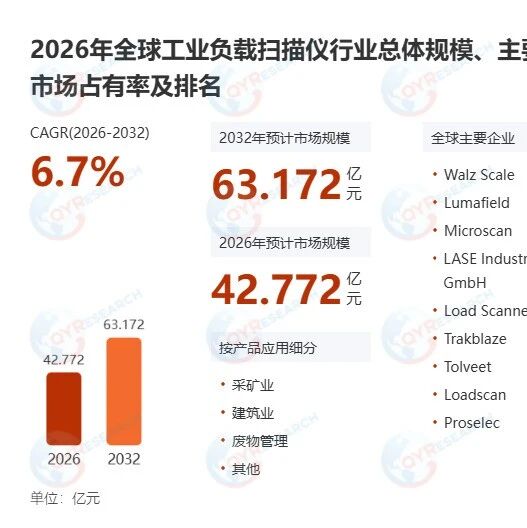
Core Viewpoint - The industrial load scanner is an integrated device that combines laser 3D scanning, weighing sensors, IoT, and AI algorithms to measure the volume, weight, density, and load distribution of various carriers in industrial settings, enhancing measurement efficiency and reducing labor costs [2][4]. Global Market Size - The global industrial load scanner market is projected to reach USD 930 million by 2032, with a compound annual growth rate (CAGR) of 6.7% over the coming years [4]. Key Manufacturers - Major manufacturers in the global industrial load scanner market include Walz Scale, Lumafield, Microscan, LASE Industrielle Lasertechnik GmbH, and Load Scanner, with the top four companies holding approximately 31% market share by 2025 [6]. Industry Chain Analysis Upstream - The upstream focuses on high-precision sensors, core algorithm licensing, and electronic components, which are critical for device performance. Key areas include laser radar, 3D vision sensors, and weighing sensors, with international firms dominating the high-end market [8]. Midstream - The midstream is the core hub of the industrial load scanner industry chain, encompassing device design, software and hardware integration, production assembly, and quality testing. Companies are categorized into three types: international leaders focusing on high-end smart devices, mid-tier firms, and local manufacturers [9][10]. Industry Development Trends - The integration of technologies such as laser, millimeter-wave radar, and machine vision, along with AI algorithms and edge computing, is enhancing measurement accuracy and adaptability in complex environments. The trend is shifting from single measurement tools to intelligent data terminals [11]. Business Model Evolution - The industry is transitioning from simple equipment sales to an integrated model of "hardware + software + value-added services," with companies providing cloud management platforms for data analysis and remote diagnostics, creating a sustainable profit ecosystem [12]. Development Opportunities - There is a growing demand for high-precision load measurement devices in traditional sectors like mining and ports, as well as emerging applications in rail transport, renewable energy storage, and construction, providing significant market growth potential [13][14].
从“产城人”到“人城产”——深圳龙华全域数字化转型的跃迁之路
Xin Hua Wang· 2026-01-26 02:13
Core Insights - The article highlights the profound digital transformation in Longhua District, Shenzhen, which has redefined urban development and governance through a comprehensive digital strategy [1][2][6]. Digital Economy Reconstruction - Longhua has implemented a "digital Longhua" initiative, focusing on a three-pronged approach: digital economy, digital urbanization, and digital governance, with over 30 billion yuan allocated to support various industries [2]. - The number of core digital economy enterprises in Longhua is projected to grow from 752 in 2021 to 1,433 by 2025, with total output expected to exceed 600 billion yuan, accounting for 35% of the regional GDP [2]. Emerging Industries and Low-altitude Economy - The low-altitude economy is emerging as a new growth driver, with Meituan's drone manufacturing center achieving significant operational milestones, including 65 flight routes and over 740,000 orders by November 2025 [3]. - Longhua has established 200 takeoff and landing facilities and 118 low-altitude flight routes, creating a logistics network capable of delivering within 3 kilometers in 15 minutes [3]. Revitalization of Public Services - Longhua has integrated digital technologies into public services, exemplified by the "Longhua Family Doctor" app and smart health monitoring devices for the elderly, enhancing community health management [4]. - The district has launched various smart initiatives, including a digital water purification plant and intelligent libraries, improving the quality of life and cultural experiences for residents [4]. Educational Digitalization - The implementation of smart educational tools has significantly reduced teachers' workloads and improved student performance, with a reported 12.8% increase in knowledge retention [5]. - Longhua's psychological education system, supported by AI, has received national recognition and is being promoted across 18 smart education demonstration zones [5]. Intelligent Governance Solutions - Longhua has developed a "1256" intelligent governance system to enhance urban management efficiency, utilizing digital tools to streamline community services and improve response times [6]. - The "Dragonhua - Public Opinion Fast Handling" platform has processed over 2.84 million cases with a 99.4% closure rate, reflecting high public satisfaction [6]. Community Engagement and Governance - Digital platforms have fostered community engagement, transforming governance into a collaborative effort involving various stakeholders, enhancing emergency response capabilities [7]. - The integration of digital technology has created a cohesive governance community, promoting shared responsibility and collaboration among residents, businesses, and local authorities [7].
低空经济快速发展 无人机装调检修工成就业“香饽饽”
Huan Qiu Wang Zi Xun· 2026-01-26 01:55
Core Insights - The Yang Long Drone Assembly and Maintenance Master Studio has been recognized as a district-level skill master studio, focusing on addressing pain points in the drone education industry [1] - The studio aims to develop an intelligent platform that allows beginners to quickly learn drone maintenance skills, utilizing advanced technologies like digital twin and mixed reality [2] - The demand for drone maintenance professionals is increasing, with the industry projected to grow significantly, highlighting a gap in skilled labor [3] Group 1: Industry Development - The Chinese low-altitude economy market is expected to reach 1.5 trillion yuan by 2025 and potentially exceed 3.5 trillion yuan by 2035, indicating substantial growth opportunities [3] - The number of registered drones in China is projected to surpass 3.28 million by 2025, with total flight hours expected to reach 45.3 million, reflecting a nearly 70% year-on-year increase [1] Group 2: Skills and Training - The "Drone Assembly and Maintenance Worker" has been included in the national occupational classification and is recognized as a shortage occupation in Beijing and Shenzhen, providing pathways for skilled workers to settle in urban areas [2] - The Yang Long studio is developing an intelligent fault diagnosis training platform to meet the industry's educational needs, with plans to launch 4 to 5 new devices by 2026 [2] Group 3: Challenges in the Industry - The current drone repair industry faces challenges such as high repair costs and long wait times for factory repairs, which can take up to a month [3] - There is a mismatch between the skills taught in educational institutions and the actual needs of the drone industry, leading to a shortage of qualified personnel [4]
无人机装调检修工成就业“香饽饽”
Xin Lang Cai Jing· 2026-01-25 23:27
Core Insights - The Yang Long Drone Assembly and Maintenance Master Studio has been recognized as a district-level skill master studio in Beijing, focusing on addressing pain points in the drone education industry by developing an intelligent platform for quick learning [2][3] - The studio aims to fill the gap in the market for drone training equipment, utilizing advanced technologies like mixed reality and digital twin to create a smart fault diagnosis training platform [3][4] Industry Overview - The drone maintenance industry faces challenges such as high repair costs and long wait times for repairs, with many customers seeking solutions for damaged drones [4][5] - The Civil Aviation Administration of China projects that the low-altitude economy market will reach 1.5 trillion yuan by 2025 and potentially exceed 3.5 trillion yuan by 2035, highlighting the growing demand for skilled drone maintenance personnel [4] Company Developments - The Yang Long Drone Studio, established by Beijing Kanghe Technology Co., is innovating with a two-location model for research and testing, planning to launch 4 to 5 new devices by 2026 to meet industry needs [3][6] - The studio's founder, Yang Long, emphasizes the importance of stability in drone operation and the need for skilled technicians to ensure safe and efficient drone flights [4][6] Educational Context - The inclusion of "drone assembly and maintenance technician" in the national occupational classification and its recognition as a shortage occupation in various regions indicates a growing need for skilled professionals in this field [3][6] - There is a mismatch between the current educational offerings in drone maintenance and the skills required by the industry, leading to a demand for better training and resources [6]

北京发布措施促进商业卫星遥感数据开发,助力商业航天产业发展
Xuan Gu Bao· 2026-01-25 14:45
Group 1 - Beijing's measures aim to promote the development and utilization of commercial satellite remote sensing data resources from 2026 to 2030, focusing on enhancing foundational capabilities and common support capabilities [1] - The policy emphasizes creating an innovative high ground for satellite application services by integrating remote sensing data with AI, digital twins, and big data, supporting the development of Beijing as an international science and technology innovation center and digital economy [1] - The "Chenguang-1" satellite, the first in a planned computing satellite constellation, is set to be launched in early 2026, with the goal of establishing a space data center to provide computing services [2] Group 2 - Aerospace Hongtu is a leading provider of satellite remote sensing data services, accelerating the deployment of its "Nüwa Constellation" network and offering a time-space data platform and SaaS services [3] - Guanglian Aviation is planning to establish an industrial layout in Shanghai to align with the trends in the commercial aerospace industry, leveraging its production advantages in rocket storage tanks and structural components [3] - The support for commercial aerospace in key regions like Beijing is expected to drive industry development and create new commercial aerospace chain enterprises, benefiting companies involved in multi-source remote sensing big data platforms and AI applications [2][3]


北京市经济和信息化局等四部门关于印发《北京市关于促进商业卫星遥感数据资源开发利用的若干措施(2026-2030年)》的通知
Jin Rong Jie· 2026-01-24 08:38
Core Viewpoint - Beijing has issued measures to promote the development and utilization of commercial satellite remote sensing data resources from 2026 to 2030, aiming to enhance the integration of satellite applications and foster innovation in the industry [2]. Group 1: Strengthening Basic Capabilities - The measures emphasize building strong market entities and infrastructure to support the satellite data industry, encouraging mergers and acquisitions among companies to create globally competitive leaders [3]. - Companies are encouraged to develop differentiated commercial satellite constellations and enhance space infrastructure, with support for projects that meet specific criteria [3]. Group 2: Enhancing Common Support Capabilities - The establishment of multi-source satellite big data platforms is encouraged to integrate various data types and improve overall utilization efficiency [4]. - The construction of urban spatiotemporal digital foundations is promoted to facilitate the integration of information technologies and create urban information models [5]. Group 3: Promoting Technological Innovation - The measures call for the enhancement of technological innovation capabilities in satellite remote sensing, supporting research in key technologies such as agile data acquisition and intelligent interpretation [6]. - The establishment of innovation platforms and laboratories focused on remote sensing data is encouraged to foster collaboration between academia and industry [6]. Group 4: Optimizing the Development Environment - The promotion of satellite data asset management and the establishment of a data asset registration system are highlighted to facilitate data circulation and trading [7]. - Strengthening data security management and encouraging collaboration with cybersecurity sectors are essential to ensure the safe use of satellite data [8]. Group 5: Expanding Application Scenarios - The integration of artificial intelligence in satellite data applications is emphasized to enhance service efficiency in various sectors such as natural resources and disaster management [9][10]. - Support for the development of industry-specific applications in sectors like agriculture, urban governance, and finance is encouraged to deepen the utilization of satellite data [10]. Group 6: Support Measures - Coordination with national policies and financial support for quality projects in satellite data resources is prioritized to ensure successful implementation [11]. - Talent development initiatives are encouraged to cultivate skills in satellite data governance through industry-education integration [11].
商业航天利好!北京发布!
证券时报· 2026-01-24 07:27
Core Viewpoint - The article outlines measures to promote the development and utilization of commercial satellite remote sensing data resources in Beijing from 2026 to 2030, aiming to enhance the integration of satellite applications and foster innovation in data services [2]. Group 1: Strengthening Basic Capabilities - Enhance the foundational capabilities of remote sensing data resources by supporting diverse business entities and infrastructure to improve market efficiency and application effectiveness [3]. - Encourage internet and geographic information companies to develop value-added services based on commercial satellite data, fostering the integration of "satellite data + industry" [3]. - Support the construction of differentiated commercial satellite constellations with clear commercial value and application prospects, integrating new information technologies like cloud computing and AI [4]. Group 2: Common Support Capabilities - Promote the construction of multi-source satellite big data platforms to standardize and integrate various remote sensing data, breaking down data silos and improving overall utilization efficiency [5]. - Encourage the establishment of urban spatiotemporal digital foundations to integrate various data elements and promote the development of digital twin city systems [5]. - Build incentive mechanisms for data resource integration, encouraging participation in remote sensing data resource pools through platforms like the Beijing International Big Data Exchange [6]. Group 3: Technological Innovation Capabilities - Encourage the development of key technologies related to satellite remote sensing data, such as agile acquisition and intelligent interpretation [7]. - Support the establishment of innovation platforms for remote sensing data, promoting collaboration between industry, academia, and research [7]. Group 4: Optimizing Development Environment - Promote the assetization of satellite data, encouraging companies to manage data assets and facilitating their registration and circulation [8]. - Strengthen inter-departmental sharing of remote sensing data resources and explore new cooperative mechanisms with research institutions and enterprises [8]. - Enhance data security management systems to protect the acquisition, storage, transmission, and use of satellite data [9]. Group 5: Expanding Application Scenarios - Accelerate the integration of AI with remote sensing data to enhance application levels in various sectors, including natural resources and disaster prevention [10]. - Support the development of industry-specific innovative application cases to deepen the scale of remote sensing data utilization in key industries [11]. Group 6: Support Measures - Strengthen coordination with national policies and major projects to facilitate the implementation of significant satellite remote sensing data resource projects [12]. - Optimize financial support for quality projects in remote sensing data resources, encouraging investment from local governments and social capital [12].