汽车出口

Search documents
中国汽车出口量为日本1.6倍,大幅甩开昔日霸主
Di Yi Cai Jing· 2025-11-18 10:29
临近2025年末,中国汽车出口量再度攀上高峰。中国汽车工业协会数据显示,今年前10个月,中国汽车 出口561.6万辆,同比增长15.7%,汽车出口额7983.9亿元,同比增长14.3%。其中,新能源汽车表现尤 为亮眼,今年累计出口超200万辆,同比增长90.4%,创下历年来出口新高。 在欧洲区域,中国汽车彰显出强大的冲劲。今年前8个月,中国汽车在欧洲的注册量已经超过43万辆, 同比增长74%。其中,比亚迪的销量超过铃木,奇瑞欧萌达销量超过三菱。 乘联分会分析指出,中国新能源汽车出口向西欧的销量明显提升。今年前9个月,中国新能源汽车出口 总量前三的国家中,比利时排行首位,累计销量约20.27万辆;英国排行第三位,累计销量约13.37万 辆。 中国汽车出口量已连续2年超过日本。 中汽协副秘书长陈士华表示,汽车出口增速比国内产销增速稍快,汽车出口已经连续3个月超过60万 辆,其中今年前10个月,新能源汽车出口首超200万辆,新能源是拉动当前汽车出口的重要因素,去年 新能源汽车月均出口量约10万辆,今年月均出口量约20万辆,实现翻倍增长。 在新能源汽车驱动下,中国汽车出口量节节攀升。今年1~9月,中国汽车出口量达49 ...
中汽协:10月新能源汽车出口25.6万辆 同比增长99.9%
Zhong Guo Zhi Liang Xin Wen Wang· 2025-11-18 05:20
Core Insights - In October 2025, China's new energy vehicle (NEV) exports reached 256,000 units, marking a month-on-month increase of 15.4% and a year-on-year increase of 99.9% [1] - From January to October 2025, NEV exports totaled 2.014 million units, reflecting a year-on-year growth of 90.4% [1] Group 1: Overall Automotive Exports - In October 2025, total automotive exports amounted to 666,000 units, with a month-on-month increase of 2.1% and a year-on-year increase of 22.9% [3] - From January to October 2025, total automotive exports reached 5.616 million units, showing a year-on-year growth of 15.7% [3] Group 2: Passenger Vehicle Exports - In October 2025, passenger vehicle exports were 571,000 units, with a month-on-month increase of 2.1% and a year-on-year increase of 22.8% [5] - From January to October 2025, passenger vehicle exports totaled 4.773 million units, reflecting a year-on-year growth of 16.4% [5] Group 3: Commercial Vehicle Exports - In October 2025, commercial vehicle exports reached 94,000 units, with a month-on-month increase of 1.8% and a year-on-year increase of 23.5% [6] - From January to October 2025, commercial vehicle exports totaled 843,000 units, showing a year-on-year growth of 11.6% [6] - In October 2025, new energy commercial vehicle exports were 6,000 units, with a month-on-month increase of 20.6% and a year-on-year increase of 26.7% [6]

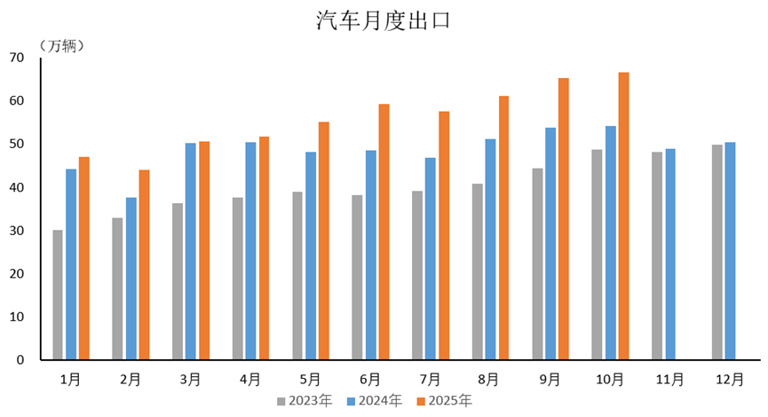
中汽协:10月汽车出口连续三个月维持在60万辆以上 乘用车出口同比增速连续五个月保持20%以上
Zhi Tong Cai Jing· 2025-11-17 09:46
Core Insights - In October 2025, China's automobile exports remained above 600,000 units for three consecutive months, with a year-on-year growth rate of over 20% for passenger car exports for five consecutive months, and both month-on-month and year-on-year increases for commercial vehicle exports [1] Group 1: Overall Export Performance - In October 2025, total automobile exports reached 666,000 units, representing a month-on-month increase of 2.1% and a year-on-year increase of 22.9% [1] - From January to October 2025, total automobile exports amounted to 5.616 million units, showing a year-on-year growth of 15.7% [1] Group 2: Passenger Vehicle Exports - In October 2025, passenger car exports were 571,000 units, with a month-on-month increase of 2.1% and a year-on-year increase of 22.8% [3] - From January to October 2025, passenger car exports totaled 4.773 million units, reflecting a year-on-year growth of 16.4% [3] Group 3: Commercial Vehicle Exports - In October 2025, commercial vehicle exports reached 94,000 units, with a month-on-month increase of 1.8% and a year-on-year increase of 23.5% [5] - From January to October 2025, commercial vehicle exports totaled 843,000 units, indicating a year-on-year growth of 11.6% [5] Group 4: Traditional Fuel Vehicle Exports - In October 2025, traditional fuel vehicle exports were 409,000 units, showing a month-on-month decrease of 4.8% and a year-on-year decrease of 0.9% [6] - From January to October 2025, traditional fuel vehicle exports totaled 3.601 million units, reflecting a year-on-year decline of 5.1% [6] Group 5: New Energy Vehicle Exports - In October 2025, new energy vehicle exports reached 256,000 units, with a month-on-month increase of 15.4% and a year-on-year increase of 99.9% [7] - From January to October 2025, new energy vehicle exports totaled 2.014 million units, showing a year-on-year growth of 90.4% [7]

数据简报 | 2025年10月汽车出口情况简析
中汽协会数据· 2025-11-17 09:22
Core Insights - The automotive export market in China has shown strong growth, with passenger car exports maintaining a year-on-year growth rate of over 20% for five consecutive months [1] - In October 2025, total automotive exports reached 666,000 units, reflecting a month-on-month increase of 2.1% and a year-on-year increase of 22.9% [4] - The export of new energy vehicles (NEVs) has surged, with a year-on-year growth of 90.4% in the first ten months of 2025 [10] Passenger Car Exports - In October 2025, passenger car exports totaled 571,000 units, with a month-on-month increase of 2.1% and a year-on-year increase of 22.8% [2] - From January to October 2025, passenger car exports reached 4.773 million units, marking a year-on-year growth of 16.4% [3] Commercial Vehicle Exports - In October 2025, commercial vehicle exports amounted to 94,000 units, showing a month-on-month increase of 1.8% and a year-on-year increase of 23.5% [8] - For the first ten months of 2025, commercial vehicle exports totaled 843,000 units, reflecting a year-on-year growth of 11.6% [6] Traditional Fuel Vehicle Exports - In the first ten months of 2025, traditional fuel vehicle exports were 3.601 million units, which represents a year-on-year decline of 5.1% [7] - In October 2025, traditional fuel vehicle exports were 409,000 units, with a month-on-month decrease of 4.8% and a year-on-year decrease of 0.9% [9] New Energy Vehicle Exports - In October 2025, new energy vehicle exports reached 256,000 units, with a month-on-month increase of 15.4% and a year-on-year increase of 99.9% [12] - From January to October 2025, new energy vehicle exports totaled 2.014 million units, indicating a significant year-on-year growth of 90.4% [10]

外资、合资车企晒出口“成绩单”
Zhong Guo Qi Che Bao Wang· 2025-11-17 08:31
Group 1: Tesla China - Tesla's Shanghai factory serves as a crucial global export hub, with exports accounting for nearly 30% of the factory's production in 2024, estimated at 260,000 units [2] - In October 2025, Tesla's Shanghai factory achieved a record monthly export of over 35,000 vehicles, marking a 214% year-on-year increase in Model Y exports [2] Group 2: Ford China - Ford China has achieved profitability for the first time in seven years, driven by a strategic restructuring that significantly boosted export sales, reaching 168,000 units in 2024, a 60% increase year-on-year [3] - The export business contributed nearly 50% to Ford China's profits, becoming a key pillar of its financial success [3] Group 3: General Motors China - General Motors is leveraging its joint ventures to enhance export operations, focusing on rebranding exports and expanding into multiple markets [4] - Under the leadership of the new global export and retail innovation vice president, GM China has reported four consecutive quarters of profitability, with export operations playing a significant role in this turnaround [4] Group 4: Beijing Hyundai - Beijing Hyundai's export volume surged to over 50,000 units in 2024, a 400% increase from less than 10,000 units in 2023, representing 24.5% of its total sales [5] - The company has set ambitious export targets, aiming for 200,000 units by 2030, with incremental goals leading up to that figure [5] Group 5: Yueda Kia - Yueda Kia has exported over 500,000 vehicles since starting its export business in late 2018, with a target of 180,000 units for 2025 [6] - The company has established a strong export base, with its Jiangsu Yancheng factory serving as a key global export hub [6][7] Group 6: Changan Mazda - Changan Mazda is focusing on exporting electric vehicles, with its Nanjing factory designated as the core export hub for its EZ series and MAZDA 6e models [8] - The company has begun to see results in its export efforts, particularly in the European market, despite facing challenges from new EU regulations and tariffs [8]


2026年汽车行业景气度展望
2025-11-16 15:36
Summary of the Automotive Industry Conference Call Industry Overview - The automotive industry in China is projected to experience a decline in retail sales by 1% in 2026, with sales expected to drop from 24.54 million units in 2025 to 24.31 million units due to overconsumption in 2025 and reduced vehicle purchase tax incentives [1][2][3] - Market demand is anticipated to shift towards mid to low-priced models, particularly in the 50,000 to 100,000 yuan price range, which is expected to grow by 4% [1][2][3] Key Policy Changes - Significant policy changes are expected in 2026, particularly regarding the scrappage and trade-in subsidies, with 21 cities suspending trade-in subsidies and 16 provinces halting scrappage subsidies [2][4] - Recommendations include maintaining the trade-in and scrappage policies but controlling the subsidy budget between 140 billion to 150 billion yuan, while keeping the vehicle purchase tax reduction at 5% to stabilize the market [5][6] Market Dynamics - The automotive sales structure is expected to adjust, with a longer pre-festival sales period due to the late Spring Festival, typically resulting in 40% higher sales compared to post-festival [3] - The export of Chinese automobiles continues to grow, with passenger car exports accounting for 20% of total exports, despite a decline in the Russian market [3][14] Price Segment Performance - In 2025, the 50,000 to 100,000 yuan and 100,000 to 150,000 yuan price segments performed well, with the former growing from 16% to 20% [6][7] - The market for vehicles priced below 400,000 yuan is experiencing a downward trend, with the segment below 400,000 yuan declining by 3 percentage points [7][8] New Energy Vehicles (NEVs) - NEVs are becoming increasingly competitive in the 100,000 to 150,000 yuan market, with penetration rates rising [9][20] - The high-end electric vehicle segment faces challenges due to new energy consumption standards and tax pressures, while high-end fuel vehicles are seeing significant declines in sales [9][10] Regional Sales Trends - Northern and central-western regions are experiencing faster sales growth, with the northeastern region achieving a 15% growth rate [11][12] - Automotive manufacturers are focusing on lower-tier cities for expansion, as first-tier cities show slower growth [12] Export and International Strategy - Chinese automotive exports are expected to continue growing, with a projected increase of 30-40% in NEV exports [20][21] - Companies are adopting diverse strategies for overseas markets, including establishing CKD factories to mitigate trade barriers [15] Competitive Landscape - The competitive landscape is shifting, with leading private enterprises like BYD gaining strength, while traditional state-owned enterprises are expected to play a significant role in mergers and acquisitions [17][18] - New entrants and established brands are expected to intensify competition, particularly in the NEV sector, with companies like Xiaomi and Huawei increasing their market presence [24][25] Future Outlook - The automotive industry is expected to face challenges from policy changes, market dynamics, and competitive pressures, but opportunities for growth remain, particularly in the NEV segment and lower-tier markets [22][23]

“银十”车市销量同比微降0.8% 自主品牌市占率升至68.7%
Mei Ri Jing Ji Xin Wen· 2025-11-12 14:01
Core Insights - In October, China's passenger car retail sales reached approximately 2.242 million units, showing a year-on-year decline of 0.8% and a month-on-month decline of 0.1% [1] - The cumulative retail sales for the year reached about 19.25 million units, reflecting a year-on-year growth of 7.9% [1] Group 1: Market Performance - The October car market performance was relatively mild, not reaching the previously expected "hot" scenario, primarily driven by the replacement purchase group [1] - The tightening of "old-for-new" subsidy policies in some regions led to differentiated sales growth across areas, preventing a sustained increase in October sales [1] Group 2: Brand Performance - In October, domestic brands achieved retail sales of approximately 1.55 million units, a year-on-year increase of 4%, capturing a domestic retail market share of 68.7%, up 3 percentage points year-on-year [2] - The cumulative market share of domestic brands for the first ten months of the year was 65%, an increase of 5.5 percentage points compared to the same period last year [2] - Major domestic groups like SAIC, Dongfeng, Changan, Chery, and BAIC saw a combined year-on-year sales growth of 17% in October [2] Group 3: Export Growth - In October, China's automobile exports reached 828,000 units, marking a year-on-year increase of 42%, with total exports for the first ten months reaching approximately 6.51 million units, up 23% year-on-year [2] - Specific companies like BYD, Chery, and Geely reported significant export figures, with BYD exporting about 80,000 units in October [3] Group 4: New Energy Vehicles (NEVs) - NEVs remain a crucial growth driver, with wholesale sales of NEVs in October reaching approximately 1.621 million units, a year-on-year increase of 18.5% [4] - The penetration rate of NEVs reached 55.3% in October, with domestic brand NEVs achieving a penetration rate of 70.1% [4] Group 5: Future Outlook - Starting January 1, 2024, the purchase tax for NEVs will shift from full exemption to a 50% reduction, prompting consumers to feel a stronger urgency to purchase vehicles by year-end [5] - The upcoming months are expected to see increased enthusiasm for vehicle purchases in rural areas, particularly for NEVs and mid-to-low-end fuel vehicles [6]



中汽协:前10个月汽车销量2768.7万辆,同比增超12%
Bei Ke Cai Jing· 2025-11-11 07:31
Group 1 - The core viewpoint of the article highlights the growth in China's automotive industry, with significant increases in production and sales figures for both the month of October and the year-to-date period [1][2] Group 2 - In October, the production and sales of automobiles reached 3.359 million and 3.322 million units, respectively, showing a month-on-month increase of 2.5% and 3%, and a year-on-year increase of 12.1% and 8.8% [1] - From January to October, the total production and sales of automobiles were 27.692 million and 27.687 million units, reflecting a year-on-year growth of 13.2% and 12.4% [1] Group 3 - In terms of exports, from January to October, 5.616 million vehicles were exported, marking a year-on-year increase of 15.7%, with over 2 million of these being new energy vehicles [2] - The passenger car market showed steady growth, with production and sales in October reaching 2.995 million and 2.961 million units, respectively, which is a year-on-year increase of 10.7% and 7.5% [2] - For the year-to-date period, passenger car production and sales totaled 24.237 million and 24.209 million units, with year-on-year growth of 13.5% and 12.9% [2]
今年10月汽车出口66.6万辆
Bei Jing Shang Bao· 2025-11-11 06:47
Core Insights - The China Automobile Industry Association reported that in the first ten months of this year, automobile exports reached 5.616 million units, representing a year-on-year increase of 15.7% [1] - In October alone, automobile exports totaled 666,000 units, showing a month-on-month growth of 2.1% and a year-on-year increase of 22.9% [1] Summary by Category - **Export Performance** - Total automobile exports for the first ten months: 5.616 million units [1] - Year-on-year growth in exports: 15.7% [1] - **October Performance** - Automobile exports in October: 666,000 units [1] - Month-on-month growth in October: 2.1% [1] - Year-on-year growth in October: 22.9% [1]
产业运行 | 2025年10月汽车工业产销情况
中汽协会数据· 2025-11-11 06:17
Core Viewpoint - The automotive industry in China is experiencing robust growth, with significant increases in production and sales, particularly in the passenger vehicle and new energy vehicle (NEV) segments, as companies capitalize on the end-of-year policy transition window [1][10][11]. Group 1: Overall Automotive Production and Sales - In October, automotive production and sales reached 3.359 million and 3.322 million units, respectively, with month-on-month increases of 2.5% and 3%, and year-on-year increases of 12.1% and 8.8% [11]. - From January to October, total automotive production and sales were 27.692 million and 27.687 million units, reflecting year-on-year growth of 13.2% and 12.4% [11]. Group 2: Domestic Sales Performance - In October, domestic automotive sales were 2.657 million units, with a month-on-month increase of 3.2% and a year-on-year increase of 5.8% [12]. - For the first ten months, domestic sales totaled 22.072 million units, marking an 11.7% year-on-year increase [12]. Group 3: Export Trends - In October, automotive exports reached 666,000 units, with a month-on-month increase of 2.1% and a year-on-year increase of 22.9% [17]. - From January to October, total automotive exports were 5.616 million units, reflecting a year-on-year growth of 15.7% [17]. Group 4: Passenger Vehicle Market - In October, passenger vehicle production and sales were 2.995 million and 2.961 million units, respectively, with month-on-month increases of 3.3% and 3.6%, and year-on-year increases of 10.7% and 7.5% [23]. - For the first ten months, passenger vehicle production and sales reached 24.237 million and 24.209 million units, with year-on-year growth of 13.5% and 12.9% [23]. Group 5: New Energy Vehicles (NEVs) - In October, NEV production and sales were 177.2 million and 286.6 million units, respectively, with year-on-year growth of 21.1% and 20% [57]. - From January to October, NEV production and sales totaled 13.015 million and 12.943 million units, reflecting year-on-year growth of 33.1% and 32.7% [57]. Group 6: Key Enterprises Performance - The top fifteen automotive groups sold a total of 25.582 million units from January to October, with a year-on-year increase of 12.5%, accounting for 92.4% of total automotive sales [76]. - BYD, SAIC, and Geely were among the top three companies, with respective sales of 370.2 thousand, 355.1 thousand, and 292.6 thousand units in October [76].