
新能源汽车购置税调整

Search documents
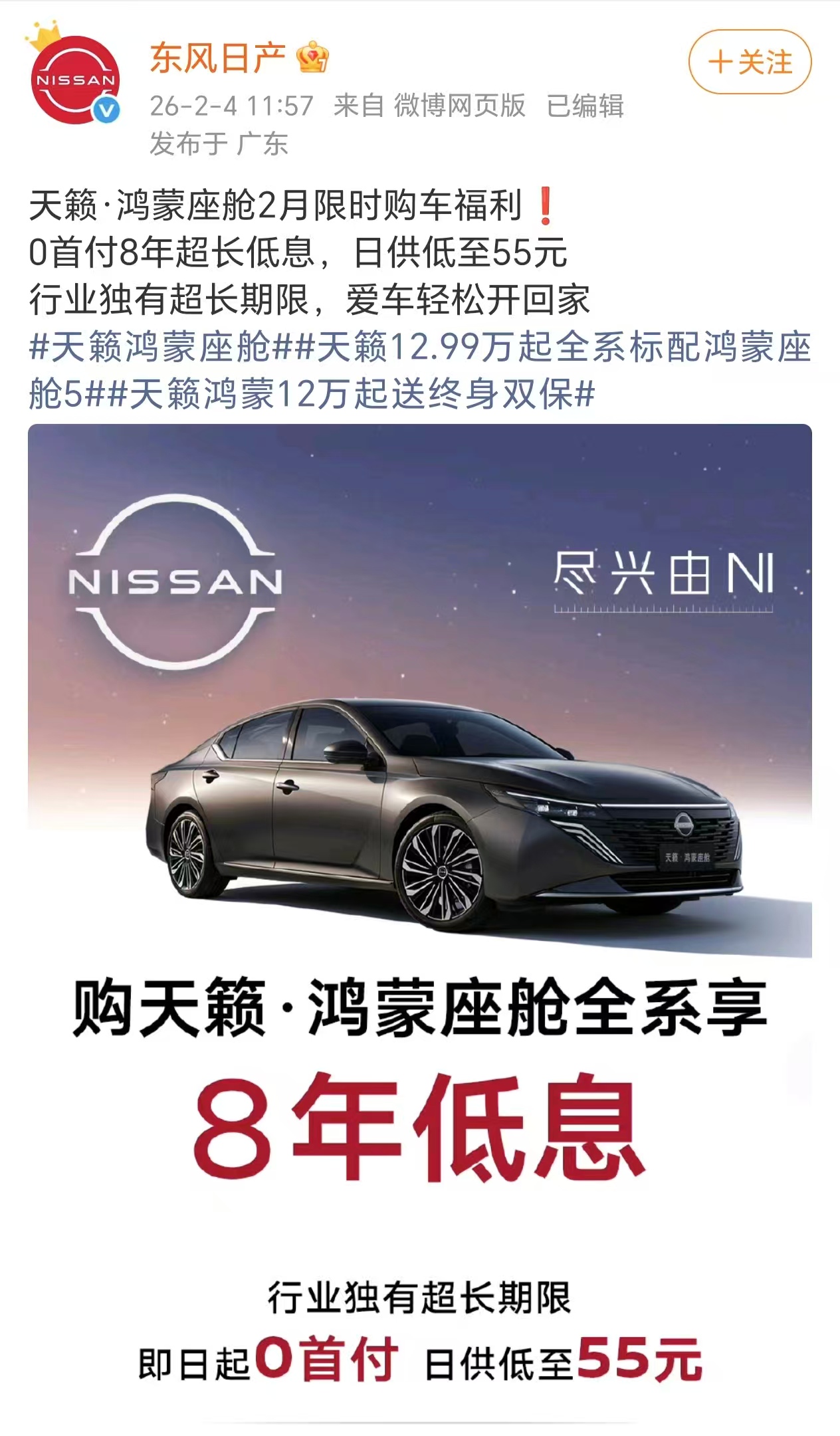
东风日产推出8年超低息0首付方案,日供低至27元
Xin Lang Cai Jing· 2026-02-04 09:29
Group 1 - Dongfeng Nissan has launched an 8-year low-interest financing plan with a zero down payment option for several models, including the Xuan Yi Classic, which has a daily payment of 27 yuan [4][7] - The promotional period for this financing offer is from February 3 to February 28 [4] - This initiative is part of a broader trend in the automotive industry, where major companies like Tesla and Li Auto have introduced similar low-interest financing options to reduce purchase barriers [7] Group 2 - Dongfeng Nissan aims to boost its vehicle sales through this financing strategy, with a reported total sales of 60,000 units in 2025, including 320,000 units of the Xuan Yi model [9] - In the new energy vehicle segment, Dongfeng Nissan achieved over 50,000 cumulative sales in 2025, with significant contributions from models like N6 and Tianlai [9] - The overall market for new energy vehicles in China saw a wholesale increase of 25.2% year-on-year, with retail sales growing by 17.6% in 2025 [9] Group 3 - The passenger vehicle market in 2026 is expected to show a U-shaped trend, with sales projected to remain flat compared to 2025 [10] - The implementation of new national standards for electric vehicle batteries in July is anticipated to release pent-up demand for mid-to-high-end vehicle replacements [10] - Exports in the automotive sector are expected to maintain a growth rate of over 10% [10]

头部份额走低 商用车驱动增长——2025动力电池格局异动
Huan Qiu Wang· 2026-01-28 09:58
Core Insights - The sales of power batteries in China reached 1200.9 GWh in the previous year, marking a year-on-year growth of 51.8%, significantly outpacing the 29% growth of new energy vehicles [2] - The rapid development of new energy commercial vehicles and battery swapping markets is driving the growth of the power battery industry, while the average battery capacity of new energy passenger vehicles has slightly decreased [2][3] - By 2025, the cumulative installed capacity of power batteries in China is expected to reach 769.7 GWh, with lithium iron phosphate batteries accounting for 81.2% of the total installed capacity [2][5] Power Battery Market Dynamics - The average battery capacity for pure electric passenger vehicles is projected to decrease from approximately 55.6 kWh in 2024 to 55 kWh in 2025, influenced by the growth of plug-in hybrid and range-extended vehicles, which have lower battery capacities [3] - Electric trucks, which have higher battery capacities, are a significant factor in the overall growth of battery sales, as they are viewed as production tools with high requirements for driving range [3][4] - The market share of leading battery manufacturers, CATL and BYD, is declining, with CATL's share down by 1.67% and BYD's by 3.17% in 2025, as second-tier manufacturers gain ground [7][8] Lithium Iron Phosphate Battery Trends - Lithium iron phosphate batteries have regained dominance in the power battery market, with their installed capacity share increasing to 81.2% by 2025, up from 74.4% in 2024 [5][6] - The cost advantage of lithium iron phosphate batteries is a key factor in their increasing adoption, especially among mid-range electric passenger vehicles [5][6] - Technological advancements have improved the low-temperature performance and energy density of lithium iron phosphate batteries, narrowing the gap with ternary lithium batteries [6] Export and Market Impact - In 2025, approximately 1.65 million pure electric vehicles (BEVs) are expected to be exported, accounting for 64% of new energy vehicle exports, with a year-on-year growth of 66% [4] - The export of plug-in hybrids (PHEVs) is also significant, with an expected volume of 970,000 units, representing a 2.3-fold increase [4] Battery Swapping Market Growth - The battery swapping market is entering a rapid growth phase, with the market size projected to increase from 40 billion yuan in 2021 to 166 billion yuan by 2025, reflecting a compound annual growth rate of 37.1% [10] - Companies like NIO and CATL are strong supporters of the battery swapping model, with NIO establishing a comprehensive network of battery swapping stations [10] Raw Material Price Impact - Rising raw material prices are a significant concern for battery manufacturers, as the cost pressures may not be fully passed on to vehicle manufacturers due to long-term supply agreements [11]
招银国际每日投资策略-20251210
Zhao Yin Guo Ji· 2025-12-10 03:49
Global Market Overview - The Hang Seng Index closed at 25,434, down 1.29% for the day but up 26.79% year-to-date [1] - The S&P 500 Index in the US closed at 6,841, down 0.09% for the day and up 16.30% year-to-date [1] - The Japanese Nikkei 225 saw a slight increase of 0.14%, with a year-to-date increase of 26.97% [1] Hong Kong Stock Performance - The Hang Seng Financial Index closed at 46,622, down 0.49% for the day and up 32.69% year-to-date [2] - The Hang Seng Real Estate Index decreased by 1.56%, with a year-to-date increase of 19.58% [2] Chinese Stock Market Insights - The Chinese stock market experienced a pullback, with Hong Kong stocks declining more than A-shares, particularly in materials, energy, and real estate sectors [3] - The net buying from southbound trading was HKD 530 million, with Tencent, Xiaomi, and Alibaba seeing the most net buying [3] - The forecast for global and Chinese energy storage battery shipments is optimistic, with an expected growth rate exceeding 80% this year [3] Industry Analysis: Internet Sector - The year 2026 is projected to be crucial for capturing user attention in the AI era, focusing on lowering usage barriers and enhancing decision-making efficiency [4] - Companies with stable cash flows supporting AI investments and strong operational capabilities are expected to have higher long-term investment value [4] - Recommended stocks include Tencent, Alibaba, and Kuaishou for their AI-related growth potential [4] Consumer Sector Insights - The e-commerce sector is expected to benefit from national subsidies, with experience-based consumption (like travel and gaming) projected to grow faster than physical goods [5] - The competition in the local lifestyle sector is intensifying, but the online travel agency (OTA) sector shows resilience [5] Technology Sector Outlook - The AI industry is expected to see intensified competition and increased application monetization in 2026, with a focus on enhancing model capabilities [6][7] - Companies like Microsoft, Google, and Amazon are recommended for their potential in AI-driven revenue growth [8] Cloud Services Growth - Cloud service revenue growth is accelerating, with a significant increase in capital expenditures driven by demand [9] - AI investments are expected to enhance profit margins and create new revenue opportunities [9] AI Monetization Opportunities - The global AI spending is projected to grow by 37% to USD 2 trillion in 2026, with a focus on AI applications in various sectors [10] - Key areas for investment include AI applications in programming, creative generation, and enterprise intelligence [10]
8点1氪丨塔斯汀90天闭店907家;新东方员工发长文控诉加班遭秒删;乐视网回应“负债238亿拟花1.8亿炒股”
3 6 Ke· 2025-12-05 00:11
Group 1 - The core point of the news highlights the significant developments in various companies and industries, including the challenges faced by New Oriental and the financial strategies of LeEco [1][2][3][4][5][6][7][8][9][10][11][12][13][14][15][16][17][18][19][20][21][22][23][24]. Group 2 - New Oriental employees expressed grievances about excessive working hours, claiming a "996 single rest" routine, which contradicts their labor contracts [1][2]. - LeEco announced plans to invest 1.8 billion yuan in stock purchases despite having a debt of 238 billion yuan, clarifying that the investment aims to enhance capital operation returns [3][4]. - Xiaomi's president, Lu Weibing, reported that the company's advancements in AI models and applications have exceeded expectations [5]. - The Hong Kong government is providing financial relief to residents affected by a recent fire, including tax reductions and fee waivers [6]. - The new national standard for food delivery platforms aims to address issues like "ghost deliveries" and enhance merchant management [7]. - ByteDance refuted rumors regarding management changes and clarified that there are no new policies regarding employee management [15]. - Apple is set to open its sixth retail store in Beijing, emphasizing sustainable design practices [8]. - Meta has hired a top design executive from Apple, indicating its commitment to advancing in AI consumer devices [9].

新能源车销量持续走高,动力电池产能吃紧?
Mei Ri Jing Ji Xin Wen· 2025-11-13 13:30
Core Insights - The current supply of power batteries in China is tight, with high capacity utilization rates among manufacturers, leading to competition among automakers to secure battery supplies [1][2] - The increase in demand for new energy vehicles (NEVs) has resulted in a "battery hoarding" battle among car manufacturers, driven by optimistic market expectations and the upcoming traditional sales peak in Q4 [2][3] - The adjustment of the new energy vehicle purchase tax is influencing manufacturers to accelerate delivery schedules to improve financial performance [3][4] Industry Dynamics - The production and sales of NEVs in China from January to October reached 13.015 million and 12.943 million units, respectively, marking a year-on-year increase of over 30% [2] - In October, NEV sales exceeded 50% of total new car sales for the first time, indicating a significant market shift [2] - The demand for high-nickel batteries, primarily used in high-end electric and hybrid vehicles, is currently constrained due to supply chain issues and raw material price fluctuations [4][5] Supply Chain Challenges - The storage market's explosive growth is a key factor contributing to the tight supply of power batteries, with the demand for lithium batteries in storage applications surging [5][6] - The production capacity for lithium iron phosphate batteries is sufficient overall, but many production lines are being diverted to meet storage project demands, leading to resource competition [5][6] - The third quarter of this year saw a 65% year-on-year increase in China's storage lithium battery shipments, with total shipments expected to reach 580 GWh for the year, a 67% increase [5][6] Future Outlook - The demand for storage is expected to remain strong, with global installation growth projected at 40% to 50% next year [7] - The ongoing high demand for storage is likely to continue affecting the availability of power batteries for electric vehicles, particularly those using lithium iron phosphate technology [7] - The current battery shortage is viewed as a short-term issue, with expectations of improved supply in the future [7]

“银十”车市销量同比微降0.8% 自主品牌市占率升至68.7%
Mei Ri Jing Ji Xin Wen· 2025-11-12 14:01
Core Insights - In October, China's passenger car retail sales reached approximately 2.242 million units, showing a year-on-year decline of 0.8% and a month-on-month decline of 0.1% [1] - The cumulative retail sales for the year reached about 19.25 million units, reflecting a year-on-year growth of 7.9% [1] Group 1: Market Performance - The October car market performance was relatively mild, not reaching the previously expected "hot" scenario, primarily driven by the replacement purchase group [1] - The tightening of "old-for-new" subsidy policies in some regions led to differentiated sales growth across areas, preventing a sustained increase in October sales [1] Group 2: Brand Performance - In October, domestic brands achieved retail sales of approximately 1.55 million units, a year-on-year increase of 4%, capturing a domestic retail market share of 68.7%, up 3 percentage points year-on-year [2] - The cumulative market share of domestic brands for the first ten months of the year was 65%, an increase of 5.5 percentage points compared to the same period last year [2] - Major domestic groups like SAIC, Dongfeng, Changan, Chery, and BAIC saw a combined year-on-year sales growth of 17% in October [2] Group 3: Export Growth - In October, China's automobile exports reached 828,000 units, marking a year-on-year increase of 42%, with total exports for the first ten months reaching approximately 6.51 million units, up 23% year-on-year [2] - Specific companies like BYD, Chery, and Geely reported significant export figures, with BYD exporting about 80,000 units in October [3] Group 4: New Energy Vehicles (NEVs) - NEVs remain a crucial growth driver, with wholesale sales of NEVs in October reaching approximately 1.621 million units, a year-on-year increase of 18.5% [4] - The penetration rate of NEVs reached 55.3% in October, with domestic brand NEVs achieving a penetration rate of 70.1% [4] Group 5: Future Outlook - Starting January 1, 2024, the purchase tax for NEVs will shift from full exemption to a 50% reduction, prompting consumers to feel a stronger urgency to purchase vehicles by year-end [5] - The upcoming months are expected to see increased enthusiasm for vehicle purchases in rural areas, particularly for NEVs and mid-to-low-end fuel vehicles [6]




今年前10个月我国新能源汽车产销量实现较高增长 10月新能源汽车销量首次超总销量50%
Yang Guang Wang· 2025-11-12 01:27
Core Insights - The Chinese automotive industry continues to experience significant growth in the new energy vehicle (NEV) sector, with production and sales increasing by over 30% year-on-year from January to October 2023 [1][2] - In October, NEV sales surpassed 50% of total new car sales for the first time, indicating a strong market shift towards electric vehicles [1] - The total automotive production and sales in China reached 27.69 million units, with NEVs accounting for 1.30 million units produced and 1.29 million units sold, reflecting growth rates of 33.1% and 32.7% respectively [1] Industry Developments - The Chinese government is set to adjust the NEV purchase tax from full exemption to a 50% reduction starting January 1, 2026, with a maximum tax reduction of 15,000 yuan per vehicle [2] - In response to this upcoming change, car manufacturers are launching tax incentive programs to ensure consumers purchasing vehicles before the end of November can still benefit from full tax exemptions [2] - The "trade-in" policy has significantly influenced consumer behavior, with 60% of consumers opting for NEVs when applying for trade-in subsidies, thereby facilitating a transition to greener vehicles [2] Market Impact - The trade-in policy is expected to result in over 12 million subsidy applications by the end of the year, potentially driving new car sales close to 1.7 trillion yuan [2]

“银十”车市微降0.8%,出口拉动自主品牌市占率升至68.7%,乘联分会:11月车企有望呈现较强表现
Mei Ri Jing Ji Xin Wen· 2025-11-10 12:20
Core Insights - The latest data from the China Automobile Dealers Association indicates that retail sales of passenger vehicles in October 2025 are approximately 2.242 million units, reflecting a year-on-year decrease of 0.8% and a month-on-month decrease of 0.1% [1] - Cumulatively, retail sales of passenger vehicles in China for the year amount to about 19.25 million units, showing a year-on-year growth of 7.9% [1] Retail and Wholesale Performance - In October, retail sales of passenger vehicles include 650,000 sedans, 85,000 MPVs, and 1.143 million SUVs, totaling 2.242 million units [2] - The wholesale figures for the same month show 600,000 sedans, 112,000 MPVs, and 1.646 million SUVs, totaling 2.268 million units [2] - Year-to-date, retail sales of passenger vehicles have reached 19.25 million units, up 7.9% compared to the same period last year [2] Market Dynamics - The automotive market in October did not meet previous expectations of a "hot" market, primarily due to the dominant role of replacement buyers and the impact of the Mid-Autumn Festival, which led many consumers to purchase vehicles before the holiday [4] - The tightening of "old-for-new" subsidy policies in certain regions has resulted in varied sales growth across different areas, contributing to the overall stagnation in October sales [4] Brand Performance - In October, domestic brands achieved retail sales of approximately 1.55 million units, a year-on-year increase of 4%, capturing a domestic retail market share of 68.7%, up 3 percentage points year-on-year [5] - Major domestic groups such as SAIC, Dongfeng, Changan, Chery, and BAIC saw a combined year-on-year sales growth of 17% in October, with notable increases from brands like Arcfox, Lantu, and Deep Blue [5] Export Growth - The export of automobiles from China remains robust, with October exports reaching 828,000 units, a year-on-year increase of 42%, and cumulative exports for the first ten months totaling approximately 6.51 million units, up 23% [6] - Specific brands like Geely and Great Wall Motors reported significant year-on-year sales growth of 35.5% and 24.1%, respectively, driven by strong export performance [6] New Energy Vehicle (NEV) Market - NEVs continue to be a key growth driver, with wholesale sales in October reaching approximately 1.621 million units, a year-on-year increase of 18.5% and a month-on-month increase of 8.5% [11] - In contrast, conventional fuel vehicle wholesale sales were 1.31 million units, showing a year-on-year decline of 3% [11] Market Penetration and Future Outlook - The penetration rate of NEVs in wholesale sales reached 55.3% in October, with domestic brands achieving a penetration rate of 70.1% [14] - The upcoming adjustment of the NEV purchase tax from full exemption to a 50% reduction starting January 1 is expected to increase consumer urgency for purchases, potentially boosting sales in the near term [14] - The automotive market is anticipated to see increased activity as rural consumers begin to purchase vehicles, particularly in the NEV and mid-to-low-end fuel vehicle segments [14]
