
流动性管理

Search documents
央行恢复公开市场国债买卖操作 10月份净投放200亿元
Zheng Quan Ri Bao· 2025-11-04 16:06
Group 1 - The People's Bank of China (PBOC) resumed the operation of buying and selling government bonds in October 2025, marking a return to activities that had been paused since January 2025, with a net injection of 20 billion yuan [1] - The PBOC's bond trading is aimed at enhancing liquidity management and is intended to be a flexible tool in conjunction with other monetary policy measures [1] - The low net buying scale of 20 billion yuan indicates the PBOC's intention to avoid rapid declines in interest rates and to maintain stable market expectations [1][2] Group 2 - The resumption of bond trading is seen as a signal to support long-term liquidity in the banking system and to stabilize macroeconomic operations for the fourth quarter of this year and the first quarter of next year [2] - The PBOC has primarily relied on reverse repos and Medium-term Lending Facility (MLF) to ensure medium-term liquidity supply since the suspension of bond trading [2] - A significant amount of reverse repos and MLF are set to mature in November, indicating ongoing liquidity management efforts by the PBOC [2][3] Group 3 - There is a high likelihood that the PBOC will increase the scale of reverse repos in November to counteract potential liquidity tightening due to high government bond issuance and increased interbank deposit maturities [3] - The PBOC's actions are aimed at maintaining a stable and ample liquidity environment in the banking system [3][4]
200亿净投放!央行重启国债买卖靴子落地
21世纪经济报道· 2025-11-04 14:39
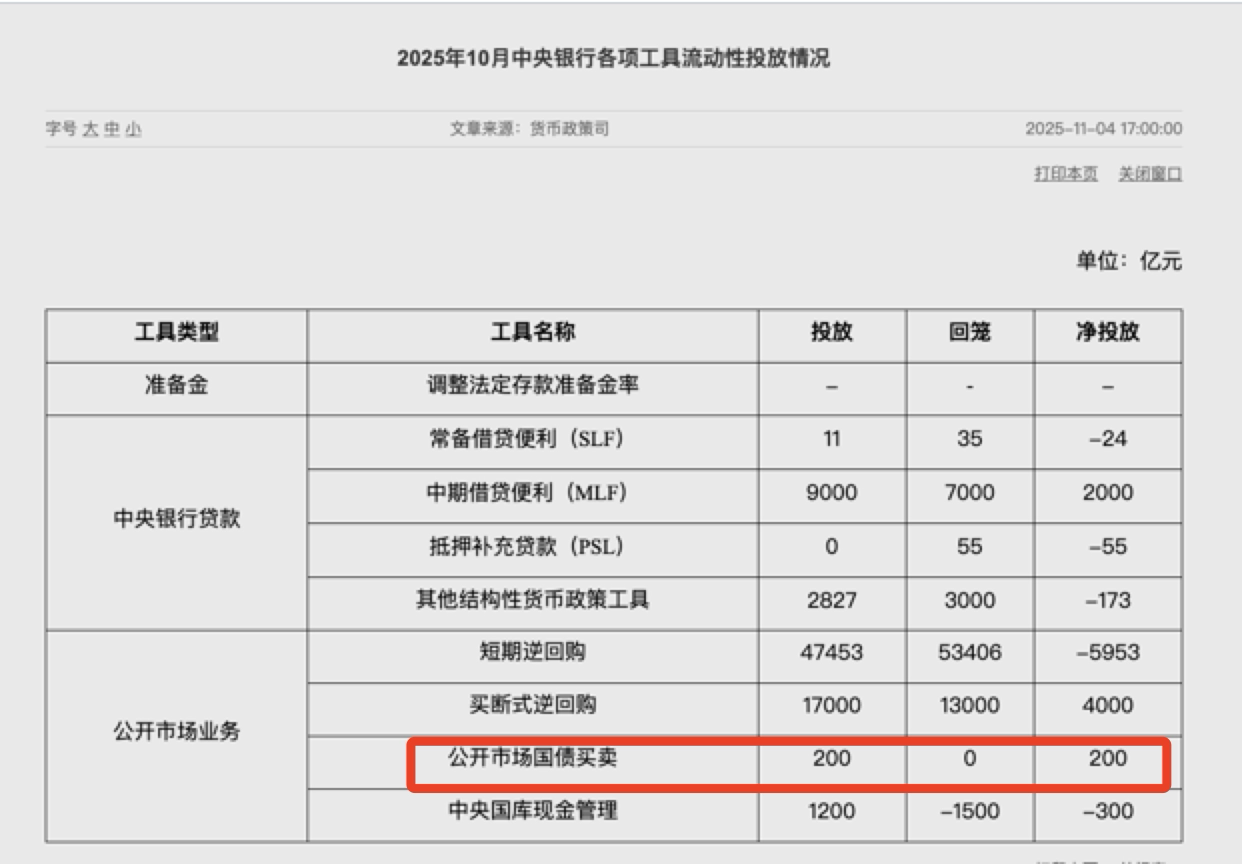
Core Viewpoint - The People's Bank of China (PBOC) has resumed open market operations for government bonds, indicating a shift in monetary policy to stabilize liquidity and bond market expectations while avoiding rapid interest rate declines [1][3][4]. Group 1: Liquidity Operations - In October 2025, the PBOC net injected 200 billion yuan through open market government bond transactions, while also conducting various liquidity operations including a net withdrawal of 5,953 billion yuan via short-term reverse repos and a net injection of 4,000 billion yuan through buyout reverse repos [1][2]. - The PBOC's operations reflect a balanced approach to managing liquidity, with a focus on maintaining stability in the bond market and avoiding excessive impacts on market expectations [3][4]. Group 2: Market Conditions - The resumption of government bond transactions comes after a period of significant adjustments in the bond market, with the 10-year government bond yield surpassing 1.8% and the 30-year yield exceeding 2.1% [4][5]. - Analysts suggest that the current conditions in the bond market, characterized by a substantial supply of government bonds and improved market stability, justify the PBOC's decision to restart these operations [4][5]. Group 3: Policy Implications - The PBOC's actions are seen as a means to enhance the effectiveness of monetary policy and fiscal policy coordination, contributing to a more reasonable and effective government bond yield curve [5]. - The central bank's strategy aims to support economic stability and growth, particularly in light of recent GDP growth rates and other economic indicators [5].

7000亿元!央行,明日操作!
证券时报· 2025-11-04 12:42
Core Viewpoint - The People's Bank of China (PBOC) is actively managing liquidity in the banking system through various monetary policy tools, including reverse repos and government bond transactions, to maintain a stable and ample funding environment amid potential liquidity tightening [1][2][5]. Group 1: Reverse Repo Operations - On November 5, the PBOC announced a 700 billion yuan reverse repo operation with a three-month term, indicating a continuation of the same amount of reverse repos maturing in November [1]. - The market anticipates another six-month reverse repo operation in November, suggesting ongoing net liquidity injection [1][2]. - Since October, the PBOC has consistently increased the scale of reverse repo operations, with five consecutive months of increased reverse repos and eight months of Medium-term Lending Facility (MLF) operations [2]. Group 2: Government Bond Transactions - The PBOC resumed government bond transactions in October, injecting 20 billion yuan, after an eight-month hiatus, signaling a shift in market expectations [4][6]. - The resumption of bond buying is seen as beneficial for the bond market, not only for liquidity but also for reversing negative market sentiment [6]. - Following the announcement of resumed operations, the yield on 10-year government bonds decreased from 1.8423% to 1.7984% by November 4, indicating improved market sentiment [6]. Group 3: Market Implications - The PBOC's actions are aimed at stabilizing the banking system's liquidity, especially in light of the recent issuance of new policy financial tools and local government debt limits [2]. - Analysts suggest that the PBOC will continue to utilize a combination of reverse repos and MLF to inject medium-term liquidity into the market [2]. - The overall improvement in the bond market's supply-demand relationship has led to a more stable yield environment, with the 10-year government bond yield stabilizing around 1.8% [4].
央行重启国债买卖靴子落地 200亿投放稳债市、稳预期、稳信心
2 1 Shi Ji Jing Ji Bao Dao· 2025-11-04 12:17
21世纪经济报道记者 唐婧 11月4日,中国人民银行公布2025年10月各项工具流动性投放情况。数据显示,人民银行10月恢复公开市场国债买卖,当月净投放200亿元。此外,人民银行 10月通过短期逆回购净回笼5953亿元,通过买断式逆回购净投放4000亿元,通过中期借贷便利(MLF)净投放2000亿元。 | 工具类型 | 工具名称 | 投放 | 回笼 | 3 | | --- | --- | --- | --- | --- | | 准备金 | 调整法定存款准备金率 | l | - | | | 中央银行贷款 | 常备借贷便利(SLF) 中期借贷便利(MLF) | 11 9000 | 35 7000 | 2 | | | 抵押补充贷款(PSL) | 0 | 55 | | | | 其他结构性货币政策工具 | 2827 | 3000 | = | | 公开市场业务 | 短期逆回购 | 47453 | 53406 | -6 | | | 买断式逆回购 | 17000 | 13000 | 4 | | | 公开市场国债买卖 | 200 | 0 | 2 | | | 中央国库现金管理 | 1200 | -1500 | - | 而就在不久 ...
200亿长期流动性落地!央行恢复暂停近10个月的国债买卖操作
Di Yi Cai Jing· 2025-11-04 12:17
预计央行将以与买断式逆回购和MLF净投放的配合为主,整体仍保持流动性"不满不溢",不会形成明显 的货币进一步宽松预期。 11月4日,中国人民银行发布2025年10月中央银行各项工具流动性投放情况。其中,公开市场国债买卖 净投放200亿元。这意味着10月央行已恢复2025年1月以来暂停的国债买卖,当月向银行体系注入长期流 动性200亿。 在10月27日举行的2025金融街论坛年会上,央行行长潘功胜宣布,目前,债市整体运行良好,将恢复公 开市场国债买卖操作。 综合市场分析来看,央行重启国债买卖操作既有利于支持实体经济,加强货币与财政政策协同,也有利 于释放流动性,稳定市场预期。 操作规模200亿元 去年8月,央行开始在二级市场开始国债买卖操作,截至去年12月,共累计买入1万亿元国债。此后在今 年年初,考虑到债券市场供求不平衡压力较大、市场风险有所累积,央行表示暂停国债买卖操作。 11月4日,央行发布的10月中央银行各项工具流动性投放情况显示,公开市场国债买卖净投放200亿元。 对此,中信证券首席经济学家明明认为,一方面,国债买卖净买入的操作模式体现了央行呵护市场流动 性和稳定债市预期的操作目标;另一方面,200亿 ...
中国人民银行:11月5日开展7000亿元买断式逆回购操作
Shang Hai Zheng Quan Bao· 2025-11-04 10:25
Core Points - The People's Bank of China (PBOC) announced a reverse repurchase operation of 700 billion yuan to maintain liquidity in the banking system [1] - The operation will be conducted on November 5, 2025, with a term of 3 months (91 days) [1] - The reverse repurchase will utilize a fixed quantity, interest rate bidding, and multiple price bidding methods [1]
央行:11月5日将开展7000亿元买断式逆回购操作
Zheng Quan Shi Bao Wang· 2025-11-04 09:09
Core Viewpoint - To maintain ample liquidity in the banking system, the People's Bank of China will conduct a 700 billion yuan reverse repurchase operation on November 5, 2025, with a term of 3 months (91 days) using a fixed quantity, interest rate bidding, and multiple price level bidding method [1] Group 1 - The People's Bank of China is implementing a reverse repurchase operation to ensure liquidity in the banking system [1] - The operation will involve a total of 700 billion yuan [1] - The term for this operation is set at 3 months (91 days) [1]
美联储会缓解流动性压力吗?结束缩表不等于解除压力
Sou Hu Cai Jing· 2025-10-29 05:25
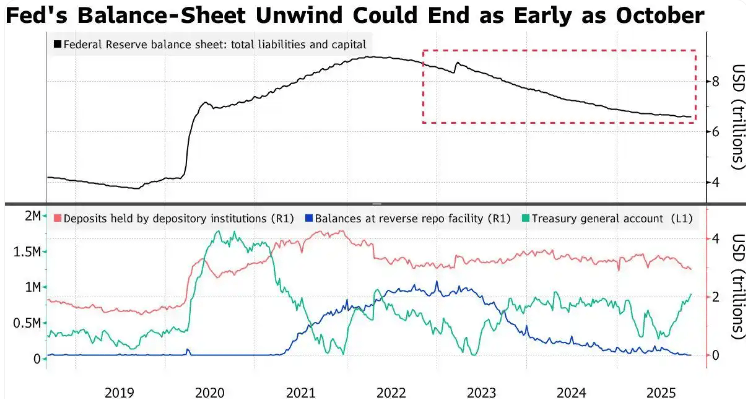
Core Viewpoint - Morgan Stanley strategists highlight that even after the end of Quantitative Tightening (QT), the Federal Reserve may still need to implement additional liquidity measures to alleviate potential pressures in the financial system [1][2]. Group 1: Federal Reserve's Actions - The Federal Reserve has seen over $2 trillion in funds leave the financial system since initiating balance sheet reduction in June 2022, leading to tight interbank liquidity and rising short-term interest rates [1]. - Market observers suggest that the current situation is reminiscent of 2019, when the New York Fed injected approximately $500 billion in short-term liquidity through large-scale repurchase operations after the end of QT [2]. - Morgan Stanley anticipates that the Federal Reserve may again resort to similar measures, including temporary open market operations and lowering key liquidity support tool rates to ease financing pressures during critical settlement periods [2]. Group 2: Liquidity Management Tools - The Federal Reserve may consider lowering the Standing Repo Facility (SRF) rate, which is a crucial tool for qualified institutions to obtain cash through collateralized government and agency securities [3]. - This action could not only reduce overnight repo rates (SOFR) and tri-party repo rates (TGCR) but also encourage dealers to use the SRF more flexibly, transforming it from a "backup facility" into a daily liquidity management tool [3]. Group 3: Market Conditions and Predictions - The issuance of a large volume of short-term Treasury securities by the U.S. Treasury continues to absorb market liquidity, exacerbating rising interbank financing costs [4]. - The Federal Reserve's reserves fell below $3 trillion earlier this month, indicating tightening cash levels within the financial system [4]. - Morgan Stanley predicts that the Federal Reserve may initiate a monthly purchase plan of approximately $8 billion in short-term Treasury securities by early 2026 to enhance cash levels in the financial system [4]. - The current market conditions, while similar to 2019, exhibit key differences such as lower volatility in the money market and a more developed set of liquidity support tools established by the Federal Reserve [4].

分析|公开市场国债买卖操作重启在即:有何深意,将如何操作
Xin Lang Cai Jing· 2025-10-28 08:13
Core Viewpoint - The People's Bank of China (PBOC) is set to resume public market government bond trading operations, which were paused earlier this year, as the bond market is currently performing well [1][2]. Group 1: Market Conditions and Policy Implications - The PBOC's decision to restart government bond trading is aimed at enhancing the coordination between monetary and fiscal policies, supporting the real economy, and ensuring liquidity for financial institutions at year-end [1][2]. - The overall bond market has shown improvement, with net financing of government bonds in the first three quarters exceeding the same period last year, and government bond issuance rates rising compared to early this year [2][3]. Group 2: Expected Outcomes and Market Reactions - Analysts expect that the resumption of government bond trading will increase liquidity flexibility in the fourth quarter, especially as the market typically experiences volatility during this period [3][5]. - The PBOC is likely to focus on net purchases of government bonds in the short term, given the existing liquidity gap and upcoming maturities of other monetary policy tools [4][5]. Group 3: Operational Strategies - The PBOC's bond trading strategy may primarily involve short-term purchases rather than long-term sales, as the current yield curve is deemed reasonable, reducing the need for adjustments [6][7]. - The anticipated scale of bond purchases may exceed expectations due to the significant amount of government bonds yet to be issued and the upcoming maturities of MLF and reverse repos [5][6].
针对潘行长讲话的四个思考——2025年金融街论坛潘行长主题演讲的学习心得:【宏观快评】
Huachuang Securities· 2025-10-28 06:52
Group 1: Market Observations - The resumption of government bond trading is linked to a reasonable short-term yield level, with the current 10-year bond yield at approximately 1.8423%, up from a low of 1.5958% earlier this year[11] - The central bank's actions in the bond market may indicate a shift in liquidity management, particularly if the scale of re-lending decreases during bond purchases[12] - A significant increase in bank holdings of government bonds during the central bank's bond purchases could positively impact total liquidity, including M1 and non-bank deposits[13] Group 2: Monetary Policy Insights - The necessity for a reserve requirement ratio (RRR) cut is low, as current policies are aimed at managing production credit rather than increasing bank lending capacity[23] - The probability of lowering policy interest rates in the short term is also low, as this could accelerate the outflow of household deposits into financial markets, potentially increasing systemic risk[26] - There is a possibility of a reduction in the 5-year Loan Prime Rate (LPR), which could help lower household debt costs and stabilize housing prices[26] Group 3: Capital Market Implications - The strength of the equity market this year is attributed to reduced volatility and drawdown, with liquidity support from the central bank creating a floor for equity prices[27] - The resumption of government bond trading sets a framework for short-term interest rates, but the bond market may still face pressure if economic conditions improve[27] - Historical trends suggest that a dual bull market in stocks and bonds requires sustained liquidity support from the central bank, with current deposit shifts likely to influence asset prices rapidly[28]