绿色化

Search documents
惠生启东基地开始生产运营
Zhong Guo Hua Gong Bao· 2026-01-21 05:45
Core Viewpoint - Huisheng Clean Energy has officially transitioned its Qidong base from construction to production operations, marking a significant milestone in its strategic investment layout [1] Group 1: Production and Operations - The Qidong base has commenced trial production and has achieved a cumulative total of 6 million safe working hours in its construction projects [1] - The base is designed for the construction and integration of large floating facilities and modules, covering an area of approximately 1.2 million square meters with a coastline of 1,372 meters [1] - The first batch of segmented manufacturing has started, and key production lines and processes are now in substantial operation [1] Group 2: Technological Advancements - The base aims to enhance manufacturing efficiency and management levels, focusing on intelligent and digital production lines [1] - It has established a highly efficient collaborative production management system, centered around key processes such as hull, module, pipeline, and coating [1] Group 3: Strategic Importance - The trial production launch signifies a critical step in the company's manufacturing layout, enhancing its capabilities in green, large-scale, and intelligent construction [1] - This development is expected to support the continuous expansion of the company's business [1]
税收数据显示:制造业经济“压舱石”作用更加凸显
Xin Hua She· 2026-01-21 04:20
新华社北京1月21日电(记者刘开雄)记者21日从国家税务总局获悉,国家税务总局日前利用税收大数 据对制造业开展分析显示,2025年,我国制造业销售收入较全国总体销售增速高1.7个百分点;制造业 占全国总体销售比重为29.7%,较上年提高0.5个百分点,制造业智能化、绿色化、融合化步伐加快,经 济"压舱石"作用更加凸显。 ...
工信部:2025年工业和信息化发展呈现“稳”“进”“新”“活”四个特点
Xin Hua Cai Jing· 2026-01-21 03:20
Core Viewpoint - The press conference held by the State Council Information Office highlighted the achievements in industrial and information development by 2025, showcasing four key characteristics: stability, progress, new momentum, and vitality. Group 1: Stability - The industrial and information sector has maintained a stable growth trajectory, with the added value of large-scale industries increasing by 5.9% year-on-year, and the manufacturing sector's contribution to GDP remaining stable, keeping its position as the world's largest for 16 consecutive years [1] - The total telecommunications business volume grew by 9.1% year-on-year, contributing over 40% to economic growth, effectively acting as a "ballast" for the economy [1] Group 2: Progress - The focus on high-quality development has accelerated, with the added value of equipment manufacturing and high-tech manufacturing increasing by 9.2% and 9.4% year-on-year, respectively, outpacing overall industrial growth by 3.3 and 3.5 percentage points [2] - The establishment of over 35,000 basic-level and 8,200 advanced-level smart factories has been achieved, alongside the cultivation of 15 leading smart factories, indicating solid progress in the digital transformation of manufacturing [2] Group 3: New Momentum - Significant advancements in technology and industry innovation have been made, with breakthroughs in major equipment such as ultra-large diameter shield machines and heavy-duty gas turbines, and over 300 key technologies reserved for 6G [3] - The added value of integrated circuits and electronic materials increased by 26.7% and 23.9% year-on-year, respectively, while industrial robot production rose by 28%, and new energy vehicle sales reached 16.49 million, up 28.2% [3] Group 4: Vitality - Reforms in key areas have been accelerated, with actions taken to reduce corporate burdens and clear overdue payments, creating a more vibrant business environment [4] - The cumulative cultivation of over 140,000 specialized and innovative small and medium-sized enterprises has been achieved, with high-tech enterprises reaching 504,000, indicating a robust ecosystem for innovation [4]
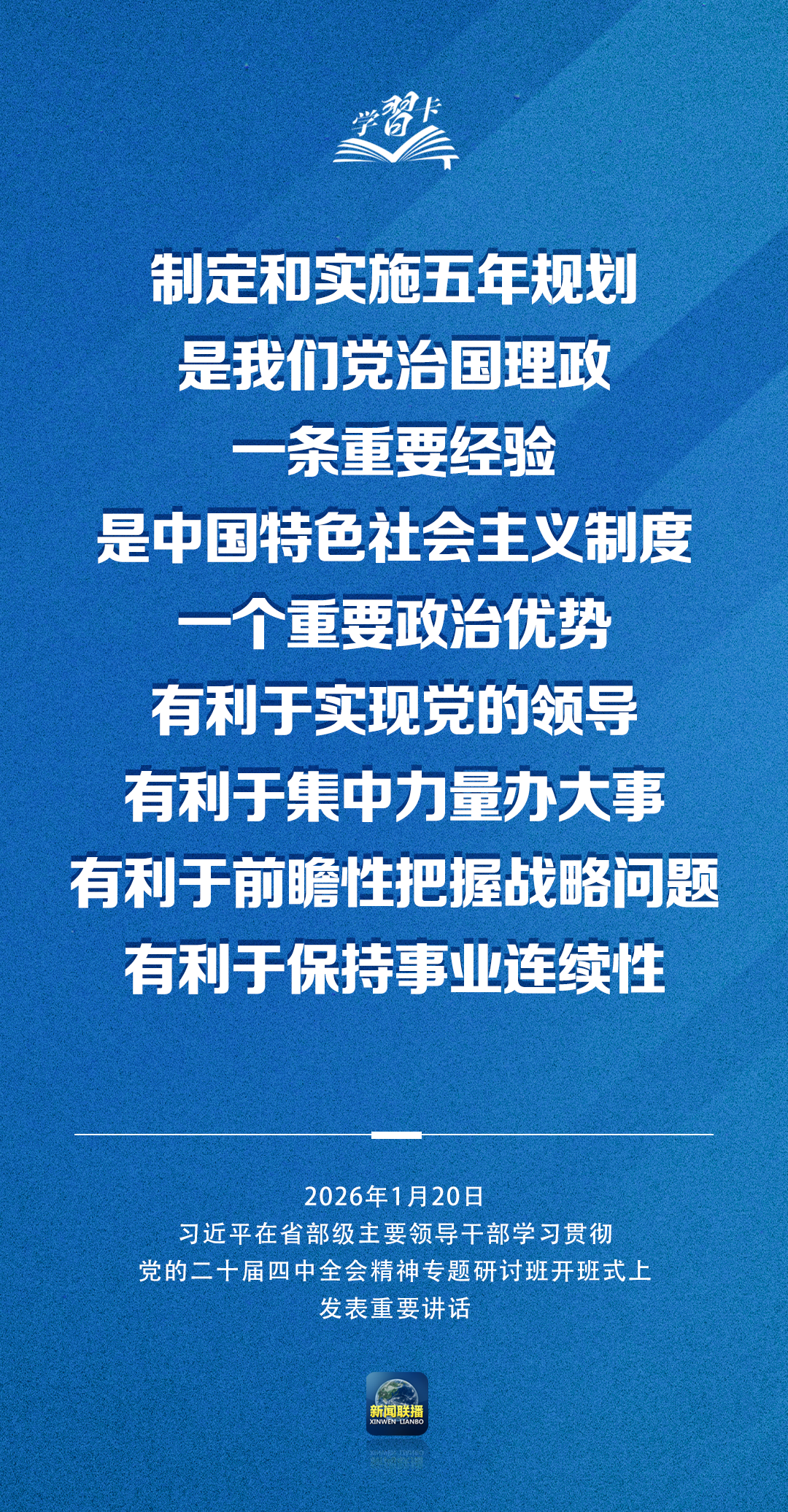
习近平:党的二十届四中全会对“十五五”时期经济社会发展作出战略部署,要全面深刻准确领会和把握
Yang Shi Xin Wen Ke Hu Duan· 2026-01-21 01:04
Core Viewpoint - The speech by Xi Jinping emphasizes the importance of deeply understanding and implementing the spirit of the 20th Central Committee's Fourth Plenary Session, aiming for a solid start to the "14th Five-Year Plan" under the strong leadership of the Party Central Committee [1][3]. Group 1: Strategic Deployment - The need for a comprehensive and accurate understanding of the strategic deployment for economic and social development during the "14th Five-Year Plan" period is highlighted [7]. - A holistic view is necessary to grasp the overall spirit of the plenary session, ensuring that all deployments are considered as an integrated whole [8]. Group 2: Policy Implementation - It is crucial to accurately understand policy boundaries and scales, ensuring that necessary actions are taken while avoiding unnecessary ones [9]. - The importance of maintaining strategic determination and tactical precision in enhancing the certainty and sustainability of national development is stressed [11]. Group 3: Economic Focus - The focus should be on domestic circulation as the mainstay, correctly balancing consumption and investment, as well as demand and supply [15]. - Improving the quality and efficiency of the national economic cycle is essential, with an emphasis on making domestic demand the main driving force for economic development [16]. Group 4: Social Development - Improving people's livelihoods should be a priority, aiming to enhance the quality of life while developing the economy [19]. - Local and special planning should align with broader strategic goals to ensure effective implementation [21].

国家发展改革委谈2026年经济工作
Xin Hua Cai Jing· 2026-01-21 00:00
全年经济总量迈上140万亿元新台阶、制造业增加值连续16年位居全球第一、年末常住人口城镇化率比 上年提高0.89个百分点……2025年,我国交出一份高质量的发展答卷。 新的一年,如何落实中央经济工作会议精神,推动"十五五"实现良好开局?国务院新闻办公室20日举行 新闻发布会,国家发展改革委相关负责人回答记者提问。 充分挖掘中国经济潜能 "经济社会发展主要目标顺利完成,经济运行稳中有进,发展韧性进一步彰显,民生政策更有温度,交 出了一份高质量答卷。"在总结过去一年经济发展成果时,国家发展改革委副主任王昌林这样概括。 "展望2026年,我们认为消费与投资、科技与产业、城乡与区域都将释放出巨大的发展潜能。"国家发展 改革委国民经济综合司司长周陈说。 从点上看,新技术新产品新场景蔚然成势。周陈表示,我国新能源、新材料、航空航天等新的经济增长 点正在蓄势待发。"目前我们正在谋划推进一批'十五五'时期的高技术产业标志性引领性重大工程。"周 陈说。 从线上看,创新链产业链人才链加速融合。周陈介绍,我国有完整的产业体系和超大规模市场,也有全 球规模最宏大、门类最齐全的人才资源,具备了将创新成果从"书架"推上"货架"的全链条全 ...
用“真金白银”来补贴老百姓的消费
Bei Jing Qing Nian Bao· 2026-01-20 18:18
Group 1 - The Chinese government plans to increase the fiscal deficit rate to around 4% for 2025, which is a 1 percentage point increase from the previous year, and the new government debt scale will reach 11.86 trillion yuan, an increase of 2.9 trillion yuan compared to last year [1] - A special long-term government bond issuance of 1.3 trillion yuan is planned for 2025 to support consumption and related sales, with 300 billion yuan allocated for subsidies to encourage consumer spending [1] - The central government will allocate 667.4 billion yuan for employment support in 2025, along with various measures to enhance social insurance and reduce unemployment insurance rates [2] Group 2 - The central government will provide approximately 4.9 trillion yuan in total subsidies in 2025, including a basic pension increase of 2% and a minimum standard increase for rural residents' pensions [2] - A gradual implementation of free preschool education will begin, benefiting around 14 million children, and a new childcare subsidy system will be established with 100 billion yuan allocated for children under three years old [2] - The Ministry of Finance announced the cancellation or reduction of export tax rebates for over 200 products, including solar and battery products, to promote resource efficiency and reduce environmental pollution [3] Group 3 - For 2026, the fiscal policy will focus on increasing total spending, optimizing the spending structure, improving the effectiveness of fund usage, and enhancing economic vitality through tax reforms [4] - The government aims to ensure that necessary spending levels are maintained and that funds are directed towards critical areas such as consumption and social welfare [4] - The emphasis will be on improving the efficiency of fund usage, ensuring that every yuan spent generates the expected benefits [4]

安徽建工:近年来公司大力发展智能建造
Zheng Quan Ri Bao Wang· 2026-01-20 14:10
Core Viewpoint - The company is focusing on the development of smart construction and the application of advanced technologies to enhance its operations and promote digital transformation in the industry [1] Group 1: Company Initiatives - The company has been actively promoting the use of intelligent construction equipment and advanced technologies such as unmanned asphalt paving for road surfaces [1] - The company is implementing plans for machine replacement and equipment upgrades to improve efficiency [1] - Future initiatives will continue to drive the industry towards digitalization, intelligence, and sustainability, leveraging technological innovation for industrial transformation and upgrading [1]

中孚实业发预增,预计2025年度归母净利润同比增加120.27%—141.59%
Zhi Tong Cai Jing· 2026-01-20 09:10
报告期内,公司以"绿色化、数字化、智能化"为方向,持续开展降本增盈和管理提升等相关工作。公司 本期业绩增长主要系电解铝业务成本下降及销售价格上涨影响。 中孚实业(600595)(600595.SH)发布2025年年度业绩预增公告,预计2025年年度实现归属于母公司所 有者的净利润为15.50亿元—17.00亿元,与上年同期相比,将增加8.46亿元到9.96亿元,同比增加 120.27%—141.59%。 ...

财政部:扩展设备更新贷款支持领域,增加航空器材、人工智能等领域
Xin Lang Cai Jing· 2026-01-20 04:33
Core Viewpoint - The Ministry of Finance has issued a notice to optimize the implementation of the financial subsidy policy for equipment renewal loans, expanding the supported sectors significantly [1] Group 1: Expanded Support Areas - The policy now includes additional sectors such as construction and municipal services, energy equipment, aviation materials, electronic information, safety production, facility agriculture, fishing vessels, cold chain facilities, grain and oil processing, waste recycling, small hydropower, commercial facilities, artificial intelligence, and elderly care [1] - The focus is on enhancing support for high-end, intelligent, green, and digital equipment renewal [1]
“双万亿”第三城,新目标定了
Mei Ri Jing Ji Xin Wen· 2026-01-20 01:40
Group 1: Core Insights - Guangzhou has become the third city in China to achieve a "double trillion" status in consumption and foreign trade during the 14th Five-Year Plan period, following Beijing and Shanghai [1][2] - By 2025, Guangzhou's airport is expected to handle over 83 million passengers, ranking among the top ten globally, while its port is projected to handle nearly 700 million tons of cargo, placing it in the top six worldwide [1] - The city aims to establish six advanced manufacturing clusters with outputs exceeding 100 billion yuan and ten service sectors with added value surpassing 100 billion yuan during the same period [1] Group 2: Economic Indicators - As of 2024, only seven cities in China have reached a consumption level of over one trillion yuan, including Guangzhou, which highlights the significance of its economic status [2] - The report indicates that Guangzhou's foreign trade volume also exceeds one trillion yuan, making it one of only seven cities to achieve this milestone [2] Group 3: Strategic Development - Guangzhou's government has outlined plans to enhance its role as a global supply chain innovation center, aiming to strengthen its core urban functions [3][4] - The city is leveraging its geographical advantages, including proximity to the Pearl River Delta manufacturing hub and its status as a major transportation and trade center, to transition from a trade hub to a supply chain management center [4] Group 4: Future Goals - The city has set ambitious goals for the 15th Five-Year Plan, focusing on increasing its visibility and resource allocation capabilities within the global resource network [3] - The government has previously articulated a vision to develop Guangzhou into a world-class city with both historical charm and modern vitality, as outlined in its urban planning documents [3]