
中美经贸关系

Search documents
美元流动性有所缓解,商品短期或震荡运行
Guo Tou Qi Huo· 2025-11-10 12:18
Group 1: Report Industry Investment Rating - No relevant information provided Group 2: Core Viewpoints of the Report - The commodity market declined last week and then rebounded, with an overall decline of 0.47%. The black sector led the decline, while precious metals and agricultural products rose. The market is expected to fluctuate in the short - term due to factors such as the possible end of the US government shutdown and mixed macro - economic indicators [1]. - Different commodity sectors, including precious metals, non - ferrous metals, black metals, energy, chemicals, and agricultural products, are expected to have short - term fluctuations based on their respective fundamentals and macro - economic factors [1][2][3]. Group 3: Summary by Related Catalogs 1. Market Review - The commodity market fell 0.47% last week. The black sector dropped 2.62%, energy and chemicals fell 0.41% and 0.06% respectively, while precious metals and agricultural products rose 0.11% and 0.57% [1]. - Among specific varieties, rapeseed meal, pulp, and eggs had the highest increases of 6.32%, 3.49%, and 2.32% respectively, while asphalt, iron ore, and methanol had the largest declines of 6.04%, 4.94%, and 3.12% [1]. - The 20 - day average volatility of the commodity market decreased, and the market scale increased by nearly 10 billion, with only the precious metals sector showing net capital outflows [1]. 2. Outlook for Different Sectors - **Precious Metals**: Officials' hawkish remarks and the uncertainty of the US government shutdown situation may keep the sector in high - level fluctuations in the short - term [1]. - **Non - ferrous Metals**: With a neutral macro - environment and mixed fundamentals, the sector is expected to fluctuate in the short - term [2]. - **Black Metals**: With weakening demand, falling production, and increasing raw material pressure, the sector may continue to be supported by costs and fluctuate [2]. - **Energy**: The oversupply of crude oil and the impact of the US government shutdown on demand may lead to short - term oil price fluctuations [2]. - **Chemicals**: Cost support from coal and mixed demand expectations may result in short - term fluctuations and mid - term anti - arbitrage opportunities [3]. - **Agricultural Products**: The reduction of US soybean tariffs and the weak rebound of palm oil may lead to different trends in different agricultural products, with some under pressure [3]. 3. Commodity Fund Overview - Gold ETFs generally had negative weekly returns, with a total scale increase of 0.81%. Energy - chemical, soybean meal, non - ferrous metal, and silver ETFs also had different return and scale changes [35].
中美大消息!
证券时报· 2025-11-10 09:31
Group 1 - The U.S. announced a suspension of its 301 investigation measures against China's maritime, logistics, and shipbuilding industries for one year starting November 10, 2025 [2][4] - In response, China decided to suspend countermeasures against five U.S. subsidiaries of Hanwha Ocean Co., Ltd. for one year, effective from November 10, 2025 [2][4] - The Ministry of Transport of China will also suspend the collection of special port fees from U.S. vessels and halt investigations related to the shipping and shipbuilding industries for one year, starting from November 10, 2025 [6][4] Group 2 - The suspension of measures is part of the consensus reached during the China-U.S. economic and trade consultations in Kuala Lumpur [6] - The decision reflects a broader effort to ease tensions and promote cooperation between the two countries in the maritime and logistics sectors [4][6]


中方刚买4船美豆,特朗普又变脸,美方通告全球,下架大批中国货
Sou Hu Cai Jing· 2025-11-09 08:41
中美高层会晤达成的贸易共识曾点燃市场期待,中方承诺当前作物季购入1200万吨美国大豆,未来三年 每年采购规模将达2500万吨,首批24万吨美豆已启运。但这份共识未及48小时便生变数,美方接连推进 针对性举措,这般前后矛盾的操作,究竟是谈判策略还是失算之举?此次会晤中,双方达成多项务实成 果:美方下调对华芬太尼相关关税至10%,暂停部分出口管制及对华造船业等领域301调查措施一年; 中方同步暂停部分稀土出口管制,美豆采购消息更推动芝加哥CBOT大豆价格攀升至15个月高点,站上 1100美分/蒲式耳关口。然而美方很快转向,联邦通信委员会推动"清洁购物车行动"(Clean Cart Action),要求亚马逊、eBay等平台下架华为、海康威视等企业产品,贸易代表仍明确保留301调查加 征关税权力。 中方随即依法对涉美船舶收取特别港务费反制,这种协议与打压并行的做法,严重冲击全球供应链稳 定,推高贸易成本,也让美国消费者面临商品涨价压力。 全球化时代,诚信是经贸合作的根基。美方 出尔反尔的行为损人不利己,唯有摒弃单边思维、坚守协商共识,才能实现互利共赢,这是中美经贸关 系行稳致远的关键。 ...
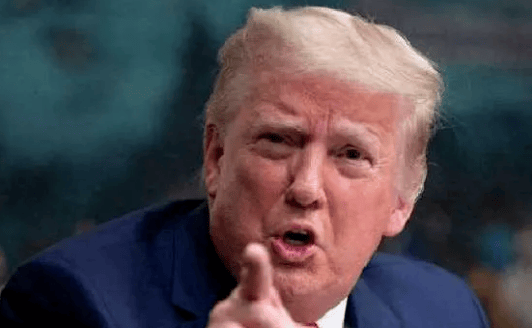
中方说话算话,美农业代表刚见完李成钢,12万吨美国小麦运往中国
Sou Hu Cai Jing· 2025-11-09 08:13
Core Points - The recent agricultural trade between China and the U.S. reflects a strategic response from China, showcasing its commitment to follow through on promises and maintain stable economic relations [1][5][23] - China's decision to purchase 120,000 tons of U.S. wheat and suspend additional tariffs on certain U.S. agricultural products for one year indicates a shift towards cooperation while retaining the ability to respond to future U.S. actions [1][5][19] Group 1: Trade Dynamics - The atmosphere between China and the U.S. has improved following a meeting between leaders in Busan, leading to a visit from a U.S. agricultural delegation [3][5] - China emphasized that previous trade tensions were initiated by the U.S. through high tariffs, indicating a desire for balanced cooperation rather than unilateral concessions [3][5][21] - The quick execution of the tariff suspension and wheat purchase demonstrates China's intent to stabilize its agricultural supply chain amidst global uncertainties [5][9][11] Group 2: Strategic Considerations - China's procurement of U.S. agricultural products is driven by domestic needs, ensuring food security and stability in the supply chain for essential commodities [9][11] - The decision to "suspend" rather than "cancel" tariffs allows China to retain leverage and respond to any future U.S. policy changes, signaling that cooperation must be mutual [13][19] - The arrangement reflects China's broader strategy of diversifying its agricultural imports to mitigate risks associated with global market volatility [11][15] Group 3: Future Outlook - The sustainability of agricultural cooperation hinges on the U.S. maintaining stable trade policies and not using trade as a political tool [21][23] - The current political climate in the U.S. poses uncertainties that could affect future trade relations, necessitating cautious engagement from China [19][21] - The agricultural sector remains a critical component of U.S.-China relations, serving as a potential stabilizer amidst broader geopolitical tensions [15][17][23]

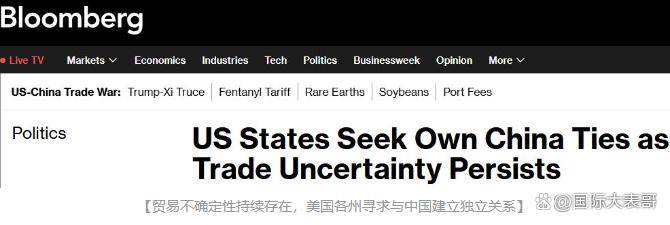
突发特讯!中国取得意外收获,美国各州独立自主,绕开特朗普和中国打交道,引发国际热议
Sou Hu Cai Jing· 2025-11-08 04:47
Core Viewpoint - The article discusses the evolving dynamics between U.S. federal and state governments regarding trade relations with China, highlighting a trend where state governments, particularly in economically significant states, are seeking to maintain and enhance their relationships with China despite federal policies that emphasize protectionism and strategic competition [1][3][4]. Group 1: State Government Actions - State governments, especially in major economic states like California and Washington, are increasingly distancing themselves from federal policies and actively pursuing better relations with China [3][4][9]. - Washington state's exports to China account for over one-third of its total exports, indicating a strong economic incentive for local officials to advocate for stable trade relations [7]. - California's Governor Newsom has taken a strong stance against federal tariffs, even suing the federal government, and is promoting cooperation with China in various sectors such as technology and agriculture [9][11]. Group 2: Economic Motivations - The actions of state officials are primarily driven by economic interests, as they seek to protect local industries from the adverse effects of federal trade policies [6][11]. - The trend of state governments engaging with China is not isolated; it reflects a broader pattern of local officials prioritizing economic stability and growth over federal directives [10][15]. - The cooperation between U.S. states and China is expanding beyond mere goods export to include investments, technology exchanges, and green energy initiatives, providing a buffer against global supply chain disruptions [13][15]. Group 3: Implications for U.S.-China Relations - The dual dynamics of federal and state government actions create a "dual structure" where both levels are calculating their own interests, leading to a complex interplay in U.S.-China relations [11][15]. - As state governments continue to assert their independence, there is an opportunity for China to deepen its economic ties with these states, potentially mitigating the impact of federal policies [11][15]. - The article suggests that for China to stabilize its relationship with the U.S., it must engage more with state governments, recognizing their role in shaping economic interactions [15].
铜月报:矿端紧张格局延续,重心抬升-20251107
Wu Kuang Qi Huo· 2025-11-07 14:40
Report Summary 1. Report Industry Investment Rating No information provided on the industry investment rating. 2. Core View of the Report In November, China's refined copper production is expected to stabilize, and consumption is expected to seasonally recover. With an increase in scrap copper substitution, supply and demand are expected to be in a tight balance. Overseas demand is expected to be neutral, and the increase in smelter maintenance and production cuts will ease the supply pressure. Meanwhile, changes in US imports need to be monitored. At the macro - level, Sino - US economic and trade relations have entered a period of relaxation, and the Fed's monetary policy will remain in a loose direction. Therefore, although the US government's continued shutdown and the correction of the US stock market at a high level are expected to be only short - term shocks, the reopening of the US government is expected to boost market sentiment again. Overall, with the tight supply pattern at the mine end, the center of copper prices will rise compared to before. If the macro - pessimistic sentiment eases, copper prices are expected to strengthen again in a volatile manner. The operating range of the main contract of SHFE copper this month is 84,000 - 90,000 yuan/ton, and that of LME 3M copper is 10,400 - 11,200 US dollars/ton. The operation suggestion is to try to go long on dips. [9] 3. Summary According to the Directory 3.1 Monthly Highlights Summary - **Supply**: In Q3, overseas copper mine production fell short of expectations, and copper mine supply remained tight, while the supply of blister copper was marginally relaxed. In October, China's refined copper production decreased, and it is expected to stabilize in November. - **Demand**: In October, the apparent consumption of refined copper in China is estimated to have declined year - on - year, and the apparent consumption in November is expected to continue to decline year - on - year. Overseas manufacturing prosperity is differentiated, and demand expectations are neutral. - **Imports and Exports**: In October, the export window for进料加工 of SHFE copper opened, the price difference between US copper and LME copper narrowed, and the arbitrage window for US copper closed. - **Inventory**: In October, the inventories of SHFE, bonded areas, and COMEX increased, while LME inventory decreased, and the total inventory rose. It is estimated that China's inventory will not change much in November. [9] 3.2 Futures and Spot Market - **Market Review**: In October, copper prices fluctuated upwards. Supply disruptions in copper mines, progress in Sino - US economic and trade negotiations, and the Fed's interest - rate cut expectations drove copper prices to hit record highs. During the month, the main contract of SHFE copper rose 4.69%, and the LME 3M contract rose 5.78%. The US dollar index rose, and the offshore RMB appreciated slightly. At the beginning of November, copper prices fell from record highs. - **Price Differences between Markets**: In October, the import loss of SHFE copper first widened and then narrowed, and the export window opened once. At the beginning of November, the import loss further narrowed. In October, the price difference between COMEX and LME copper fluctuated and declined. Although the expectation of future tariffs continued to support the price difference, the continuous inventory build - up in COMEX gradually closed the import arbitrage window. - **Inventory and Basis**: As of the end of October, the total inventory of the three major exchanges plus the Shanghai bonded area was about 680,000 tons, an increase of 67,000 tons from the end of September. The total inventory was at a relatively high level in recent years, but there were still structural inventory problems (COMEX inventory accounted for a high proportion, about 47.5%). LME copper inventory decreased, and COMEX copper inventory continued to rise. In terms of basis, in October, the Cash/3M in the LME market first rose and then fell; the domestic basis first rose and then declined, and at the beginning of November, the spot price had a slight premium over the futures price. - **Fund Sentiment**: As of the end of October, the proportion of long positions of LME investment funds increased, and the sentiment remained relatively positive. The position of SHFE copper first rose and then fell, and the current position was still at a relatively high level, with intense long - short games. In November, the impact on market sentiment is expected to mainly come from inventory and changes in US policies. [17][20][23][26][29] 3.3 Supply and Demand Analysis - **Supply - Copper Mine**: The copper mine production of 17 medium - and large - sized copper mine enterprises in Q3 was about 3.497 million tons, a year - on - year decrease of 2.2%. Mine accidents, ore grade problems, etc. led to production falling short of expectations, and the year - on - year decline in mine production in Q4 is expected to further expand. In September, Chile's copper production decreased year - on - year and rebounded month - on - month, and the production was at a low level. In October, the inventory of copper concentrates at major ports in China first decreased and then increased, and the spot supply at ports was first tight and then loose. In terms of processing fees, the spot TC of copper concentrates fluctuated and declined in October, and the spot TC at the end of October was reported at around - 42 US dollars/ton. In November, it is the time for long - term contract negotiations, and it is expected that both supply and demand sides will be in a stalemate. [34][37] - **Supply - Refined Copper**: In October, the processing fee for domestic blister copper turned up, and the rise in copper prices drove up the processing fee. The supply of raw materials for refined copper production was marginally relaxed. The price of sulfuric acid, a by - product of smelting in mainstream domestic regions, fluctuated and rebounded, remaining at a relatively high level, making a positive contribution to smelting revenue. In October, the number of smelter maintenance activities increased, and China's refined copper production continued to decline month - on - month. In November, the impact of copper smelter maintenance is still there but is decreasing marginally. Coupled with the increase in the number of scrap copper to produce blister copper/anode plates due to the rise in copper prices, refined copper production is expected to stabilize. [42][44] - **Supply - Recycled Copper**: In October, the average price difference between refined and scrap copper in China was about 3,580 yuan/ton, widening month - on - month. Without the full implementation of local tax refund policies, scrap copper had a good substitution advantage. In October, the operating rate of recycled copper rod enterprises fluctuated and rebounded. The widening of the refined - scrap price difference and the marginal easing of policy impacts in some regions drove the operating rate to rebound, increasing the substitution for refined copper. [48] - **Demand - China**: Assuming a decrease in net imports, the apparent consumption of domestic refined copper in October is estimated to be 1.321 million tons, a slight year - on - year increase of 0.3%. From January to October, the cumulative apparent consumption was about 13.674 million tons, a year - on - year increase of 8.8%. From the perspective of leading economic indicators, both the official manufacturing PMI and the Caixin manufacturing PMI in China weakened month - on - month in October, and the manufacturing prosperity weakened marginally. In the first nine months of 2025, China's copper product output increased by about 9.6%, and the growth rate declined month - on - month. According to SMM data, the operating rate of copper products weakened in October and is expected to rebound in November. In October, the operating rate of China's refined copper rod enterprises was weak, and the average operating rate was lower than that of the same period last year. The current operating level has not returned to the level before the National Day. The operating conditions of domestic wire and cable enterprises in October were weaker than expected, and the operating rate is expected to rebound in November. In September, the year - on - year decline in power investment (power source + power grid) continued, and the decline slightly expanded. The newly installed photovoltaic capacity continued to decline year - on - year and increased month - on - month, while the newly installed wind power capacity declined month - on - month. Near the end of the year, relevant demand is expected to improve marginally. High - frequency data shows that in October, domestic real estate transaction data was weaker than that of the same period last year, and the production scheduling of household appliances at the back - end of the real estate market remained weak; the high - frequency sales performance of automobiles in October was strong. [51][54][57][60][65] - **Demand - Overseas**: In October, the manufacturing prosperity of major overseas developed economies was differentiated. India, the Eurozone, and the UK improved, while the manufacturing prosperity of the US and Japan weakened. According to ICSG data, in August 2025, the global refined copper consumption decreased month - on - month and continued to increase year - on - year. From January to August, consumption increased by about 5.9%. [68] 3.4 Macro Analysis - The US government shutdown led to the postponement of the release of non - farm data. Recently released ADP data and the number of corporate layoffs show that the US job market is weak. In September, inflation rose and core inflation declined. Due to the lack of data, the probability of the Fed cutting interest rates in December has decreased, but the probability is still close to 70%. At the same time, the Fed will stop shrinking its balance sheet on December 1st, and the marginal loosening direction of the policy remains unchanged. - In October, the US dollar index rebounded and is still oscillating within the range; the 10 - year inflation expectation in the US is running weakly, still deviating from the copper price trend. [72][74]
华泰证券2026年度投资峰会:中国资产重估将进一步纵深
Sou Hu Cai Jing· 2025-11-07 03:58
华泰证券机构业务委员会主席梁红在致辞中表示,2025是"十四五"收官之年,中国经济展现更多的确定 性。"十五五"规划建议重提以经济建设为中心,明确提出要提高居民消费占GDP的比例,将从出口、投 资驱动的模式迈向消费为主、内需驱动的增长模式。展望明年,相信中国资产的重估将会进一步走向纵 深,权益投资者从过去两年"左手红利、右手科技"的策略,可能会逐步关注与经济基本面改善更加密切 的能源、消费、地产等顺周期板块,尤其是这些"老经济"板块中的优质龙头企业。 明年宏观政策如何演进,经济形势将有哪些变化?华泰证券首席宏观经济学家易峘认为,出口方面, 2025年中国出口韧性成为市场强共识,预计2026年仍保持较强韧性,产业升级成为主要叙事;财政政策 将保持温和扩张态势,为去杠杆周期"收尾"提供支持;地产去杠杆对信用周期和企业现金流的冲击边际 缓解、甚至消失。海外来看,美国政策"无序性"边际下降,全球财政、货币政策同步宽松,中美经贸关 系波动性有望回落。 2026年股市和债市如何发展、关注点有哪些?华泰证券研究所所长、固收首席张继强指出,今年股市主 要由情绪、资金和估值驱动,市场认知和叙事变化驱动行情,明年有望转向业绩验证 ...

第八届进博会|记者手记:进博会参展美企心头的“两笔账”
Xin Hua She· 2025-11-07 00:42
Group 1 - The core viewpoint of the articles highlights the importance of the China International Import Expo (CIIE) for American companies, showcasing their successful participation and the potential for mutual benefits in the U.S.-China trade relationship [1][2][3] - American companies have maintained the largest exhibition area at the CIIE for seven consecutive years, with 19 exhibitors in the U.S. Food and Agriculture Pavilion this year, indicating strong interest and commitment to the Chinese market [1] - Companies like "当然买" and others have signed cooperation agreements with Chinese firms, reflecting the growing collaboration in sectors such as livestock, aquaculture, and pet care, with expectations of significant orders [1] Group 2 - The U.S. essential oil company doTERRA has expanded its presence in China, demonstrating a successful growth trajectory and the strategic importance of the Chinese market for global competitiveness [2] - Otis, an American elevator company, introduced new products targeting the aging population, emphasizing China's role as a key strategic market and innovation driver [2] - Intuitive Surgical, a robotic surgery company, underscores the significance of stable U.S.-China relations for sustaining business growth and global economic stability [2][3]
李成钢会见美国农产品贸易代表团
Qi Huo Ri Bao Wang· 2025-11-06 00:45
Core Viewpoint - The meeting between China's Vice Minister of Commerce Li Chenggang and the U.S. agricultural trade delegation emphasizes the importance of stable China-U.S. economic and trade relations for both countries and the global economy [1] Group 1: Economic Relations - Li Chenggang highlighted that good China-U.S. economic relations benefit both nations and the world, with five meetings held since May to stabilize trade relations based on the consensus of the two countries' leaders [1] - The dialogue and cooperation between China and the U.S. demonstrate that solutions can be found through mutual respect and equality [1] Group 2: Agricultural Trade - China and the U.S. are significant agricultural trade partners, but fluctuations in agricultural trade this year are attributed to unilateral tariff measures from the U.S. [1] - Both countries possess complementary advantages in natural endowments, markets, capital, and technology, indicating a broad space for cooperation in agriculture [1] Group 3: Future Cooperation - The U.S. delegation expressed that China is a vital export market for U.S. agricultural products, and the agricultural sector in the U.S. values its partnership with China [1] - There is a mutual commitment to maintaining a positive development trend in bilateral economic relations, which is crucial for agricultural trade [1]

中美开始落实吉隆坡经贸磋商共识
Huan Qiu Shi Bao· 2025-11-05 22:57
国务院关税税则委员会5日连续发布两则公告,决定自2025年11月10日13时01分起,在一年内继续暂停 实施24%的对美加征关税税率,保留10%的对美加征关税税率,并自上述时间起停止对原产于美国的进 口鸡肉、小麦、玉米、棉花加征的15%关税,以及对高粱、大豆、猪肉、牛肉、水产品等加征的10%关 税。国务院关税税则委员会在公告中表示,本次中美继续暂停实施部分双边加征关税,有利于推动中美 经贸关系健康、稳定、可持续发展,造福两国人民,促进世界繁荣。 5日下午,中国商务部以答记者问的形式宣布,为落实中美吉隆坡经贸磋商共识,决定自2025年11月10 日起,调整3月4日和4月4日对美国企业采取的出口管制管控名单措施和不可靠实体清单措施。 中国世贸组织研究会副会长霍建国5日接受《环球时报》记者采访时表示,中美元首釜山会晤结束后, 中方宣布了中美经贸团队在吉隆坡磋商的成果共识,"中美共同调整或取消相关关税和非关税措施,是 落实中美元首会晤重要共识的具体体现"。 【环球时报报道 记者 倪浩】中美近期相继调整多个关税或非关税措施,开始落实双方吉隆坡经贸磋商 达成的成果共识。当地时间4日,美国白宫连续发布两项总统行政令,宣布自 ...