
光伏行业反内卷

Search documents
光伏产业出清落后产能 需打破地方保护壁垒
Zheng Quan Shi Bao· 2025-08-13 05:51
Core Viewpoint - The photovoltaic industry is facing significant challenges, including severe supply-demand mismatches and continuous losses over multiple quarters, prompting a consensus for "anti-involution" within the industry [1][3]. Group 1: Industry Challenges - The photovoltaic industry has seen a drastic decline in revenue, with total revenue for 64 listed companies projected to be 931.1 billion yuan in 2024, a decrease of 22.4% year-on-year, and a shift from a profit of 104.9 billion yuan in 2023 to a loss of 29.8 billion yuan in 2024 [3]. - The industry is currently in a painful transition period, with many companies understanding the regulatory push against low-price competition and the need for capacity optimization [2][3]. Group 2: Policy and Market Responses - The Ministry of Industry and Information Technology held a meeting with 14 photovoltaic companies to discuss production, innovation, and market competition, which has instilled confidence in the industry [2]. - Industry leaders are advocating for a combination of market-driven mergers, technological elimination, and policy enforcement to clear outdated capacities [3][4]. Group 3: Capacity Reduction Strategies - Companies are exploring market-based capacity reduction strategies, such as larger firms acquiring smaller ones to streamline production [4][5]. - The head of GCL-Poly Energy mentioned that leading companies control 60%-70% of effective silicon material capacity and are negotiating acquisitions with smaller firms [5]. Group 4: Technological Innovation - Technological advancements are seen as a crucial method for market-driven capacity reduction, with companies focusing on high-efficiency products to outcompete lower-quality offerings [6]. - The industry is encouraged to adopt advanced technologies to enhance competitiveness and facilitate the exit of outdated capacities [6][7]. Group 5: Local Government Challenges - The complexity of capacity reduction is exacerbated by local government interests, as closures can lead to conflicts with regional economic priorities [8]. - There are concerns about local protectionism, which may hinder the necessary capacity reductions and complicate the industry's recovery [8][9].
爱旭股份(600732):公司中报点评:海外高价值市场销售扩大,公司二季度业绩转正
Zhongyuan Securities· 2025-08-12 12:51
Investment Rating - The report assigns a "Buy" rating for the company, indicating an expected increase of over 15% relative to the CSI 300 index within the next six months [23]. Core Views - The company has shown significant improvement in its performance, with a notable recovery in the second quarter, achieving a positive net profit [8]. - The company's ABC photovoltaic components have gained market recognition, leading to increased sales and improved gross margins [8]. - The company is expanding its sales in overseas high-value markets, with a strong performance in Europe and significant growth in shipment volumes [8]. - The report highlights the company's technological advantages in the BC battery sector, supported by a robust patent portfolio [8][9]. - The overall photovoltaic industry is expected to undergo a phase of capacity elimination, which will improve the supply-demand dynamics and benefit leading companies like the one under review [10]. Financial Summary - For the first half of 2025, the company reported total revenue of 8.446 billion yuan, a year-on-year increase of 63.63%, while the net profit attributable to shareholders was a loss of 238 million yuan, significantly narrowing compared to previous periods [5]. - The company achieved a net cash flow from operating activities of 1.855 billion yuan, indicating a positive turnaround [5]. - The gross margin for the second quarter was 7.4%, with a net profit margin of 1.16%, reflecting substantial quarter-on-quarter improvements [8]. - The forecasted net profits for 2025, 2026, and 2027 are projected to be 258 million yuan, 613 million yuan, and 1.53 billion yuan, respectively [10].

中原证券:给予爱旭股份增持评级
Zheng Quan Zhi Xing· 2025-08-12 11:20
Core Viewpoint - Aixi Co., Ltd. has shown significant improvement in its financial performance in the first half of 2025, with a notable recovery in its second-quarter net profit, driven by strong sales of its ABC photovoltaic components in both domestic and overseas markets [2][3][4]. Financial Performance - In the first half of 2025, the company achieved total operating revenue of 8.446 billion yuan, a year-on-year increase of 63.63% [2]. - The net profit attributable to shareholders was a loss of 238 million yuan, but the loss margin significantly narrowed compared to the previous year [2]. - The net cash flow from operating activities was 1.855 billion yuan, showing a clear turnaround [2]. - The basic earnings per share were -0.13 yuan [2]. Sales and Market Expansion - The company’s ABC photovoltaic components have entered a ramp-up phase, with shipments reaching 8.57 GW in the first half of 2025, a year-on-year increase of over four times [4]. - The sales gross margin for the second quarter was 7.4%, and the net profit margin was 1.16%, with quarter-on-quarter increases of 6.87 and 8.73 percentage points, respectively [3]. - The company has successfully expanded its sales in high-value overseas markets, achieving a price premium of 10%-50% for its ABC components compared to traditional TOPCon components [4]. Technological Advancements - The company holds complete proprietary intellectual property rights for its ABC technology and has made significant advancements in the BC battery field [5]. - As of mid-2025, the company has obtained 37 ABC patent authorizations, including 104 authorized invention patents [5]. - The third-generation "full-screen" components have achieved a conversion efficiency of over 25% [4]. Industry Outlook - The photovoltaic industry is expected to undergo a "de-involution" process, which will lead to the elimination of backward production capacity and improvement in the supply-demand balance [5]. - The central government has proposed measures to regulate excessive competition and promote capacity governance in key industries, which may positively impact the photovoltaic sector [5]. Investment Recommendations - The company is projected to achieve net profits of 258 million yuan, 613 million yuan, and 1.53 billion yuan for the years 2025, 2026, and 2027, respectively, with corresponding fully diluted EPS of 0.14 yuan, 0.34 yuan, and 0.84 yuan [6]. - The current stock price of 14.40 yuan per share corresponds to PE ratios of 101.88, 42.88, and 17.18 for the respective years [6]. - Given the company's technological advantages and expansion into overseas markets, it is recommended to maintain an "overweight" investment rating [6].


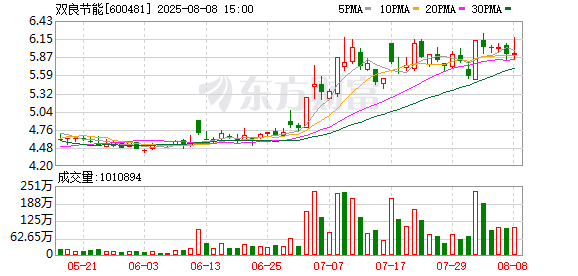
四年前的“回旋镖”,击中如今600481
Shang Hai Zheng Quan Bao· 2025-08-10 12:33
Core Viewpoint - The aggressive expansion strategy of the company in the photovoltaic industry, fueled by high financial leverage, has led to significant losses and financial distress as the industry enters a deep adjustment phase [2][4][12]. Group 1: Investment Strategy and Expansion - In March 2021, the company announced a plan to invest 7 billion yuan in the photovoltaic silicon wafer production sector, which was significantly higher than its total assets of 4.109 billion yuan at the end of 2020 [2][8]. - From 2021 to 2022, the company announced a total of 28.7 billion yuan in investment plans for photovoltaic silicon wafers and components, despite warnings from the Shanghai Stock Exchange [9][10]. - The company utilized various financing methods, including loans, private placements, and convertible bonds, to support its aggressive expansion [10][11]. Group 2: Financial Performance and Risks - The company's debt ratio reached 83% by the end of the first quarter of 2023, indicating a high level of financial risk [4][17]. - Revenue figures for the company from 2021 to 2024 were 3.83 billion yuan, 14.48 billion yuan, 23.15 billion yuan, and 13.04 billion yuan, respectively, with net profits showing a decline to -2.134 billion yuan in 2024 [14][15]. - The company's gross margin for photovoltaic products fell to -16.63% in 2024, a decrease of nearly 25 percentage points from the previous year [14]. Group 3: Industry Context and Challenges - The photovoltaic industry is experiencing a significant downturn due to oversupply, leading to rapid price declines across the supply chain [14][24]. - The company has accumulated nearly 100 GW of single crystal silicon capacity but has not achieved corresponding profit returns due to the aggressive expansion strategy [14][15]. - The introduction of "anti-involution" policies in the industry aims to stabilize the market, but challenges remain, including a predicted decline in market demand in the second half of the year [24][30]. Group 4: Future Outlook and Credit Ratings - The company's credit rating was downgraded to AA- by a well-known rating agency, reflecting concerns over its financial stability and ability to manage operational risks [17][21]. - The company faces significant challenges in releasing new capacity effectively, with ongoing risks of further financial deterioration if market conditions do not improve [21][22].

光伏板块领涨!“反内卷”积极,光伏50ETF(159864)盘中涨超1.4%,近10日净流入近1亿元
Sou Hu Cai Jing· 2025-08-08 02:02
Group 1 - The core viewpoint emphasizes the importance of "anti-involution" and the elimination of backward production capacity in the photovoltaic industry, as highlighted by recent high-level statements [1] - Specific policies include the People's Daily addressing low-price disorderly competition, the Central Financial Committee's meeting calling for legal governance of low-price competition, and the Ministry of Industry and Information Technology's emphasis on comprehensive governance of low-price competition [1] - The National Development and Reform Commission and the State Administration for Market Regulation have jointly released a draft for revising the Price Law, which includes strict management of the photovoltaic industry, aiming to shift from price competition to value competition [1] Group 2 - The recent signals for "anti-involution" indicate a coherent policy direction, with the Price Law revision underscoring the importance of this initiative [1] - Currently, many sectors in the photovoltaic industry are operating at a loss due to declining prices, and there is a possibility of photovoltaic glass prices being adjusted to around cost price, which could lead to profit recovery in the sector [1] - Investment opportunities are suggested to focus on the dynamic supply-demand changes in photovoltaic glass and the inventory de-stocking cycle [1]
新能源及有色金属日报:商品情绪回调,工业硅盘面下跌-20250805
Hua Tai Qi Huo· 2025-08-05 05:07
Group 1: Industry Investment Rating - No industry investment rating is provided in the report. Group 2: Core Viewpoints - The fundamentals of industrial silicon have changed little. In August, both supply and demand will increase, and there may be a slight reduction in inventory overall, but the total inventory pressure is significant. With the cooling of sentiment caused by anti - involution, the industrial silicon futures market may experience a weak and oscillating correction in the near term [2]. - After continuous increases, polysilicon has seen a correction. It is expected to have strong support around 45,000 yuan/ton. The details of the anti - involution plan in the photovoltaic industry are still being determined, and the implementation of policies and the downward transmission of spot prices need to be continuously monitored. In the medium to long term, polysilicon is suitable for long - position layout on dips [5]. Group 3: Market Analysis of Industrial Silicon Price and Trading Volume - On August 4, 2025, the futures price of industrial silicon dropped significantly. The main contract 2509 opened at 8,490 yuan/ton and closed at 8,360 yuan/ton, a change of - 300 yuan/ton (- 3.46%) from the previous settlement. The position of the main contract 2509 was 176,164 lots at the close, and the total number of warehouse receipts was 50,312 lots, a change of - 204 lots from the previous day [1]. Supply - The spot price of industrial silicon declined. In July 2025, the output of industrial silicon was 338,300 tons, a month - on - month increase of 3.2% and a year - on - year decrease of 30.6%. From January to July 2025, the cumulative output of industrial silicon was 2.2112 million tons, a year - on - year decrease of 20.0% [1]. Consumption - The quoted price of silicone DMC was 12,100 - 12,700 yuan/ton. The non - affected units of the Shandong accident monomer plant have gradually resumed normal operation, while the affected units need renovation and reconstruction, with the completion time undetermined. The matching degree of transactions has decreased because downstream enterprises have sufficient raw material inventories and limited purchasing意愿 [1]. Group 4: Strategy for Industrial Silicon - Unilateral: Cautiously bearish - No strategies are provided for inter - delivery spread, cross - variety, spot - futures, and options [2] Group 5: Market Analysis of Polysilicon Price and Trading Volume - On August 4, 2025, the main contract 2511 of polysilicon futures fluctuated widely. It opened at 48,800 yuan/ton and closed at 48,980 yuan/ton, a change of - 1.23% from the previous trading day. The position of the main contract reached 106,749 lots (99,344 lots the previous day), and the trading volume was 296,610 lots [3]. Supply and Inventory - The spot price of polysilicon remained stable. The polysilicon manufacturers' inventory decreased, while the silicon wafer inventory increased. The latest polysilicon inventory was 229,000 tons, a month - on - month change of - 5.76%, and the silicon wafer inventory was 18.15GW, a month - on - month change of 1.57%. The weekly output of polysilicon was 26,500 tons, a month - on - month change of 3.92%, and the silicon wafer output was 11.00GW, a month - on - month change of - 1.79% [3]. Group 6: Strategy for Polysilicon - Unilateral: Short - term range trading - No strategies are provided for inter - delivery spread, cross - variety, spot - futures, and options [5]
三超新材: 2025年度向特定对象发行A股股票预案
Zheng Quan Zhi Xing· 2025-08-04 16:36
Core Viewpoint - Nanjing Sanchao Advanced Materials Co., Ltd. plans to issue 12,475,049 A shares to a specific entity, Bodao He Yi Technology Co., Ltd., to raise funds for working capital and repay bank loans, amidst a challenging photovoltaic industry environment [1][9][10]. Group 1: Issuance Details - The issuance will not exceed 30% of the company's total share capital prior to the issuance [1][18]. - The issuance price is set at 20.04 RMB per share, which is not less than 80% of the average trading price over the previous 20 trading days [2][20]. - The total amount to be raised is capped at 250 million RMB, which will be used entirely for working capital and loan repayment [3][21]. Group 2: Industry Context - The photovoltaic industry is experiencing a supply-demand imbalance, leading to declining profits and excess capacity [8][9]. - The industry is transitioning towards high-quality development, focusing on technological innovation and cost control to navigate the downturn [8][9]. Group 3: Company Strategy - The company emphasizes research and development as a core driver for sustainable growth, aiming to enhance product quality and diversify its offerings [9][10]. - The funds raised will help optimize the company's business layout and strengthen its market competitiveness [10][11]. Group 4: Control Changes - Following the issuance, Bodao He Yi will increase its shareholding to 24.83%, becoming the controlling shareholder, while the actual controller will be Liu Jingqi [14][22]. - The control change is structured to maintain governance stability and operational efficiency [10][14]. Group 5: Financial Health - The company has been increasingly reliant on bank loans, which has raised financial costs and impacted profitability [10][11]. - The issuance aims to improve the financing structure and reduce financial burdens, thereby enhancing profitability and risk resilience [10][11]. Group 6: Regulatory Compliance - The issuance plan requires approval from the shareholders' meeting and regulatory bodies, including the Shenzhen Stock Exchange and the China Securities Regulatory Commission [1][23]. - The company has already obtained necessary approvals from its board and supervisory committee [22][23].

三超新材: 向特定对象发行A股股票方案的论证分析报告
Zheng Quan Zhi Xing· 2025-08-04 16:36
Group 1 - The core viewpoint of the article is that Nanjing Sanchao New Materials Co., Ltd. plans to issue shares to a specific entity, Wuxi Boda He Yi Technology Co., Ltd., to raise funds for operational liquidity and debt repayment, amidst a challenging photovoltaic industry environment [1][2][3] - The photovoltaic industry is experiencing a transition towards high-quality development, with companies focusing on technological innovation and cost control to navigate the downturn [2][3] - The company’s main product, electroplated diamond wire, faces increased competition and declining prices due to overcapacity and market dynamics [2][3] Group 2 - The purpose of the issuance is to supplement working capital and repay bank loans, which will enhance the company's operational flexibility and market competitiveness [2][3][4] - The company aims to optimize its capital structure and reduce financial costs through this issuance, thereby improving profitability and risk resistance [3][5] - The issuance will also solidify the control of Wuxi Boda He Yi over the company, enhancing governance stability and decision-making efficiency [3][4][6] Group 3 - The issuance will involve 12,475,049 A-shares at a price of 20.04 RMB per share, which is not lower than 80% of the average trading price over the previous 20 trading days [8][11] - The issuance process complies with relevant regulations and has been approved by the company's board, with necessary disclosures made [9][13] - The company has committed to using the raised funds effectively and has established a management system for the funds to ensure compliance with legal requirements [19][20] Group 4 - The potential dilution of immediate returns due to the issuance is acknowledged, with measures in place to mitigate this risk and enhance future profitability [17][20] - The company plans to improve operational efficiency and financial management to enhance overall profitability in the coming years [18][20] - The commitment from Wuxi Boda He Yi to support the company’s governance and operational integrity is emphasized, ensuring alignment with shareholder interests [21][22]
隆基绿能HPBC2.0电池稳定产出已达2GW/月 未调整全年组件出货量目标
Zheng Quan Shi Bao Wang· 2025-08-03 12:36
Core Viewpoint - Longi Green Energy is focusing on enhancing product quality and addressing low-price competition in the photovoltaic industry, while maintaining its annual module shipment target of 80GW to 90GW for 2025 despite market challenges [1][2][3] Group 1: Industry Developments - The Central Financial Commission's sixth meeting emphasized the need to regulate low-price competition in enterprises and promote the exit of outdated production capacity in the photovoltaic sector [1] - The Ministry of Industry and Information Technology held a meeting with photovoltaic manufacturing companies to discuss the same issues of low-price competition and the need for quality improvement [1] - The photovoltaic industry has shown positive changes under policy guidance, with a noticeable recovery in silicon wafer prices from previous lows [1] Group 2: Company Performance and Strategy - Longi Green Energy reported a significant increase in module shipments in Q2 2025, driven by a customer-centric approach and the introduction of high-efficiency products like HPBC2.0 [1][3] - The company maintains its annual module shipment target of 80GW to 90GW, despite concerns about a potential downward revision due to a significant drop in domestic photovoltaic installations in June [1] - Longi Green Energy's HPBC2.0 battery production has reached a stable output of 2GW per month, with a production line yield of approximately 97% [2] Group 3: Market Outlook - The global photovoltaic market demand growth is expected to slow down starting in 2025, influenced by energy policy adjustments and trade barriers in traditional markets like China, Europe, and the U.S. [2] - Emerging markets such as the Middle East, Africa, and India are projected to maintain high growth rates due to energy transition strategies and rigid electricity demand [2] - Longi Green Energy's component factory in Indonesia is expected to remain unaffected by the U.S. anti-dumping investigation against photovoltaic products from Indonesia, as it is set to produce 1.6GW of capacity using HPBC2.0 technology [2] Group 4: Financial Performance - Longi Green Energy anticipates a net loss of 2.4 billion to 2.8 billion yuan for the first half of 2025, which represents a significant reduction in losses compared to the previous year [3] - The company has focused on increasing customer-oriented product and service investments, leading to growth in module sales despite a competitive environment where market prices fell below cost [3] - Internal operational management improvements have led to a rapid decrease in unit costs, selling expenses, management expenses, and asset impairment losses [3]

硅片价格延续涨势 产业链价格回暖趋势明显
Zheng Quan Ri Bao· 2025-08-01 15:47
Core Viewpoint - The recent increase in silicon wafer prices is driven by a combination of reduced supply and improved demand in the photovoltaic market, with significant price hikes observed across various specifications of silicon wafers [1][2]. Group 1: Price Trends - Silicon wafer prices have continued to rise, with average prices increasing by approximately 0.1 yuan per piece in the latest week [1]. - The average transaction price for N-type G10L monocrystalline silicon wafers reached 1.2 yuan per piece, up 9.09% week-on-week; N-type G12R at 1.35 yuan per piece, up 8.00%; and N-type G12 at 1.55 yuan per piece, up 7.64% [1]. - In July, the price of N-type G10L monocrystalline silicon wafers increased from 0.88 yuan per piece at the beginning of the month to 1.2 yuan per piece by the end, marking a rise of over 36% [1]. Group 2: Market Dynamics - The photovoltaic market has seen a positive sentiment since July, with price increases in the upstream polysilicon segment leading to a recovery in downstream prices, including silicon wafers [1][2]. - The overall operating rate in the silicon wafer industry remained stable, with major companies operating at 50% and 40% capacity, while integrated companies operated between 50% and 80% [2]. - Despite the reduction in production by silicon wafer manufacturers, profitability pressures remain due to ongoing cost pressures from upstream and price negotiations with downstream customers [2]. Group 3: Future Outlook - The photovoltaic industry is experiencing a rebound in prices across the supply chain, particularly in silicon materials, silicon wafers, and battery segments, although component and auxiliary material prices show divergence [3]. - The demand for battery cells is notably influenced by export tax rebates and changes in overseas policies, indicating a clear recovery trend [3]. - By 2026, the photovoltaic industry chain is expected to reach a more definitive price turning point, contingent on policy execution and adjustments across various segments [3].