
光伏50ETF(159864)

Search documents
SpaceX收购xAI,太空光伏持续加速,光伏50ETF(159864)大涨超5%
Mei Ri Jing Ji Xin Wen· 2026-02-03 06:47
Group 1 - SpaceX has acquired xAI, aiming to accelerate the deployment of data centers in space and is preparing for an IPO [1] - The FCC documents indicate that SpaceX plans to launch and operate up to 1 million satellites, which will support large-scale AI reasoning and data center applications [1] - The satellite constellation will operate at altitudes between 500 to 2000 km, powered by solar energy, and will connect to the existing Starlink network via laser links [1] Group 2 - Elon Musk has proposed that SpaceX and Tesla will build a total of 200 GW of photovoltaic capacity in the U.S. over the next three years, with each company contributing 100 GW [1] - The demand for photovoltaic equipment is expected to surge due to the need for solar power for ground data centers and space AI satellites [1] - The low Earth orbit satellite and space computing advancements are pushing the space photovoltaic industry into a verification phase, requiring higher efficiency and flexibility [1]
太空光伏概念拉升,关注光伏50ETF(159864)
Mei Ri Jing Ji Xin Wen· 2026-01-28 01:33
Core Viewpoint - The space photovoltaic sector is gaining traction, with the photovoltaic 50 ETF (159864) rising by 0.82% on January 27, indicating growing investor interest in this technology [1]. Group 1: Space Photovoltaic Overview - Space photovoltaic refers to the technology that converts solar energy into electrical energy in space environments, such as satellite orbits and space stations, which face extreme conditions [2]. - Low Earth orbit (LEO) resources are becoming a new battleground for major powers, with China applying for frequency and orbital resources for 203,000 satellites by December 2025 to secure valuable orbital resources [2]. - The global commercial space boom is expected to benefit space photovoltaic technology, with companies like SpaceX and Tesla aiming to increase solar energy production to 100 GW annually [2]. Group 2: Space Computing Power - Space computing power involves deploying data centers in space to address energy and space limitations, utilizing solar energy and the vacuum's ultra-low temperature for efficient power and cooling solutions [2]. - The rising operational costs of ground-based computing power highlight the advantages of space computing, which may lead to increased demand for photovoltaic technology [2]. Group 3: Technological Choices for Space Photovoltaics - Gallium arsenide (GaAs) is the current mainstream choice for space photovoltaics due to its radiation resistance, high conversion efficiency, and long lifespan, although it faces limitations in production capacity and cost [3]. - Crystalline silicon is progressing faster in industrialization due to its strong radiation resistance and lower production costs, making it suitable for low Earth orbit satellites [3]. - Perovskite solar cells show potential with high theoretical efficiency and better radiation resistance than silicon, but their practical application remains limited due to a lack of empirical data and a less mature supply chain [3]. Group 4: Investment Opportunities - Investors interested in the photovoltaic sector can consider the photovoltaic 50 ETF (159864) for a comprehensive investment in the entire photovoltaic supply chain, including silicon materials, wafers, cells, modules, and equipment [3].
2026市场整体乐观,行稳致远成导向
Sou Hu Cai Jing· 2026-01-26 02:07
Group 1 - The overall market trend for 2026 is expected to be optimistic, driven by a combination of fundamental, liquidity, sentiment, and policy factors [1][2] - China's GDP has surpassed 140 trillion, indicating a strong economic achievement that supports market performance [1] - Despite a recent cooling in market sentiment, the overall bullish sentiment remains high, and the market is currently undergoing a necessary adjustment phase [2] Group 2 - Historical analysis shows that previous bull markets have been characterized by short bursts of activity followed by long periods of adjustment, which negatively impacted investor experiences [3] - The current market environment is being guided towards healthier long-term development through measures such as increased margin requirements and regulatory support [4] - The AI sector remains a key focus for 2026, with strong growth expected in upstream computing power and semiconductor equipment due to expansion and rising demand [5][6] Group 3 - The innovative drug sector is projected to continue its growth trajectory in 2026, focusing on new drug platforms and expanding applications for existing treatments [6]
光伏50ETF(159864)大涨点评
Mei Ri Jing Ji Xin Wen· 2026-01-23 05:46
Group 1 - The solar photovoltaic sector is experiencing significant growth, with the photovoltaic 50 ETF rising over 5.9% and the carbon neutrality 50 ETF increasing over 4% in early trading [1] - The competition in space resources is intensifying, with the U.S. leveraging SpaceX's lead in low Earth orbit communication satellites, as the FCC has approved the deployment of an additional 7,500 second-generation Starlink satellites [1] - China plans to submit an application for 203,000 satellites' frequency and orbital resources to the ITU by December 2025, aiming to secure valuable orbital resources [1] Group 2 - The commercial space sector is witnessing a resurgence, with space photovoltaics poised for development opportunities, utilizing energy sources such as gallium arsenide, crystalline silicon, and perovskite [2] - The National Development and Reform Commission is addressing chaotic price competition, promoting rational pricing in the industry, which is expected to enhance high-quality development [3] - The industry is expected to gradually alleviate oversupply pressures through self-discipline, capacity consolidation, and technological iteration, leading to a recovery in profitability across the entire supply chain [3] Group 3 - SpaceX plans to launch its second-generation Starlink system by 2027 to provide faster internet services [4] - Gallium arsenide is currently the mainstream choice for space photovoltaics due to its strong radiation resistance and high conversion efficiency, although it faces limitations in production capacity and raw material costs [4] - Crystalline silicon is advancing rapidly in industrialization and is suitable for low Earth orbit satellites, while perovskite shows potential for future applications but lacks substantial empirical data for large-scale deployment [4]
“太空光伏”主题持续升温,关注光伏50ETF(159864)
Sou Hu Cai Jing· 2026-01-20 01:34
Core Viewpoint - The recent announcement by the Ministry of Finance and the State Administration of Taxation regarding the cancellation of VAT export tax rebates for photovoltaic products starting April 1, 2026, is expected to lead to a short-term increase in overseas export volumes of photovoltaic modules, while also accelerating the clearance of outdated production capacity in the long term [1]. Group 1: Short-term Impacts - The cancellation of export tax rebates will directly increase the costs for photovoltaic module companies, prompting overseas terminal enterprises to rapidly increase order demand during the transition period [1]. - This surge in demand is likely to boost short-term industry growth in photovoltaic components [1]. Group 2: Long-term Industry Trends - The industry may focus more on brand building and technological innovation as outdated production capacity is cleared [1]. - High-efficiency components such as BC and TOPCon 3.0 are expected to command higher premiums, allowing leading companies to further expand their market share due to brand and technological advantages [1]. Group 3: Emerging Themes - The theme of "space photovoltaics" is gaining traction, leading to a reevaluation of industry valuations [1]. - The global increase in satellite launches is expected to drive demand for GW-level space photovoltaic solutions, which are well-suited for extreme conditions in space [1]. - SpaceX has confirmed the P-type HJT battery technology as its route for large-scale economic production of space solar cells, indicating that space photovoltaics may become a strategic solution for commercial aerospace and high-end applications [1].
光伏50ETF(159864)收涨超2.1%,行业关注太空光伏与海外需求双主线
Mei Ri Jing Ji Xin Wen· 2025-12-24 09:52
Group 1 - The core viewpoint emphasizes the importance of the "space photovoltaic" theme in the photovoltaic equipment industry, highlighting its connection to US-China strategic competition and low-orbit resource contention, with fundamental catalysts expected to accelerate faster than emerging industries like nuclear fusion [1] - The European offshore wind demand is showing continuous improvement, with Poland's 3.4GW offshore wind tender being realized, and it is anticipated that the annual grid-connected scale of offshore wind in Europe will exceed 14GW by 2031-2032, leading to an acceleration in the release of future orders for piles, submarine cables, and wind turbines [1] - The price of lithium carbonate is surging, with spot prices breaking through 100,000 yuan/ton, and market inventory falling below 110,000 tons, indicating that prices are expected to remain strong in the short term [1] Group 2 - The photovoltaic 50 ETF (159864) tracks the photovoltaic industry index (931151), which selects listed companies involved in the entire solar photovoltaic power generation industry chain from the Shanghai and Shenzhen markets, including upstream raw material supply, midstream battery component manufacturing, and downstream power station construction and operation [1] - The index focuses on companies that are technologically advanced and competitive in the market, aiming to comprehensively reflect the overall development status and future trends of China's photovoltaic industry [1]
践行绿色金融,国泰基金构建更完善ESG投资生态
Sou Hu Cai Jing· 2025-12-19 07:07
Core Viewpoint - The acceleration of green transformation in economic and social development is a strategic choice aligned with China's modernization and high-quality development goals, with a focus on integrating green finance and sustainable investment into the financial sector [1] Group 1: ESG Investment Strategy - The ESG (Environmental, Social, and Governance) investment philosophy has rapidly gained traction in global markets, emphasizing a comprehensive evaluation that includes environmental protection and social responsibility alongside financial performance [2] - Since becoming a signatory to the UN Principles for Responsible Investment (PRI) in 2022, the company has achieved the highest five-star rating in the 2024 PRI assessment across multiple dimensions, including passive equity and active quantitative strategies [2] - An ESG research team has been established to set sustainable investment goals and ensure the integration of ESG principles throughout the investment research process [2] Group 2: Green Financial Research Framework - The company is focused on building a rigorous research framework to support its green finance strategy, ensuring that ESG principles are embedded in the investment decision-making process [4] - Investment decisions incorporate positive and negative screening, as well as ESG integration, using an ESG rating system to assess the green governance performance of investment targets [4] - Fund managers consider both internal and external ESG ratings when constructing investment portfolios, prioritizing investments with strong green governance [4] Group 3: Product Innovation - The company is committed to supporting the energy revolution and sustainable investment, focusing on clean energy utilization and the development of a new energy system [6] - A diverse range of green financial products is offered, including various ETFs and actively managed funds, aimed at directing social capital towards green industries [6] - The product lineup includes industry-leading innovations and specialized tools, providing long-term funding support for green industry development and offering investors a variety of options to participate in the green transition [6] Group 4: Collaborative Ecosystem - The company recognizes the importance of collaboration in advancing green finance and aims to enhance its ESG investment ecosystem through product innovation, technology, and industry partnerships [7] - Plans include leveraging big data and AI to improve risk assessment and yield analysis for green projects, as well as fostering communication among investment institutions, enterprises, and regulatory bodies [7] - The company aims to guide social capital towards green sectors, contributing to the low-carbon transition of the real economy while achieving its own high-quality development [7]


ETF日报:中央经济工作会议定调26年继续推进反内卷,光伏板块依旧值得期待,关注电网ETF
Xin Lang Cai Jing· 2025-12-16 13:29
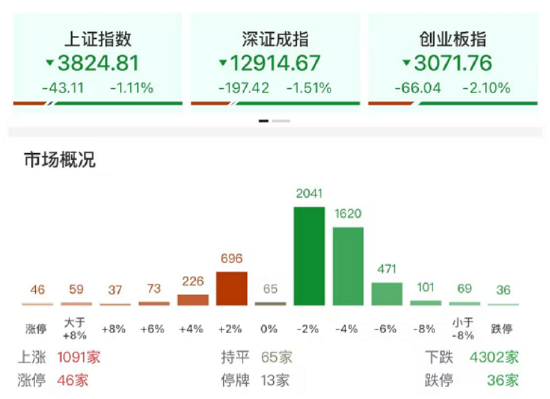
Market Overview - The market experienced a day of volatility with all three major indices opening lower and closing down. The Shanghai Composite Index fell by 1.11%, the Shenzhen Component by 1.51%, and the ChiNext Index by 2.1% [1][13] - The total trading volume in the Shanghai and Shenzhen markets was 1.72 trillion yuan, a decrease of 49.3 billion yuan from the previous trading day, with over 4,300 stocks declining [1][13] Macro Economic Factors - The Bank of Japan is set to discuss a potential interest rate hike from 0.5% to 0.75% during its monetary policy meeting on December 18-19, which would be the highest rate in 30 years [1][13] - Concerns about tightening liquidity and the ongoing worries regarding an AI bubble in overseas markets have contributed to market sentiment [1][13] AI and Semiconductor Sector - The semiconductor and AI-related sectors saw significant declines, particularly in communication and entrepreneurial AI stocks, likely due to weak overseas AI trading [3][15] - Despite recent downturns, there is a strong expectation for continued growth in capital expenditure in the AI sector next year, with a focus on upstream supply chain stocks in A-shares [3][15] - Communication ETF (515880) and semiconductor equipment ETF (159516) are recommended for investors looking to capitalize on domestic alternatives and AI-related opportunities [3][15][20] Automotive Sector - The smart automotive sector performed relatively well, with the smart automotive ETF (159889) rising by 0.19% [8][21] - The Ministry of Industry and Information Technology has granted approval for the first batch of L3 conditional autonomous driving vehicles, marking a significant step towards commercialization [8][21] - Tesla's advancements in L4 autonomous driving technology may serve as a benchmark for domestic players aiming to initiate similar operations [9][21] New Energy Sector - The new energy sector experienced notable declines, with the electric grid ETF (561380) down 3.13% and the photovoltaic ETF (159864) down 3.05% [11][23] - Factors contributing to this decline include external macroeconomic influences and the approaching sales off-season, leading to concerns about the sustainability of energy storage demand [11][23] - Despite the current downturn, the outlook for energy storage remains positive, with expectations of sustained demand into the first half of next year [11][24]
光伏50ETF(159864)涨超1.6%,技术迭代与价格企稳或促行业筑底
Mei Ri Jing Ji Xin Wen· 2025-12-12 07:02
Core Viewpoint - The photovoltaic industry is experiencing short-term price declines and increased equipment demand, with long-term growth expected due to continuous cost reductions and installation demand increases [1] Industry Summary - The industry is currently at a bottom phase, with expectations for a turning point in 2026, where accelerated supply-side clearing may promote a "de-involution" process [1] - Technological themes such as "cost reduction and efficiency enhancement, technological innovation" remain eternal, with advancements in TOPCon, HJT, and XBC technologies driving both volume and price increases in battery and component equipment [1] - New directions like perovskite technology are anticipated to open up long-term growth opportunities [1] Company Summary - Photovoltaic equipment companies are extending into the semiconductor sector to further expand their development potential [1] - The Photovoltaic 50 ETF (159864) tracks the photovoltaic industry index (931151), which selects listed companies involved in the entire photovoltaic industry chain, including upstream silicon materials, midstream battery and component production, and downstream power station operations [1] - This index exhibits significant growth and volatility characteristics, effectively reflecting the development dynamics of the photovoltaic industry [1]
行业反内卷决心明确,关注光伏50ETF(159864)
Mei Ri Jing Ji Xin Wen· 2025-12-10 01:12
Core Viewpoint - The photovoltaic (PV) sector is currently facing significant supply surplus, primarily involving private enterprises, and requires a gradual policy approach to resolve the issue, focusing on self-discipline, capacity integration, and technological iteration [1] Group 1: Industry Performance - On December 9, the photovoltaic sector showed relatively good performance, with the PV 50 ETF (159864) rising by 0.32% [1] - Since Q3 2025, the prices in the silicon material segment have stabilized and begun to rise, leading to improved profitability across the entire PV industry chain [2] - The overall price of the photovoltaic industry chain has shown a recovery trend, with multi-crystalline silicon dense material increasing from 35 yuan/kg to 52 yuan/kg, and 182N silicon wafers rising from 0.88 yuan/piece to 1.18 yuan/piece [2] Group 2: Policy and Market Dynamics - The National Development and Reform Commission (NDRC) has held discussions to address disorderly price competition among enterprises, aiming to maintain a good market price order and support high-quality development [1] - The determination to combat "involution" in the industry is clear, and as capacity reduction measures are implemented, a trend of profitability recovery is expected to emerge [2] Group 3: Technological Advancements - The perovskite photovoltaic industry in China has seen significant breakthroughs this year, with stability in lifespan being achieved, indicating rapid progress from laboratory to industrialization [3] - Perovskite technology is expected to become a core solution for space energy due to its high efficiency, low cost, flexibility, and radiation resistance, presenting investment opportunities as its industrialization accelerates [2]