数字消费

Search documents
9.37万亿元里是科技创新的活力
Xin Lang Cai Jing· 2025-12-21 16:37
Core Insights - The report from the China Internet Network Information Center indicates that China's digital consumption reached 9.37 trillion yuan in the first half of the year, accounting for nearly half of total household consumption expenditure [1] Group 1: New Trends - The digital consumer demographic includes 117 million users aged 60 and above, highlighting the growing participation of the "silver economy" in digital consumption [1] - Innovative products such as cooking robots and AI glasses are continuously emerging, significantly enhancing the quality of life for consumers [1] - New consumption scenarios like digital business districts and smart street areas are being developed, offering both trendy and efficient shopping experiences [1] Group 2: Market Potential - The robust growth of digital consumption signals positive trends in technology innovation and indicates substantial potential within the consumer market [1]
数字消费已占我国居民消费支出总额近半
Xin Lang Cai Jing· 2025-12-21 16:36
Core Insights - The report indicates that China's digital consumption reached 9.37 trillion yuan in the first half of 2025, accounting for nearly half of total household consumption expenditure [2][5] - Digital consumption is evolving as a new consumption model, expanding the consumption space and becoming a significant driving force for the economy [2] Group 1: Digital Consumption Trends - The user base for digital consumption has surpassed 958 million, with Generation Z accounting for 261 million users, representing 27.2% of the total [3] - The elderly population (60 years and above) constitutes 117 million digital consumers, making up 12.2% of the user base, showing a mix of price comparison and impulsive buying behaviors [3] - Rural digital consumers number 249 million, which is 26.0% of the total, indicating a balanced participation in online consumption subsidies compared to urban areas [3] Group 2: Innovations in Consumption Spaces - Digital technologies are reshaping physical commercial spaces, with new business models like digital business circles and smart districts injecting new vitality into the consumption market [4] - The Hangzhou Lakeside Pedestrian Street has undergone digital service upgrades to create a multi-dimensional consumption scene, enhancing visitor experiences through technology [4] - The report highlights a growing trend in digital cultural tourism, with micro-short drama users reaching 626 million and online gaming users at 584 million, indicating a rich supply of digital entertainment content [4] Group 3: Evolving Consumer Preferences - Digital consumption is entering a phase where practicality and experience are equally prioritized, with 67.1% of online shoppers focusing on product practicality and 60.6% willing to pay for personal enjoyment and emotional value [5] - A significant portion of consumers (16.8%) utilize online subsidies for purchasing new products, while 14.7% prefer second-hand platforms for buying used items [5] - Consumers are increasingly blending fast online shopping with immersive offline experiences facilitated by VR/AR technologies [5] Group 4: Immersive Experience Consumption - The XR experience space at the Qin Shi Huang Mausoleum has attracted over 20,000 visitors in three months, showcasing the growing acceptance and enthusiasm for immersive digital experiences [6] - VR experience venues in cities like Nanchang are witnessing high foot traffic, indicating a rising interest among young consumers in immersive activities [6] - The digital economy is driving deeper engagement in immersive experience consumption, reflecting a shift in consumer behavior towards experiential offerings [6]


线上“快”购物与线下“慢”体验交融共生 感知9.37万亿元、9.58亿人背后数字消费澎湃活力
Yang Shi Wang· 2025-12-21 09:03
Group 1 - The core viewpoint of the report indicates that digital consumption in China is rapidly expanding, with a total expenditure of 9.37 trillion yuan expected in the first half of 2025, accounting for nearly half of total household consumption spending [1][5] - The report highlights that the user base for digital consumption has surpassed 958 million, with the "Z generation" making up 261 million users, representing 27.2% of the total, and being the main consumers of smart products, digital content, and emotional spending [6] - The report also notes that the elderly population (aged 60 and above) constitutes 12.2% of digital consumers, with 11.7 million users engaging in both price comparison and impulsive purchases during live broadcasts [7] Group 2 - Rural digital consumers number 249 million, making up 26.0% of the total, with their participation in online consumption subsidies being comparable to urban areas [8] - The report emphasizes the importance of diverse digital consumer groups across different ages and regions, which lays the foundation for a multi-faceted digital consumption market [10] - Digital services are deeply integrated into daily life, with online food delivery consumption exceeding 1 trillion yuan and online services in healthcare, education, and domestic services surpassing 500 billion yuan [17] Group 3 - The report indicates a shift towards a balance between practicality and experience in digital consumption, with 67.1% of online shoppers prioritizing product practicality and 60.6% willing to pay for personal interests and emotional value [19][21] - Immersive digital experiences, such as VR and AR, are becoming increasingly popular, with projects like the XR experience at the Terracotta Army attracting over 20,000 visitors in just three months [23] - The growing acceptance and enthusiasm for VR experiences among consumers, particularly the youth, is evident, with many engaging in various immersive activities [25][26]

视频丨一组数据看懂我国数字消费潜力
Yang Shi Xin Wen Ke Hu Duan· 2025-12-21 07:06
Core Insights - The report indicates that China's digital consumption reached 9.37 trillion yuan in the first half of this year, accounting for nearly half of total household consumption expenditure [1][3] - Digital consumption is evolving as a new consumption model, expanding the consumption space and becoming a significant driving force for overall consumption [1] Digital Consumption Scale - By the first half of 2025, the scale of digital consumption based on goods, services, and content is projected to reach 9.37 trillion yuan, representing 46.5% of total household consumption expenditure [3][5] - The number of digital consumption users has surpassed 958 million, with the "Z generation" accounting for 261 million users (27.2%), and the elderly (60 years and above) comprising 117 million users (12.2%) [5][6] Consumer Behavior Trends - Different age groups and regions contribute to a diverse digital consumption market, with rural digital consumers at 249 million (26.0%) [5][6] - 67.1% of online shoppers prioritize product practicality, while 60.6% are willing to pay for personal interests and emotional value [22] Integration of Digital and Physical Spaces - Digital technologies are reshaping physical commercial spaces, with new business models like digital shopping districts and smart neighborhoods accelerating the integration of online and offline consumption [7][15] - The report highlights the success of interactive live streaming and digital product spaces in urban areas, enhancing consumer engagement and driving foot traffic [9][11] Immersive Experience in Digital Consumption - The report notes a shift towards a balance between practical and experiential digital consumption, with consumers seeking both convenience and immersive experiences [16][19] - Popularity of VR and AR technologies is rising, with significant engagement in immersive experiences, such as the XR experience at the Terracotta Army site attracting over 20,000 visitors in three months [19][21]

锐财经丨消费市场新意浓
Ren Min Ri Bao Hai Wai Ban· 2025-12-20 05:53
Core Viewpoint - The consumption market in China is experiencing steady growth, driven by various policies aimed at boosting consumption and the emergence of new consumption patterns, with a notable increase in both retail sales and service consumption [1][3][5]. Group 1: Consumption Market Performance - From January to November, the total retail sales of consumer goods increased by 4% year-on-year, surpassing both the previous year's growth and the overall growth for the year [1]. - In November, retail sales of cultural and office supplies and communication equipment grew by 11.7% and 20.6% year-on-year, respectively, indicating a strong demand for quality consumption [2]. - Service retail sales increased by 5.4% year-on-year from January to November, outpacing the growth of goods retail sales, reflecting a shift towards service consumption [2]. Group 2: New Consumption Trends - New consumption models such as instant retail and live-streaming e-commerce are rapidly growing, with online retail sales of physical goods increasing by 5.7% year-on-year, accounting for 25.9% of total retail sales [4]. - Digital, green, and health-related consumption are emerging as new hotspots, indicating a shift in consumer preferences towards more sustainable and health-conscious products [4]. Group 3: Challenges and Opportunities - Despite the growth, there are challenges such as low consumer confidence and spending capacity, with the consumer rate projected at 39.9% in 2024, still lagging behind developed countries by 10-30 percentage points [6]. - To enhance consumer spending, measures will be taken to improve employment and income levels, as well as to implement policies that stimulate consumption, such as the trade-in program for consumer goods [6][7].
同比增长26.1%!
Sou Hu Cai Jing· 2025-12-20 05:23
Group 1 - In the first 11 months of the year, China's e-commerce has continuously stimulated consumer vitality, with digital consumption and online services being the main growth drivers [2] - The growth of digital products monitored by the Ministry of Commerce increased by 8.2%, with smart wearables and smart robots maintaining double-digit growth [2] - Online service consumption saw a significant increase of 21.7% [2] Group 2 - The average price index for China's bulk commodities is expected to be 112.1 points in 2025, showing a trend of stabilization and recovery, with clear characteristics of new and old kinetic energy conversion [3] - In November, actual foreign investment used in China increased by 26.1% year-on-year, with 61,207 new foreign-invested enterprises established in the first 11 months, a 16.9% increase [3] - In November alone, 7,425 new foreign-invested enterprises were established, marking a year-on-year growth of 35.3% [3] Group 3 - The 2025 China International Tourism Trade Fair opened in Haikou, attracting over 1,000 travel merchants and representatives from 101 countries and regions, with a total exhibition area of 65,000 square meters [3] Group 4 - Beijing has enhanced public services related to Taiwan, focusing on eight areas including entry, residence, travel, education, employment, medical care, social security, and assistance, resulting in a streamlined service process [4] - A total of 13 "process testing" sessions have been conducted to address specific issues in areas such as medical care and social security, improving the experience for Taiwanese residents [4] Group 5 - The second "Tongqi Zhi Guang" Cross-Strait Animation Fashion Design Week was held in Shanghai, promoting cultural exchange and collaboration between the two sides through various activities [5] - The event serves as a significant platform for youth cultural exchange, fostering substantial interaction among young talents in the creative and cultural sectors [5]

前十一月,社零总额增长百分之四——消费市场新意浓
Xin Hua Wang· 2025-12-19 23:45
Core Insights - The consumer market in China is experiencing steady growth, with a year-on-year increase of 4% in retail sales of consumer goods from January to November, surpassing both the previous year's growth and the total growth for the entire year [1][2][3] Group 1: Consumer Market Performance - The overall consumer market remains stable, with retail sales continuing to expand and service consumption growing rapidly [2][3] - In November, retail sales of cultural and office supplies and communication equipment increased by 11.7% and 20.6% year-on-year, respectively, indicating a strong demand for quality consumption [2] - Retail sales of food and essential goods also saw a significant increase, with grain and oil retail sales rising by 6.1% year-on-year in November [2] Group 2: New Consumption Trends - New forms of consumption, such as instant retail and live-streaming e-commerce, are growing steadily, with online retail sales of physical goods increasing by 5.7% year-on-year, accounting for 25.9% of total retail sales [4] - Digital, green, and health-related consumption are emerging as new hotspots, reflecting a shift in consumer preferences [4][5] Group 3: Economic Context and Future Outlook - The increase in consumer spending is linked to the per capita GDP surpassing $10,000, leading to an upgrade in consumption structure [5] - The potential for consumption growth remains significant, driven by a large middle-income population and the ongoing development of new technologies and consumption models [4][5] - However, challenges such as low consumer confidence and limited spending power persist, necessitating further efforts to enhance consumer capacity and willingness [6][7]
消费市场新意浓(锐财经)
Ren Min Ri Bao Hai Wai Ban· 2025-12-19 23:40
Group 1 - The core viewpoint of the articles highlights the steady growth of the consumption market in China, driven by various policies aimed at boosting consumption and the emergence of new consumption patterns [1][3][5] - From January to November, the total retail sales of consumer goods increased by 4% year-on-year, surpassing both the same period last year and the overall growth rate for the previous year [1][2] - The service consumption sector has shown rapid growth, with service retail sales increasing by 5.4% year-on-year, outpacing the growth of goods retail sales [2][5] Group 2 - The trend of quality upgrading in consumption is evident, with new consumption models such as instant retail and live e-commerce gaining traction [4][5] - Digital, green, and health-related consumption are emerging as new hotspots, contributing significantly to the overall consumption landscape [5][6] - The potential for consumption upgrade remains substantial, with a large middle-income group in China and expectations for GDP per capita to exceed $13,000 in 2024, leading to a shift from basic needs to more discretionary spending [5][6] Group 3 - There are challenges in enhancing residents' consumption capacity and confidence, with the current consumption rate at 39.9%, which is significantly lower than that of developed countries [6][7] - Future efforts will focus on increasing residents' consumption willingness and enhancing their purchasing power through various policies, including employment stabilization and urban renewal initiatives [6][7] - The market's resilience and potential are expected to continue to manifest as new consumption scenarios and environments are developed [7]

前11个月全国网上零售额增长9.1%
Xin Lang Cai Jing· 2025-12-19 19:25
Group 1 - The core viewpoint of the articles highlights the growth of online retail in China, with a 9.1% increase in online retail sales from January to November, driven by digital consumption and online service spending [1] - The digital products monitored by the Ministry of Commerce saw an 8.2% growth, with smart wearables and smart robots growing by 22.1% and 19.4% respectively, while online service consumption increased by 21.7% [1] - The rural online retail sales grew by 9.8%, and key monitored e-commerce platforms reported textile and pharmaceutical transaction growth of 6.6% and 3.5% respectively [1] Group 2 - The "Silk Road Cloud Products" e-commerce month event led to significant sales increases for products like Australian steak and Indonesian bird's nest, with sales growth exceeding 10 times, contributing to a 5.6% increase in retail sales of imported goods from January to November [2] - The e-commerce sector is enhancing its role in connecting domestic and international markets, with ongoing capacity-building initiatives in countries like Thailand and Laos, involving over 150 representatives from government, industry, and SMEs [2] - The average R&D intensity of major e-commerce platforms reached 8.3% in the first three quarters, with advancements in AI cloud, self-developed text-to-video, and text-to-image models ranking among the world's best [1]
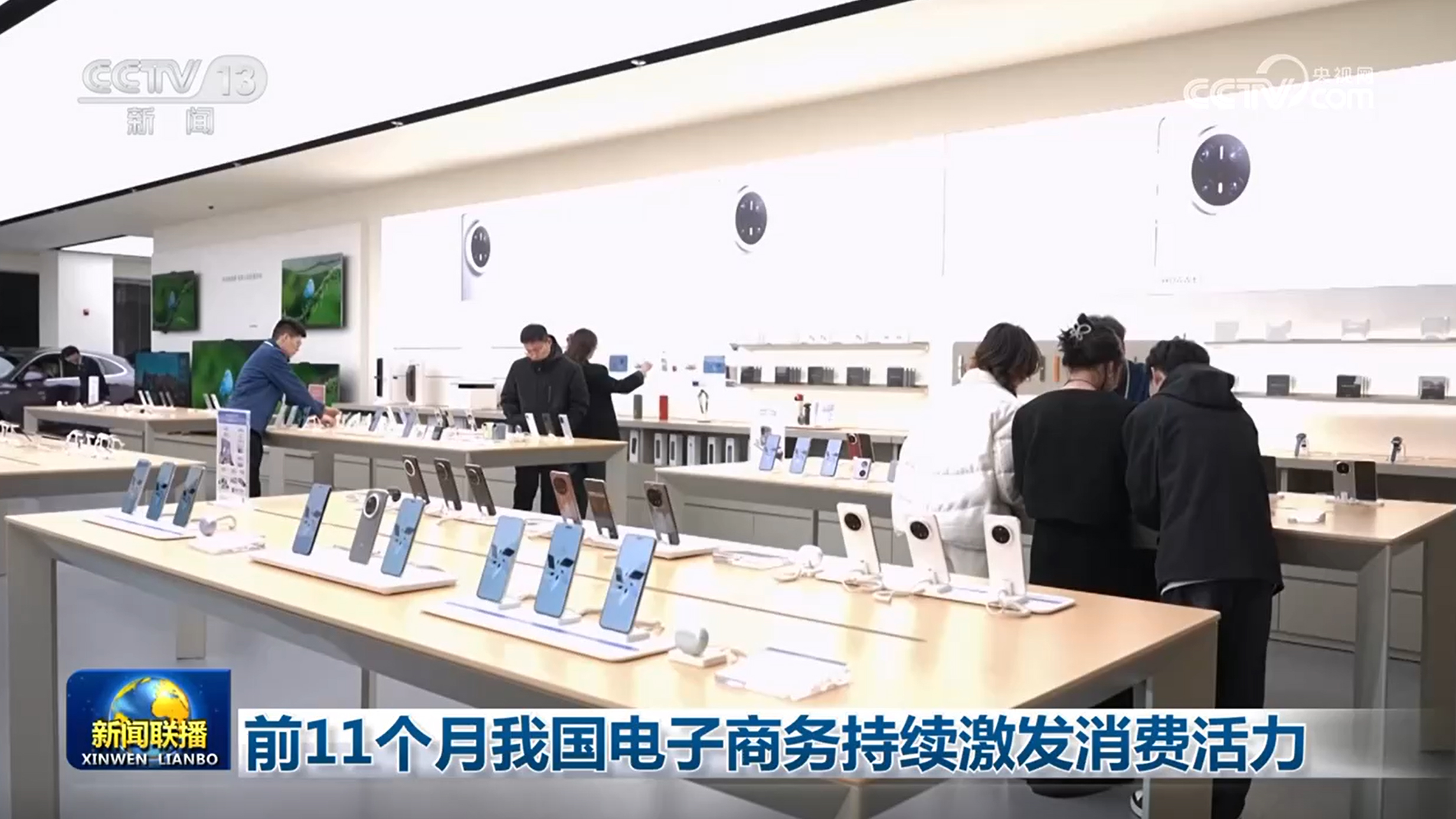
前11个月我国电子商务持续激发消费活力
Yang Shi Wang· 2025-12-19 12:18
Group 1 - The core viewpoint of the article highlights the sustained growth of e-commerce in China, driven by digital consumption and online services, with significant increases in various sectors [1][3] - In the first 11 months of the year, the digital products monitored by the Ministry of Commerce grew by 8.2%, with smart wearables and smart robots experiencing double-digit growth [1] - Online service consumption surged by 21.7%, indicating a strong shift towards digital services [1] Group 2 - Rural online retail sales increased by 9.8% from January to November, showcasing the potential of domestic demand [1] - The average R&D intensity of major e-commerce platforms reached 8.3% in the first three quarters, reflecting a focus on innovation [1] - The "Silk Road Cloud Products" e-commerce month event contributed to a 5.6% growth in retail sales of imported goods on monitored platforms, enhancing the connection between domestic and international markets [3]