
数字产品

Search documents
新华文轩(00811) - 关於2025年年度主要经营数据的公告
2026-03-26 12:43
香港交易及結算所有限公司及香港聯合交易所有限公司對本公告之內容概不負責,對其準確性 或完整性亦不發表任何聲明,並明確表示,概不對因本公告全部或任何部分內容而產生或因倚 賴該等內容而引致之任何損失承擔任何責任。 新華文軒出版傳媒股份有限公司 XINHUA WINSHARE PUBLISHING AND MEDIA CO., LTD. (於中華人民共和國註冊成立之股份有限公司) (股份代號:811) 關於2025年年度主要經營數據的公告 出版業務涵蓋了圖書、報刊、音像製品及數字產品等出版物的出版;印刷服務及 物資供應等業務。 發行業務涵蓋了向學校及師生提供教學用書,中小學教育信息化及教育裝備業 務;出版物零售、分銷及互聯網銷售業務等。 特此公告。 本公告乃由新華文軒出版傳媒股份有限公司(「本公司」,連同其附屬公司統稱「本 集團」)根據香港聯合交易所有限公司證券上市規則(「上市規則」)第13.09條以及 香港法例第571章證券及期貨條例第XIVA部的規定作出。 本公司董事會及全體董事保證本公告內容不存在任何虛假記載、誤導性陳述或者 重大遺漏,並對其內容的真實性、準確性和完整性承擔法律責任。 本公司根據《上海證券交易 ...
2025年广州经济的“稳”与“进”
Sou Hu Cai Jing· 2026-02-06 07:07
Core Insights - Guangzhou's economic performance in 2025 reflects resilience amid external challenges and internal structural adjustments, with a focus on consumption and industrial upgrades as dual engines of growth [1][6] Consumption Dynamics - The city's consumption market shows strong resilience, with daily retail sales for automobiles and communication devices reaching 375 million yuan and 132 million yuan respectively, and various goods maintaining an annual growth rate of over 6% [3] - Online retail sales of physical goods exceeded 350 billion yuan, marking a 13.1% year-on-year increase and accounting for 31.9% of total retail sales, indicating a transition from a traditional to a digital commerce hub [3] - Service consumption is becoming a new growth driver, with over 110,000 commercial performances held in a year, attracting 264 million tourists and boosting cultural and tourism consumption [3][4] Infrastructure and Investment - Baiyun Airport handled over 83 million passengers, ranking among the top ten globally, while the metro system recorded an annual ridership of 3.4 billion, showcasing robust transportation infrastructure [4] - New loans exceeded 510 billion yuan, ranking third nationally, with actual foreign investment growing by 9.1%, supporting the consumption infrastructure [4] Industrial Growth - The service sector's contribution to GDP surpassed 2.4 trillion yuan, accounting for over 80% of GDP growth, with the productive service industry making up 59% of this sector [4] - The digital economy is rapidly expanding, with core industry value-added growth at 6%, and digital product services growing by 15% [4][6] - Traditional industries are revitalizing through technological upgrades, with significant investments in industrial technology improvements during the 14th Five-Year Plan period [5][6] Emerging Industries - The "3+5" strategic emerging industries are projected to exceed 1 trillion yuan in value-added, growing by 4.2% and constituting 32.4% of GDP [6] - The automotive sector is transitioning towards new energy vehicles, with production increasing by 21.6%, and significant growth in charging stations and battery production [6] - The integration of innovation and industry is evident, with a notable increase in the number of specialized small and medium enterprises contributing significantly to industrial growth [6] Conclusion - Guangzhou's economic report illustrates a balanced approach to transitioning from old to new, with a solid foundation for current stability and a clear trajectory for future growth [6]

2026·贸促进行时 | 浙江省贸促会聚焦提能增效,锚定高水平开放
Huan Qiu Wang· 2026-01-30 12:32
Core Viewpoint - The China Council for the Promotion of International Trade (CCPIT) is implementing targeted measures to help enterprises effectively respond to external challenges and seize development opportunities, particularly in the context of the 14th Five-Year Plan and a complex international environment [2]. Group 1: Key Initiatives and Goals - The Zhejiang Provincial CCPIT aims to enhance its capabilities and effectiveness in promoting trade, focusing on the dual service brands "Zhejiang Going Global" and "Zhejiang Win-Win" to support enterprises in achieving international competitiveness [6][9]. - The provincial government report emphasizes the need for high-level opening up, aiming for a 6% growth in service trade and over 8% in digital trade by 2026, while maintaining stable export shares in goods trade [4][5]. Group 2: Strategic Focus Areas - The CCPIT will concentrate on three major tasks: enhancing the capabilities of open platforms, strengthening hub functions, and innovating trade models to boost trade quality and quantity [3][4]. - Specific initiatives include the construction of a world-class port in Ningbo-Zhoushan, the establishment of a resource allocation hub for bulk commodities, and the promotion of cross-border e-commerce [3][4]. Group 3: Trade Promotion Activities - The CCPIT plans to organize various international trade and investment activities, including the fourth Chain Expo and international procurement series, to facilitate connections between local enterprises and global markets [8][12]. - The organization will also enhance legal services for businesses, focusing on compliance, intellectual property protection, and dispute resolution to support enterprises in their international ventures [9][10]. Group 4: FTA and Investment Environment - The CCPIT is set to implement a three-year action plan for Free Trade Agreement (FTA) research and application, aiming to publish multiple practical guides and conduct numerous training sessions to assist enterprises in leveraging FTAs [13][14]. - Efforts will be made to optimize the foreign investment environment through extensive evaluations and feedback mechanisms, ensuring that foreign enterprises' needs are addressed effectively [14].
佳华科技:公司密切关注主要客户相关经营情况的变化
Zheng Quan Ri Bao Zhi Sheng· 2026-01-30 11:35
Core Viewpoint - JiaHua Technology is actively optimizing its customer structure in response to changes in the operational conditions of its major clients, focusing on enhancing customer engagement and expanding its client base for sustainable development [1] Group 1: Customer Engagement and Development - The company is strengthening its relationship with existing clients by upgrading technology and iterating product development to explore new demands and growth points [1] - JiaHua Technology is analyzing user profiles of its digital products to accurately target and expand its customer base, ensuring continuous development [1] Group 2: Operational Strategy - The board and management team are fully committed to acquiring new orders while controlling costs and improving quality and efficiency [1] - The company aims to achieve operational improvement and sustainable healthy development through these strategic initiatives [1]

【宏观经济】一周要闻回顾(2026年1月21日-1月27日)
乘联分会· 2026-01-27 09:00
Foreign Investment - In 2025, the actual use of foreign capital in China amounted to 747.69 billion RMB, a year-on-year decrease of 9.5% [8] - A total of 70,392 new foreign-invested enterprises were established, representing a year-on-year increase of 19.1% [8] - The manufacturing sector attracted 185.51 billion RMB, while the service sector attracted 545.12 billion RMB [8] - High-tech industries saw significant foreign investment growth, with e-commerce services up by 75%, medical instruments by 42.1%, and aerospace manufacturing by 22.9% [8] - Investment from Switzerland, UAE, and the UK increased by 66.8%, 27.3%, and 15.9% respectively [8] E-commerce Development - In 2025, China's e-commerce sector continued to lead globally, contributing to consumption and industrial transformation [10] - The online retail sales of physical goods grew by 5.2%, contributing 36.2% to the total retail sales of consumer goods [10] - Digital products like smartphones and smart robots saw online sales growth of 20.5% and 18% respectively [10] - Online service consumption increased by 22%, with significant growth in online ticketing for sports events (63.3%), tourism products (40.6%), and dining (23.7%) [10] Industrial Profit Growth - In 2025, profits of large-scale industrial enterprises totaled 7,398.2 billion RMB, a year-on-year increase of 0.6% [19] - State-owned enterprises saw a profit decline of 3.9%, while foreign and Hong Kong/Macau/Taiwan enterprises experienced a profit increase of 4.2% [19] - The mining sector's profits dropped by 26.2%, while manufacturing profits grew by 5% [19] - Notable profit increases were observed in black metal smelting (300%), non-ferrous metal smelting (22.6%), and computer/electronic equipment manufacturing (19.5%) [20] Electricity Market - The total electricity market transaction volume reached 6.6 trillion kWh in 2025, marking a year-on-year growth of 7.4% [14] - By December 2025, the transaction volume was 608 billion kWh, with a 6.6% increase from the previous year [15] - Intra-provincial transactions accounted for 46.41% of the total, while inter-provincial transactions grew by 11.3% [15] - Green electricity transactions increased by 32.3%, reaching 31.7 billion kWh [15]

税收数据显示2025年我国制造业智能化、绿色化、融合化加快发展
Ren Min Ri Bao· 2026-01-22 01:55
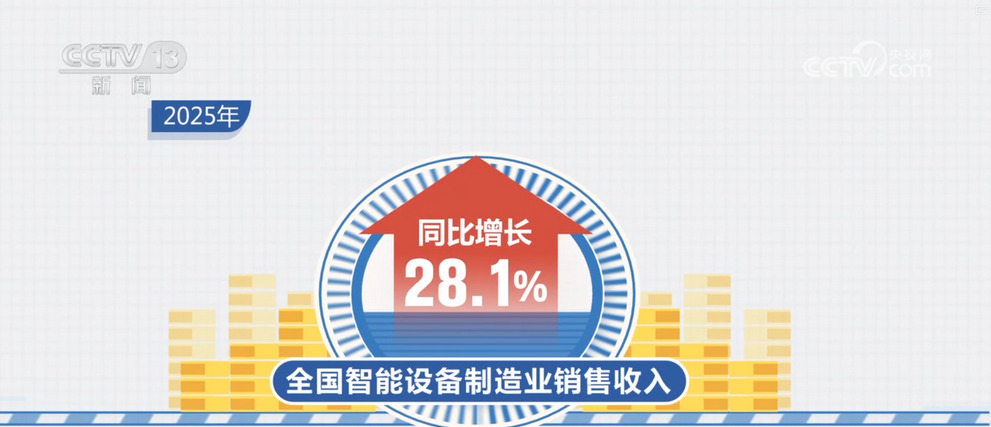
Core Insights - The manufacturing sector in China is projected to have a sales revenue growth rate that exceeds the national average by 1.7 percentage points by 2025, with a manufacturing share of 29.7% of total sales, an increase of 0.5 percentage points from the previous year [1] Group 1: Intelligent Upgrading - The procurement of automation and digital equipment by manufacturing enterprises is expected to grow by 11.3% and 10% year-on-year respectively in 2025, indicating a rapid advancement in the intelligent transformation and digital renovation of the manufacturing sector [1] - The sales revenue of the intelligent equipment manufacturing industry is anticipated to increase by 28.1% year-on-year in 2025, driven by the intelligent upgrades in manufacturing [1] Group 2: Green Transformation - The sales revenue of high-energy-consuming manufacturing industries is projected to decrease by 1.1 percentage points as a share of total manufacturing, reflecting an ongoing optimization of the industrial structure [1] - The amount spent by manufacturing enterprises on environmental governance services is expected to grow by 7.3% year-on-year, with high-energy-consuming sectors seeing a 14.6% increase in spending on environmental governance services, indicating a significant rise in green investment [1] Group 3: Digital Integration - The sales revenue of the digital product manufacturing industry is forecasted to grow by 9.4% year-on-year in 2025, showcasing the deepening integration of the digital economy with the real economy [1] - The procurement of digital technologies by manufacturing enterprises is expected to increase by 10.4% year-on-year, further emphasizing the trend of digital integration within the manufacturing sector [1]
税收数据视角下的2025年制造业发展亮点:智能化、绿色化步伐加快
Yang Shi Wang· 2026-01-21 08:41
Group 1 - The core viewpoint of the articles indicates that by 2025, China's manufacturing industry will accelerate its development in terms of intelligence and greenness, with steady increases in sales revenue from intelligent equipment, new energy vehicles, and digital products [1][3][4] Group 2 - In 2025, the sales revenue of high-energy-consuming manufacturing industries will decrease by 1.1 percentage points compared to the previous year, reflecting an optimization in industrial structure [3] - The amount spent by manufacturing enterprises on environmental governance services will increase by 7.3% year-on-year, indicating a growing investment in green governance [3] - The sales revenue of the new energy vehicle manufacturing industry and lithium-ion battery manufacturing will grow by 14.3% and 25.1% year-on-year, respectively [3] Group 3 - The sales revenue of the intelligent equipment manufacturing industry will increase by 28.1% year-on-year in 2025, with industrial robots and special operation robots growing by 17.4% and 42.1% respectively [4] - The procurement of automation and digital equipment by manufacturing enterprises will increase by 11.3% and 10% year-on-year, respectively [4] Group 4 - The sales revenue of the digital product manufacturing industry will grow by 9.4% year-on-year in 2025, with the procurement of digital technology by manufacturing enterprises increasing by 10.4%, an acceleration of 3.5 percentage points compared to the previous year [6] - In the automotive manufacturing and computer communication equipment manufacturing sectors, the procurement of digital technology will increase by 24.5% and 11.8% year-on-year, respectively [6]
从“140万亿元”看中国对世界的信心供给——解码数字里的“机遇清单”
Ren Min Ri Bao· 2026-01-20 08:50
Group 1 - China's economy has surpassed 140 trillion yuan, with a GDP growth of 5.0% year-on-year, contributing approximately 30% to global economic growth [1] - The economy has successfully crossed significant thresholds during the 14th Five-Year Plan, demonstrating resilience and adaptability in a complex international environment [1] - China's economic growth is seen as a positive signal for the struggling global economy, providing certainty and new opportunities [1] Group 2 - The World Economic Forum 2026 emphasizes the need for innovative solutions to global challenges, with China providing new ideas and examples for cooperation and growth [2] - In 2025, China's R&D expenditure intensity reached 2.8%, surpassing the OECD average, with significant advancements in digital manufacturing and emerging technologies [2] - The share of new energy vehicles in domestic sales exceeded 50%, indicating a shift towards sustainable production capabilities [2] Group 3 - China is committed to further opening its economy, with the Hainan Free Trade Port achieving a 3.8% increase in total import and export volume, providing vast market opportunities [3] - In 2025, the per capita disposable income of Chinese residents grew by 5.0%, aligning with economic growth and reflecting improvements in living standards [3] - China's focus on high-quality development and high-level openness aims to inject more certainty and new momentum into the global economy [3]
从“一百四十万亿元”看中国对世界的信心供给——解码数字里的“机遇清单”①(和音)
Ren Min Ri Bao· 2026-01-19 22:23
Core Insights - China's economy has surpassed 140 trillion yuan, with a GDP growth of 5.0% year-on-year, contributing approximately 30% to global economic growth [1][2] - The achievement of crossing the 140 trillion yuan mark reflects China's resilience and ability to adapt to complex international conditions, providing certainty and new opportunities for the global economy [1][3] Economic Performance - In the "14th Five-Year Plan" period, China's economy has consistently crossed significant thresholds: 110 trillion, 120 trillion, 130 trillion, and now 140 trillion yuan, showcasing its robust growth [1] - The manufacturing value added in the digital product sector increased by 9.3% year-on-year, indicating strong growth in advanced technology sectors [2] Innovation and Development - By 2025, China's R&D expenditure intensity is expected to reach 2.8%, surpassing the OECD average for the first time, highlighting a commitment to innovation [2] - Significant advancements in cutting-edge fields such as artificial intelligence, quantum technology, and brain-computer interfaces are emerging, contributing to new productive forces [2] Trade and Openness - The Hainan Free Trade Port has commenced full island closure operations, with total import and export volume increasing by 3.8%, demonstrating China's commitment to maintaining open trade despite global protectionism [3] - China's per capita disposable income grew by 5.0%, aligning with economic growth, and improvements in social welfare sectors such as elderly care and healthcare are evident [3] Future Outlook - The upcoming "15th Five-Year Plan" outlines ambitious goals for China's economic and social development, presenting a "list of opportunities" for global collaboration [3] - China's focus on high-quality development and high-level openness is expected to inject more certainty and new momentum into the global economy, fostering shared growth [3]
商务部部长:坚定不移推动“十五五”时期扩大高水平对外开放
Xin Lang Cai Jing· 2026-01-13 06:22
Core Viewpoint - The report emphasizes the importance of expanding high-level opening-up to promote inclusive and beneficial economic globalization, highlighting its significance in China's modernization efforts and global economic cooperation [2][4][5]. Group 1: Significance of High-Level Opening-Up - High-level opening-up is a strong driving force for comprehensive high-quality development, enhancing competitiveness in various industries such as high-speed rail, 5G, and artificial intelligence [2]. - It is a crucial pathway to meet the people's needs for a better life, directly impacting employment and consumer choices, with over 200 million jobs created through foreign trade and investment [3]. - High-level opening-up is a proactive approach to promote inclusive globalization, transitioning from a "follower" to a "leader" in global economic engagement [4]. Group 2: Achievements in High-Level Opening-Up - The open economy has reached new heights, with China's foreign trade maintaining its position as the world's largest, with imports and exports exceeding 41.2 trillion yuan, a 3.6% increase year-on-year [8]. - Significant breakthroughs in autonomous opening-up include zero tariffs on 100% of products for least developed countries and a reduction in overall tariff levels to 7.3% [9]. - Open cooperation has shown new initiatives, such as the Belt and Road Initiative, which has become a popular international cooperation platform, enhancing trade and investment partnerships [10]. Group 3: Challenges and Opportunities - The current environment for opening-up is characterized by complex changes, with strategic opportunities and risks coexisting, necessitating proactive adaptation to external uncertainties [12][13]. - The transition period involves reshaping the economy towards digital and green sectors, with digital trade expected to reach 2.9 trillion yuan, growing by 6.5% [14]. - The vision for opening-up emphasizes shared development and global governance, with China aiming to provide more global public goods and take on greater responsibilities [15]. Group 4: Key Tasks for Future Opening-Up - The focus will be on expanding autonomous opening-up, aligning with international standards, and enhancing market access in service sectors [16]. - Promoting trade innovation and integrating domestic and international markets will be essential for strengthening the domestic economy while enhancing external trade [17]. - High-quality cooperation in the Belt and Road Initiative will be prioritized, fostering strategic partnerships and enhancing legal protections for overseas investments [19].