服务消费

Search documents
中观景气跟踪3月第4期:周期资源景气分化,新兴科技延续高增
GUOTAI HAITONG SECURITIES· 2026-03-25 14:23
Group 1: Upstream Resources - Crude oil prices continue to rise significantly, with Brent crude futures settling at $112.2 per barrel, up 8.8% from the previous period as of March 20 [7] - Non-ferrous metal prices have declined sharply, with COMEX gold, LME copper, and LME aluminum prices down 9.6%, 6.7%, and 6.5% respectively [10] - Coal prices have shown slight fluctuations, with a 0.8% increase, reflecting weak demand during the off-season [8] Group 2: Midstream Cycles and Manufacturing - Emerging technology sectors continue to experience high growth, with PCB exports in January-February 2026 increasing by 28.3% year-on-year, reaching $4.55 billion [19] - The electronic industry in Taiwan reported a revenue growth of 29.4% year-on-year during the same period, driven by strong demand in IC manufacturing and storage segments [19] - Construction demand remains weak, with steel prices showing slight fluctuations and a marginal increase in building material prices due to rising costs [21][28] Group 3: Downstream Consumption - Real estate sales show marginal improvement, with a year-on-year decline of 5.7% in transaction volume across 30 major cities [32] - The food and beverage sector is facing weak demand, with live pig prices down 1.1% week-on-week, while agricultural commodity prices have shown slight increases [33] - Service consumption remains strong, with a 14.9% year-on-year increase in domestic movie box office revenue and a 90.3% increase in Shanghai Disneyland's crowd index [40] Group 4: Logistics and Passenger Flow - Passenger travel demand has increased, with major cities reporting a 3.0% year-on-year rise in subway passenger volume [48] - Road freight demand has shown a marginal increase of 3.4%, while express delivery volumes have decreased slightly [50] - Port throughput has improved, with cargo and container throughput increasing by 0.8% and 3.7% respectively [55]
国泰海通|策略:原油链持续涨价,出海制造景气提升
国泰海通证券研究· 2026-03-20 09:20
Group 1 - The core viewpoint of the article highlights the differentiated economic conditions, with rising prices in the oil and chemical chain, an upward shift in emerging technology sectors, and strong growth in travel and consumer goods in the first quarter [1][2]. Group 2 - The oil chain continues to see price increases due to disruptions in oil transportation through the Strait of Hormuz, with Brent crude oil futures settling at a +11.3% increase as of March 13, and domestic chemical prices rising by +12.5% [2]. - Emerging technology sectors, particularly in semiconductors, show significant growth, with South Korea's semiconductor exports increasing by +40.0% year-on-year as of February 2026, and domestic machinery exports rising by +27.1% [3]. - Traditional consumer sectors are experiencing a slight decline, with real estate transactions in 30 major cities down by -3.8% year-on-year, while tourism remains strong, evidenced by a +281.9% increase in visitor numbers at Shanghai Disneyland [4]. Group 3 - Passenger transport volume in major cities has increased by +5.5% year-on-year, indicating robust travel activity, while freight transport also shows growth with national road and rail freight volumes up by +0.6% and +4.3% respectively [4].


国泰海通|食饮:政策加码、资本赋能,新消费与服务消费迎双重利好——评十四届全国人大四次会议经济主题记者会
国泰海通证券研究· 2026-03-08 14:30
Core Viewpoint - The article emphasizes a dual signal of policy enhancement and capital empowerment for the consumer industry, marking a golden window period for demand expansion and supply-side capitalization, with a focus on new consumption and service consumption [1][2]. Group 1: Policy Signals - The recent press conference highlighted key topics such as expanding domestic demand, boosting consumption, and deepening capital market reforms, signaling a clear policy direction to activate both domestic and international markets through a combination of consumption policies [2][3]. - The Ministry of Commerce plans to continuously develop the "Buy in China" brand through activities, policies, and optimized scenarios, introducing new policies for product consumption expansion and an upgraded version of the outbound tax refund policy [2][3]. Group 2: Capital Market Reforms - The reform of the ChiNext board is expected to reshape the supply structure of the consumer sector, accelerating the capitalization of light-asset, high-growth new consumption enterprises [3]. - Traditional listing standards have primarily focused on heavy assets and profit scale, which may not adequately support new consumption brands and service-oriented enterprises; the new reforms aim to enhance the inclusivity for these types of companies [3]. Group 3: Consumer Market Potential - The combination of "Buy in China" and the outbound tax refund 2.0 policy is expected to resonate with both domestic and international demand, enhancing the attractiveness of China's consumer market and increasing the willingness of foreign travelers to spend in China [3]. - The outbound tax refund 2.0 policy is likely to focus on lowering shopping thresholds for foreign travelers, improving the conversion efficiency of inbound consumption, which will benefit service consumption sectors such as duty-free, cultural tourism, dining, and specialty retail [3].

财信证券宏观策略周报(3.9-3.13):市场宽幅震荡,关注资源品及政策利好方向-20260308
Caixin Securities· 2026-03-08 11:28
Group 1 - The report maintains the view that the A-share index will gradually return to its inherent momentum from after the Spring Festival until the end of April, presenting a wide fluctuation trend with increased bidirectional volatility [5][8] - Key factors influencing the market include escalating overseas turmoil, particularly the Middle East conflict affecting oil prices, the weakening of the "calendar effect," and the intensifying global stock market linkage effect [5][8] - Investment opportunities are suggested in sectors such as energy products, oil transportation, precious metals, and military industries due to the Middle East geopolitical conflicts [5][14] Group 2 - The macro policy is expected to focus on quality improvement and efficiency enhancement, with a GDP growth target set between 4.5% and 5% for 2026, emphasizing "safety, technology, high quality, and risk" [8][9] - The "14th Five-Year Plan" highlights the importance of high-quality development, with a target of over 7% annual growth in R&D expenditure and a goal for the digital economy's core industries to account for 12.5% of GDP by the end of the plan [9][10] - The report notes the reform of the listing standards for the ChiNext board, aiming to support innovative enterprises in new consumption and modern service industries [10] Group 3 - The report indicates that the manufacturing PMI for February was significantly affected by the Spring Festival, with a reading of 49.0%, reflecting a decline in both production and new orders [11] - The U.S. non-farm payrolls for February showed a net decrease of 92,000, which was below market expectations, raising concerns about stagflation risks in the U.S. economy [12][13] - The report highlights the impact of rising oil prices on the global economy and asset prices, with significant increases in WTI and Brent crude oil prices, indicating potential long-term effects on inflation and central bank policies [13][14]
2026年生活经济报告-北大国发院
北大国发院· 2026-02-28 01:35
Investment Rating - The report does not explicitly state an investment rating for the industry Core Insights - The demand structure has fundamentally shifted from "having" to "quality," with rising needs for personalization, service, and emotional value, while traditional supply struggles to adapt, leading to supply-demand mismatches and "involution" [5] - Life communities have become key carriers for expressing and stimulating demand, with decentralized UGC platforms (like Xiaohongshu) enabling micro-life needs to be seen, connected, and stimulated, forming a "demand expression-connection-stimulation" cycle [5] - The life economy reshapes supply-side logic, with companies achieving precise innovation through community insights, flexible production, and online-offline integration, fostering "prosumers" and super individuals, thus driving high-quality supply [5] - The life economy exhibits endogenous stability, with demand anchored in individual lifestyles and aesthetics, leading to more rational decision-making and lower return rates, while community interactions create reputation constraints that compel supply quality improvement [5] - Policies need to actively embrace the life economy by encouraging the use of life big data, supporting co-creation in production and sales, promoting online-offline integration, and proactively planning for AI empowerment and governance, transforming the aspiration for a "better life" into an economic growth driver [5] Summary by Sections Research Background Assessment - The research is conducted by the National Development Research Institute of Peking University, a leading think tank with deep academic and policy influence in economics and management [3] - The report integrates diverse data sources, including iResearch, the World Bank, and Xiaohongshu, and is based on a robust theoretical framework and rich policy research experience [3] - The report is an academic research document proposing a "life economy" theoretical framework, combining policy recommendations and industry insights [3] Scope and Boundaries Confirmation - The life economy encompasses a wide range of sectors, focusing on service consumption (cultural tourism, experiences, Citywalk), physical consumption (apparel, home appliances, 3C, beauty), digital content (UGC community, AI-generated content), and individual entrepreneurship (super individuals, micro-enterprises) [4] - The primary market is the mainland China market, with a focus on active users of online life communities (like Xiaohongshu), primarily young individuals seeking personalized and quality lifestyles [4] Key Data Capture and Presentation - Nearly 90% of consumers are very or somewhat concerned about new product releases [7] - Service consumption accounts for 46.1% of per capita consumer spending [7] - Citywalk-related content has a browsing volume of 2.1 billion times on Xiaohongshu [7] - Citywalk-related tags have a playback volume of 4.52 billion times on Douyin [7] - Xiaohongshu's user search penetration rate is 65% [7] - 50% of Xiaohongshu's platform traffic is allocated to ordinary users [7] - In 2023, the final consumption expenditure of Chinese residents accounted for 39.13% of GDP [7] - The average consumption propensity of Chinese residents in 2021 was 0.56 [7]
提振消费:既要政策给力,也要改革发力
Sou Hu Cai Jing· 2026-02-27 04:10
Core Viewpoint - Consumption is a crucial driver of economic growth in China, transitioning from traditional investment-driven growth to a model supported by domestic demand, particularly consumption, in response to both domestic and international changes [1][3]. Group 1: Economic Transition - China's economy has entered a high-quality development phase, necessitating a shift from large-scale factor input to a focus on domestic consumption [1]. - The contribution rate of domestic demand to economic growth is expected to exceed 67% by 2025, with consumption contributing 52% [3]. Group 2: Consumption Potential and Challenges - China possesses a vast market demand advantage, particularly in the service consumption sector, which still has significant potential for growth [3]. - Current challenges include structural differentiation in consumption, institutional constraints, and supply shortages, with the consumption rate around 40%, lagging behind developed countries by 10-30 percentage points [3][4]. Group 3: Policy Recommendations - To boost consumption, it is essential to distinguish between short-term consumption potential and long-term consumption capacity, with policy adjustments aimed at the former and institutional reforms for the latter [4]. - Recommendations include optimizing support policies, removing unreasonable restrictions in the consumption sector, enhancing income distribution, and improving public service systems to alleviate consumer concerns [4].

从房价到股市,2026年投资逻辑彻底变了!这篇讲透
Sou Hu Cai Jing· 2026-02-22 07:46
Group 1 - The core issue for 2026 remains whether housing prices have bottomed out or will continue to decline, with a nationwide downward adjustment in housing prices being a high probability event [1] - The aging population is leading to a decrease in the number of potential homebuyers, impacting demand for new homes, while first-tier cities may experience short-term stability [1] - In January 2026, the transaction volume of second-hand homes in 13 key cities increased by 16% month-on-month and 33% year-on-year, but new home sales in 50 key cities plummeted by 32% month-on-month and 20% year-on-year, indicating a disparity in market performance [1] Group 2 - Domestic consumption faces challenges, with durable goods under pressure due to the withdrawal of subsidies and a declining population, while essential goods are also struggling as income expectations remain low [2] - Infrastructure investment is seen as the only viable option to stabilize the economy, with a focus on new infrastructure projects such as data centers and logistics, as traditional infrastructure faces financial constraints [2] - The macroeconomic outlook for 2026 indicates significant pressure, necessitating stronger policies to stabilize the real estate market, support consumer spending, and promote infrastructure investment [3] Group 3 - The stock market is expected to be influenced by policy changes in 2026, with structural opportunities in sectors like artificial intelligence, semiconductors, and high-end consumer goods [3] - The focus on new infrastructure and the acceleration of monetary policy easing, including potential interest rate cuts, are critical for economic recovery [3]
西南证券:新经济、新动能行业洞察系列(二):新消费演进中的价格与产业洞察
Sou Hu Cai Jing· 2026-02-21 14:27
Group 1 - The report highlights that "new consumption" is driven by information technology and focuses on quality and personalization, serving as a strategic pillar for domestic demand circulation and enhancing its strategic position as policies continue to strengthen [1][8][17] - Since 2023, final consumption expenditure has consistently contributed the most to GDP, with a stable contribution rate around 3%, significantly higher than developed economies [1][25][28] - Service consumption is showing strong growth momentum, with retail sales of services expected to outpace goods retail sales by 1.7 percentage points in 2025, indicating a shift towards experience-based consumption [1][29][31] Group 2 - The restructuring of CPI weights reflects a shift in consumer spending from basic necessities to quality upgrades, with significant increases in the weights of housing, transportation, and communication categories from 2021 to 2025 [2][3][22] - New consumption is providing an upgrade path for industrial development, with policies transitioning from broad expansion to precision targeting, effectively stimulating mid-to-upstream industries [2][4][18] - Rural consumption is becoming a core scene for new consumption, with retail sales in rural areas expected to grow at a rate of 4.1% in 2025, outpacing urban areas for four consecutive years [2][4][39] Group 3 - The report indicates that new consumption is reshaping the economic landscape by enhancing supply-demand matching efficiency, which in turn supports price stability and drives industrial upgrades [16][22][23] - The analysis of consumer spending shows that healthcare and other services are experiencing the highest growth rates, while traditional categories like food and clothing are growing at a slower pace [31][39] - The report emphasizes that the new consumption model is characterized by digital technology and innovation, which reduces reliance on traditional economic cycles and provides new growth momentum for the economy [22][23][24]


【央视新闻】新闻1+1丨从春节到全年 服务消费如何发力
Sou Hu Cai Jing· 2026-02-12 17:22
Core Viewpoint - The article discusses the transformation and growth of service consumption in China, highlighting the shift from product-centric to service-oriented spending, particularly during the upcoming Spring Festival, with a focus on quality and innovation in service offerings [1][2]. Group 1: Changes in Supply Side - The demand for services is characterized by diversity, personalization, and quality, which drives continuous innovation in supply [1]. - New technologies and smart solutions are enhancing service experiences, particularly in sectors like cruise economy, inbound tourism, and winter sports [1]. Group 2: Service Consumption Demand - Service consumption has rapidly increased, transitioning to a balanced focus on both goods and services [2]. - Key areas of service demand include essential services like elderly care, childcare, and domestic help, alongside rapidly growing sectors such as tourism, wellness, and entertainment, especially during the nine-day Spring Festival holiday [2]. Group 3: Potential Growth Areas - The nine key service sectors identified by the State Council are crucial for service consumption and economic development, expected to become new growth points in the service economy [3]. - Understanding service consumption involves recognizing its role in fulfilling emotional and experiential needs, such as leisure and relaxation, as well as practical needs like domestic assistance [3][4]. Group 4: Connection Between Service Consumption and Livelihood - Essential services like elderly care, childcare, and domestic help are closely tied to daily life and are foundational to service consumption [5]. - Policies aimed at supporting and regulating these sectors are necessary to expand supply while ensuring quality, which in turn can stimulate enterprise engagement and better meet consumer needs through data-driven insights [5].
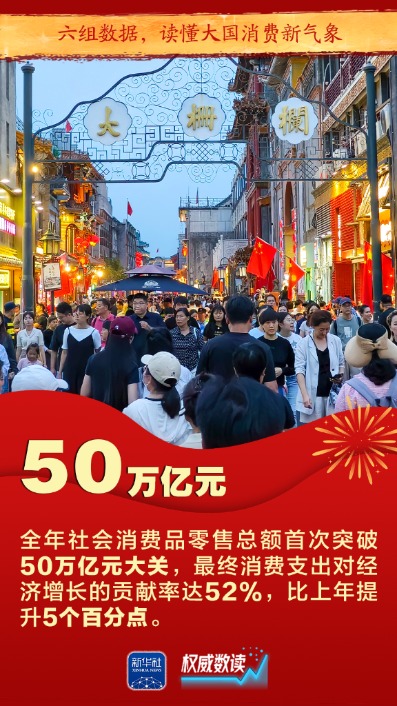
权威数读丨六组数据 读懂大国消费新气象
Xin Hua She· 2026-02-11 06:05
Group 1 - The core viewpoint of the article highlights the characteristics of consumption in China by 2025, which include the expansion and upgrading of goods consumption, improvement of service consumption to benefit the public, and increasingly diverse consumption scenarios [1] Group 2 - By 2025, the sales of related goods from the implementation of the old-for-new consumption policy are expected to reach 2.61 trillion yuan, benefiting 366 million people, with a significant number of green and smart products entering households [3] - The projected automobile sales for 2025 are 34.4 million units, while the sales of home appliances and communication equipment are expected to exceed 1 trillion yuan each [6] - The service retail sector is anticipated to grow by 5.5% due to the improvement of the "1+N" policy system for service consumption and the implementation of actions to enhance service consumption [7] - Over 60 events will be organized to promote the "Buy in China" and "Export from China" brands, including high-quality consumption months and international consumption seasons, along with pilot projects for international consumption environment construction and optimization of tax refund policies for departing tourists [8]