新兴产业

Search documents
竞速未来产业 各地如何抢占新增长极
Xin Lang Cai Jing· 2026-01-07 16:09
Group 1 - The core viewpoint of the articles emphasizes the strategic importance of future industries in the "14th Five-Year Plan" across various provinces, highlighting the focus on emerging sectors such as artificial intelligence, low-altitude economy, and commercial aerospace as key growth areas for regional economic development [1][2][6] - Provinces are leveraging their unique resources and industrial foundations to create differentiated development paths, with examples including Guangdong's focus on "AI + robotics" and Hainan's integration of agriculture, deep-sea, and aerospace [1][3] - The integration of technology and industry is a common theme, with provinces like Beijing aiming to cultivate a leading AI industry ecosystem and Jiangsu focusing on deepening integration within the Yangtze River Delta's aerospace industry cluster [2][4] Group 2 - The articles highlight the importance of regional collaboration, such as the Beijing-Tianjin-Hebei model, which optimizes resource allocation through a cooperative framework, and the Guangdong-Hong Kong-Macau Greater Bay Area, which fosters differentiated policy matrices to support industrial development [5][6] - The need for systemic innovation in mechanisms to support future industries is emphasized, including talent cultivation, technological breakthroughs, and ecosystem development, as well as the importance of capital support from various sources to drive growth in these sectors [7][8] - The articles suggest that achieving successful outcomes in future industries requires not only market-driven initiatives but also precise policy support to facilitate the transformation of research results into marketable products [8]
东芯股份:公司将积极关注新兴产业的发展方向
Zheng Quan Ri Bao Wang· 2026-01-07 14:11
证券日报网讯1月7日,东芯股份在互动平台回答投资者提问时表示,公司将积极关注新兴产业的发展方 向。公司将继续聚焦主业发展,努力提升经营业绩以回报投资者。 ...

恒丰银行金融活水“川”流不息
Jin Rong Jie· 2026-01-07 08:14
Core Viewpoint - Sichuan's key industrial projects are being accelerated, with a focus on aligning financial services with regional economic development to support the maturation of local industrial systems [1] Group 1: Financial Support for Key Industries - Hengfeng Bank Chengdu Branch is providing targeted financial support to align with regional industrial evolution, facilitating the development of industrial clusters [1] - The bank has approved a total of 3.97 billion yuan in loans for the "next-generation high safety and solid-state battery industrialization customized factory project" in Yibin [2] - A total of 7.3 billion yuan in loans has been allocated for the construction of supporting facilities in the Yibin Sanjiang New Area, enhancing the region's capacity to form a 100 billion yuan battery industry cluster [3] Group 2: Energy and Infrastructure Development - The Nanchong Airport Industrial Park plans to build a 100 MW/200 MWh user-side energy storage power station to improve energy supply capacity, potentially saving core enterprises nearly 5 million yuan in electricity costs [4] - Hengfeng Bank Chengdu Branch has provided 1.76 billion yuan in special credit to support the industrial park's manufacturing stability and project implementation [7] Group 3: Innovation and Emerging Industries - The bank is enhancing resource allocation efficiency through innovative financial products and digital tools, particularly for technology companies in the Chengdu metropolitan area [8] - A drone manufacturing company, recognized as one of China's top ten drone brands, received 500,000 yuan in inclusive financing to support its R&D and production capacity expansion [8] Group 4: Future Outlook - Hengfeng Bank Chengdu Branch aims to continue optimizing financial supply structures to support stable and high-quality local economic development in the new historical phase [10]

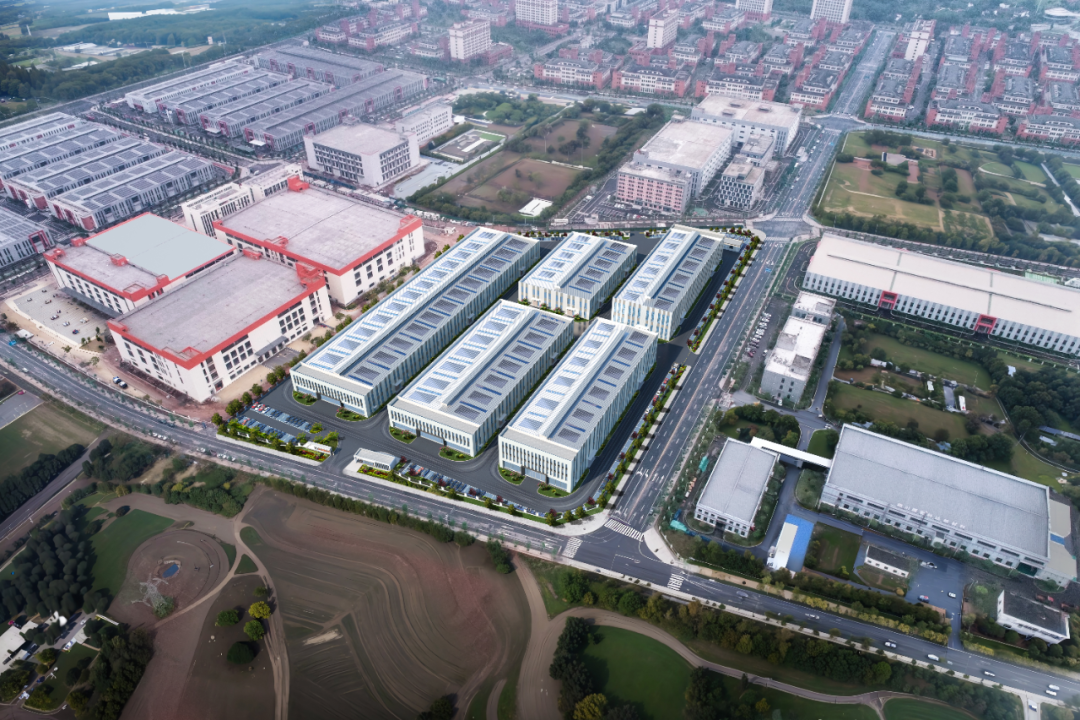
新赛道升级 塑造发展新优势
Jing Ji Ri Bao· 2026-01-06 22:35
Core Insights - The "15th Five-Year Plan" emphasizes the cultivation and expansion of emerging and future industries, aiming to create new pillar industries and strategically position future industries for growth [1] Group 1: Emerging Industries - During the "14th Five-Year Plan," China's emerging industries accelerated development, forming significant scale effects with several trillion-yuan market opportunities emerging by 2025 [2] - The commercial aerospace industry is on the verge of explosion, with advancements such as the successful launch of the Zhuque-3 rocket and accelerated deployment of satellite internet constellations [2] - The low-altitude economy is entering a commercial phase, marked by the issuance of operational certificates for manned civil unmanned aerial vehicles and the promotion of typical application scenarios by the Ministry of Transport [2] - New materials are crucial for breakthroughs in aerospace performance, with innovations in high-strength stainless steel and carbon fiber composites being utilized in key projects [2] Group 2: Energy Transition - China's energy transition has accelerated, establishing the world's largest power infrastructure and renewable energy systems, with plans to increase the share of renewable energy significantly by 2026 [3] - The "15th Five-Year Plan" aims to enhance emerging pillar industries, focusing on innovation in sectors like renewable energy, new materials, aerospace, and low-altitude economy [3] Group 3: Future Industries - Rapid advancements in future industries such as artificial intelligence, quantum information, and biomanufacturing have been noted, with significant breakthroughs achieved during the "14th Five-Year Plan" [4] - The development of 6G technology is prioritized, with expectations for commercial applications to begin around 2030, indicating a deep integration with AI [4][5] - Future industries are characterized by their potential to create new demands and economic forms, with quantum technology and nuclear fusion energy expected to play pivotal roles [6] Group 4: Market Opportunities and Challenges - Emerging industries are entering a rapid growth phase, with key scenarios being validated and replicable business models established, while future industries are still in the exploratory phase [7] - The uncertainty in future industries stems from both technological and commercial aspects, requiring significant R&D investment and policy support [8] - The collaboration between emerging and future industries is essential for driving new economic engines, with a focus on innovation and long-term value creation [9]
新赛道活力迸发 塑造经济发展新优势
Zheng Quan Ri Bao· 2026-01-06 16:28
Core Insights - During the "14th Five-Year Plan" period, China has made significant strides towards high-level technological self-reliance, with emerging and future industries showing robust vitality and growth potential [1][3] Emerging Industry Development - The emerging industries in China have rapidly developed and formed scale effects, with multiple trillion-yuan markets accelerating formation [2] - By 2025, China's commercial aerospace industry is on the brink of explosion, with significant advancements in reusable launch vehicles and satellite internet applications [2] - The low-altitude economy is also gaining traction, with the issuance of operational certificates for manned civil unmanned aerial vehicles marking the entry into commercial use [2] New Energy Industry - China has established the world's largest power infrastructure and renewable energy system, creating the most complete new energy industry chain globally [3] - The "15th Five-Year Plan" emphasizes the development of emerging pillar industries, including new energy, new materials, aerospace, and low-altitude economy [3] Future Industry Breakthroughs - Significant progress has been made in future industries such as artificial intelligence, quantum information, and biomanufacturing, with key breakthroughs achieved [4] - The integration of 6G and AI is becoming a consensus in the industry, with clear development directions emerging [4] - The biomanufacturing industry has expanded steadily, reaching a total scale of 1.1 trillion yuan, becoming a new economic growth point [4] Dual-Engine Development - Emerging and future industries, while both part of the "long slope, thick snow" track, have different development stages, leading to varying market opportunity release rhythms [6] - Emerging industries are entering a rapid growth phase, with vertical segments expected to explode in the next 3 to 4 years, while future industries will focus on technology and application exploration in the early stages of the "15th Five-Year Plan" [6] Investment and Market Dynamics - The future industries face challenges related to technological and commercial uncertainties, with unclear business models and long investment return cycles [7] - The "15th Five-Year Plan" period is seen as a critical window for future industries, with policy support and technological breakthroughs expected to drive development [7] - Investors are advised to focus on companies' core technology reserves and their progress in validating business value through application scenarios [8]
炬华科技:公司将在新兴产业领域中积极寻求产业投资和并购机会
Zheng Quan Ri Bao Zhi Sheng· 2026-01-06 14:13
Group 1 - The core viewpoint of the article is that Juhua Technology is actively seeking investment and merger opportunities in emerging industries to achieve industrial upgrades and create new profit growth points [1] Group 2 - The company emphasizes that mergers and acquisitions are important strategic means for rapid expansion and optimizing resource allocation [1] - Juhua Technology aims to leverage these strategies specifically within the context of new industries [1]

伊之密:公司高度重视新兴产业带来的战略机遇
Zheng Quan Ri Bao· 2026-01-05 14:29
证券日报网讯 1月5日,伊之密在互动平台回答投资者提问时表示,公司高度重视新兴产业带来的战略 机遇。公司会积极把握与公司发展需求契合的合作机会。 (文章来源:证券日报) ...

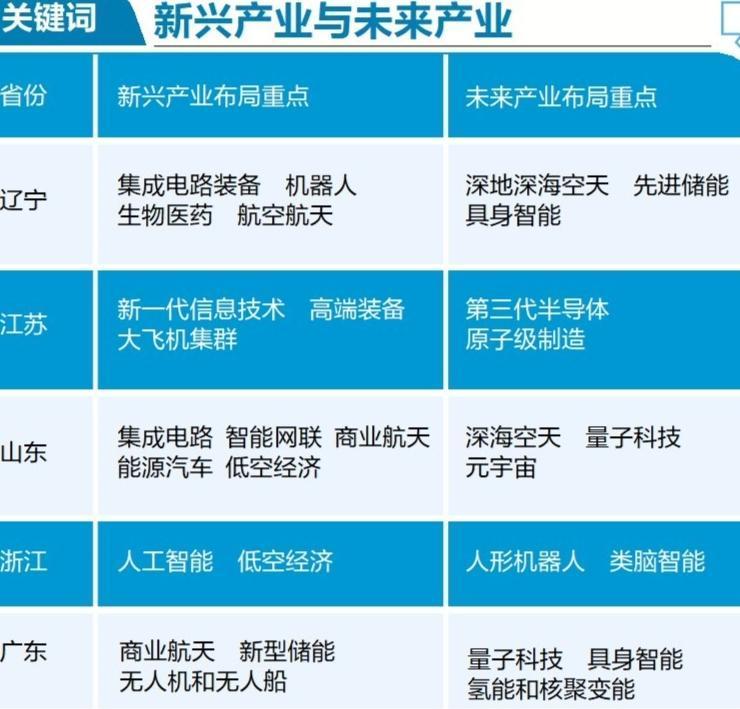
竞逐新赛道,都有啥新招?
Xin Lang Cai Jing· 2026-01-04 22:08
Group 1: Emerging and Future Industries - Various provinces are focusing on emerging and future industries, with specific emphasis on sectors like integrated circuits, robotics, and advanced energy storage [1][6] - Jiangsu aims to deepen integration into the Yangtze River Delta's aircraft manufacturing cluster and emphasizes atomic-level manufacturing [6] - Provinces like Shandong and Guangdong are prioritizing sectors such as quantum technology and hydrogen energy, indicating a trend towards high-tech and sustainable industries [1][7] Group 2: Digital Development - Provinces are actively developing digital infrastructure, with Liaoning focusing on data annotation industries and integrating AI into traditional industries [2][9] - Beijing aims to become a global benchmark city for digital economy, emphasizing core technologies like high-end chips and software [2][9] - Guangdong is enhancing its data trading platforms to foster industrial clusters, showcasing a strong market-driven approach [2][9] Group 3: Marine Economy - Coastal provinces are shifting their focus to marine economies, with Guangdong and Shandong aiming to create comprehensive marine industry ecosystems [8][19] - Liaoning and Jiangsu are leveraging their industrial bases to upgrade traditional marine industries towards high-end and green solutions [8][19] - The emphasis on marine economic development reflects a strategic pivot towards utilizing ocean resources for economic growth [8][19] Group 4: Consumption and Economic Growth - Guangdong is promoting the establishment of international consumption centers, aiming to enhance service industry standards and consumer environments [10][11] - Provinces like Beijing and Jiangsu are emphasizing high-energy consumption innovations, focusing on cultural and tourism integration to stimulate local economies [11][15] - The strategies aim to release local market potential and enhance consumer confidence through improved infrastructure and services [11][15] Group 5: Strategic Technology and Talent Development - Provinces are prioritizing the establishment of national laboratories and major scientific facilities to strengthen strategic technological capabilities [12][14] - There is a focus on integrating education, technology, and talent development to foster innovation and address regional needs [13][14] - Collaborative efforts across provinces aim to enhance the overall effectiveness and resilience of the national innovation system [12][14]
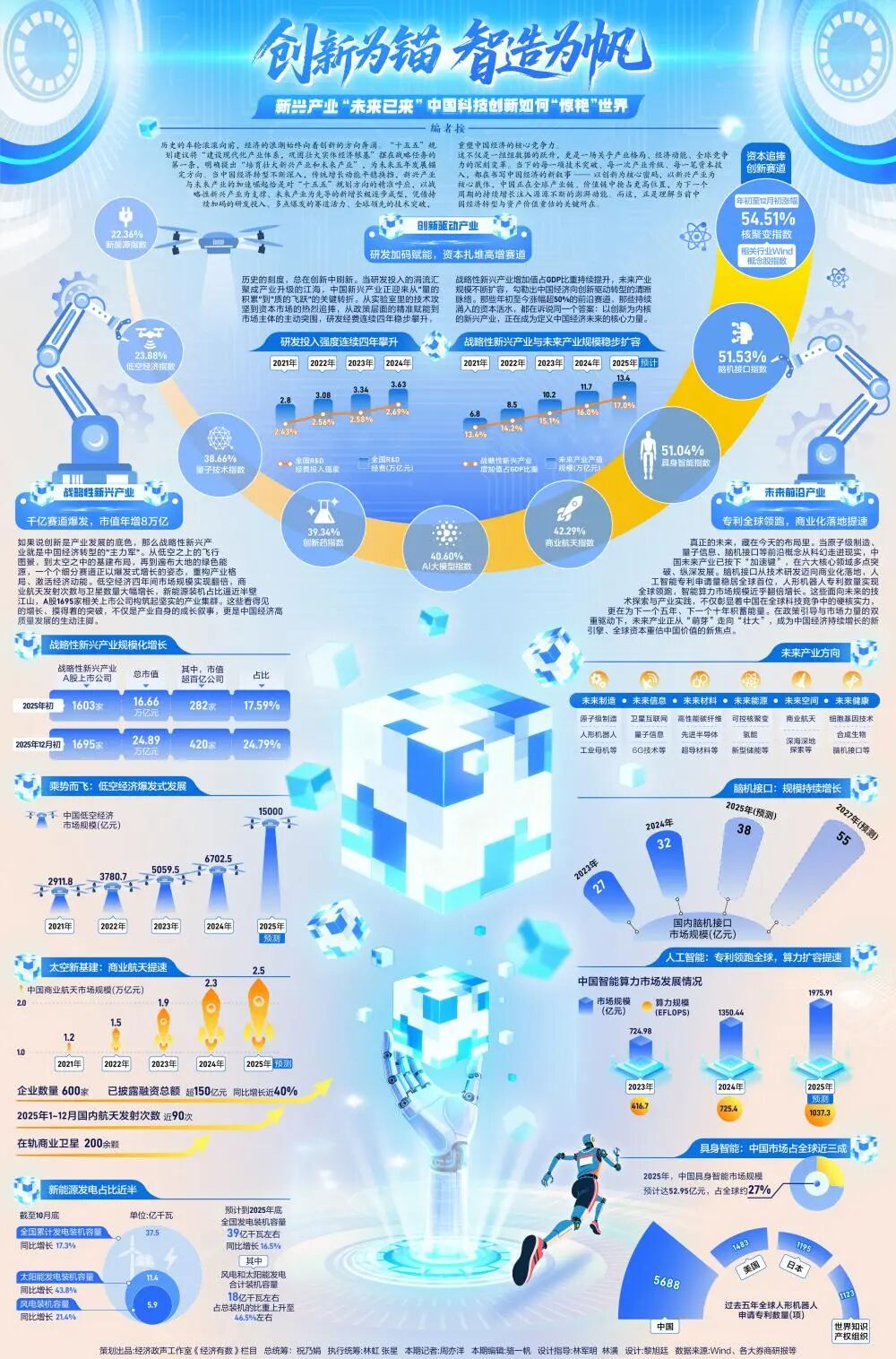
新兴产业“未来已来”,中国科技创新如何惊艳世界
2 1 Shi Ji Jing Ji Bao Dao· 2026-01-04 02:37
Group 1 - The core viewpoint emphasizes the importance of innovation in driving China's economic transformation and the rise of emerging industries as a response to the "14th Five-Year Plan" [1] - The plan highlights the construction of a modern industrial system and the strengthening of the real economy as strategic tasks, with a focus on nurturing emerging and future industries [1] - Continuous R&D investment and technological breakthroughs are reshaping China's core competitiveness in the global industrial and value chains [1] Group 2 - As of the end of October, China's installed power generation capacity reached approximately 3.9 billion kilowatts, with a year-on-year growth of 17.3% [3] - The share of renewable energy generation, particularly wind and solar power, has increased significantly, with solar power capacity growing by 43.8% year-on-year [3] - The humanoid robot market in China is projected to account for nearly 30% of the global market by 2025, with an expected market size of 5.295 billion yuan [3]
观察·透视外国游客购物清单上主力产品 解码“中国购”新亮点、新趋势
Yang Shi Wang· 2026-01-03 06:54
Core Insights - The article highlights the increasing influx of foreign tourists to Shenzhen's Huaqiangbei, driven by the optimized visa policies and the appeal of "Chinese manufacturing" products [1][10][14] Group 1: Foreign Tourist Behavior - Foreign tourists are actively purchasing a variety of products, including toys, technology items, and personal care gadgets, often expressing satisfaction with the prices [6][7][13] - Many tourists arrive with empty bags or suitcases specifically to shop, indicating a strong demand for "Chinese-made" goods [8][10] - The average daily foot traffic of foreign visitors to Huaqiangbei exceeds 7,000, with a notable increase in foreign visitors after major trade events [14][46] Group 2: Popular Products - The most sought-after products among foreign tourists include AI glasses, drones, translation devices, and portable cameras, reflecting a trend towards innovative and high-tech items [21][19] - The sales of "Huaqiangbei-made" AI glasses have seen a remarkable year-on-year increase of 270% in overseas markets during the first half of 2025 [19] Group 3: Market Dynamics - The shopping experience in Huaqiangbei is enhanced by the availability of translation devices, making communication easier for foreign visitors [17] - The overall transaction volume in Huaqiangbei is projected to exceed 400 billion yuan in 2025, indicating a robust market for electronic products [46] Group 4: Comparative Insights - Foreign tourists find prices in Huaqiangbei significantly more attractive compared to those in Europe, contributing to the area's popularity as a shopping destination [13][14] - The article also mentions Yiwu, known as the "world supermarket," where foreign visitors are also drawn to innovative products and flexible pricing strategies [22][25]