
自动驾驶技术

Search documents
营收反弹,利润大幅下滑超三成,特斯拉盘后下挫超3%
Di Yi Cai Jing Zi Xun· 2025-10-22 23:04
Core Insights - Tesla reported third-quarter revenue of $28.1 billion, a 12% year-over-year increase, ending a two-quarter decline, surpassing market expectations of $26.37 billion [1] - The automotive segment revenue grew from $20 billion in the same quarter last year to $21.2 billion, reflecting a 6% increase [1] - The company delivered a record 497,099 vehicles in the third quarter, with total vehicle production at 447,450 [2] Financial Performance - Net profit for the third quarter decreased by 37% year-over-year, dropping from $2.17 billion (or $0.62 per share) to $1.37 billion (or $0.39 per share) [2] - Automotive regulatory credit revenue fell from $739 million to $417 million, a decline of 44% year-over-year [2] Market Dynamics - The expiration of the U.S. federal electric vehicle tax credit led to a surge in vehicle purchases before the deadline, impacting sales timing [2] - Tesla introduced lower-cost "Standard" versions of the Model Y and Model 3 to make products more affordable post-tax credit expiration [3] - Analysts predict an 8.5% decline in Tesla's vehicle deliveries by 2025 due to the tax credit expiration, reliance on older models, and increased competition [3] Future Outlook - Tesla did not provide specific sales targets for future demand but plans to start mass production of Cybercab, Semi, and Megapack 3 by 2026 [3] - The energy production and storage segment saw a 44% year-over-year revenue increase, reaching $3.42 billion [3] - The company is building the first production line for its humanoid robot, Optimus, reflecting a strategic shift towards automation and AI [4]

奔驰大规模“裁员”落地
Zheng Quan Shi Bao· 2025-10-22 14:38
奔驰大规模"裁员"落地。 据多家外国媒体报道,德国汽车巨头梅赛德斯-奔驰今年4月开始的"自愿离职计划"开始落实。目前已经 有数千人接受遣散方案离职。除奔驰外,多家欧洲汽车制造商已经宣布裁员计划。 奔驰推自愿离职计划 今年4月,根据德国《Handelsblatt》报道,梅赛德斯-奔驰启动一场代号为"自愿遣散计划"的裁员风暴。 奔驰CEO奥拉·卡列尼乌斯当时表示,通过提供丰厚的遣散费,公司期望能够鼓励约3万名员工自愿离 职。他强调,对于不愿离职的员工,公司不会强迫,也不会因此解雇他们。此外,梅赛德斯-奔驰还保 留拒绝某些员工接受买断计划的权利,尤其是关键岗位上的员工,以尽可能保留顶尖人才。 该计划涵盖了多个层面的员工,入门级员工获得与任期挂钩的基本遣散费,而管理职位则受益于放大薪 酬的乘数。例如,服务15年的董事可能有资格获得30万欧元,而副总裁可能达到50万欧元的上限。此 外,还采取了阶梯方案,工龄每增加一年,补偿金额将递增15%。 奔驰公司预计到2027年每年将节省约50亿欧元,这主要来自这项自愿遣散计划。这些资金将重新用于电 动汽车 (EV) 和自动驾驶技术的研发。自愿遣散计划是这一财务战略的基石,使公司能 ...
德国汽车巨头,大规模“裁员”落地!
Zheng Quan Shi Bao· 2025-10-22 13:53
奔驰大规模"裁员"落地。 据多家外国媒体报道,德国汽车巨头梅赛德斯-奔驰今年4月开始的"自愿离职计划"开始落实。目前已经有数千人接受遣散方案离职。除奔驰外,多家欧洲 汽车制造商已经宣布裁员计划。 奔驰推自愿离职计划 今年4月,根据德国《Handelsblatt》报道,梅赛德斯-奔驰启动一场代号为"自愿遣散计划"的裁员风暴。奔驰CEO奥拉.卡列尼乌斯当时表示,通过提供丰 厚的遣散费,公司期望能够鼓励约3万名员工自愿离职。他强调,对于不愿离职的员工,公司不会强迫,也不会因此解雇他们。此外,梅赛德斯-奔驰还保 留拒绝某些员工接受买断计划的权利,尤其是关键岗位上的员工,以尽可能保留顶尖人才。 该计划涵盖了多个层面的员工,入门级员工获得与任期挂钩的基本遣散费,而管理职位则受益于放大薪酬的乘数。例如,服务15年的董事可能有资格获得 30万欧元,而副总裁可能达到50万欧元的上限。此外,还采取了阶梯方案,工龄每增加一年,补偿金额将递增15%。 相较于裁员,奔驰的自愿离职计划避免了与工会的潜在冲突,并维护了奔驰作为负责任雇主的声誉。劳工代表也承认该公司为提供慷慨的条款所做的努 力,他们将继续监测对剩余劳动力稳定性的影响。 德国 ...


德国汽车巨头,大规模“裁员”落地!
证券时报· 2025-10-22 13:50
Core Viewpoint - Mercedes-Benz has initiated a voluntary severance plan to reduce workforce and cut costs, aiming to save approximately €5 billion annually by 2027, while reallocating funds towards electric vehicle and autonomous driving technology development [3][5]. Group 1: Severance Plan Details - The voluntary severance plan, launched in April, aims to encourage around 30,000 employees to leave voluntarily by offering generous severance packages [3]. - Approximately 4,000 employees have already accepted the severance offer [4]. - The severance packages vary based on tenure, with entry-level employees receiving basic compensation linked to their service duration, while management positions can receive significantly higher amounts, such as €300,000 for a 15-year service director [3]. Group 2: Financial Performance - In the first half of 2025, Mercedes-Benz reported sales revenue of €66.3 billion, a decrease of 8.6% year-on-year, with a net profit of €2.7 billion, down 55.8% compared to the previous year [7]. - Global sales volume for the first half of the year was 1.0763 million units, reflecting an 8% decline, with electric vehicle sales dropping 14% to 87,300 units [7][8]. - The Chinese market, being the largest single market for Mercedes-Benz, saw a significant decline in sales, with a 14% drop to 293,200 units, marking it as the market with the highest decline globally [8]. Group 3: Industry Context - The German automotive industry is under significant pressure, with competitors like BMW and Volkswagen also reporting declines in sales and profits [8]. - BMW's sales revenue for the first half of the year was €67.7 billion, down 8%, while Volkswagen reported a slight decrease in revenue to €158.4 billion [8]. - The industry faces additional challenges from U.S. tariffs, which have increased export costs for German manufacturers, impacting their global supply chain strategies [9].
优步(UBER.US)加码自动驾驶布局 携手Nebius(NBIS.US)向Avride投资3.75亿美元
Zhi Tong Cai Jing· 2025-10-22 12:53
Group 1 - Uber and Dutch cloud infrastructure company Nebius plan to invest up to $375 million in Nebius's autonomous vehicle subsidiary, Avride, to accelerate the expansion of Avride's autonomous fleet, which is expected to reach 500 vehicles [1] - The investment will support product development and market expansion for Avride, with potential additional investments contingent on achieving specific milestones [1] - This investment marks the first external funding for Avride and is structured as convertible debt, allowing Uber the option to convert the investment into equity in the future [1] Group 2 - Uber's CEO Dara Khosrowshahi stated that the company will continue to invest in the autonomous driving technology ecosystem, betting on a future where human and autonomous driving coexist [2] - Uber has invested or committed funds to several autonomous driving and drone companies, including significant partnerships with companies like Lucid and Nuro, with some deals reaching hundreds of millions of dollars [2] - Since selling its own autonomous driving division in 2020, Uber has established partnerships with over ten autonomous driving companies to compete with firms like Waymo and Tesla, including collaborations with Waymo in certain U.S. markets [2]

评论 || “智驾”不是驾驶责任“免罪金牌”
Zhong Guo Qi Che Bao Wang· 2025-10-22 08:17
Core Viewpoint - Recent court cases regarding drunk driving highlight the importance of driver responsibility and the limitations of technology in circumventing legal obligations [1][4]. Group 1: Legal Implications - The Beijing Second Intermediate People's Court upheld a sentence of three months' detention and a fine of 6,000 yuan for a defendant who claimed to use automatic driving features while driving under the influence [1]. - A case in Hangzhou involved a defendant who used a so-called "smart driving device" while sleeping in the passenger seat, resulting in a conviction for dangerous driving [1]. - These cases collectively send a clear message that technological advancements cannot override legal responsibilities, emphasizing the rigidity of judicial rulings in the context of "smart driving" applications [1][4]. Group 2: Consumer Awareness and Misuse - There is a growing concern about consumers misinterpreting driver assistance technologies as substitutes for human drivers, leading to dangerous behaviors such as modifying vehicles to bypass safety systems [2][3]. - The proliferation of aftermarket "smart driving devices" has created a gray market, complicating regulatory efforts due to their ambiguous legal status [2][3]. - Public awareness campaigns are needed to clarify that driver assistance systems are meant to assist, not replace, human control, urging consumers to remain vigilant while using these technologies [3]. Group 3: Regulatory Recommendations - The government and industry organizations should collaborate to promote awareness that "driver assistance is not autonomous driving," using real case studies to illustrate legal boundaries [3]. - There is a call for regulatory bodies to address the oversight gaps in the aftermarket sector, ensuring that companies producing non-compliant devices are held accountable [4]. - Future legal frameworks should clearly delineate responsibilities associated with different levels of driving assistance and consider incorporating these regulations into driver licensing processes [3][4].
谁会是港股Robotaxi第一股
2 1 Shi Ji Jing Ji Bao Dao· 2025-10-21 07:44
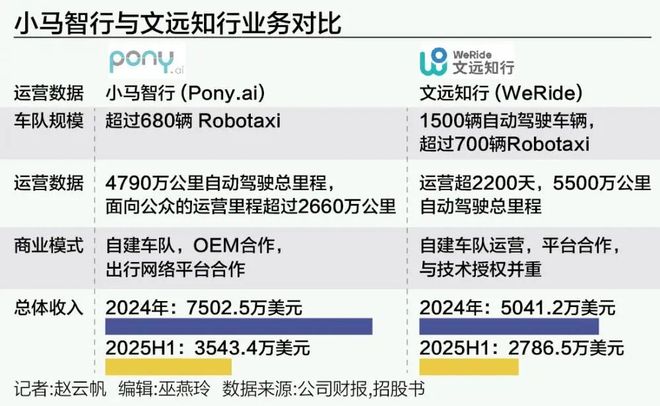
记者丨赵云帆 编辑丨巫燕玲 中国资本市场将迎来Robotaxi(自动驾驶出租车)行业的盛宴时刻。 10月14日,中国证监会网站信息显示,中国Robotaxi的双雄——小马智行(Pony.AI)、文远知行 (WeRide)港股IPO于同日成功完成备案。 备案信息显示,小马智行、文远知行将分别于香港联交所发行1.021亿股、1.024亿股新股。 "巧合"数字的背后,两家Robotaxi资本化和市场化进程可谓长期并驾齐驱。2024年10月,文远知行率先 在纳斯达克市场完成上市;同年11月,小马智行也正式完成纳斯达克市场登陆。 此次,两家公司亦先后通过联交所聆讯,其中小马智行10月17日发布聆讯后招股书,文远知行则于10月 19日发布聆讯后招股书。 资本化进程你追我赶的背后,港股"Robotaxi第一股"花落谁家?市场又会如何展望两家公司的未来? | pony | | 1 > VeRide | | --- | --- | --- | | 运营数据 | 小马智行 (Pony.ai) | 文远知行(WeRide) | | 车队规模 | 超过680辆 Robotaxi | 1500辆自动驾驶车辆, | | | | 超过70 ...
谁会是港股Robotaxi第一股
21世纪经济报道· 2025-10-21 07:36
记者丨赵云帆 编辑丨巫燕玲 中国资本市场将迎来Robotaxi(自动驾驶出租车)行业的盛宴时刻。 10月14日,中国证监会网站信息显示, 中国Robotaxi的双雄——小马智行(Pony.AI)、文远知行(WeRide)港股IPO于同日成功 完成备案。 备案信息显示,小马智行、文远知行将分别于香港联交所发行1.021亿股、1.024亿股新股。 "巧合"数字的背后,两家Robotaxi资本化和市场化进程可谓长期并驾齐驱。2024年10月,文远知行率先在纳斯达克市场完成上市; 同年11月,小马智行也正式完成纳斯达克市场登陆。 此次,两家公司亦先后通过联交所聆讯,其中小马智行10月17日发布聆讯后招股书,文远知行则于10月19日发布聆讯后招股书。 资本化进程你追我赶的背后,港股"Robotaxi第一股"花落谁家?市场又会如何展望两家公司的未来? 2024年以来,包括速腾聚创等自动驾驶视觉传感器供应商,如祺出行等涉足Robotaxi的出行平台,均有借助Robotaxi东风上市之 嫌。 但真正从主机厂合作、解决方案供应到自建车队运营的Robotaxi企业,小马智行、文远知行无疑是唯二的独角兽。 此前,两家公司均已完成了 ...
Waymo&特斯拉Robotaxi业务进展更新
2025-10-19 15:58
Summary of Key Points from the Conference Call Industry Overview - The conference call focuses on the Robotaxi business, specifically comparing the progress of Tesla and Waymo in the autonomous driving sector [1][3][6]. Core Insights and Arguments - **Tesla's Robotaxi Operations**: - Tesla has circumvented regulatory restrictions by equipping its Robotaxi fleet with a driver, allowing operations at a competitive price of $2 per mile (approximately $1.3 per kilometer), which is lower than Waymo's $2.6 per kilometer [1][3]. - The current fleet size is approximately 39 vehicles, primarily operating in Austin and California [3]. - **Waymo's Growth**: - Waymo's fleet and order volume are rapidly increasing, with an expected daily average of over 20 orders per vehicle by December 2024 [1][3]. - The company's valuation is projected to rise from over $20 billion in 2024 to $100 billion in 2025, indicating a steady commercialization process [1][3]. - **Technological Differences**: - Tesla employs a pure vision-based approach, demonstrating stable performance in complex weather conditions, while Waymo's algorithms focus on generalization and deregulation [1][4][5]. - Both companies are committed to optimizing their autonomous driving algorithms to enhance safety and efficiency [5]. - **Market Potential**: - The Robotaxi market is expected to be substantial, with China's market projected to reach 100 billion RMB by 2035 and a global potential of $500-600 billion [1][11]. - Core cities are crucial for Robotaxi commercialization due to residents' insensitivity to price and strong payment capabilities [7][8]. - **Regulatory Environment**: - Increased support from various city levels in China for Robotaxi development, with clear targets set by first-tier cities [13][14]. - Successful operation in major cities can facilitate easier expansion into lower-tier cities due to regulatory recognition [8]. Additional Important Insights - **Challenges and Opportunities**: - Tesla's main challenges include rapid expansion of operational areas and fleet size while still needing a driver due to regulatory constraints [6]. - Waymo faces initial order volume fluctuations in new cities but has a mature technology base and has secured testing licenses in key markets like New York [6]. - **International Expansion**: - Waymo plans to enter markets in Tokyo and parts of Europe in 2025, indicating a steady international expansion strategy [9]. - **Competitive Landscape**: - Various companies, including traditional automakers and tech giants, are actively participating in the Robotaxi space, recognizing its vast potential [12]. - Local governments are setting ambitious targets to promote the development of Robotaxi services, further driving industry growth [14]. - **Future Market Size**: - By 2035, it is estimated that there will be 500,000 to 600,000 Robotaxis in China, generating significant revenue and contributing to a large market share in shared mobility [11]. - **Political and Social Implications**: - The promotion of Robotaxi services has political significance, showcasing a city's technological capabilities and innovation [15]. - The introduction of Robotaxi services has led to protests from traditional drivers, but regulatory measures are in place to prevent price wars and ensure fair competition [16][17]. - **Technological Trends**: - The convergence of L3 and L4 autonomous driving technologies is noted, with expectations for L3 penetration to reach 30% by 2028 [2][18]. - **Hardware Development**: - The autonomous driving hardware market is experiencing growth, with significant advancements in processing capabilities expected to benefit chip manufacturers and domain controller suppliers [19][20]. - **Key Players**: - Notable companies in the L3 and L4 autonomous driving space include WeRide and Pony.ai, with significant market potential anticipated [21]. This summary encapsulates the critical insights and developments in the Robotaxi industry as discussed in the conference call, highlighting the competitive landscape, technological advancements, and market potential.
阿斯顿·马丁前总裁:稳定政策和完备产业链让中国实现角色转变
Zhong Guo Xin Wen Wang· 2025-10-18 14:21
此外,安迪·帕尔默还表示,他重点关注储能相关业务。中国在锂离子电池应用领域处于领先地位,而 英国企业在软件和控制技术方面具备优势。目前,安迪·帕尔默的团队已与中国供应链展开合作,重点 围绕储能领域开拓市场。(完) (文章来源:中国新闻网) 中新社北京10月18日电 (刘洋)阿斯顿·马丁前总裁安迪·帕尔默(Andy Palmer)18日在北京表示,长期稳定 的政策与完备的产业链,助力中国从非汽车产业强国快速成长为全球最大汽车生产国。 HICOOL 2025全球创业者峰会于16日至18日在北京举行,安迪·帕尔默在参会期间接受中新社专访。他 表示,中国汽车产业的发展,关键在于各种体量的企业与设备制造商间的高效紧密协作。中国既有 能"爆发"创造潜能的初创企业,也有具备成熟技术研发能力的大型企业,更有制造能力强大的工厂,已 形成从设计、技术革新到制造的完备产业链。同时,长期稳定的政策让从业者对自身事业更有信心,这 两大因素共同推动中国汽车产业实现跨越式发展。 对于汽车行业未来发展趋势,他认为,某些特定领域仍会使用合成燃料,自动驾驶技术将不断发展成 熟。更重要的是,汽车不再只是代步工具,和人们的日常工作、休闲生活紧密联系 ...