药品集采

Search documents
津药药业半年报:营收利润双降,遭反垄断重罚,应收账款激增至5.61亿元
2 1 Shi Ji Jing Ji Bao Dao· 2025-08-26 03:01
Core Insights - The company reported a significant decline in revenue and net profit for the first half of 2025, with revenue at 1.588 billion yuan, down 11.81% year-on-year, and net profit plummeting 65.28% to 49.3 million yuan [1] Financial Performance - Revenue for the first half of 2025 was 1.588 billion yuan, reflecting an 11.81% decrease compared to the previous year [1] - Net profit fell sharply by 65.28%, amounting to 49.3 million yuan [1] - Operating cash flow decreased from 316 million yuan in the same period last year to 2 million yuan, a decline of 93.6% [1] - Accounts receivable surged by 92.6% to 561 million yuan, representing 27% of current assets, indicating worsened sales collection efficiency [1] Factors Affecting Performance - The decline in revenue and profit was primarily due to intensified competition in the international market and the impact of drug price negotiations, leading to reduced sales and profit margins for core products [1] - Key product categories, including steroid hormones and amino acids, experienced revenue declines, with amino acid product revenue down by 9.01% and other categories down by 22.09%, including a 22.01% drop in formulation revenue [1] - The company faced a significant financial penalty due to antitrust issues, resulting in a total fine and confiscation of illegal gains amounting to 69.1924 million yuan, which was recorded as an extraordinary expense, causing a 31,905.46% year-on-year increase in such expenses [1] Research and Development - In line with cost-cutting strategies, the company's R&D expenses decreased by 24.65% to 63.17 million yuan [2] - Despite the reduction in R&D spending, the company successfully obtained approval for three new drugs, including a treatment for respiratory diseases [2]

集采倒逼传统药企转型,多家企业创新药收入贡献过半
第一财经· 2025-08-25 15:51
Core Viewpoint - The article highlights the successful transformation of traditional pharmaceutical companies towards innovative drug development, driven by the implementation of drug procurement policies since 2018, which pressured companies reliant on generic drug revenues to adapt and innovate [3][7]. Group 1: Performance of Pharmaceutical Companies - Heng Rui Medicine reported a revenue of 15.762 billion yuan in the first half of 2025, a year-on-year increase of 15.88%, with a net profit of 4.45 billion yuan, up 29.67% [5]. - In the same period, Heng Rui's innovative drug sales and licensing income reached 9.561 billion yuan, accounting for 60.66% of total revenue, with innovative drug sales alone at 7.570 billion yuan [6]. - Hansoh Pharmaceutical achieved approximately 6.145 billion yuan in innovative drug and cooperative product sales, a 22.1% increase, making up 82.7% of total revenue [7]. - Yuan Da Pharmaceutical reported a record revenue of approximately 6.11 billion HKD, with innovative and barrier products accounting for about 51% of total revenue, a nearly 15 percentage point increase year-on-year [7]. - Xiansheng Pharmaceutical's total revenue grew by 15.1% to 3.585 billion yuan, with innovative drug revenue reaching 2.776 billion yuan, a 26% increase, and accounting for 77.4% of total revenue [8]. Group 2: R&D Investments and Internationalization - Heng Rui Medicine invested 3.871 billion yuan in R&D in the first half of 2025, with cumulative R&D investments exceeding 48 billion yuan [9]. - Xiansheng Pharmaceutical reported an R&D investment rate of 28.7%, with over 10 billion yuan invested in the past decade [10]. - China National Pharmaceutical's innovative drug revenue accounted for 44.4% of total revenue, with plans to enhance its innovative drug business through acquisitions, including a recent 500 million USD acquisition of a Shanghai-based innovative drug company [10]. - The article notes that while many pharmaceutical companies are increasing R&D investments, their innovative drug sales are primarily focused on the domestic market, with limited international presence [11]. - Heng Rui has established 15 external authorization collaborations, emphasizing a strategy of combining independent R&D with international partnerships to enhance global market penetration [12]. - Xiansheng Pharmaceutical is accelerating its global layout with successful dual clinical trials in China and the U.S., aiming for sustainable growth through international collaborations [13].


集采倒逼传统药企转型,多家企业创新药收入贡献过半
第一财经网· 2025-08-25 10:13
Core Insights - The pharmaceutical industry is witnessing a significant transformation towards innovation, with many companies reporting that innovative drugs now account for over half of their revenues [1] Group 1: Company Performance - Heng Rui Medicine reported a revenue of 15.762 billion yuan for the first half of 2025, a year-on-year increase of 15.88%, with net profit reaching 4.45 billion yuan, up 29.67% [2] - Heng Rui's innovative drug sales and licensing income amounted to 9.561 billion yuan, representing 60.66% of total revenue, with innovative drug sales reaching 7.570 billion yuan [2] - Han Sen Pharmaceutical achieved approximately 6.145 billion yuan in innovative drug and cooperative product sales, a year-on-year increase of 22.1%, accounting for about 82.7% of total revenue [3] - Han Sen's total revenue for the first half of 2025 was 7.434 billion yuan, up 14.3%, with net profit of 3.135 billion yuan, a 15% increase [4] - Yuan Da Pharmaceutical reported a record revenue of approximately 6.11 billion HKD, with innovative and barrier products accounting for about 51% of total revenue, a nearly 15 percentage point increase year-on-year [4] - Xian Sheng Pharmaceutical's total revenue grew by 15.1% to 3.585 billion yuan, with adjusted net profit of 651 million yuan, up 21.1%, driven by innovative drug revenue [4] Group 2: R&D Investment - Heng Rui Medicine invested 3.871 billion yuan in R&D in the first half of 2025, with cumulative R&D investment exceeding 48 billion yuan [5] - Xian Sheng Pharmaceutical reported an R&D investment rate of 28.7%, with cumulative R&D investment exceeding 10 billion yuan over the past decade [5] Group 3: Market Expansion and Challenges - China National Pharmaceutical's innovative drug revenue accounted for 44.4% of total revenue, with plans to enhance its innovative drug business through acquisitions, including a recent acquisition of a Shanghai-based innovative drug company for 500 million USD [6] - Despite the growth in innovative drug sales, most companies are still primarily focused on the domestic market, with limited international presence [6][7] - Heng Rui has established 15 external licensing collaborations and is actively seeking partnerships with global pharmaceutical companies to enhance international market penetration [8] - Xian Sheng Pharmaceutical is accelerating its global layout, having achieved three self-researched products going overseas, with external licensing expected to be a sustainable growth source [8]
天宇股份20250824
2025-08-24 14:47
Summary of Tianyu Co., Ltd. Conference Call Company Overview - **Company**: Tianyu Co., Ltd. - **Period**: First half of 2025 - **Key Financials**: - Net profit: 150 million yuan, up 180.96% YoY [2][4] - Non-recurring net profit: 141 million yuan, up 125.11% YoY [2][4] - Revenue: 1.567 billion yuan, up 23.87% YoY [4] Core Business Segments 1. Textile Medicine, Raw Materials, and Intermediates - Revenue reached 1.13 billion yuan, driven by non-sartan raw materials and intermediates [2][4] - Significant growth attributed to market expansion and cost control, leading to improved gross margins [4][5] - Non-sartan product gross margin increased to nearly 30%, with expectations to reach over 40% in the future [5][12] 2. CDMO (Contract Development and Manufacturing Organization) - Revenue exceeded 200 million yuan, a 44% increase YoY, surpassing expectations [2][4][9] - Gross margin maintained above 50%, benefiting from scale advantages in projects [9] - Anticipated continued growth in customer demand for the second half of 2025 and beyond [9] 3. Formulation Business - Revenue of 180 million yuan, up 84.72% YoY, with sales volume surpassing 500 million tablets, a 71% increase [2][4] - Gross margin improved to 58%, with losses reduced by 20 million yuan [4][10] - Despite not being profitable yet, the speed of loss reduction is accelerating [4] Regulatory and Market Developments - Approved 12 new drug specifications in the first half of 2025, totaling 65 approvals across 40 varieties [2][6] - Successfully participated in centralized procurement projects in Jiangsu and Guangdong [6] - Rapid growth in sales channel networks, including medical, retail, and online platforms [6] Future Outlook - Non-sartan products expected to see significant growth as original drug patents expire, with a larger pipeline than sartan products [7][12] - CDMO business projected to maintain strong growth, with optimistic profitability outlook [9] - Anticipated improvements in cash flow management and operational efficiency in the second half of 2025 [14] Challenges and Risks - Increased impairment provisions totaling 72.16 million yuan due to credit and inventory impairments [5][11] - Competitive pressures in the sartan product market, leading to slight revenue declines despite stable sales volumes [15] - Overall product prices have decreased slightly but are expected to stabilize [16] R&D and Innovation - R&D expenses for the first half of 2025 were approximately 600 million yuan, maintaining focus on raw materials and CDMO sectors [19] - New collaborations and patent acquisitions in the field of psychotropic drugs, with plans for further development [13] Conclusion - Tianyu Co., Ltd. demonstrated robust growth across its business segments in the first half of 2025, with significant improvements in profitability and market presence. The company is well-positioned for future growth, particularly in non-sartan products and CDMO services, while navigating challenges in competitive pricing and cash flow management.
集采断崖式降价压垮仿制药企!赛隆药业创始人集体撤离
Xin Lang Zheng Quan· 2025-08-22 08:41
Core Viewpoint - The recent resignation of the founder and key executives of *ST Sailong marks a significant shift for the company, which is facing a delisting crisis due to severe financial struggles and reliance on price-cutting in the drug procurement process [1][2]. Group 1: Company Background - *ST Sailong, founded in 2017, specializes in generic drugs for cardiovascular and digestive systems [2]. - The company faced a major turning point with the onset of drug procurement policies, which led to intense price competition [2]. Group 2: Financial Performance - The price of the company's main product, injection omeprazole sodium, plummeted by 91.7% in the seventh round of procurement in 2022 [2]. - In the eighth round of procurement in 2023, the price of tranexamic acid injection was reported at 7.9 yuan, half of the highest price [2]. - The company is projected to incur continuous losses from 2020 to 2024, with a forecasted revenue of less than 300 million yuan in 2024, a year-on-year decline of over 15% [2]. - The net profit loss for 2024 is expected to reach 33.1456 million yuan, a staggering decline of 447.67% [2]. Group 3: R&D Challenges - In 2023, the company's R&D investment was only 27.52 million yuan, accounting for 8.8% of revenue, which is below industry standards [3]. - Despite a 7% increase in R&D spending in 2024, it remains insufficient for the high costs associated with innovative drug development [3]. - The company has been trapped in a cycle of "winning bids means losses," with seven products winning bids but failing to generate profit [3]. Group 4: Leadership Changes and Future Prospects - The founder, Cai Nanguai, has chosen to exit amid the ongoing crisis, with a new entity, Hainan Yayi Gongying Technology Partnership, acquiring 14.16% of the company's shares for 199 million yuan [3]. - The new controlling shareholder, Hainan Yayi, includes a member from the second generation of the Libai Group, indicating a potential shift in strategy as they enter the pharmaceutical industry [3]. - The entry of new shareholders raises questions about whether they can help the struggling company find a viable path forward [3].
资金连续5日加仓,医疗器械ETF回踩5日线
Mei Ri Jing Ji Xin Wen· 2025-08-13 02:33
近期医疗器械板块走出相对独立行情,相关投资标的医疗器械ETF(562600)6月23日至今37个交易 日,收出24个阳线,区间涨幅18.07%。持仓股票,赛诺医疗、利德曼、麦澜德、翔宇医疗、大博医 疗、中红医疗、热景生物表现亮眼。今日盘整,回踩5日均线。 从资金面来看,近5日资金连续流入该ETF,净流入金额达2520万元。 据国家医保局消息,近日,国家组织药品联合采购办公室发布《关于组织医疗机构报送第十一批国家组 织药品集中采购品种需求量的通知》,于8月6日至25日开展第十一批药品集采医疗机构需求量填报工 作。本次集采共涉及55个品种,报量工作主要有以下特点:一是医疗机构可按厂牌报量。二是要求医疗 机构如实准确报量。三是与基本药物、儿童用药等政策保持衔接。 中信建投证券分析表示,受耗材集采、医疗合规要求提升等政策因素影响,A股申万医疗器械指数过去 4年持续下跌,2025年初至今指数有所反弹。随着政策缓和、集采出清、企业战略转型和国际业务拓 展,多家公司业绩和估值将迎来修复,预计2025年下半年和2026年多家公司迎来高增长,部分低估值个 股迎来长线投资机会。 医疗器械 ETF(562600)为投资者提供一键把 ...
药品行业周报:关注底部资产修复投资机会-20250810
Xiangcai Securities· 2025-08-10 15:30
Investment Rating - The report maintains a "Buy" rating for the pharmaceutical industry [2][5] Core Viewpoints - The innovative drug sector is expected to achieve significant excess returns driven by overseas licensing transactions and improvements in domestic medical policies. The generic drug and raw material drug sectors are also anticipated to recover due to ongoing optimization of centralized procurement policies [2][5] - The industry is transitioning from capital-driven growth to profit-driven growth, with a mid-term outlook suggesting that performance will continue to improve, leading to sustained valuation increases [2][5] - The report emphasizes the importance of innovation as the core driving force for the industry, with a focus on selecting investment targets that align with industry development trends [5][33] Market Analysis and Outlook - The pharmaceutical manufacturing sector has shown a 21.3% increase from January 1, 2025, to August 10, 2025, outperforming the broader market by 8.4 percentage points [3][9] - The report highlights that the pharmaceutical industry is currently experiencing a recovery phase, with the innovative drug sector expected to lead this trend [5][33] - The eleventh batch of national drug procurement has commenced, involving 55 varieties and 480 companies, which is expected to improve the profitability of the procurement varieties [31][33] Investment Recommendations - Two main investment themes are recommended: innovation-driven opportunities and recovery-driven opportunities. Specific companies to watch include: - Innovation-driven: Sanofi, East China Pharmaceutical, Aosaikang, and Health元 [5][33] - Recovery-driven: Changchun High-tech, Weixin Kang, and China Resources Sanjiu [5][33]
双成药业上半年亏损扩大
Zhong Guo Jing Ying Bao· 2025-08-08 14:41
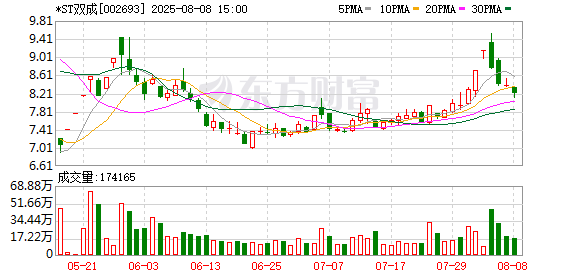
Core Viewpoint - The financial performance of Shuangcheng Pharmaceutical (002693.SZ) is deteriorating, with significant declines in revenue and profits, raising concerns about its future viability and potential delisting from the Shenzhen Stock Exchange [2][6][7]. Financial Performance - In the first half of 2025, Shuangcheng Pharmaceutical reported total revenue of 84.12 million yuan, a year-on-year decrease of 11.35% [2]. - The net profit attributable to shareholders was -18.47 million yuan, down 8.97% year-on-year, while the net profit after deducting non-recurring items was -21.02 million yuan, a decline of 18.34% [2]. - The company's cash reserves plummeted by over 70% compared to the same period last year, leaving only 4.78 million yuan, insufficient to cover even one month of operating expenses [5]. Product Performance - Revenue from peptide products, other products, and entrusted business all experienced declines in the first half of 2025, with entrusted business revenue dropping by 41.04% [2][4]. - The revenue from peptide products was 40.07 million yuan, a decrease of 3.95%, and accounted for 47.64% of total revenue, with a gross margin of 46.5%, down 13.87 percentage points from the previous year [3]. Market Challenges - The decline in gross margin is attributed to price reductions for core products, particularly the injection of thymosin alpha-1, which saw a significant drop in sales profits due to new procurement pricing [3]. - The company has faced challenges in expanding its entrusted business, with revenue from this segment only accounting for 13.90% of total revenue, and slow progress in external CMO collaborations [4]. Legal and Financial Issues - Shuangcheng Pharmaceutical has initiated legal action against Zhongrong Trust due to overdue financial products, seeking repayment of 21.05 million yuan in principal and interest [8][9]. - The company has reported cumulative losses exceeding 700 million yuan over the past nine years, raising concerns about its financial sustainability [6]. Future Outlook - The company has proposed several measures to improve performance, including increasing R&D investment, expanding sales channels, and optimizing operational processes [7]. - However, the revenue trend from 2022 to 2025 shows a consistent decline, indicating significant challenges ahead in meeting the revenue threshold to avoid delisting [7].

医疗器械板块持续走强资金跑步入场,医疗器械 ETF(562600)收涨0.76%
Mei Ri Jing Ji Xin Wen· 2025-08-08 08:55
中信建投证券分析表示,受耗材集采、医疗合规要求提升等政策因素影响,A股申万医疗器械指数过去 4年持续下跌,2025年初至今指数有所反弹。随着政策缓和、集采出清、企业战略转型和国际业务拓 展,多家公司业绩和估值将迎来修复,预计2025年下半年和2026年多家公司迎来高增长,部分低估值个 股迎来长线投资机会。 医疗器械 ETF(562600)为投资者提供一键把握医疗器械行业成长机遇的便捷工具。该ETF追踪中证全 指医疗器械指数,精心选取 100 支覆盖医疗器械、医疗服务、医疗信息化等核心医疗领域的代表性上市 公司证券作为样本。从行业结构看,该指数医疗器械行业占比高达 89.08%,集中度突出,能精准捕捉 医疗器械领域的发展红利。感兴趣的投资者可以持续关注。 8月8日医疗器械板块持续走强,医疗器械 ETF(562600)延续昨日上涨行情,收涨0.76%。该ETF持仓 股尚荣医疗、赛诺医疗强势涨停,利德曼、麦澜德涨超9%。从资金上看,资金连续两个交易日净流入 医疗器械 ETF(562600),8月6日净流入364万元、8月7日净流入464万元,市场交易活跃。 据国家医保局消息,近日,国家组织药品联合采购办公室发布《关 ...
55个品种纳入,第十一批国家药品集采报量启动
21世纪经济报道· 2025-08-08 05:57
Core Viewpoint - The article discusses the transformation of China's drug procurement policy from a "low-price only" approach to a "quality first" strategy, marking a significant reform in the pharmaceutical industry that balances efficiency and clinical needs [1][2][5]. Group 1: Changes in Procurement Rules - The 11th batch of national drug centralized procurement involves 55 varieties, with a new rule allowing medical institutions to report demand by brand name instead of only by generic name [1][2]. - A reporting threshold of 80% of the average usage over the past two years has been established, requiring institutions to report no less than this amount [1][7]. - Institutions can provide written explanations for significant decreases in expected usage due to clinical demand changes [1][7]. Group 2: Quality Control and Market Dynamics - The new procurement rules emphasize quality control, requiring companies to have at least two years of production experience and compliance with quality management standards [7][9]. - The principle of "anti-involution" aims to prevent excessive price competition, encouraging companies to focus on quality and reasonable profits [9][10]. - The procurement process is designed to stabilize market expectations, allowing companies to better manage production and inventory [10]. Group 3: Impact on the Pharmaceutical Industry - The changes in procurement rules are expected to reshape the industry supply chain logic, with a focus on maintaining clinical stability and quality assurance [5][11]. - The procurement process will allow for flexible adjustments based on seasonal demand and specific needs, particularly for pediatric medications [11][12]. - The article highlights the potential for further price reductions in the market, benefiting patients while also posing challenges for companies facing increased competition [12][13].