贸易协议

Search documents
瑞士央行行长:通胀料温和回升,重推负利率门槛极高
Sou Hu Cai Jing· 2025-11-24 00:35
Core Viewpoint - The Swiss National Bank (SNB) President, Thomas Jordan, indicated that while current inflation remains stable within the bank's defined price stability range, Switzerland's very low inflation rate is expected to rise moderately in the coming quarters [1] Group 1: Inflation Outlook - The current inflation rate is at the lower limit of the SNB's target range of 0%-2% [1] - A slight increase in inflation is anticipated over the next few quarters [1] Group 2: Monetary Policy - Jordan emphasized that a high threshold must be met to restart the negative interest rate policy implemented from 2015 to 2022 [1] - The current expansionary monetary policy supports both inflation and economic vitality [1] Group 3: Trade Agreement Implications - The newly announced preliminary trade agreement with the United States is expected to significantly reduce tariffs on Swiss export goods [1] - However, Jordan warned that tariffs are just one factor contributing to the overall uncertainty, which he described as "poison for the economy" [1]
最新!美国:瑞士关税降至15%!4国取消部分关税!
Sou Hu Cai Jing· 2025-11-18 07:10
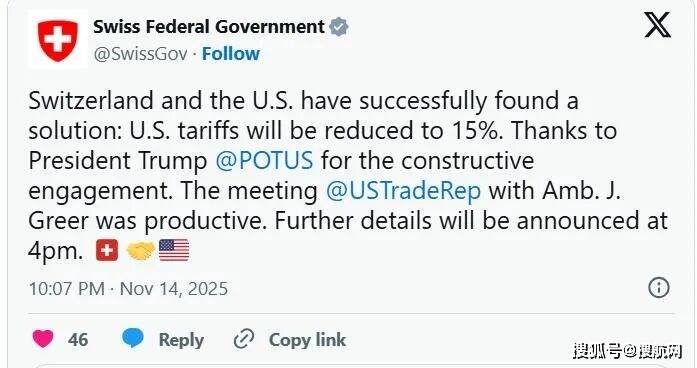
Core Points - Switzerland and the United States have reached a trade agreement that significantly reduces tariffs on Swiss products from 39% to 15% [1][2] - In exchange, Swiss companies are committed to investing $200 billion in the U.S. by the end of 2028 [1][2] Group 1: Trade Agreement Details - The trade agreement aligns Switzerland's tariff rates with those of the European Union, affecting approximately 40% of Swiss exports [2] - The U.S. Trade Representative indicated that Switzerland will increase purchases of Boeing's commercial aircraft as part of the agreement [2] - The pharmaceutical industry is the largest sector for Swiss exports to the U.S. [2] Group 2: Economic Impact - In 2024, the trade surplus between Switzerland and the U.S. is projected to be $38.3 billion, expanding to $55.7 billion in the first seven months of 2025 [5] - The increase in trade surplus is attributed to preemptive stockpiling by the U.S. before the implementation of "reciprocal tariffs" in April [5] - The U.S. will also eliminate tariffs on certain food and other goods imported from Argentina, Ecuador, Guatemala, and El Salvador, enhancing market access for U.S. companies [5]

特朗普,下调关税
Zhong Guo Ji Jin Bao· 2025-11-15 23:13
Core Points - The U.S. government has signed an order to lower tariffs on various food items, including beef, tomatoes, coffee, and bananas, in response to voter pressure to reduce grocery costs [1][2] - The tariff reductions will take effect retroactively from November 13, 12:01 AM New York time, and apply to products that the domestic supply cannot meet [1] - This decision reflects a shift in focus towards affordability measures amid rising concerns about the economy under the current administration [1][2] Tariff Adjustments - The tariff exemptions include hundreds of food items such as coconuts, nuts, avocados, and pineapples [1] - The adjustments are part of a broader strategy to provide tariff relief for key goods and industries, as stated by U.S. Trade Representative Jamison Greer [2] - The recent tariff changes only affect the 10% retaliatory tariff on Brazilian products, while an additional 40% tariff remains in place, continuing to impact coffee and beef prices [3] Market Impact - Coffee prices have surged, with U.S. imports of coffee beans from Brazil dropping over 50% from August to October due to previous tariffs [3] - The agricultural trade deficit has widened, with imports of tropical products expected to reach $39.4 billion this year, accounting for 18% of total agricultural imports [4] - Coffee alone represents about one-third of the value of these imports, indicating significant reliance on foreign sources for products not widely grown domestically [4]
ThinkCareBelieve: Week 43 of America's Climb into the Golden Age
Globenewswire· 2025-11-15 22:26
Government Shutdown and Legislative Actions - The 43-day government shutdown ended with the passage of the Clean CR Bill after multiple failed votes by Democrat Senators [1] - The shutdown caused significant stress on various programs including FAA, SNAP, WIC, and military services [1] International Relations and Trade Agreements - Meetings were held with the new President of Syria to discuss Middle East peace, leading to the suspension of Caesar Act sanctions [2] - New trade agreements were established with El Salvador, Argentina, Ecuador, and Guatemala to strengthen supply chains and eliminate unfair trade practices [2] - A trade deal with Switzerland and Liechtenstein was finalized, expected to drive billions in investment and create thousands of jobs in the U.S. [2] Defense and Military Sales - An agreement was reached to sell up to 48 F-35 Lightning II stealth fighter jets valued at $58–60 billion, part of a larger $142 billion U.S.-Saudi defense package [2] Healthcare Initiatives - A $10,000 bonus was awarded to Air Traffic Controllers who remained during the shutdown, highlighting the impact of the shutdown on workers [4] - President Trump proposed a healthcare system that directs funds to individuals rather than insurance companies, supported by three executive orders aimed at price transparency and drug pricing [4] - Plans for $2,000 tariff stimulus checks for Americans earning under $100,000 were announced, with surplus funds intended to reduce national debt [4] Fraud Investigations and Reforms - Investigations revealed fraud within the SNAP system, with deceased individuals and duplicate recipients identified [5] - Plans to require all SNAP participants to reapply and recertify eligibility were announced to ensure proper distribution of benefits [5] Social and Community Initiatives - An Executive Order was signed to improve the U.S. Foster Care System, focusing on mentorships, scholarships, and workforce training for youth [7] Activism and Government Transparency - The article emphasizes the importance of public participation and awareness in government, advocating for improved transparency and communication between the public and government [8]

周六你需要知道的隔夜全球要闻:美国部分关键数据发布时间确定 美股抛售压力暂缓
Sou Hu Cai Jing· 2025-11-14 22:39
Group 1 - The U.S. economic data release schedule has been confirmed, with key reports including the September non-farm payrolls set for November 20 and August trade data on November 19 [1] - The Federal Reserve's hawkish stance continues, with various regional Fed presidents expressing mixed views on potential rate cuts in December [2][3] - U.S. stock indices closed mixed, with the Dow Jones down 0.65% and the Nasdaq up 0.13%, reflecting volatility in tech stocks [4][5] Group 2 - Geopolitical risks have driven oil prices higher, with WTI crude rising 2.39% to $60.09 per barrel and Brent crude up 2.19% to $64.39 per barrel [6] - Gold prices fell over 3% due to uncertainty from the longest government shutdown in U.S. history, with spot gold hitting a low of $4032 per ounce [7] - Most popular Chinese concept stocks declined, with the Nasdaq Golden Dragon China Index down 1.61% [8] Group 3 - The U.S. and Switzerland have reached a trade agreement, reducing tariffs on Swiss products from 39% to 15%, with Switzerland committing to invest $200 billion in the U.S. by the end of 2028 [9] - Google plans to invest $40 billion in building data centers in Texas, indicating a significant expansion in its infrastructure [10] - Berkshire Hathaway has taken a position in Alphabet, ranking among the top ten holdings in its portfolio for the third quarter [11]
美国与瑞士达成贸易协议,将瑞士商品关税下调至15%
财联社· 2025-11-14 18:37
Group 1 - The Swiss government announced a trade agreement with the US, reducing tariffs on Swiss products from 39% to 15%, impacting approximately 40% of Swiss exports [1] - Swiss companies are committed to investing $200 billion in the US by the end of 2028, with a significant portion expected to come from the pharmaceutical and life sciences sectors [1][2] - The agreement sets a 15% tariff ceiling for Swiss pharmaceutical companies, protecting them from potential high tariffs under the upcoming "national security tariffs" [2] Group 2 - The trade agreement will also lower import tariffs on industrial goods, fish, seafood, and certain agricultural products deemed "non-sensitive" by Switzerland [2] - In 2024, the trade surplus between Switzerland and the US is projected to be $38.3 billion, expanding to $55.7 billion in the first seven months of 2025 [2] - The reduction in tariffs is expected to significantly benefit Swiss small and medium-sized manufacturers, providing them with competitive conditions in the US market [2] Group 3 - The KOF economic research institute forecasts that the economic growth rate for Switzerland in 2026 will be 0.9%, but this could exceed 1% due to the tariff reductions [3]



US-Switzerland trade deal: tariffs slashed to 15%, boosting pharma and watches
Invezz· 2025-11-14 16:55
Core Points - The US and Switzerland have reached a breakthrough deal to reduce tariffs from 39% to 15% [1] - This agreement comes after months of intense trade tensions between the two countries [1] Summary by Categories Trade Agreement - The new tariff rate of 15% represents a significant reduction from the previously imposed 39% [1] - The deal is seen as a positive development in US-Switzerland trade relations [1] Economic Impact - The reduction in tariffs is expected to facilitate increased trade between the US and Switzerland [1] - This agreement may lead to improved economic conditions for businesses operating in both countries [1]

刚刚,关税大消息!降至15%
Zhong Guo Ji Jin Bao· 2025-11-14 14:58
Group 1 - The United States and Switzerland have reached a trade agreement that reduces tariffs on Swiss goods from 39% to 15% [1][2] - The agreement is expected to provide significant relief for Switzerland, which has faced the highest tariffs among developed countries due to previous U.S. policies [1] - As part of the agreement, Switzerland has committed to invest $200 billion in the U.S. during President Trump's term, including $70 billion in the next year, focusing on sectors like pharmaceuticals and gold refining [1] Group 2 - The trade agreement is seen as a positive development for U.S. manufacturing, with expectations of a shift in Swiss manufacturing to the U.S. in industries such as pharmaceuticals and railway equipment [2] - The resolution of this trade dispute comes after months of negotiations, which began when the Trump administration imposed high tariffs on Swiss exports in response to a trade deficit [2]
刚刚,关税大消息!降至15%
中国基金报· 2025-11-14 14:53
Core Points - The United States and Switzerland have reached a breakthrough trade agreement, reducing tariffs on Swiss goods from 39% to 15% [2] - The agreement is expected to provide significant relief for Switzerland, which has faced the highest tariffs among developed countries under the previous administration [2] - In exchange for the tariff reduction, Switzerland has committed to investing $200 billion in the U.S. during President Trump's term, including $70 billion in the next year, focusing on sectors like pharmaceuticals and gold refining [2] - The agreement marks the end of a prolonged dispute that began in August, when the U.S. imposed high tariffs on Swiss exports, which was seen as a response to a trade deficit [2] Summary by Sections Trade Agreement Details - The U.S. Trade Representative, Jamison Greer, announced that the agreement includes the most-favored-nation tariff rate and some existing tariffs, similar to arrangements with the European Union [2] - The deal is a result of extensive diplomatic efforts by Swiss officials and business leaders over the past few months [2] Impact on Industries - Key Swiss industries, including watches, machinery, and precision instruments, have suffered due to high U.S. tariffs [2] - The agreement is expected to lead to a significant shift of Swiss manufacturing to the U.S., particularly in pharmaceuticals, gold refining, and railway equipment [2]

White House says tariffs will be lowered on some imports from four countries in new deals
Fox Business· 2025-11-14 13:56
Group 1: Trade Agreements Overview - The White House announced trade deals with Ecuador, Guatemala, El Salvador, and Argentina aimed at reducing tariffs on certain goods like coffee, bananas, and beef exports [1][2] - The agreements will maintain reciprocal rates but will lower tariffs on items that cannot be produced in the U.S., with Argentina, Guatemala, and El Salvador facing a 10% tariff, while Ecuador will have a 15% tariff [2] Group 2: Political Reactions - The framework with Argentina includes lower tariffs on beef imports but does not increase the U.S. import quota, leading to concerns from both Democrats and Republicans about the impact on U.S. farmers and ranchers [5][6] - A letter signed by 14 Republican lawmakers expressed concerns that increased market access to Argentina could undermine American cattle producers and reintroduce animal health risks [6][9] Group 3: Benefits and Commitments - The White House highlighted potential benefits for Americans, including commitments from El Salvador to address non-tariff barriers and from Argentina to provide preferential market access for U.S. goods [13] - Guatemala has committed to not imposing digital services taxes that discriminate against U.S. products, while Ecuador will adopt high levels of environmental protection [13]