
养老金融

Search documents
别上当!守好自己的钱袋子(法治聚焦) ——从三起案件揭秘非法集资犯罪骗术
Ren Min Ri Bao· 2025-06-11 22:08
Core Viewpoint - The article emphasizes the importance of public awareness and prevention against illegal financial activities, particularly through the dissemination of typical cases of illegal fundraising by the Supreme People's Procuratorate [1]. Group 1: High-Interest Investment Schemes - High-interest investment schemes often disguise illegal fundraising as legitimate online lending, using promises of guaranteed returns and high interest rates to attract investors [2]. - A case involving Zhang and others illegally raised over 2.69 billion yuan, resulting in losses of 1.05 billion yuan for investors, by promoting debt-related financial products with annual returns of 6% to 12.5% [2]. Group 2: Elderly Financial Scams - Scams targeting the elderly, such as "retirement finance" schemes, have emerged, promoting products like "prepaid travel cards" and "retirement apartments" under false pretenses [4]. - A case led by Shen and others illegally raised over 50.3 billion yuan, with unpaid amounts reaching 15.4 billion yuan, by falsely promising guaranteed returns and high-quality services to elderly investors [4]. Group 3: Forex Trading Frauds - Fraudulent forex trading platforms often mislead investors by claiming to offer real forex margin trading, while in reality, funds do not enter legitimate markets [6][7]. - A case involving Wang and others raised over 19.2 billion yuan through a fake forex platform, with unpaid principal amounting to 3.9 billion yuan at the time of the incident [7]. Group 4: Prevention Measures - Investors are advised to verify the qualifications of financial service providers, the authenticity of underlying assets, and the actual use of funds before investing [3][5]. - It is crucial for investors, especially the elderly, to consult with family or professionals and report any suspicious activities to authorities [5].
到2027年现代服务业增加值超1300亿元
Guang Zhou Ri Bao· 2025-06-11 20:17
Core Viewpoint - The "Action Plan" aims to promote high-quality development of the modern service industry in Jiangmen City, targeting a value-added increase of over 130 billion yuan by 2027, with an average annual growth rate of 5% [1] Group 1: Development Goals - By 2027, the modern service industry is expected to achieve a value-added of over 130 billion yuan, with the establishment of various commercial zones including one 10 billion yuan zone, one 20 billion yuan zone, and three 1 billion yuan zones [1] - The plan includes the addition of 300 service projects with investments exceeding 100 million yuan, 90 service enterprises with revenues over 100 million yuan, and 30 buildings generating tax revenues exceeding 10 million yuan [1] - The total number of large-scale service enterprises is projected to reach 3,300 by 2027 [1] Group 2: Key Areas of Focus - The plan outlines 13 key areas for development, including technology services, industrial design, software information, business services, financial services, human resources, modern logistics, inspection and certification, green low-carbon services, modern commerce, cultural tourism, health and elderly care, and sports services [1][2] - Specific targets include reaching 54 large-scale technology service enterprises with revenues of 1.5 billion yuan, and establishing 1 to 3 provincial-level pilot platforms by 2027 [2] Group 3: Business Services and Financial Services - In business services, the goal is to have 200 large-scale enterprises with revenues of 6.5 billion yuan by 2027, and to facilitate international arbitration services involving 20 billion yuan [3] - The financial services sector will focus on technology finance, green finance, inclusive finance, pension finance, and digital finance [3] Group 4: Human Resources and Logistics Services - The human resources sector aims to have 50 large-scale service institutions with revenues of 2.5 billion yuan by 2027, supporting the development of a comprehensive human resources solution provider [3] - In logistics services, the plan includes the construction of logistics parks and centers, with a target of achieving a value-added of over 16 billion yuan in transportation, warehousing, and postal services, and reaching 95 large-scale enterprises [3]
渤海银行总行最新组织架构
数说者· 2025-06-11 14:57
Group 1 - The core viewpoint of the article highlights the financial performance and organizational structure of Bohai Bank as of the end of 2024, showcasing its growth and strategic adjustments in departments [1][2][4]. - As of the end of 2024, Bohai Bank's total assets reached 1.84 trillion yuan, representing a year-on-year growth of 6.41%. The bank achieved an operating income of 25.482 billion yuan, up 1.94% year-on-year, and a net profit attributable to shareholders of 5.256 billion yuan, which is a 3.4% increase year-on-year [1]. - The largest shareholder of Bohai Bank is Tianjin TEDA Investment Holding Co., Ltd., holding 20.34% of the shares, followed by Standard Chartered Bank with 16.26% [1]. Group 2 - As of the end of 2024, Bohai Bank has a total of 32 departments at the head office, with new departments such as the Group Customer Department (Green Finance Department), Network Finance Department, and Asset Protection Department being added [2]. - The bank has established branches in 25 provinces across the country, excluding six provinces, and has one overseas branch in Hong Kong, along with a subsidiary, Bohai Wealth Management Co., Ltd. [3]. - The total number of employees in Bohai Bank Group is 13,824 as of the end of 2024 [4].


曾刚:做好养老金融产品与服务创新,提升国民养老意识与养老储备 | 养老金融健康专题
清华金融评论· 2025-06-11 10:51
Core Viewpoint - The article emphasizes the urgent need to address the challenges posed by an aging population, highlighting the importance of developing a robust pension finance system to support elderly care and financial planning for future retirees [1][2]. Group 1: Current Challenges Faced by the 70s and 80s Generations - The 70s and 80s generations are under significant pressure to support both aging parents and children, leading to increased economic burdens [3]. - There is a widespread issue of inadequate pension preparation among this demographic, with a reliance on traditional savings and a lack of awareness regarding pension insurance and financial products [4]. - Psychological and social support deficiencies are also critical, as traditional family structures weaken, necessitating a multi-layered pension security system [4]. Group 2: Improving Acceptance and Participation in Pension Financial Products - To enhance acceptance of pension financial products among the 70s and 80s generations, financial institutions should focus on increasing financial literacy through targeted educational initiatives [5]. - Product design must be optimized to meet the diverse needs of this demographic, ensuring offerings are both stable and yield returns [6]. - Lowering participation barriers and enhancing convenience through simplified purchasing processes and digital tools is essential [7]. - Policy support, such as tax incentives and subsidies, should be strengthened to encourage participation in pension financial products [8]. Group 3: Demand for Pension Financial Products - Families primarily seek pension financial products for capital preservation and growth, reflecting a growing need for stable investment options [9]. - There is an increasing demand for diversified pension services that extend beyond mere financial management to include healthcare and long-term care solutions [10]. - Personalized and long-term planning is crucial, as different families have varying income levels and risk preferences [11]. Group 4: Misconceptions About Pension Financial Products - Many families over-rely on public pensions, underestimating the limitations of basic pension insurance and neglecting supplementary commercial products [12]. - There is a perception that pension financial products are overly complex, which deters participation [13]. - A focus on short-term gains leads some families to overlook the long-term stability and benefits of pension financial products [14]. Group 5: Balancing Innovation and Risk Regulation in Pension Financial Products - Balancing innovation with risk regulation is vital to protect family investors' interests, ensuring that product designs are transparent and focused on stability [17]. - Regulatory frameworks must be strengthened to ensure compliance and safeguard against potential risks associated with innovative pension products [18]. - Investor education is necessary to enhance risk awareness and prevent uninformed investment decisions [18]. - Establishing mechanisms to mitigate risks, such as smoothing funds and improved valuation rules, is essential for protecting pension investments [18]. Group 6: Global Pension Models - Major global pension models include government-led public pension systems, which face fiscal pressures due to aging populations [21]. - Individual savings models, like the U.S. 401(k) plan, offer flexibility but require strong financial planning skills [22]. - The reverse mortgage model allows seniors to convert home equity into cash flow, improving their quality of life, though it carries risks related to property valuation and market fluctuations [23][24].

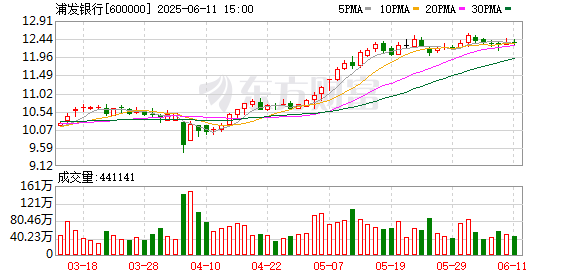
浦发银行:打造“敬老消费生态圈” 激发银发消费活力
Xin Hua Cai Jing· 2025-06-11 08:55
Core Viewpoint - The collaboration between Pudong Development Bank and China Pacific Insurance aims to enhance the consumption rights of the elderly and stimulate the silver economy through the establishment of a "Respect for the Elderly Consumption Ecosystem" [2][3] Group 1: Elderly Consumption Market - The elderly demographic is becoming a significant force in the consumer market, with diverse consumption needs ranging from essential goods to health, wellness, and leisure activities [2] - The initiative seeks to meet the growing material and spiritual needs of the elderly, improving their quality of life and happiness index [2] Group 2: Financial Services and Initiatives - Pudong Development Bank emphasizes the importance of elderly finance as part of its broader financial strategy, focusing on the political and social responsibilities of financial services [3] - The bank is committed to building a "Respect for the Elderly Consumption Ecosystem" that integrates finance, consumption, and services to promote the development of the silver economy [3] Group 3: Specific Programs and Activities - The "Silver Life Festival Pudong Benefits Payment" event has been launched to cater specifically to customers aged 60 and above, offering tailored discounts and services in shopping, dairy product ordering, travel, and local cuisine tasting [3] - The event is part of a broader initiative in response to government actions aimed at promoting silver consumption [3]

与海南自贸港同行 广发银行书写琼岛金融发展新答卷
2 1 Shi Ji Jing Ji Bao Dao· 2025-06-11 08:11
Core Viewpoint - The establishment of Hainan Free Trade Port has entered a new phase of comprehensive deepening of reform and opening up, with Guangfa Bank playing a significant role in supporting its development [1] Group 1: Financial Services System - Guangfa Bank has accelerated its efforts to introduce financial resources into Hainan, leveraging its comprehensive financial advantages as a member of China Life [2] - The bank issued a comprehensive financial service plan in 2021 to support the construction of Hainan Free Trade Port, focusing on key areas such as digital development, cross-border trade, and optimizing the business environment [2] Group 2: Financial Service Quality - Guangfa Bank has enhanced its financial services to support Hainan's regional development, demonstrating a commitment to the construction of Hainan Free Trade Port [3] Group 3: Technological and Green Finance - The Haikou branch has increased credit support for technology enterprises and strategic emerging industries, issuing loans totaling 1.58 billion yuan to tech companies [4] - The branch has also issued 78.1 million yuan in green bonds and implemented a "priority review" mechanism for green credit, achieving a 13.2% increase in green credit balance by May 2025 [4] Group 4: Social Responsibility - Guangfa Bank has supported over 5,600 households in housing projects with more than 2.2 billion yuan in credit, demonstrating its commitment to social welfare [5] - The bank has also established a special fund for hearing-impaired children and has been recognized as an advanced collective in national disability work [5] Group 5: Future Outlook - As Hainan Free Trade Port approaches a critical phase of operation, Guangfa Bank aims to integrate its "finance for the people" philosophy into its actions, contributing to the development of Hainan [6]
再获大股东“输血”!泰康养老注册资本将升至110亿元
Guo Ji Jin Rong Bao· 2025-06-10 10:58
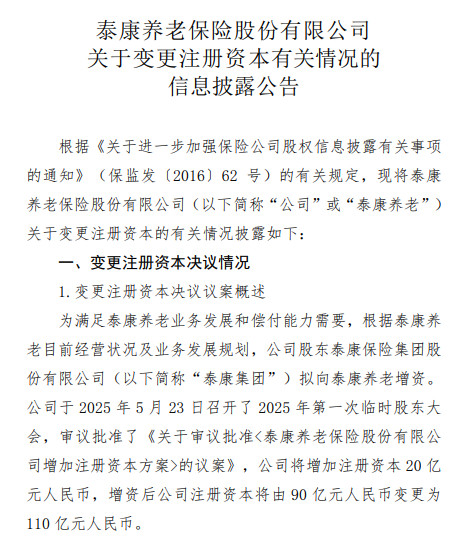
Group 1 - The core point of the article is that Taikang Pension has initiated a capital increase plan of 2 billion yuan to meet business development and solvency needs, raising its registered capital from 9 billion yuan to 11 billion yuan [1][4] - This capital increase will be fully funded by the shareholder Taikang Insurance Group, which will increase its shareholding from 99.33% to 99.45%, while Taikang Asset's shareholding will decrease from 0.67% to 0.55% [4] - This marks the fourth capital increase for Taikang Pension in nearly two years, with previous increases of 1 billion yuan in April 2023, 1 billion yuan in August 2023, and 2 billion yuan in April 2024 [4] Group 2 - The increase in capital is partly driven by the higher entry barriers for exclusive commercial pension insurance, as mandated by the financial regulatory authority, which requires a solvency ratio of at least 150% and a core solvency ratio of at least 75% [5] - The regulatory framework has been strengthened with specific requirements for pension insurance companies to enhance their capital management and risk resilience [6] - The aging population in China is expected to drive significant growth in the pension financial market, projected to reach 22.3 trillion yuan by 2030, presenting favorable development opportunities for the pension insurance sector [6] Group 3 - Taikang Pension has faced financial challenges in recent years, with a net loss of 1.97 billion yuan in 2023 and 1.407 billion yuan in 2024, despite a recovery in 2022 with a net profit of 120 million yuan [7] - In the first quarter of this year, Taikang Pension reported insurance business income of 7.597 billion yuan and a net profit of 347 million yuan [7] - As of the end of the first quarter, Taikang Pension's core and comprehensive solvency ratios were 142.41% and 239.81%, respectively, with expectations of a decline by the end of the second quarter [7]
曹德云:完善中国养老金融政策,创新养老金融产品服务,支持家庭养老金融健康发展 | 养老金融健康专题
清华金融评论· 2025-06-10 10:31
Core Viewpoint - The article emphasizes the urgent need to address the challenges posed by the aging population in China, highlighting the importance of developing a robust pension finance system to support individual and family financial resilience [1][2]. Summary by Sections Section on Pension Finance Policy Optimization - The development of China's pension system has primarily focused on the first and second pillars, with recent efforts to establish a third pillar through personal pensions to supplement retirement security [3]. - Current challenges include limited tax incentives and insufficient attractiveness of personal pension schemes, which are in the process of gradual improvement [3]. Section on Addressing Urban-Rural Disparities - Recommendations include reforming the household registration and land systems to reduce urban-rural disparities and enhance the pension levels for farmers [4]. - Emphasis on rural urbanization, professionalization of farmers, and agricultural industrialization to improve the basic pension security system [4]. Section on Meeting Public Demand for Pension Products - Financial institutions are encouraged to innovate pension products that genuinely meet public needs, ensuring stability and risk management [4][5]. - The design of pension products should prioritize simplicity, safety, and long-term viability, with a focus on user needs rather than solely institutional perspectives [6][8]. Section on Enhancing Public Awareness - There is a need to improve public awareness regarding pension planning, as many still rely on traditional family support systems [5]. - Regulatory bodies and industry associations should enhance pension education to increase acceptance of market-based pension solutions [5]. Section on Capital Market Development - A healthy capital market is essential for balancing the safety and returns of pension funds, with a focus on long-term investment strategies [10][11]. - The article suggests that increasing equity investments and alternative assets can enhance the value of pension funds, drawing on international experiences [11]. Section on Challenges in Pension Services - The current pension service system faces challenges in matching supply with the actual needs of the elderly, leading to dissatisfaction and high turnover in care facilities [12]. - Future reforms should focus on personalized service models and understanding the evolving demands of different generational cohorts [12][14]. Section on International Comparisons - Japan's long-term care insurance system serves as a model for sustainable pension service funding, highlighting the importance of shared financial responsibility [15]. - The article advocates for systemic innovations in payment systems and service delivery to create a multi-tiered pension service framework that meets diverse needs [15].

王忠民:中国家庭资产负债表的增衰逻辑
清华金融评论· 2025-06-10 10:31
Core Insights - The article discusses the challenges and opportunities in the context of aging population and the need for effective financial solutions for retirement, emphasizing the importance of family asset-liability management in ensuring sustainable retirement funding [2][3]. Group 1: Importance of Family Asset-Liability Management - The family asset-liability statement reveals significant challenges in the current social pension landscape, with traditional retirement assets like stocks and real estate experiencing notable declines, impacting retirement security [3][5]. - The weakening wealth effect and increasing pension contribution pressures due to aging and declining birth rates are raising risks on the liability side of family finances [3][5]. - A comprehensive understanding of the family asset-liability framework is essential for strategic planning in retirement finance, especially in the digital economy where personal digital assets are emerging as new forms of wealth [3][6]. Group 2: Multi-faceted Approaches to Pension Funding - The urgency to enhance the financial support capacity of the pension system is highlighted, with ongoing efforts in developing a three-pillar pension system through policy support, institutional design, and financial product innovation [6][7]. - Social security funds are becoming more resilient in the current market environment, while life insurance companies are increasingly recognized as vital components of family retirement financial planning due to their long-term, stable product structures [6][7]. - The traditional pay-as-you-go system is facing sustainability challenges, necessitating a reevaluation of personal pension accounts to enhance their long-term return capabilities [6][7]. Group 3: Systemic Considerations from an Asset-Liability Perspective - The asset-liability analysis can extend beyond families to include various entities such as government agencies, enterprises, and local governments, all of which are interconnected in the pension landscape [7][8]. - The sustainability of pension guarantees in public institutions is closely tied to employment stability and contribution capacity, while economic cycles directly affect the asset quality and profit levels of enterprises and financial institutions [7][8]. - The central government's asset-liability management plays a crucial role in supporting nationwide pension coordination through fiscal policies and transfers [7][8]. Group 4: New Opportunities in the Era of Digital Assets - The future of family asset-liability management will incorporate digital assets and life data, creating a new dimension of personal wealth structure [8][9]. - Digital footprints from gig economy activities are becoming valuable digital assets, providing new value propositions for workers amid structural economic changes [8][9]. - Health-related data, when integrated with AI and algorithms, can lead to personalized medical solutions, enhancing long-term health security and risk management in an aging society [8][9]. Conclusion - The family asset-liability statement serves as a critical lens for assessing social security capabilities and financial health, with multi-dimensional institutional design and financial innovation being key to advancing high-quality pension finance [9].

中国人民银行山东省分行等11部门联合印发《山东省金融服务养老事业和银发经济工作方案》
Qi Lu Wan Bao· 2025-06-10 00:24
Core Insights - The People's Bank of China Shandong Branch, in collaboration with 11 departments, has issued a work plan to enhance financial services for the elderly and promote the silver economy in Shandong Province [1][2]. Group 1: Key Initiatives - The work plan outlines 15 key tasks across five areas: innovation in pension financial products and services, increased investment support for the elderly industry, enhancement of the pension insurance system, improvement of financial services for elderly care, and establishment of a long-term mechanism for pension finance development [2]. - Financial institutions are encouraged to innovate products tailored to different elderly demographics and to provide comprehensive financial services [2]. - The plan emphasizes the need for financial institutions to support the financing of industries related to elderly products, smart health care, rehabilitation aids, anti-aging, and senior tourism [2]. Group 2: Regional Focus and Financial Support - Cities with a high proportion of elderly populations, such as Weihai, Yantai, Zibo, Rizhao, and Binzhou, are encouraged to develop innovative financing service models to lead in the development of the elderly industry [2]. - The government will leverage guiding funds to stimulate the silver economy and support enterprises in the elderly and pharmaceutical sectors through various financing methods, including public listings and bond issuance [2]. - As of April 2025, the loan balance for the elderly industry in Shandong Province reached 14.25 billion, reflecting a year-on-year growth of 24.8%, significantly outpacing the overall loan growth rate by 15.2 percentage points [3].