
人民币汇率

Search documents
央行:上半年社会融资规模增量为22.83万亿元,6月末M2同比增长8.3%,下阶段将把握好政策实施力度和节奏,保持流动性充裕
Sou Hu Cai Jing· 2025-07-14 11:45
Core Viewpoint - The People's Bank of China (PBOC) is implementing a moderately accommodative monetary policy to support economic recovery, with a focus on maintaining liquidity and promoting reasonable growth in money and credit supply [1][2][5]. Monetary Policy Implementation - The PBOC has introduced a series of monetary and credit policies, including a package of 10 measures announced on May 7, aimed at enhancing liquidity and supporting the economy [6][7]. - As of the end of June, the social financing scale and broad money supply (M2) grew by 8.9% and 8.3% year-on-year, respectively, with increases of 0.8 and 2.1 percentage points compared to the previous year [1][2]. Financial Support for the Real Economy - In the first half of the year, the incremental social financing scale reached 22.83 trillion yuan, an increase of 4.74 trillion yuan year-on-year, indicating that the financial system is effectively meeting the funding needs of the real economy [2][5]. - The PBOC emphasizes the need for time to observe the effects of implemented monetary policies and will continue to assess their transmission and effectiveness [2][5]. Focus Areas for Future Policies - The PBOC plans to maintain a balance between supporting the real economy and ensuring the health of the financial system, with a focus on sectors such as technology innovation, consumption expansion, and support for small and micro enterprises [9][10]. - The PBOC aims to enhance the effectiveness of financial services to the real economy by improving the policy framework and ensuring that monetary policy tools are effectively utilized [9][10]. Currency Exchange Rate Management - The PBOC is committed to maintaining the flexibility of the RMB exchange rate while preventing excessive fluctuations, with a focus on stabilizing the currency at a reasonable equilibrium level [10][11]. - Recent trends show that the RMB has remained stable against the USD, with fluctuations managed effectively since early April [10][11].

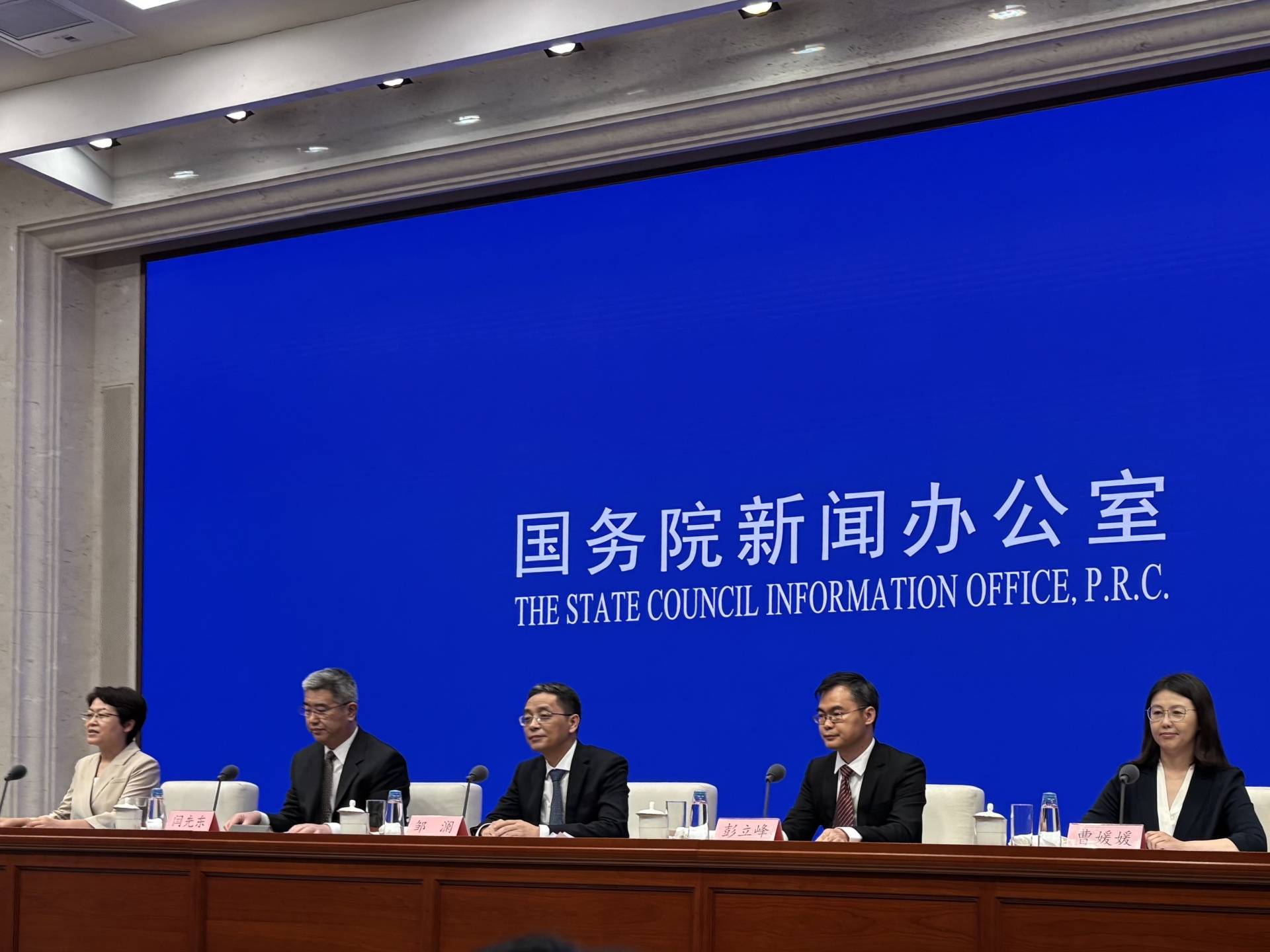
关于货币政策、汇率、中小银行债券投资,央行释放最新信号
Xin Lang Cai Jing· 2025-07-14 10:05
Monetary Policy and Economic Support - The People's Bank of China (PBOC) reported that in the first half of 2025, new loans in RMB amounted to 12.92 trillion yuan, indicating strong credit support for the real economy [1] - Corporate loans accounted for 89.5% of all new loans, an increase of 6.6 percentage points compared to the same period last year, with major investments directed towards manufacturing and infrastructure [1] - The PBOC aims to maintain a moderately accommodative monetary policy, closely monitoring the transmission and effectiveness of previously implemented policies to better support domestic demand and stabilize market expectations [1][5] Financial Market Performance - As of June, the total social financing stock grew by 8.9% year-on-year, while the broad money supply (M2) increased by 8.3% and RMB loans rose by 7.1% [3] - The average interest rate for newly issued corporate loans was approximately 3.3%, down about 45 basis points from the previous year, while the rate for personal housing loans was around 3.1%, a decrease of about 60 basis points [3] - The financial market has shown resilience, maintaining stability in major financial markets despite significant changes in the external environment [4] Future Monetary Policy Directions - The PBOC plans to enhance the execution and supervision of interest rate policies, ensuring that monetary policy measures effectively support the real economy [5][6] - The focus will be on improving financial services for key areas such as technological innovation, consumption expansion, and support for small and micro enterprises [5] - The PBOC will continue to strengthen market monitoring and risk management tools to prevent financial market risks, particularly concerning the bond investments of small and medium-sized banks [7] Exchange Rate Policy - The PBOC maintains a clear stance that China does not seek to gain international competitive advantages through currency depreciation, emphasizing the importance of market forces in exchange rate formation [2][8] - The recent appreciation of the RMB against the USD, alongside a stable overall exchange rate, reflects a solid domestic economic foundation [8] - Factors influencing the exchange rate include economic growth, monetary policy, and geopolitical risks, with the PBOC committed to maintaining a stable RMB at a reasonable equilibrium level [8][9] Support for Small and Micro Enterprises - The PBOC is focused on enhancing the financial support system for private and small enterprises, promoting reasonable growth in inclusive loans [12] - As of May, the balance of inclusive micro and small loans reached 34.42 trillion yuan, with a year-on-year growth of 11.6% [13] - The average interest rates for newly issued inclusive loans and private enterprise loans have decreased compared to the previous year, indicating improved financing conditions [13]
央行最新发布!事关人民币汇率、货币政策……
第一财经· 2025-07-14 09:30
Core Viewpoint - The article discusses the current state and future direction of China's monetary policy, emphasizing the stability of the RMB exchange rate and the expected improvements in the alignment of monetary policy cycles between China and the US, as well as the focus on supporting key sectors like technology innovation and consumption. Group 1: Monetary Policy Overview - The RMB exchange rate remains stable with a solid foundation due to the improving domestic economy [1] - The expectation of the Federal Reserve restarting interest rate cuts in the second half of the year will help narrow the interest rate differential between China and the US [2] - Recent years have seen a supportive monetary policy environment, with multiple reductions in reserve requirements and interest rates [3] Group 2: Future Monetary Policy Direction - The effects of previously implemented monetary policies will continue to manifest over time, with a commitment to maintaining a moderately loose monetary policy [4] - Structural monetary policy tools will focus on supporting technology innovation and boosting consumption, enhancing the effectiveness of economic restructuring and transformation [5][6] Group 3: Financial Support for Key Areas - The People's Bank of China (PBOC) will enhance financial services for the real economy, ensuring liquidity remains ample and aligning monetary supply growth with economic growth targets [7] - Emphasis will be placed on supporting private and small enterprises, improving the financial support system, and increasing the availability of financing for these sectors [8]

聚焦人民币汇率、货币政策、提振消费……央行发布会要点速览
Di Yi Cai Jing· 2025-07-14 08:46
Core Viewpoint - The People's Bank of China (PBOC) will continue to implement a moderately accommodative monetary policy, with the effects of previously implemented policies expected to further materialize [1][4]. Group 1: Monetary Policy Implementation - The PBOC emphasizes that the transmission of monetary policy takes time, and the effects of already implemented policies will continue to emerge [4]. - The current monetary policy environment is supportive, with cumulative effects from multiple recent rate cuts and reserve requirement ratio reductions [3]. - The PBOC plans to maintain ample liquidity and ensure that the growth of social financing and money supply aligns with economic growth and price level expectations [6]. Group 2: Focus Areas for Monetary Policy - Structural monetary policy tools will focus on supporting technological innovation and boosting consumption, adhering to principles of being targeted, reasonable, and adaptable [5]. - The PBOC aims to enhance financial services for the real economy, particularly in key areas such as technology innovation, consumption expansion, and support for small and micro enterprises [6]. - There will be a continued effort to improve the financial support system for private and small enterprises, including enhancing credit availability and promoting efficient financing connections [7]. Group 3: International Context - The divergence in monetary policy cycles between China and the U.S. is expected to improve, with narrowing interest rate differentials anticipated as the market expects the Federal Reserve to resume rate cuts in the second half of the year [2]. - The stability of the RMB exchange rate is supported by a solid domestic economic foundation, despite uncertainties in the U.S. dollar's performance [1].
央行重磅发声!事关货币政策、汇率
财联社· 2025-07-14 08:42
Core Viewpoint - The People's Bank of China (PBOC) is implementing structural monetary policy tools to support technological innovation and boost consumption, aiming to enhance economic transformation and upgrade [3][8]. Group 1: Monetary Policy Measures - In May, the PBOC launched a comprehensive set of financial policy measures, all of which were implemented by the end of May, with a focus on supporting technological innovation and consumption [3][7]. - As of the end of June, the total social financing stock increased by 8.9% year-on-year, with M2 growing by 8.3% and RMB loans up by 7.1% [6]. - Since 2020, the PBOC has cut the one-year and five-year Loan Prime Rate (LPR) by 115 and 130 basis points respectively, reflecting a supportive monetary policy stance [5][9]. Group 2: Economic Indicators - By the end of May, the contract amount for loans related to technological innovation and technological transformation reached 17.4 trillion yuan, available for enterprises to draw upon [3]. - The balance of loans for the "Five Major Financial Articles" reached 103.32 trillion yuan by the end of May, a year-on-year increase of 14%, with technology loans accounting for 43.3 trillion yuan, up 12% [16]. - In the first half of the year, new loans primarily targeted the manufacturing and infrastructure sectors, with manufacturing medium- and long-term loans growing by 8.7% and infrastructure loans by 7.4% [15]. Group 3: Consumption and Service Sector - The PBOC has established a 500 billion yuan service consumption and elderly care refinancing facility to enhance financial support for the service sector, which is crucial for boosting consumption and expanding domestic demand [13]. - The service consumption market shows strong demand, but the main limitation to expanding service consumption is supply [12][13]. Group 4: Bond Market and Financing - In the first half of 2025, China's bond market issued various bonds totaling 4.43 trillion yuan, a 16% year-on-year increase, significantly supporting fiscal policy implementation and financing for real enterprises [19]. - The net financing from bonds accounted for 38.6% of the increase in social financing, indicating a robust bond market performance [19].

央行邹澜:当前美元走势仍有不确定性 人民币汇率在双向波动中保持基本稳定具有坚实基础
news flash· 2025-07-14 07:35
人民银行副行长邹澜7月14日在国新办新闻发布会上表示,各方面对美联储的货币政策变化非常关注, 近期美国经济增速有所放缓,但物价水平仍然高于美联储的目标水平,关税政策进一步增加了美国通胀 走势的不确定性,影响美联储降息节奏,美元指数、美债收益率波动的加大,对全球金融市场都产生了 一定的溢出效应。相比较而言,我国金融市场表现出较强韧性,运行总体平稳,影响汇率的因素是多元 的,比如经济增长、货币政策、金融市场、地缘政治、风险事件等。当前美元走势仍然有不确定性,但 中国国内基本面持续向好,人民币汇率在双向波动中保持基本稳定具有坚实基础。 ...
7月14日电,央行14日发布数据显示,6月末,国家外汇储备余额为3.32万亿美元。6月末,人民币汇率为1美元兑7.1586元人民币。
news flash· 2025-07-14 07:07
Core Points - As of the end of June, the national foreign exchange reserves amounted to 3.32 trillion USD [1] - The exchange rate of the RMB against the USD was 7.1586 RMB per USD at the end of June [1]
今日汇率公开:7月12日1美元能换多少人民币?
Sou Hu Cai Jing· 2025-07-14 05:33
Core Viewpoint - The recent appreciation of the Renminbi (RMB) against the US dollar presents significant implications for individuals holding USD or engaging in overseas transactions, prompting questions about the optimal timing for currency exchange and future exchange rate trends [1] Exchange Rate Status - On July 12, the RMB to USD exchange rate midpoint was reported at 7.1475, marking a continuous rise for three days and reaching the highest point since November of the previous year. The onshore rate peaked at 7.1672, while the offshore rate was 7.1697, indicating a narrow spread of only 25 basis points, reflecting stable market expectations and balanced supply and demand for USD [2] Reasons for RMB Appreciation - The recent appreciation of the RMB is attributed to multiple factors: - Weakening of the USD: The Federal Reserve's decision to maintain interest rates has led to a relative weakening of the USD, indirectly supporting the appreciation of the RMB [4] - Recovery in Exports: Continuous improvement in China's export data has increased the supply of USD from foreign trade enterprises, thereby suppressing the depreciation of the RMB [5] - Stable Market Sentiment: Optimistic market expectations and reduced demand for currency exchange among investors have contributed to a balanced supply and demand, stabilizing the exchange rate [6] Historical Comparison and Future Predictions - The current exchange rate is similar to the fluctuations seen at the end of last year, which ranged between 7.10 and 7.18. However, considering the earlier drop below 7.24, the current rate represents a recovery from previous lows. For those engaged in foreign exchange transactions or foreign trade, the current rate is more favorable compared to the past two months. Future exchange rate movements will be influenced by: 1. The strength of domestic economic recovery, which could provide room for further RMB appreciation 2. The trajectory of the USD, where the Federal Reserve's monetary policy will directly impact the USD's performance 3. Trade and investment flows, where growth in exports and foreign capital inflows will help stabilize the RMB exchange rate [7] Short-term Exchange Rate Outlook - In the short term, the RMB exchange rate is expected to fluctuate within the range of 7.13 to 7.20, with limited potential for significant volatility unless unexpected international financial events occur [8] Currency Exchange Strategies for Different Groups - The impact of RMB exchange rate fluctuations varies among different groups: - Students, tourists, cross-border e-commerce practitioners, and those with foreign income or debts are directly affected by exchange rate movements, with recent RMB appreciation benefiting cross-border e-commerce sellers by increasing their RMB returns upon currency conversion [10] - Investors should closely monitor exchange rate fluctuations to avoid making impulsive foreign currency purchases at high points [10] Current Need for Currency Exchange - For individuals with immediate needs, such as tuition payments, rent, or travel expenses, it is advisable to exchange currency in batches to mitigate risks. For those merely observing the market without immediate financial implications, it is prudent to stay informed and wait for a more favorable exchange opportunity [12]
三大人民币汇率指数上周全线上涨,CFETS按周涨0.3
Xin Hua Cai Jing· 2025-07-14 04:40
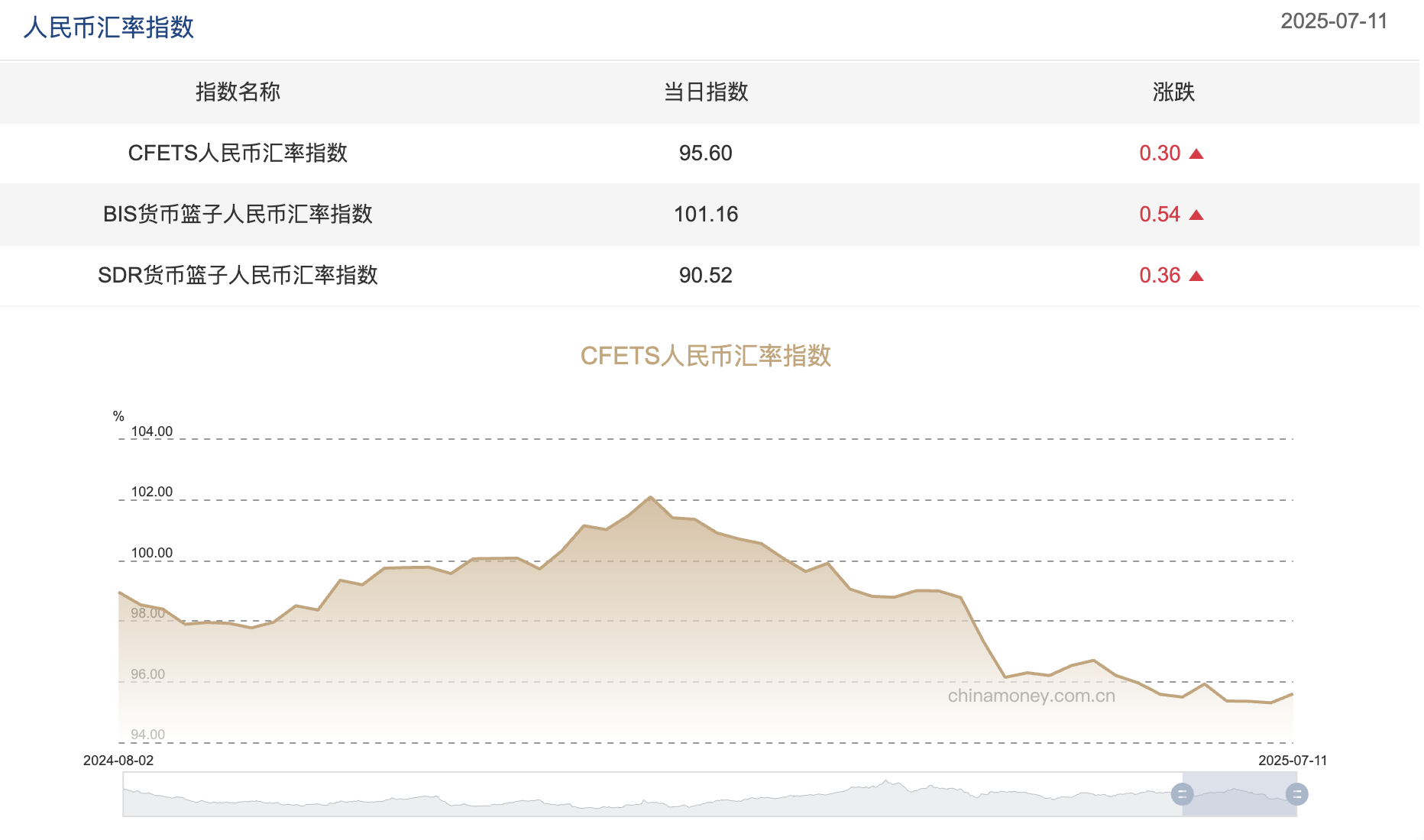
新华财经上海7月14日电(葛佳明) 中国外汇交易中心公布数据显示,7月11日当周三大人民币汇率指数全线上涨,CFETS人民币汇率指数报95.6,按周涨 0.3;BIS货币篮子人民币汇率指数报101.16,按周涨0.54;SDR货币篮子人民币汇率指数报90.52,按周涨0.36。 | 指数名称 | 当日指数 | | --- | --- | | CFETS人民币汇率指数 | 95.60 | | BIS货币篮子人民币汇率指数 | 101.16 | | SDR货币篮子人民币汇率指数 | 90.52 | 图片来源:中国外汇交易中心 上周(7月7日至7月11日)美元迎来今年2月末以来最为强劲的反弹,全周累计涨幅达0.91%,报97.873;非美货币兑美元多数走弱,日元上周大幅收跌2%; 欧元上周最终收跌0.76%;受到低迷经济增长数据的影响,英镑上周持续自历史高位回落,最终收跌1.15%。 人民币汇率上周保持稳健,在主要货币中表现较为靠前,对一篮子货币亦出现小幅反弹。具体来看,离岸人民币兑美元收盘报7.1736,全周累计跌90个基 点;人民币兑美元中间价报7.1475,创2024年11月8日以来最高,全周累计升60个基点 ...
2025年7月14日银行间外汇市场人民币汇率中间价
news flash· 2025-07-14 01:19
2025年7月14日银行间外汇市场人民币汇率中间价 美元/人民币报7.1491,上调(人民币贬值)16点; 欧元/人民币报8.3610,下调87点; 港元/人民币报0.91072,上调1.8点; 英镑/人民币报9.6665,下调477点; 澳元/人民币报4.7127,下调29点; 加元/人民币报5.2349,下调42点; 100日元/人民币报4.8659,下调322点; 人民币/俄罗斯卢布报10.8731,上调407点; 新西兰元/人民币报4.3047,下调178点; 人民币/林吉特报0.59388,上调2.9点; 瑞士法郎/人民币报8.9919,上调60点; 新加坡元/人民币报5.5928,下调5点。 ...