
农业新质生产力

Search documents
2026年“三农”工作重点聚焦六大方面
Yang Shi Wang· 2026-01-22 23:59
Core Viewpoint - The Chinese government is accelerating agricultural modernization and rural revitalization, focusing on six key areas to ensure food security, poverty alleviation, agricultural technology independence, farmer income stability, rural living conditions, and rural reform [2][3] Group 1: Food Security and Agricultural Production - Emphasis on stabilizing the production and supply of important agricultural products, enhancing overall agricultural production capacity and quality [2] - Development of a diversified food supply system and expansion of green, high-quality agricultural products to ensure stable and safe food supply [2] Group 2: Poverty Alleviation and Support Mechanisms - Continuous consolidation of poverty alleviation achievements with a focus on preventing the return to poverty through regular support mechanisms [2] - Implementation of targeted assistance for vulnerable populations and enhancement of collaborative support between regions [2] Group 3: Agricultural Technology and Innovation - Promotion of high-level agricultural technology self-reliance and innovation, with a focus on organized research and breakthroughs in key areas such as seed industry and smart agriculture [3] - Integration of technological innovation with industrial development to enhance agricultural productivity [3] Group 4: Farmer Income and Rural Industries - Development of rural industries to increase farmer income, focusing on local specialties and agricultural processing [3] - Establishment of fair mechanisms for sharing the benefits of industrial development with farmers [3] Group 5: Rural Living Conditions - Improvement of rural living conditions through the implementation of suitable construction mechanisms and enhancement of rural environments [3] - Promotion of cultural and social reforms to foster a civilized rural atmosphere [3] Group 6: Rural Reform and Development - Advancement of rural reform tasks, including extending land contracts and developing modern agricultural management systems [3] - Strengthening the management of rural housing land and promoting new types of rural collective economies [3]
农业农村部:今年常态化精准帮扶“缺什么、补什么”
Ren Min Ri Bao· 2026-01-22 23:24
Core Viewpoint - The article emphasizes the stability and progress in rural employment and agricultural production in China, highlighting the continuous efforts in poverty alleviation and rural revitalization, with a focus on maintaining a stable workforce of over 30 million in the labor market for five consecutive years [4][7][12]. Group 1: Agricultural Production and Employment - The agricultural sector has maintained a steady growth, with grain production stabilizing at over 1.4 trillion jin for two consecutive years, and the production of meat reaching 100.72 million tons, a year-on-year increase of 4.2% [5][12]. - The employment scale of the rural labor force has remained above 30 million for five years, with over 32 million workers engaged in employment from the poverty alleviation population [7][12]. Group 2: Food Supply and Quality - The supply of vegetables and other "basket" products is assured, with a significant increase in vegetable planting area by over 1.9 million mu compared to the previous year, and stable wholesale price indices for these products [6][12]. - The quality of agricultural products has improved, with a national monitoring compliance rate of 98% for food safety, and the comprehensive utilization rate of livestock manure exceeding 80% [5][9]. Group 3: Rural Infrastructure and Development - Continuous improvements in rural infrastructure are noted, with the rural sanitation toilet coverage rate at approximately 77%, and enhancements in water, electricity, and road conditions [9][10]. - The rural economy is diversifying, with a 5.6% year-on-year increase in the value added of large-scale agricultural processing, and the growth of new industries such as rural e-commerce and leisure tourism [9][12]. Group 4: Policy and Support Measures - The government is committed to maintaining stable support policies post-transition, integrating regular assistance into the rural revitalization strategy, and implementing targeted measures based on specific needs [7][8]. - A unified monitoring system will be established to ensure precise identification and dynamic adjustment of support for the poverty-stricken population, enhancing the effectiveness of employment assistance [8][12]. Group 5: Technological Advancements in Agriculture - The application of modern technology in agriculture is increasing, with a focus on enhancing agricultural innovation and the contribution rate of agricultural technology expected to exceed 64% by 2025 [11][12]. - Significant breakthroughs in agricultural biotechnology and the integration of artificial intelligence into agricultural practices are being pursued to improve productivity and sustainability [11].

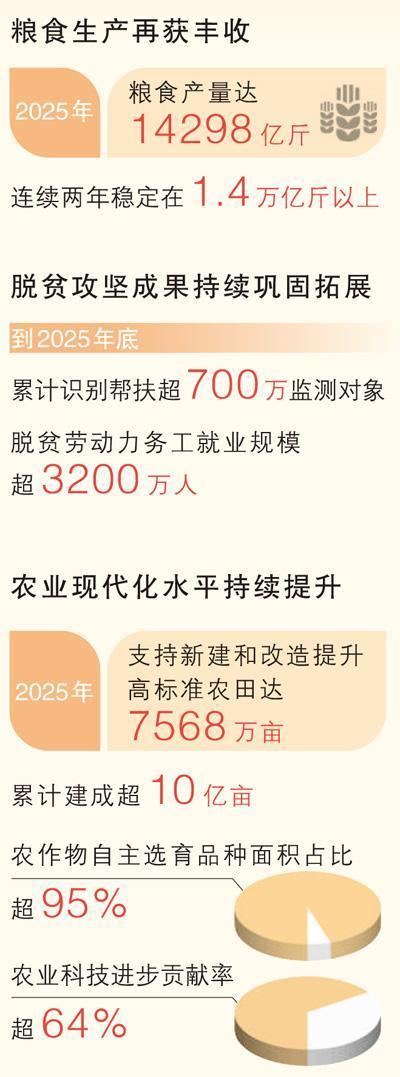
农业农村发展保持稳中向好势头(锐财经)
Ren Min Ri Bao Hai Wai Ban· 2026-01-22 22:36
Core Viewpoint - The Chinese government is accelerating agricultural modernization and rural revitalization, aiming for a stable and positive development in agriculture and rural areas by 2025, with a focus on achieving high-quality economic and social development [2]. Group 1: Grain Production - By 2025, China's grain production is expected to reach 14,298 billion jin, an increase of 168 billion jin, marking a new historical high [3]. - The increase in grain production is primarily attributed to autumn grain, which accounts for over 90% of the total increase, with a significant contribution from the northeastern provinces, Inner Mongolia, and Xinjiang [3]. - Corn production has increased by 126.4 billion jin, representing 75% of the total grain production increase [3]. Group 2: Agricultural Support Measures - The government plans to stabilize grain planting areas and implement a new round of actions to enhance grain production capacity, aiming for a significant increase in grain output [4]. - Measures include promoting high-yield crop varieties, optimizing production structures, and enhancing agricultural efficiency through technology and policy support [4]. - Disaster reduction strategies will be improved, including infrastructure development and pest control measures to minimize losses [4]. Group 3: Poverty Alleviation and Employment - By the end of 2025, over 7 million individuals will be identified for assistance, with efforts to eliminate risks of returning to poverty, and employment support for over 32 million former poverty-stricken laborers [6]. - The government emphasizes the importance of maintaining a stable support policy for poverty alleviation and integrating it into rural revitalization strategies [6][7]. - A focus on developing local industries and improving infrastructure in key poverty alleviation areas will be prioritized to enhance public services and economic growth [7]. Group 4: Agricultural Technology - The contribution rate of agricultural technology progress is expected to exceed 64% by 2025, with significant advancements in agricultural research and innovation [8]. - Breakthroughs in agricultural biotechnology and the integration of artificial intelligence in agriculture are being prioritized to enhance productivity [8][9]. - The government aims to strengthen the role of agricultural enterprises in technological innovation and improve the commercialization of research outcomes [9].
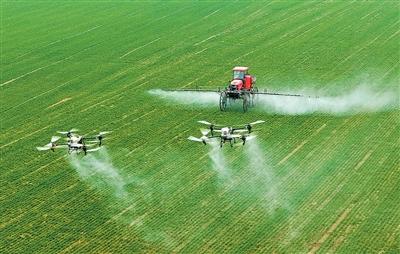
2025年全国农业科技进步贡献率超64%
Mei Ri Jing Ji Xin Wen· 2026-01-22 15:27
Core Viewpoint - The Chinese government is accelerating agricultural modernization and rural revitalization, focusing on improving agricultural product quality and enhancing production capacity to ensure food security and promote rural income growth [1][3]. Group 1: Agricultural Quality and Safety - The Ministry of Agriculture and Rural Affairs will strengthen quality safety risk monitoring and supervision for key regions, varieties, and processes, ensuring the quality of agricultural products from the initial market entry [1][4]. - There is a commitment to implement an agricultural brand enhancement action to create high-quality, distinctive regional public brands that can command better prices in the market [4]. Group 2: Agricultural Technology and Innovation - By 2025, the contribution rate of agricultural technology progress in China is expected to exceed 64%, with significant breakthroughs in basic research, including the cloning of the world's first high-temperature resistant rice gene [2]. - The application of "Artificial Intelligence + Agriculture" is accelerating, with advancements in smart agriculture models and agricultural bio-manufacturing [2]. Group 3: Enhancing Agricultural Production Capacity - The government aims to increase agricultural production capacity through a new round of initiatives to boost grain production, ensuring a diversified food supply system to meet growing demand [3]. - There is a focus on developing high-end intelligent agricultural machinery suitable for hilly areas to enhance production efficiency [3]. Group 4: Rural Economic Development - The strategy includes fostering rural industries to increase farmers' income and enhance rural vitality by strengthening the agricultural product processing industry and improving supply chain efficiency [4][5]. - The development of multiple agricultural functions and the integration of agriculture with culture and tourism are emphasized to transform local resource advantages into market and economic benefits [4].
农业农村部:因地制宜发展农业新质生产力
Zheng Quan Ri Bao Wang· 2026-01-22 14:06
一是强化高质量科技成果供给。不断完善"面向产业征集需求、面向场景研究示范、面向用户评价验 收"的攻关机制,加快在核心种源、高端智能和丘陵山区适用农机装备等领域取得一批标志性原创成果 和重大实用装备。 二是强化科技领军企业培育。深入实施"百千万"农业科技企业培育工程,促进创新资源向企业集聚,组 建一批企业牵头的创新联合体,推进产学研融通创新。 1月22日,国务院新闻办公室举行新闻发布会,介绍加快农业农村现代化,扎实推进乡村全面振兴有关 情况。 农业农村部副部长张兴旺表示,2025年我国农业农村发展保持了稳中有进、稳中向好的势头,全年 和"十四五"各项目标任务顺利完成,为推动经济社会高质量发展提供了基础支撑。主要体现在以下几个 方面:第一,粮食生产再获丰收,"菜篮子"产品供给充裕;第二,脱贫攻坚成果持续巩固拓展,牢牢守 住了不发生规模性返贫致贫这一底线;第三,科技装备支撑不断强化,农业现代化水平持续提升;第 四,宜居宜业和美乡村建设扎实推进,民生福祉持续增进;第五,农村改革持续深化,发展活力进一步 增强。 据张兴旺介绍,2025年我国粮食生产克服了局地干旱、洪涝、连阴雨等不利天气,产量达到了14298亿 斤、增产 ...
农业农村发展保持稳中有进稳中向好势头
Zhong Yang Ji Wei Guo Jia Jian Wei Wang Zhan· 2026-01-22 11:42
Core Viewpoint - China's grain production is projected to reach a historical high of 14,298 billion jin in 2025, with an increase of 168 billion jin, reflecting a steady and positive trend in agricultural and rural development [2] Group 1: Agricultural Production and Income - The total grain production in China is expected to hit 14,298 billion jin by 2025, marking an increase of 168 billion jin from previous levels [2] - The per capita disposable income of rural residents is projected to reach 24,456 yuan, representing a real growth of 6% compared to the previous year [2] Group 2: Rural Development Initiatives - The construction of high-standard farmland is set to reach 7,568 million mu, with a cumulative total exceeding 1 billion mu nationwide [2] - The focus on building livable, workable, and beautiful villages includes improving rural infrastructure, public services, and living environments [2] - The integration of primary, secondary, and tertiary industries in rural areas is emphasized to enhance local employment and income [2] Group 3: Agricultural Modernization and Technology - The contribution rate of agricultural technology progress has surpassed 64%, indicating significant advancements in agricultural science and technology [2] - Major breakthroughs include the cloning of the world's first high-temperature resistant rice gene and the application of artificial intelligence in agriculture [2] - The initiative aims to develop new agricultural productivity and achieve notable results in core seed sources and high-end intelligent agricultural equipment [2] Group 4: Poverty Alleviation and Support Mechanisms - The transition from a five-year poverty alleviation period to a normalized support phase has been established, ensuring no large-scale return to poverty [3] - Over 7 million monitoring subjects have been identified and supported to eliminate risks of returning to poverty [3] - The focus is on developing leading industries in 832 poverty alleviation counties, with each cultivating 2-3 strong, driving industries [3] Group 5: Future Agricultural Goals - The year 2026 marks the beginning of the "14th Five-Year Plan," emphasizing the importance of agricultural and rural work [4] - The goal is to modernize agriculture into a significant industry, ensure rural areas meet modern living standards, and improve the quality of life for farmers [4]
农业农村部:将聚焦推动科技创新和产业创新深度融合 因地制宜发展农业新质生产力
Xin Hua She· 2026-01-22 08:22
1月22日,国务院新闻办公室举行新闻发布会,介绍加快农业农村现代化,扎实推进乡村全面振兴 有关情况,并答记者问。农业农村部科学技术司司长周云龙表示,将聚焦推动科技创新和产业创新深度 融合,因地制宜发展农业新质生产力。 新华社音视频部制作 0:00 / 1:25 ...
联小农、强服务、促衔接——农业社会化服务体系不断完善
Zhong Guo Jing Ji Wang· 2026-01-22 05:49
Core Viewpoint - The development of agricultural social services is essential for connecting small farmers with modern urban agriculture and serves as a driving force for new agricultural productivity [1][2]. Group 1: Agricultural Social Services Development - Agricultural social services are crucial for addressing the challenges faced by small farmers, such as high costs, weak bargaining power, and low risk resistance [2]. - The agricultural social service industry has rapidly emerged, with over 1.111 million operational entities providing services to nearly 93 million small farmers, covering an annual service area of over 2.29 billion acres [2]. - The integration of advanced technologies and comprehensive service offerings is promoting the organic connection between small farmers and modern agriculture [2]. Group 2: Practical Challenges and Solutions - Farmers express concerns about service timing and the scattered nature of service areas, which complicates machinery operations and trust in service providers [3]. - Agricultural service providers are focusing on not missing critical farming times, balancing service area size with timely execution to avoid losses [3]. - Many service providers are implementing collective procurement strategies to lower production costs, with examples showing a reduction of at least 50 yuan per acre in production costs for farmers through bulk purchasing [3]. Group 3: Future Directions and Recommendations - The agricultural social service system should prioritize the convenience and efficiency of service for small farmers, encouraging innovation and digital transformation [4]. - There is a call for the establishment of a modern agricultural operating system and a more efficient agricultural social service framework [4]. - Future development should focus on not missing farming times while ensuring profitability for service providers [4].
事关2026年“三农”工作,农业农村部最新发声
Qi Huo Ri Bao· 2026-01-22 04:47
Core Viewpoint - The Chinese government is accelerating agricultural modernization and rural revitalization, focusing on six key areas for the "Three Rural Issues" in 2026, as outlined by the Ministry of Agriculture and Rural Affairs [2][3]. Group 1: Key Focus Areas for Agricultural Development - Emphasis on stabilizing the production and supply of important agricultural products, enhancing agricultural productivity and quality, and developing a diversified food supply system [2]. - Continuous efforts to consolidate and expand poverty alleviation achievements, establishing a regular mechanism to prevent poverty and ensuring stable support policies [2]. - Promotion of high-level agricultural technology independence and innovation, with a focus on breakthroughs in key areas such as seed industry and smart agriculture [3]. Group 2: Strategies for Grain Production - In 2025, China's grain production reached a record high of 1.4 trillion jin, with significant contributions from autumn grain and specific regions like Northeast China and Inner Mongolia [4][5]. - The Ministry of Agriculture plans to implement a new round of actions to enhance grain production capacity, focusing on five key strategies: stabilizing planting area, increasing yield, optimizing structure, enhancing efficiency, and disaster reduction [6][7]. Group 3: Specific Measures for Grain Production - Stabilizing the planting area by enforcing responsibilities for land protection and grain security [6]. - Encouraging yield improvements through advanced agricultural practices and technologies [6]. - Optimizing the production structure by promoting high-quality crop varieties [6]. - Enhancing efficiency through policy support and compensation mechanisms for grain-producing regions [6]. - Implementing disaster reduction measures to minimize agricultural losses from adverse weather conditions [7].
藏在武都的优商密码
Xin Lang Cai Jing· 2026-01-22 00:44
Core Insights - The article highlights the efforts of Wudu District in Gansu Province to enhance regional development through deepening East-West cooperation and strengthening investment attraction, focusing on addressing operational pain points for enterprises [1][2] Group 1: Investment and Economic Development - Wudu District aims to create a strong investment magnet by building a high-quality business environment and providing efficient government services to accelerate project construction [1] - The "Smart Fishing + Vertical Composite Ecological" greenhouse project in Jiao Gong Village exemplifies the integration of advanced technologies like AI, IoT, and big data to enhance agricultural productivity and efficiency [1] Group 2: Government Support and Collaboration - The rapid implementation and efficient progress of projects are attributed to the collaborative efforts between government and enterprises, with local authorities actively resolving issues related to land planning, electricity access, and road construction [2] - Jiao Gong Town has established a dedicated task force to focus on key areas such as land coordination and infrastructure development, ensuring ongoing support for project phases and enterprise operations [2] Group 3: Agricultural Innovation and Community Impact - The project is seen as a new engine for transforming agriculture in the region towards smart and ecological practices, significantly improving land utilization efficiency [1] - The local government emphasizes a service-oriented approach to foster enterprise growth and rural revitalization, aiming for a win-win situation that enhances both corporate development and community income [2]