
居民消费价格指数(CPI)

Search documents
重要数据公布!
新华网财经· 2025-10-15 06:48
Core Insights - The overall consumer market in September remained stable, with the Consumer Price Index (CPI) rising by 0.1% month-on-month and decreasing by 0.3% year-on-year, while the core CPI (excluding food and energy) increased by 1.0% year-on-year, marking the fifth consecutive month of growth [1][3][4]. CPI Analysis - The month-on-month CPI increase was driven by a 0.7% rise in food prices, contributing approximately 0.13 percentage points to the CPI increase. Seasonal price increases were noted in fresh vegetables, eggs, fresh fruits, lamb, and beef, with price changes ranging from 0.9% to 6.1% [3]. - Year-on-year, the CPI decline was primarily influenced by a 4.4% drop in food prices, which accounted for about 0.83 percentage points of the CPI decrease. Notably, pork, fresh vegetables, eggs, and fresh fruits saw significant price drops of 17.0%, 13.7%, 13.5%, and 4.2%, respectively [4]. - The core CPI's year-on-year growth rate has expanded for five consecutive months, reaching 1%, the highest in nearly 19 months. Prices for industrial consumer goods, excluding food and energy, rose by 1.8%, with notable increases in gold and platinum jewelry prices of 42.1% and 33.6%, respectively [4]. PPI Analysis - The Producer Price Index (PPI) remained flat month-on-month for two consecutive months, with a year-on-year decline of 2.3%, which is a narrowing of the decline by 0.6 percentage points compared to the previous month [5][6]. - The PPI's stability was attributed to improved supply-demand dynamics in certain industries, with coal processing prices rising by 3.8% and black metal smelting prices increasing by 0.2% [6]. - The decline in oil-related industry prices was influenced by falling international oil prices, with oil extraction prices decreasing by 2.7% and refined oil product prices down by 1.5% [6]. Market Dynamics - The construction of a unified national market has led to a narrowing of year-on-year price declines in several industries, including coal processing and black metal smelting, with reductions in PPI's downward pressure by approximately 0.34 percentage points [7]. - Upgrading industrial structures and releasing consumer potential have contributed to price increases in specific sectors, such as aircraft manufacturing and electronic materials, with notable price increases of 1.4% and 1.2%, respectively [7].


9月核心CPI同比涨幅连续5个月扩大
Sou Hu Cai Jing· 2025-10-15 06:37
Group 1 - The overall consumer market in September remained stable, with the Consumer Price Index (CPI) rising by 0.1% month-on-month, shifting from flat in the previous month [1] - Food prices increased by 0.7%, driven by seasonal price rises in fresh vegetables, eggs, and fresh fruits, while pork and aquatic product prices decreased due to sufficient supply [1] - Clothing prices rose by 0.8% as autumn collections were introduced [1] Group 2 - Year-on-year, the CPI decreased by 0.3%, with the decline narrowing by 0.1 percentage points compared to the previous month [4] - Among the eight categories of goods and services that constitute the CPI, six categories saw price increases, while only food, tobacco, alcohol, and transportation and communication prices declined [4] Group 3 - The core CPI, excluding food and energy prices, rose by 1.0% year-on-year, marking the fifth consecutive month of expansion and the first time in 19 months that the growth rate returned to 1% [5] - The increase in core CPI is primarily attributed to rising prices of durable consumer goods and services, supported by effective policies to stimulate domestic demand and consumption [7] Group 4 - Prices of industrial consumer goods, excluding energy, increased by 1.8%, with the growth rate expanding for the fifth consecutive month [8] - Prices for household appliances and communication tools rose by 5.5% and 1.5%, respectively, indicating an upward trend [8] - Service prices increased by 0.6%, showing stable growth [8]

9月份CPI同比下降0.3%,环比由平转涨|快讯
Hua Xia Shi Bao· 2025-10-15 03:54
Core Insights - The Consumer Price Index (CPI) in China decreased by 0.3% year-on-year in September 2025, with urban areas seeing a decline of 0.2% and rural areas a decline of 0.5% [2] - The average CPI from January to September 2025 fell by 0.1% compared to the same period last year [2] Price Changes - Food prices dropped by 4.4%, contributing approximately 0.83 percentage points to the CPI decline, making it the primary factor for the decrease [3] - Specific food items such as pork, fresh vegetables, eggs, and fresh fruits saw significant price drops of 17.0%, 13.7%, 13.5%, and 4.2% respectively, collectively impacting the CPI by about 0.78 percentage points [3] - Energy prices decreased by 2.7%, contributing around 0.20 percentage points to the CPI decline [3] Core CPI and Industrial Prices - The core CPI, excluding food and energy, increased by 1.0%, marking the first return to this growth rate in 19 months [3] - Industrial consumer goods prices, excluding energy, rose by 1.8%, with notable increases in gold and platinum jewelry prices of 42.1% and 33.6% respectively [3] Service Prices - Service prices increased by 0.6%, with stable growth observed in medical services and household services, which rose by 1.9% and 1.6% respectively [3] - Prices for hotel accommodations and airline tickets decreased by 1.5% and 1.7% respectively [3]

9月我国CPI同比下降0.3% 环比上涨0.1%
Xin Hua Wang· 2025-10-15 02:49
Group 1 - The core viewpoint of the article is that the consumer price index (CPI) in China showed a year-on-year decline of 0.3% in September, while the core CPI, excluding food and energy, increased by 1.0%, marking the first return to a 1% increase in nearly 19 months [1] Group 2 - In September, food prices decreased by 4.4% year-on-year, while non-food prices rose by 0.7%. Overall, consumer goods prices fell by 0.8%, and service prices increased by 0.6% [1] - The average CPI from January to September decreased by 0.1% compared to the same period last year [1] - The decline in CPI is primarily attributed to the "carryover effect," with the carryover impact accounting for approximately -0.8 percentage points of the CPI change, while new price changes contributed about 0.5 percentage points [1] - The decrease in food prices had a significant impact on the CPI, contributing approximately -0.83 percentage points to the year-on-year decline, while energy prices decreased by 2.7%, contributing about -0.20 percentage points [1]
积极信号!统计局最新公布
Sou Hu Cai Jing· 2025-10-15 02:38
Group 1 - The core CPI excluding food and energy prices increased by 1.0% year-on-year, marking the first return to a 1% increase in nearly 19 months, with the growth rate expanding for the fifth consecutive month [1][4] - In September 2025, the national consumer price index (CPI) decreased by 0.3% year-on-year, with urban areas down 0.2% and rural areas down 0.5% [1][4] - Food prices fell by 4.4%, significantly impacting the CPI decline, while non-food prices rose by 0.7% [1][2] Group 2 - In September, the prices of food, tobacco, and alcohol decreased by 2.6% year-on-year, contributing approximately 0.74 percentage points to the CPI decline [1][2] - Specific food items saw significant price drops: fresh vegetables down 13.7%, eggs down 11.9%, and pork down 17.0% [1][4] - The average CPI for January to September 2025 was down 0.1% compared to the same period last year [1] Group 3 - The PPI (Producer Price Index) decreased by 2.3% year-on-year, with the decline narrowing by 0.6 percentage points compared to the previous month [7] - The industrial producer purchase prices also fell by 3.1% year-on-year, with a 0.1% increase month-on-month [4][7] - The prices of coal processing and black metal smelting industries showed signs of stabilization, with coal processing prices up by 3.8% month-on-month [5][7]
国家统计局公布重要数据
Zhong Guo Zheng Quan Bao· 2025-10-15 02:35
Group 1: Consumer Price Index (CPI) Insights - In September, the Consumer Price Index (CPI) showed a month-on-month increase of 0.1%, reversing from the previous month where it was flat [1][3] - Year-on-year, the CPI decreased by 0.3%, but the decline was narrower by 0.1 percentage points compared to the previous month [6] - The core CPI, excluding food and energy, rose by 1.0% year-on-year, marking the first return to a 1% increase in nearly 19 months [6] Group 2: Producer Price Index (PPI) Insights - The Producer Price Index (PPI) remained flat month-on-month for the second consecutive month [7] - Year-on-year, the PPI decreased by 2.3%, with the decline narrowing by 0.6 percentage points from the previous month [11] - Factors contributing to the PPI trends include improved supply-demand structures in certain industries and the impact of international oil prices on domestic oil-related industry prices [9][10]
国家统计局:9月CPI环比由平转涨,PPI同比降幅继续收窄
Guan Cha Zhe Wang· 2025-10-15 02:27
Core Insights - In September 2025, the national consumer price index (CPI) decreased by 0.3% year-on-year, while it increased by 0.1% month-on-month [2][4] Group 1: Year-on-Year Changes - The CPI decline was influenced by a 4.4% decrease in food prices, while non-food prices rose by 0.7% [2][4] - Urban areas saw a 0.2% decrease in prices, while rural areas experienced a 0.5% decline [2] - Major contributors to the CPI decline included fresh vegetables (-13.7%), eggs (-11.9%), and pork (-17.0%) [4][5] Group 2: Month-on-Month Changes - In September, the CPI increased by 0.1% month-on-month, with urban prices remaining stable and rural prices rising by 0.2% [2][8] - Food prices rose by 0.7% month-on-month, with fresh vegetables increasing by 6.1% [8] - Other categories showed mixed results, with clothing prices up by 0.7% and transportation and communication prices down by 0.9% [8] Group 3: Industrial Producer Prices - The industrial producer price index (IPP) saw a year-on-year decline of 2.4%, primarily due to a 9.0% drop in mining prices [12] - Life goods prices decreased by 1.7%, impacting the overall IPP [12] - Month-on-month, the IPP remained stable, with mining prices increasing by 1.2% [15]
国家统计局:9月CPI同比下降0.3% 核心CPI同比涨幅持续扩大
Guo Jia Tong Ji Ju· 2025-10-15 01:55
Core Insights - In September 2025, the national consumer price index (CPI) decreased by 0.3% year-on-year, while it increased by 0.1% month-on-month [2][12][14] - The average CPI from January to September 2025 showed a decline of 0.1% compared to the same period last year [3][10] Price Changes - Urban CPI fell by 0.2% and rural CPI decreased by 0.5% year-on-year [3][10] - Food prices dropped by 4.4% year-on-year, significantly impacting the overall CPI, while non-food prices rose by 0.7% [3][14] - In September, food prices increased by 0.7% month-on-month, contributing to a 0.13 percentage point rise in CPI [8][12] Detailed Price Movements - Fresh vegetables saw a significant year-on-year price drop of 13.7%, while pork prices decreased by 17.0% [5][14] - Other categories showed mixed results, with clothing prices rising by 1.7% year-on-year, while transportation and communication prices fell by 2.0% [5][10] Core CPI Insights - The core CPI, excluding food and energy, rose by 1.0% year-on-year, marking the fifth consecutive month of growth [12][14] - This increase in core CPI indicates a stabilization in consumer demand and pricing trends [11][12] Producer Price Index (PPI) Trends - The PPI remained flat month-on-month but decreased by 2.3% year-on-year, with the decline narrowing by 0.6 percentage points compared to the previous month [12][17] - Improvements in supply-demand structures have led to price stabilization in several industries, including coal and metal processing [15][17] Sector-Specific Insights - The prices in the coal processing sector increased by 3.8% month-on-month, indicating a recovery in that industry [15][17] - The prices of high-end manufacturing sectors, such as aircraft and electronic materials, showed positive year-on-year growth, reflecting an upward trend in consumer demand [17]
国家统计局:9月份CPI同比下降0.3% 环比上涨0.1%
智通财经网· 2025-10-15 01:48
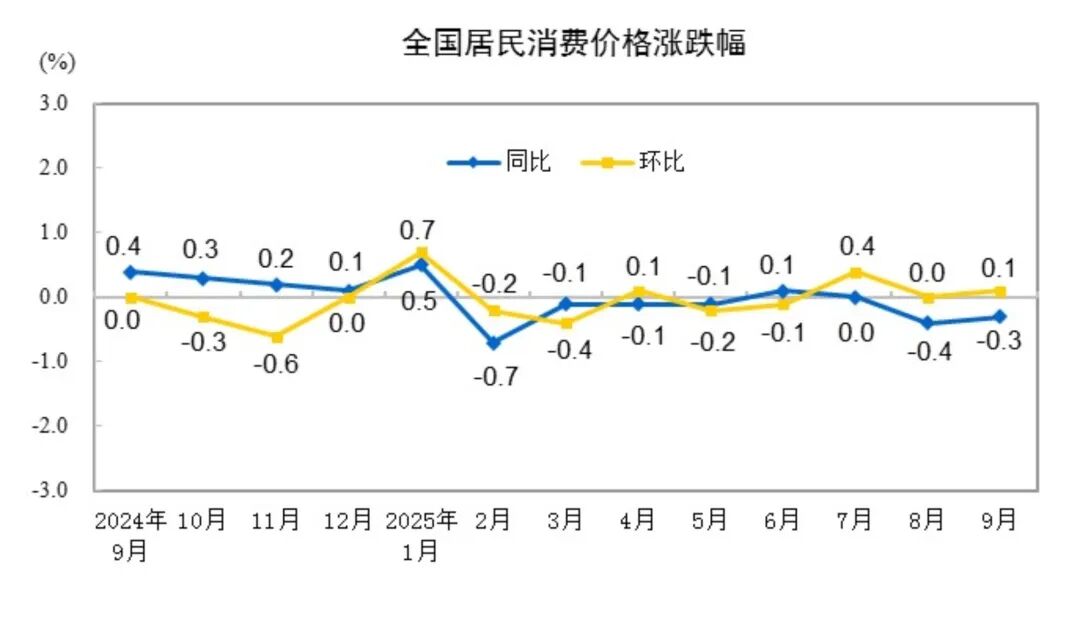
智通财经APP获悉,10月15日,国家统计局发布的数据显示,2025年9月份,全国居民消费价格同比下降0.3%。其中,城市下降0.2%,农村下降0.5%;食品 价格下降4.4%,非食品价格上涨0.7%;消费品价格下降0.8%,服务价格上涨0.6%。1—9月平均,全国居民消费价格比上年同期下降0.1%。9月份,全国居民 消费价格环比上涨0.1%。其中,城市持平,农村上涨0.2%;食品价格上涨0.7%,非食品价格下降0.1%;消费品价格上涨0.3%,服务价格下降0.3%。 原文如下: 2025年9月份居民消费价格同比下降0.3% 环比上涨0.1% 2025年9月份,全国居民消费价格同比下降0.3%。其中,城市下降0.2%,农村下降0.5%;食品价格下降4.4%,非食品价格上涨0.7%;消费品价格下降0.8%,服 务价格上涨0.6%。1—9月平均,全国居民消费价格比上年同期下降0.1%。 9月份,全国居民消费价格环比上涨0.1%。其中,城市持平,农村上涨0.2%;食品价格上涨0.7%,非食品价格下降0.1%;消费品价格上涨0.3%,服务价格下降 0.3%。 9月份,食品烟酒类价格环比上涨0.5%,影响CPI上涨约0 ...
国家统计局:9月份居民消费价格同比下降0.3% 环比上涨0.1%
Yang Shi Wang· 2025-10-15 01:43
央视网消息:据国家统计局网站消息,2025年9月份,全国居民消费价格同比下降0.3%。其中,城市下降0.2%,农村下降0.5%;食品价格下降4.4%,非食品 价格上涨0.7%;消费品价格下降0.8%,服务价格上涨0.6%。1—9月平均,全国居民消费价格比上年同期下降0.1%。 9月份,全国居民消费价格环比上涨0.1%。其中,城市持平,农村上涨0.2%;食品价格上涨0.7%,非食品价格下降0.1%;消费品价格上涨0.3%,服务价格下 降0.3%。 一、各类商品及服务价格同比变动情况 其他七大类价格环比四涨一平两降。其中,其他用品及服务、衣着价格分别上涨1.3%和0.7%,生活用品及服务、医疗保健价格分别上涨0.3%和0.2%;居住 价格持平;交通通信、教育文化娱乐价格分别下降0.9%和0.4%。 9月份居民消费价格' (%) 1.5 1.0 0.7 0.5 0.5 0.3 0.0 0.0 -0.5 -1.0 -1.5 居住 衣着 生活用品 食品烟酒 及服务 2025年9月份居民消费价格主要数据 | | | | | 环比涨跌幅 | 同比张跌幅 | 1-9月 | | --- | --- | --- | --- | ...