日元贬值

Search documents
总裁选预测:小泉赢日元升、高市赢股价涨
日经中文网· 2025-09-23 02:58
Core Viewpoint - The Japanese Liberal Democratic Party (LDP) presidential election is drawing significant attention from financial and capital markets, with varying predictions on market impacts depending on the candidates' economic policies [2][4][5]. Group 1: Candidate Analysis - Among the candidates, Takashi Kawai is noted for his strong fiscal expansion and monetary easing stance, with predictions suggesting that if he wins, the Nikkei average could rise to around 48,000 points by year-end [2][5]. - Shunichi Suzuki, representing a continuation of the current government's fiscal tightening policies, is perceived as lacking the ability to drive overall market growth, leading to expectations of a slight market adjustment if he wins [4][7]. - Yoshihide Suga's policies are expected to maintain the status quo, with limited impact on market fluctuations if he is elected [7][8]. Group 2: Market Reactions - The market has reacted positively to the prospect of Kawai's victory, with short-term foreign capital inflows boosting related stocks, indicating a strong correlation between candidate selection and market performance [5][8]. - In the foreign exchange market, there is a consensus that Kawai's election would not hinder the Bank of Japan from raising interest rates, with expectations for the yen to appreciate towards 145 yen per dollar [4][7]. - Conversely, if Suzuki wins, the yen may depreciate by approximately 2 yen against the dollar, reflecting concerns over fiscal policy direction [7]. Group 3: Economic Policy Implications - Kawai's economic policies emphasize growth through advanced technologies and tax revenue increases, while also showing signs of pragmatic adjustments, such as reconsidering previous tax reduction proposals [7][8]. - Concerns about fiscal deterioration are prevalent, with predictions that the 30-year government bond yield could drop to around 3% from its current level of approximately 3.2% [4][7]. - The upcoming election is expected to be more dynamic than in 2024, with a smaller candidate pool allowing for more in-depth discussions, potentially exposing weaknesses in candidates like Suzuki [8].


就市论市丨美联储降息预期持续升温 美元再度承压?
Sou Hu Cai Jing· 2025-09-05 09:31
Group 1 - The US dollar exchange rate has fallen to its lowest level since the end of July, influenced by various factors [1] - The upcoming non-farm payroll data release in the US is expected to significantly impact the dollar's performance [1] - Analysts predict that the dollar index will experience fluctuations, initially declining before rising again due to interest rate cut expectations and potential interventions [1] Group 2 - The divergence in French policies highlights the challenges of policy coordination, which may affect the dollar index in relation to the euro [1] - Internal and external pressures are contributing to the depreciation of the Japanese yen, with expectations of a potential rebound in the future [1]
在日外国人2025年汇款回国金额或超1万亿日元
日经中文网· 2025-08-31 00:33
Core Viewpoint - The remittance amount from foreign workers in Japan has significantly increased, reaching a historical high in the first half of 2025, with expectations to exceed 1 trillion yen for the year due to factors such as bonuses and long holidays [2][4]. Group 1: Remittance Trends - In the first half of 2025, remittances from foreign workers in Japan amounted to 506.8 billion yen, marking a 38% increase year-on-year and setting a new half-year record [2][4]. - The total remittance amount is projected to surpass the previous record of 847.5 billion yen set in 2024, potentially exceeding 1 trillion yen for the first time [4]. - The number of foreign workers in Japan has increased by 12% year-on-year, reaching 2.3 million, with Vietnamese nationals being the largest group [4]. Group 2: Remittance Destinations - The top remittance destinations in 2024 included Vietnam (326.2 billion yen), Indonesia (102.1 billion yen), and the Philippines (90.2 billion yen) [6]. - Global remittance flows have tripled over the past 20 years, with Japan ranking 25th in terms of outbound remittance amounts [6]. Group 3: Risks Associated with Remittances - There are two main risks associated with remittances from foreign workers: illegal activities and the impact on the yen exchange rate [8]. - A survey indicated that 2% of foreign residents in Japan used underground remittance services, primarily due to favorable exchange rates [8]. - Increased remittance amounts could lead to higher selling pressure on the yen as foreign workers convert yen to their local currencies [8]. Group 4: Domestic Remittance Trends - In the first half of 2025, remittances from Japanese residents abroad to Japan totaled 303.1 billion yen, a 10% decrease year-on-year [9]. - The net selling of yen after accounting for remittances was 203.7 billion yen, the highest half-year figure since comparable data began in 1996 [9].

【日经BP书籍】日元贬值的背后:虚假的贸易顺差国
日经中文网· 2025-08-29 02:48
Core Viewpoint - The long-term depreciation of the Japanese yen, which began in 2022 and continues into 2025, is primarily driven by underlying issues in Japan's trade balance rather than just interest rate differentials between the US dollar and the yen [6]. Group 1: Trade Balance Analysis - Japan's trade balance statistics reveal a disconnect from actual cash flows, indicating that Japan has entered a trade deficit when considering the "digital deficit" issue [6]. - The reliance on US IT giants, high costs of overseas insurance and pension services, and stagnation in domestic R&D capabilities are significant economic problems affecting Japan's international trade [6]. Group 2: Currency and Cash Flow Dynamics - The fluctuations in exchange rates reflect the movement of cash flows, which helps to understand the complex dynamics of global trade and the competition between nations [6].

JacksonHole年会点评:鲍威尔重磅讲话之后:相信你所相信的
Huafu Securities· 2025-08-24 08:25
Group 1: Federal Reserve Policy Insights - Powell's speech at Jackson Hole provided a clear hint of potential interest rate cuts, causing significant market reactions, with the dollar index dropping as much as 0.94% on August 22[3] - The Fed is facing challenges with inflation risks skewed upwards and employment risks skewed downwards, indicating a need to adjust policy stance[3] - The abandonment of the flexible average inflation targeting framework opens the door for quicker rate cuts if inflation shows signs of rapid decline[4] Group 2: Labor Market Dynamics - The U.S. labor market is exhibiting a "curious kind of balance," with both labor supply and demand significantly slowing, which could lead to a rise in unemployment if participation rates do not improve[4] - The upcoming August non-farm payroll data will be crucial for assessing labor market conditions ahead of the September FOMC meeting[4] - Initial jobless claims rose in the third week of August, indicating potential weakness in the labor market, but previous strong data complicates the assessment[4] Group 3: Global Economic Context - Japan's core CPI remained flat at 3.4% in July, suggesting that input inflation may be ending, with future inflation risks leaning towards a decline[26] - The U.S. imposition of "reciprocal tariffs" on Japan is expected to further impact Japan's manufacturing PMI, indicating a deteriorating external demand environment[26] - If U.S. economic data points to effective fiscal expansion and improved employment, a rebound in the already weakened dollar index may be more likely[5]
日本市场业绩增速不如国际市场 寿司郎母公司:积极拓展新店
Nan Fang Du Shi Bao· 2025-08-19 16:42
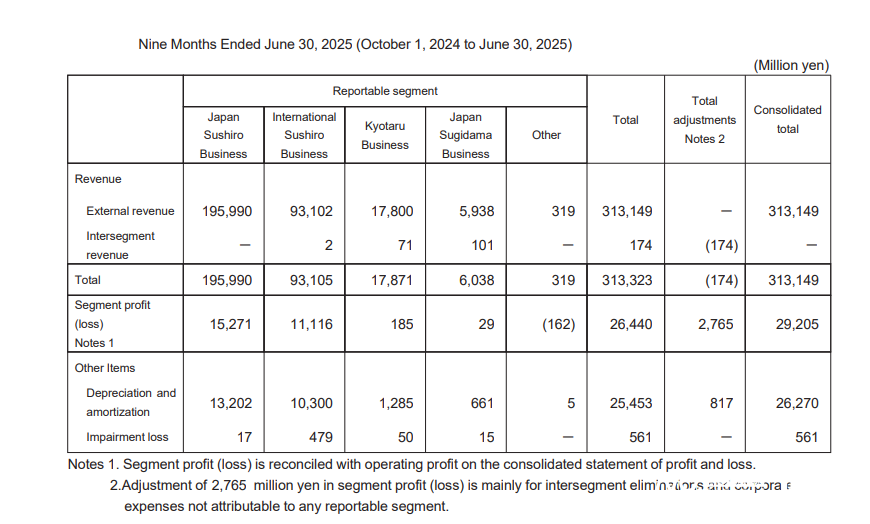
Core Insights - FOOD&LIFE COMPANIES (F&LC) reported a revenue increase of 18.3% year-on-year to 313.149 billion yen for the fiscal year 2025 third quarter, with a net profit growth of 74.3% to 18.072 billion yen [1] - The company operates multiple restaurant brands, including Sushiro, Sugidama, Kyotaru, and Misaki, with a total of 1,180 stores, an increase of 25 stores year-on-year [1] - Sushiro remains the primary revenue driver, with a significant performance difference between domestic and international markets [2] Financial Performance - For the first three quarters of fiscal year 2025, Sushiro's net sales in Japan grew by 11.6% to 195.99 billion yen, while international sales surged by 41.2% to 93.105 billion yen [2][3] - Segment profit for Sushiro in Japan was 15.271 billion yen, while international segment profit reached 11.116 billion yen, reflecting a strong international performance [3] Market Expansion - Sushiro has expanded its international presence, with 212 stores outside Japan, a 38-store increase year-on-year, while the domestic market saw a decrease of 12 stores to 960 [1] - F&LC plans to continue expanding its international footprint while carefully evaluating the business environment in various regions [4] Economic Context - The recovery of Japan's economy is attributed to rising personal consumption and increased demand from overseas tourists, although challenges remain due to global political instability and prolonged yen depreciation [3] - The restaurant industry faces ongoing challenges, including rising prices of raw materials and energy, as well as a long-term labor shortage [3]
日本央行坎坷的加息之路
2 1 Shi Ji Jing Ji Bao Dao· 2025-08-08 22:32
Group 1 - The Bank of Japan decided to maintain the current interest rate at 0.5% despite rising inflation, with no indication of a near-term rate hike [1][2] - Japan's consumer price index (excluding fresh food) rose by 3.3% year-on-year in June, exceeding the Bank of Japan's inflation target of 2% for over three years [1][2] - Major financial institutions in Japan are calling for a rate hike in September or October, citing the need to address the widening interest rate differential with the US and Eurozone [1][2] Group 2 - Despite high inflation, the Bank of Japan believes the underlying inflation rate has not reached 2%, and consumer activity has been declining since March [2][3] - Japan's GDP growth was -0.2% in Q1 and stagnant in Q2, indicating that inflation is not a sign of economic strength but rather a result of yen depreciation and labor shortages [3][4] - Political instability following the recent upper house elections complicates the situation, making it difficult for the Bank of Japan to raise interest rates [4][5] Group 3 - The US economy grew by 3.0% in Q2, but this growth is seen as temporary, and potential rate cuts by the Federal Reserve could impact Japan's interest rate decisions [5][6] - If the US economy remains strong, it could lead to further yen depreciation and increased domestic prices in Japan, potentially creating an opportunity for the Bank of Japan to raise rates [5][6]
日本企业“破产潮”影响广泛
Jing Ji Ri Bao· 2025-08-01 21:59
Core Insights - The number of bankrupt companies in Japan with liabilities exceeding 10 million yen reached 4,990 in the first half of 2025, marking a 1.19% increase from the previous year and the highest level since 2014 [1] - Various industries, including services, construction, childcare, and healthcare, are facing significant bankruptcy risks due to rising costs and economic pressures [1][2][3] Industry Analysis - In the construction sector, the number of bankruptcies in the renovation and painting industry reached 119, surpassing the figures during the 2009 financial crisis, indicating a 20-year high for the first half of the year [1] - The childcare sector saw 22 bankruptcies in the first half of 2025, a 70% increase year-on-year, with predictions of a record high for the entire year due to fierce competition and rising operational costs [2] - Home care institutions reported 45 bankruptcies, a 12.5% increase from the previous year, driven by factors such as reduced service demand and rising costs [2] - The healthcare sector experienced 21 hospital and clinic bankruptcies, a 16.6% increase, with larger institutions facing more severe financial crises due to rising operational costs and labor shortages [3] Economic Factors - High prices contributed to 343 bankruptcies in the first half of 2025, although this represents an 8.5% decrease from the previous year, maintaining a high level above 300 for three consecutive years [3] - Labor shortages led to 172 bankruptcies, the highest for the same period, with recruitment difficulties and rising labor costs being significant contributors [4] - Tax-related bankruptcies reached 77, the second highest since 2016, as companies struggled to meet tax obligations amid rising operational costs [4] - The depreciation of the yen resulted in 33 bankruptcies, with total liabilities exceeding 88.9 billion yen, eight times that of the previous year, highlighting systemic risks for small export-oriented companies [4] Overall Outlook - Japan is facing a systemic crisis characterized by high prices, labor shortages, and debt repayment peaks, particularly in critical sectors like childcare and healthcare [5] - The political instability and uncertain economic policies from the U.S. may further exacerbate the bankruptcy situation, with predictions suggesting that the total number of bankruptcies could exceed 10,000 for the year [5]
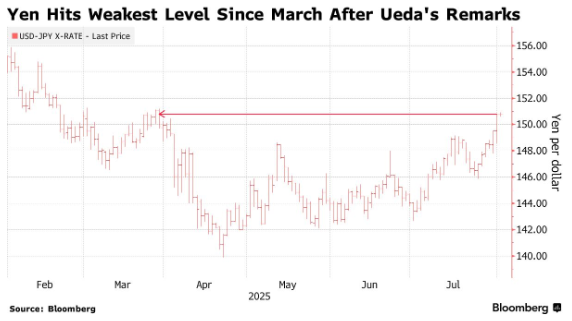
日央行鸽派重创日元跌破150关口 日财长发声示警 市场紧盯155与干预可能
智通财经网· 2025-08-01 06:37
Group 1 - Japanese Finance Minister Kato Katsunobu expressed concerns over the depreciation of the yen, which has fallen to its lowest level since March due to dovish signals from the Bank of Japan [1][3] - The yen broke the 150 yen per dollar mark, with warnings from Tokyo market strategists that it could further depreciate to 155 yen per dollar, potentially prompting intervention from Japanese authorities [1][3] - The yen depreciated approximately 4.5% in July, influenced by domestic political uncertainty and tariff issues, alongside reduced expectations for a Federal Reserve rate cut [3][4] Group 2 - Kato noted that recent trade agreements with the EU and the US could help mitigate trade policy uncertainties and their negative impacts on Japan and the global economy [4] - The US White House set a 15% tariff rate on Japanese goods, effective August 7, as part of the trade agreement, which Kato emphasized requires ongoing monitoring for its impact [4][5] - Kato stated that the Japanese government will take necessary measures to alleviate the impact of tariffs on domestic industries and employment [5]