
流动性管理

Search documents
央行发布公告
Sou Hu Cai Jing· 2025-10-15 00:02
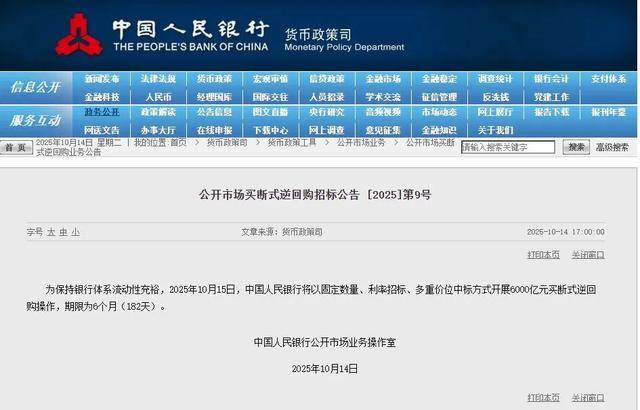
为保持银行体系流动性充裕,2025年10月15日,中国人民银行将以固定数量、利率招标、多重价位中标 方式开展6000亿元买断式逆回购操作,期限为6个月(182天)。 | | | 中国人民视行 THE PEOPLE'S BANK OF CHINA | | 货币政策司 Monetary Policy Department | | | | | | | --- | --- | --- | --- | --- | --- | --- | --- | --- | --- | | 信息公开 | 新闻发布 | 不排不断 炭而改变 | | 宏观审位 信频改策 | 金融市场 | 全融动态 | 加查按计 | 银行会计 | 支付休系 | | 金融科技 | | 人民币 | 经理国际 | 围辉交住 人员招录 | 学术交流 | 征值管理 | 反洗钱 | 党建工作 | | | 服务互动 | 最普公开 阿瑟文告 | 政策解读 办事大厅 | 公告信息 在线申报 | 脚文 ( 央行研究 下载中心 阿上调查 | 置换限频 重期管理 | 市场动态 全融知识 | SHERT 关于我们 | 据备下载 | 报时年级 | | 2025年10月14日 星期二 ...

月内第二次买断式逆回购将落地 合计加量续作4000亿
Sou Hu Cai Jing· 2025-10-14 18:00
10月9日,央行已开展1.1万亿元3个月(91天)期买断式逆回购,相较当月到期量实现3000亿元加量续 作;此次6000亿元6个月期操作则进一步加量1000亿元。至此,10月两个期限品种合计加量续作规模达 4000亿元,较9月增加1000亿元。 对此,东方金诚首席宏观分析师王青表示,6000亿元6个月期买断式逆回购投放能有效熨平资金波动, 维持市场流动性稳定充裕。 [ 央行通过买断式逆回购注入中期流动性,既能助力政府债券顺利发行、引导金融机构加大信贷投放, 也释放出数量型政策工具持续加力的信号,彰显货币政策的支持性立场。 ] 10月15日,中国人民银行开展6000亿元6个月期(182天)买断式逆回购操作,操作方式为固定数量、利 率招标、多重价位中标。此举为10月第二次买断式逆回购操作,旨在保持银行体系流动性充裕,应对潜 在资金面收紧压力。 公开数据显示,10月共有1.3万亿元买断式逆回购到期,其中3个月期8000亿元、6个月期5000亿元。 招联首席研究员董希淼则认为,3个月期与6个月期买断式逆回购的组合,不仅能呵护节后资金面平稳, 更可保障明年元旦前后市场流动性充裕,为跨年金融市场平稳运行奠定基础。同时,由 ...
风口智库|利好!央行再宣布买断式逆回购操作,继续注入中期流动性
Sou Hu Cai Jing· 2025-10-14 11:36
Core Viewpoint - The People's Bank of China (PBOC) is set to conduct a 600 billion yuan buyout reverse repurchase operation on October 15, 2025, to maintain ample liquidity in the banking system [2] Group 1: Monetary Policy Tools - The buyout reverse repurchase is a monetary policy tool introduced by the PBOC on October 28 of the previous year, aimed at injecting liquidity into the market by purchasing bonds from primary dealers [2] - The PBOC has been actively using reverse repurchase operations to adjust short-term liquidity and enhance medium-term liquidity through tools like the Medium-term Lending Facility (MLF) [2][3] - The upcoming 600 billion yuan operation follows the maturity of 800 billion yuan in 3-month buyout reverse repos, helping to smooth short-term funding fluctuations [2] Group 2: Market Impact and Expectations - In October, the PBOC has increased the scale of buyout reverse repos by 400 billion yuan compared to the previous month, indicating a continued effort to inject medium-term liquidity into the market [3] - Analysts suggest that the PBOC's actions are aimed at stabilizing the funding environment amid potential liquidity tightening due to government bond issuances and other market dynamics [4] - Future monetary policy may include a combination of buyout reverse repos and MLF to further support liquidity needs related to government bond issuance and other strategic areas [4][5]

央行6000亿元买断式逆回购操作来了
2 1 Shi Ji Jing Ji Bao Dao· 2025-10-14 09:43
10月14日,央行发布公开市场买断式逆回购招标公告,2025年10月15日,中国人民银行将以固定数量、利率招标、多重价位中标方 式开展6000亿元买断式逆回购操作,期限为6个月(182天)。 | 中国人民银行 | | THE PEOPLE'S BANK OF CHINA | | | 货币政策司 Monetary Policy Department | | | | | | | --- | --- | --- | --- | --- | --- | --- | --- | --- | --- | --- | | 信息公开 | 新闻发布 | 深体活视 | 货币政策 | 宏观审慎 | 信贷政策 | 金融市场 | 金融稳定 | 调查统计 | 银行会计 | 支付体系 | | 人民币 | 金融科技 | | 经理国库 | 国际交往 | 人员招录 | 学术交流 | 征信管理 | 反洗钱 | 党建工作 | | | 政策解读 服务互动 | 政务公开 | | 公告信息 | 图文直播 | 央行研究 | 音频视频 | 市场动态 | 网上展厅 | 报告下载 | 报刊年 | | 网送文告 办事大厅 | | | 在线申报 | 下载中心 | 网 ...

央行6000亿元买断式逆回购操作来了
21世纪经济报道· 2025-10-14 09:43
记者丨黎雨桐 编辑丨江佩霞 10月14日,央行发布公开市场买断式逆回购招标公告,2025年10月15日,中国人民银行将以固定数量、利率招标、多重价 位中标方式开展6000亿元买断式逆回购操作,期限为6个月(182天)。 | | | 中国人民银行 THE PEOPLE'S BANK OF CHINA | | | 货币政策司 Monetary Policy Department | | | | | | | --- | --- | --- | --- | --- | --- | --- | --- | --- | --- | --- | | 信息公开 | 新闻发布 | 深体深刻 | 货币政策 | 宏观审慎 | 信贷政策 | 全融市场 | 金融稳定 | 调查统计 | 银行会计 | 支付体系 | | 金融科技 | | 人民币 | 经理国库 | 国际交往 | 人员招录 | 学术交流 | 征信管理 | 反洗钱 | 党建工作 | | | 服务互动 | 政务公开 | 政策解读 | 公告信息 | 图文直播 | 央行研究 | 音频视频 | 市场动态 | 网上展厅 | 报告下载 | 报刊年登 | | 网送文告 | | 办事大厅 | ...
央行将于10月15日开展6000亿元6月期买断式逆回购操作
Bei Jing Shang Bao· 2025-10-14 09:36
Core Viewpoint - The People's Bank of China announced a fixed quantity, interest rate bidding, and multi-price bidding method for a 600 billion yuan reverse repurchase operation to maintain ample liquidity in the banking system, set to take place on October 15, 2025, with a term of 6 months (182 days) [1] Group 1 - The operation will involve a total of 600 billion yuan [1] - The reverse repurchase operation is aimed at ensuring sufficient liquidity in the banking system [1] - The term for the operation is set at 6 months, specifically 182 days [1]
央行:10月15日将开展6000亿元买断式逆回购操作 期限为6个月
Zheng Quan Shi Bao Wang· 2025-10-14 09:08
Core Viewpoint - To maintain ample liquidity in the banking system, the People's Bank of China will conduct a 600 billion yuan reverse repurchase operation on October 15, 2025, with a term of 6 months (182 days) using a fixed quantity, interest rate bidding, and multiple price level bidding method [1] Group 1 - The operation will involve a total of 600 billion yuan [1] - The reverse repurchase operation is aimed at ensuring liquidity in the banking system [1] - The term for this operation is set at 6 months (182 days) [1]
迎接“破1”时代,货基会消失吗?
CAITONG SECURITIES· 2025-10-14 08:33
Report Industry Investment Rating No information provided regarding the report industry investment rating. Core Viewpoints - With the decline of the interest rate center, China's money market fund (MMF) yields have entered the "1%" era. Given the current weak fundamentals, MMF yields may continue to adjust, and a full "break below 1%" is just a matter of time. However, MMFs are important liquidity management tools for both households and institutions. The expansion space of China's MMFs remains large [2][3][4]. Summary by Relevant Catalogs 1. MMF Yields Breaking Below 1% is Inevitable in a Low-Interest Rate Environment - MMF yields have been continuously declining and entered the 1% range this year. In September 2025, the monthly average yield of MMFs was about 1.15%, a decrease of 0.17bp compared to June. The 25% quantile of the 7-day annualized yield of MMFs also dropped to 1.04%. All MMF yields have been below 2% since this year, and the yield range with the highest proportion of MMF numbers has shifted left for two consecutive quarters, reaching 1.0% - 1.2% at the end of the second quarter [9]. - Deposits, certificates of deposit (CDs), and funds lending are the basic allocation of MMFs, driving the continuous decline of MMF yields. In the second quarter of 2025, the allocation proportion of MMFs to interbank certificates of deposit, bank deposits, and repurchase agreements reached 91.6%. Against the backdrop of the central bank's continuous loose monetary policy, the decline of the broad - spectrum interest rate center has led to a synchronous decline in MMF yields [11]. - Considering the need to support the fundamentals, cooperate with fiscal policies, and resolve bank risks, the broad - spectrum interest rate is likely to continue to decline, and it is only a matter of time before MMF yields "break below 1%" on a large scale [15]. 2. MMFs are Important Liquidity Management Tools for Households and Institutions 2.1 Household Sector: Deposit Outflow and the Re - balance between "Yield and Liquidity" - The phenomenon of financial disintermediation may deepen under low - interest rates, and MMFs are one of the main channels for household deposit transfer. In Japan's low - interest - rate era, household time deposits were largely converted into demand deposits, and deposits remained within the bank balance sheet. In China, there has been an acceleration of financial disintermediation, with household deposits flowing out of the balance sheet and into fixed - income - like product investments. From July to August this year, non - bank deposits increased significantly while household deposits increased less, mainly due to the rising preference for wealth management and other investments among households [17][18]. - Households' preference for liquidity and stable returns will also benefit MMFs. After the epidemic, households first valued stable returns. From 2024, their preference gradually shifted to "balancing yield and liquidity". Compared with wealth management products, MMFs have the advantage of the amortized cost method, with less volatility, smoother returns, and more flexible and diverse promotion channels [25][26]. 2.2 Institutional Sector: Cash Management Tools for Institutional Investors - For institutional investors, MMFs have high flexibility and resilience in a low - interest - rate environment. In the short term, MMF yields may face some pressure. In the long run, if the funds rate continues to decline, the flexibility advantage of MMFs in underlying asset allocation will be evident [34]. - Compared with short - term bond funds, MMFs have more prominent advantages. Short - term bond funds face the dual pressures of low interest rates and high volatility. The implementation of the new fund sales regulations will also impact short - term bond funds, and the cost advantage of MMFs will be more obvious, leading to a potential diversion of funds from short - term bond funds to MMFs [35]. 3. MMFs Will Not Disappear in China 3.1 How are MMFs in Overseas Markets? - Different economies have different development paths for MMFs in a low - interest - rate environment. Japan's MMFs have almost disappeared because of extremely low interest rates and the freedom for funds to go overseas. In the US and Europe, MMFs show strong resilience. In the US, MMFs are still important cash management tools, with a relatively strong economic base, strong ability to absorb global funds, and more diversified product types. In the eurozone, MMF yields were higher than the funds rate during the negative - interest - rate period [41][42]. 3.2 What are the Differences in China's MMFs? - China's MMFs may develop more like those in the US and still have development potential and space in the medium and long term. Under the central bank's "interest rate corridor + macro - prudential" adjustment model, China's short - term interest rates are unlikely to fall into the extreme negative range like in Europe and Japan. The asymmetry in the "convenience of funds going overseas" also means that due to relatively strict capital account management in China, the demand for liquidity management remains, and MMFs still have value. The resonance of channels and regulatory orientation makes MMFs beneficiaries of policies. The deep binding of online payment scenarios and the construction of an ecological closed - loop by platforms have significantly enhanced the competitive advantage of MMFs [48][49].
21社论丨货币政策保持前瞻性和针对性,为稳增长提供坚实支撑
21世纪经济报道· 2025-10-11 04:18
2025年10月9日,为维护银行体系流动性合理充裕,中国人民银行以利率招标方式开展11000 亿元3个月期买断式逆回购操作。鉴于10月份有8000亿元同期限逆回购到期,此次操作实现净 投放3000亿元中期流动性。央行开展如此大规模的逆回购操作,不仅是技术上的流动性管理, 更具有深刻的政策信号意义。这一操作清晰释放出央行积极应对潜在流动性缺口、稳固资金面 的明确信号,蕴含着稳增长、稳预期与防风险的多重考量。 央行选择在节后首个工作日立即出手,是对10月份乃至第四季度复杂流动性形势的前瞻性、针 对性应对,凸显了在复杂内外环境下货币政策精准调控、有的放矢的取向。这次操作背后,皆 在应对资金面潜在三重收紧压力。 首先,政府债券较大规模发行引起市场资金趋紧。 9月份全国共发行地方债12843亿元,净融 资额为11056亿元,发行量和净融资额均创年内新高。按照计划,今年新增地方债和超长期特 别国债均在10月份发行完毕,将继续吸纳市场资金。央行开展逆回购操作,精准地对冲政府债 券大规模发行带来的流动性压力,这是货币政策与财政政策协同、稳定市场预期的关键之举。 其次,政策性工具发力引致资金需求上升。 9月29日,国家发改委宣 ...
货币政策保持前瞻性和针对性,为稳增长提供坚实支撑
2 1 Shi Ji Jing Ji Bao Dao· 2025-10-10 22:38
Core Viewpoint - The People's Bank of China (PBOC) conducted a significant 1.1 trillion yuan three-month reverse repurchase operation to maintain adequate liquidity in the banking system, signaling proactive measures to address potential liquidity shortages and stabilize market expectations [1][2][3] Group 1: Liquidity Management - The PBOC's operation resulted in a net liquidity injection of 300 billion yuan, countering the 800 billion yuan in reverse repos maturing in October [1] - The large-scale reverse repo operation is a strategic response to the tightening liquidity caused by substantial government bond issuances, with local bonds reaching a record issuance of 1.2843 trillion yuan in September [1][2] - The operation reflects a coordinated effort between monetary and fiscal policies to stabilize market expectations amid complex internal and external environments [1][3] Group 2: Structural Pressures - The introduction of new policy financial tools by the National Development and Reform Commission is expected to increase funding demand, necessitating significant loans from commercial banks, which could create structural liquidity pressures [2] - Seasonal factors, such as increased cash demand during the National Day and Mid-Autumn Festival, along with higher fiscal deposits, contribute to short-term liquidity tightening [2] Group 3: Policy Framework - The choice of a buyout reverse repo over traditional tools offers advantages such as longer terms and no collateral requirements, providing stable medium-term funding support [3] - The PBOC's recent actions are part of a broader trend of increasing liquidity support since the second half of 2025, indicating a commitment to maintaining ample liquidity in the banking system [3][4] - Future policies are expected to focus on fiscal strength and monetary easing, with a likelihood of continued use of reverse repos and medium-term lending facilities (MLF) to inject liquidity [4] Group 4: Coordination of Policies - The collaboration between fiscal and monetary policies is anticipated to enhance economic development, with government bonds serving as a core link in this coordination [4] - The PBOC is expected to continue using government bond transactions to manage liquidity, promoting healthy bond market development and improving monetary policy transmission efficiency [4]