
财富管理转型

Search documents
招商证券(600999)2025年半年报点评:财富管理转型持续推进 业绩符合预期
Xin Lang Cai Jing· 2025-09-12 02:34
Core Insights - The company reported a revenue of 10.52 billion yuan (+9.64%) and a net profit attributable to shareholders of 5.186 billion yuan (+9.23%) for the first half of 2025, indicating steady growth in financial performance [1] Group 1: Wealth Management Transformation - The company achieved net income from brokerage business of 3.733 billion yuan (+44.86%) and revenue from agency securities trading of 4.037 billion yuan (+65.13%) in the first half of 2025, reflecting active market trading [2] - The number of wealth management clients and high-net-worth clients increased by 45.53% and 23.99% year-on-year, respectively, demonstrating successful client acquisition [2] - The net income from selling financial products reached 462 million yuan (+32.61%), indicating a positive trend in wealth management services [2] Group 2: Underwriting and Advisory Services - The company reported net income from investment banking of 402 million yuan (+41.05%) and achieved an equity underwriting scale of 24.438 billion yuan (+371.50%), ranking 7th in the industry [3] - The bond underwriting scale reached 201.465 billion yuan (+17.51%), with financial bond underwriting accounting for 42.93% of the total, up 5.97 percentage points from the previous year [3] - The company has 14 A-share IPO projects under review, ranking 6th in the industry, indicating a strong pipeline for future growth [3] Group 3: Asset Management Performance - The company generated net income from asset management of 440 million yuan (+29.41%), but the total asset management scale decreased by 5.21% to 253.46 billion yuan [4] - The scale of collective asset management decreased significantly by 57.44%, while specialized asset management saw a slight increase of 7.41% [4] - The company’s self-operated business revenue declined by 13.25% to 4.124 billion yuan, primarily due to a decrease in fixed income investment returns [4] Group 4: Future Outlook - The company is expected to benefit from improved market liquidity and ongoing wealth management transformation, with projected basic earnings per share of 1.38 yuan, 1.42 yuan, and 1.49 yuan for 2025-2027 [5] - The projected net asset per share is expected to be 12.72 yuan, 13.75 yuan, and 14.83 yuan for the same period, indicating a positive growth trajectory [5]

东北证券(000686) - 东北证券股份有限公司2025年9月11日投资者关系活动记录表
2025-09-11 11:30
Group 1: Wealth Management Business - The company focuses on wealth management transformation, targeting key client groups such as wealth management clients, entrepreneurs, and private equity institutions, enhancing its competitive edge through specialized teams [2][3] - In the first half of 2025, the company significantly improved its wealth management capabilities, achieving a substantial increase in client scale and transaction volume [3] Group 2: Investment Banking Performance - The decline in investment banking fees in the first half of 2025 is attributed to the cyclical nature of the business, with core projects expected to complete in the second half [3] - The company is actively advancing various projects, including underwriting and financial advisory, with some already completed or making significant progress [3] Group 3: Regional Performance - The East China region, as the second-largest revenue area, saw a 47% year-on-year revenue growth in the first half of 2025, with operating profit doubling [3] - The company has established 51 brokerage branches in East China, enhancing its client resource base and driving significant growth in private equity products and transaction volumes [3] Group 4: Investment Strategies - The company adopts a cautious investment strategy in its proprietary securities investments, focusing on diversified profit models and risk management [4][5] - Fixed income business emphasizes enhancing research capabilities and adjusting investment strategies in response to market changes [5] Group 5: Fund Management Impact - The public fund reform has prompted the company’s subsidiaries, Dongfang Fund and Yin Hua Fund, to focus on long-term investment performance and align incentives with investor interests [6] - As of mid-2025, Dongfang Fund manages 68 public funds with a total asset size of CNY 123.4 billion, a 9.37% increase from the end of 2024; Yin Hua Fund manages 227 public funds with CNY 580.7 billion, an 8.79% increase [6] Group 6: Core Development Advantages - The company has a 37-year history, emphasizing customer-centric operations and a vision of becoming a leading modern financial service provider [7][8] - It has established a comprehensive business system and optimized its operational layout across major cities, enhancing its marketing network and client resources [8] Group 7: Strategic Focus and Talent Management - The company is focused on enhancing asset allocation efficiency and integrating investment business systems, aiming for a dual-driven business model [9] - The talent strategy includes both external recruitment for high-market areas and internal training for established business sectors [9] Group 8: Industry Trends and Shareholder Returns - The company is monitoring the trend of mergers in the brokerage industry, considering resource integration and strategic partnerships to enhance competitiveness [10] - Since its listing in 2007, the company has distributed a total of CNY 3.411 billion in dividends, with plans for continued stable cash dividends [11] Group 9: IT Investment and Digital Transformation - The company is committed to digital transformation, enhancing IT capabilities to support various business sectors and operational management [11] - Since 2022, the company has been implementing a new information system, achieving its targets and ensuring stable operation [11]

《资本中介的进阶》 - 券商行业分析框架
2025-09-10 14:35
Summary of Key Points from the Conference Call Industry Overview - **Industry**: Securities Brokerage Industry - **Key Trends**: Transition from traditional commission-based business to capital intermediary services, with a focus on meeting diverse financing needs of retail, institutional, and corporate clients [1][3][4] Core Insights and Arguments - **Business Model Shift**: The brokerage industry is experiencing a significant shift where traditional fee-based services are being replaced by capital intermediary services, particularly for institutional clients who require more capital-intensive services [1][3] - **Value of Research and Investment Banking**: Although the direct revenue contribution from research and investment banking departments is low, their influence and ability to facilitate transactions significantly enhance the overall value of brokerages, promoting the development of capital-intensive businesses [1][5] - **Impact of Asset Management Regulations**: The introduction of asset management regulations has disrupted guaranteed returns, leading to a notable increase in retail brokerage business as clients shift towards equity assets. This has made wealth management a crucial revenue source for brokerages [1][6] - **Challenges in Wealth Management Transformation**: Chinese clients exhibit low willingness to pay for value-added services, which complicates the promotion of valuable but low-revenue services like research and investment banking. Brokerages need to develop financial solutions based on clients' life goals [1][7] - **Explosion of Institutional Business**: Following the asset management regulations, there has been a surge in institutional business as residents invest through financial products, leading to rapid growth in asset management institutions and increased demand for institutional services [1][8][11] Additional Important Insights - **Declining Earnings Elasticity**: The earnings elasticity of brokerages has decreased due to a higher proportion of fixed-income assets in their proprietary portfolios and the use of derivatives for hedging, resulting in reduced performance volatility [1][9][10][14] - **Revenue Sources**: Currently, the primary revenue sources for brokerages are proprietary trading, capital intermediary services, and stable fixed-income investments. The shift towards a more stable earnings model has reduced the appeal of directional investments [1][12] - **IPO Policy Impact**: Corporate service revenues are significantly influenced by IPO policies, with higher revenues during periods of increased IPO activity. However, the overall contribution of investment banking to brokerage revenues remains relatively low [1][13][18] - **Market Concentration Among Leading Brokerages**: The competitive landscape is increasingly favoring leading brokerages, which are achieving higher returns on equity (ROE) and are well-positioned for sustained outperformance compared to industry averages [2][15][20] - **Investment Opportunities**: The brokerage sector is often viewed as a bellwether for bull markets due to its sensitivity to changes in retail, institutional, and corporate demand, as well as market risk appetite [19] Conclusion The securities brokerage industry is undergoing a transformative phase characterized by a shift towards capital intermediary services, increased focus on wealth management, and evolving client needs. Leading brokerages are likely to benefit from these trends, positioning themselves for stable growth and enhanced market performance.
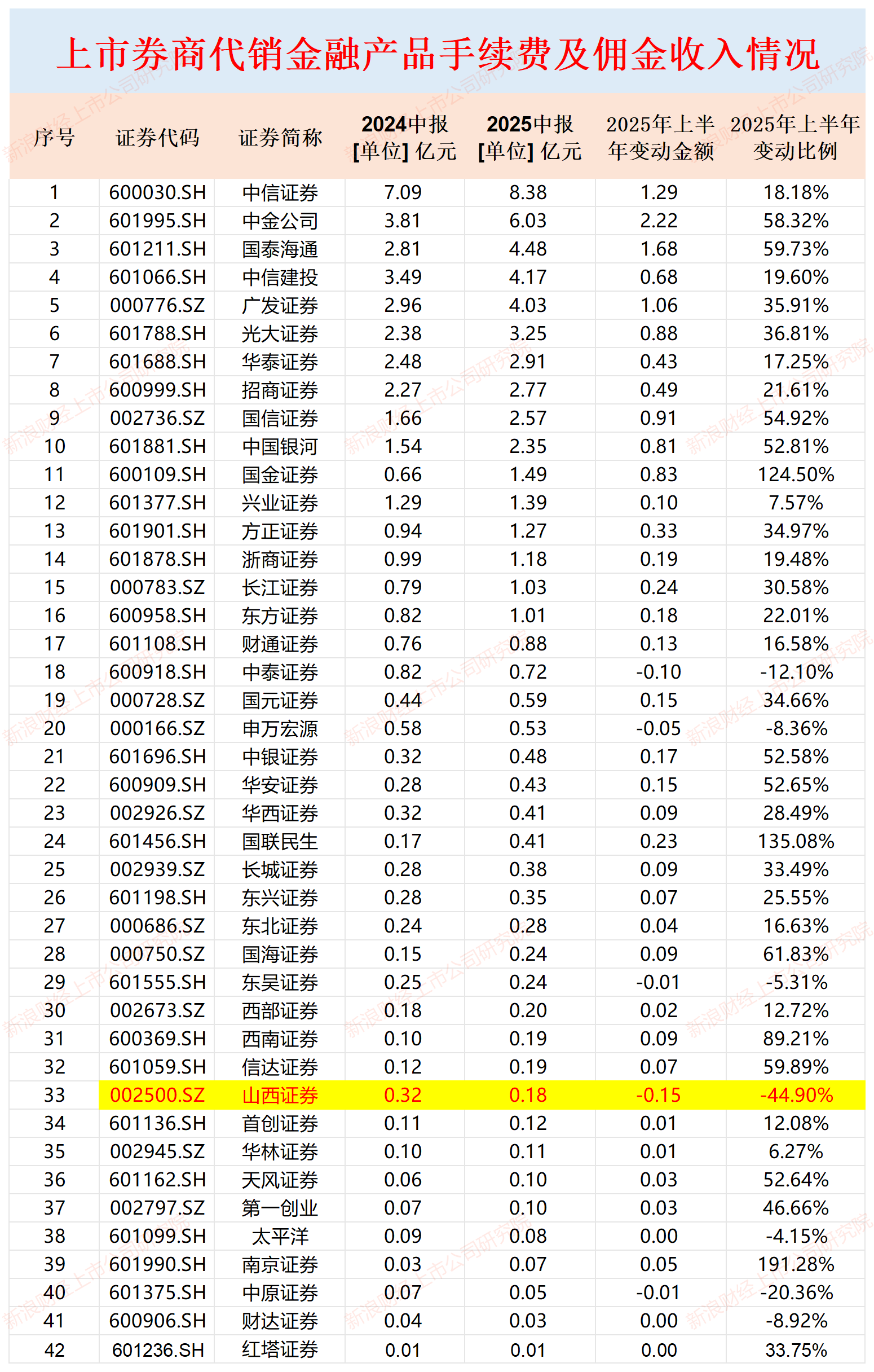
山西证券代销金融产品收入降幅最大高达45% 财富管理业务如何转型?|券商半年报
Xin Lang Zheng Quan· 2025-09-10 13:12
Core Insights - In the first half of 2025, 42 listed securities firms reported a total operating revenue of 251.9 billion yuan, a year-on-year increase of 31%, and a net profit attributable to shareholders of 104 billion yuan, up 65% [1] - The brokerage business generated a net income of 63.45 billion yuan, reflecting a growth of 43.98%, with all firms experiencing an increase in brokerage income [1] - The distribution of financial products by these firms reached 5.568 billion yuan, marking a 32.09% increase year-on-year, indicating a shift towards comprehensive wealth management services [5] Brokerage Business Performance - The brokerage business saw a significant increase in revenue, with all 42 firms reporting growth in this segment [1] - Notably, the fastest growth in brokerage income was observed in Nanjing Securities, which surged by 191.28%, while Shanxi Securities experienced the largest decline at -44.9% [1][3] Shanxi Securities Analysis - Shanxi Securities reported a revenue of 1.641 billion yuan, a year-on-year increase of 17.22%, and a net profit of 524 million yuan, up 64.47% [2] - The firm’s investment income reached 1.057 billion yuan, a substantial increase of 173.13%, with self-operated business income accounting for 50.87% of total revenue [3] - However, the firm faced a significant drop in financial product distribution income, which fell to 18 million yuan, the lowest among the 42 firms [3][6] Market Position of Leading Firms - Leading firms in the financial product distribution sector included CITIC Securities, with 838 million yuan, followed by CICC and Guotai Junan, indicating a strong competitive position in the market [7] Regulatory and Legal Challenges - Shanxi Securities' subsidiary, Zhongde Securities, has been embroiled in a lawsuit related to the LeEco financial fraud case, which could impose significant financial liabilities on the firm [8][9] - The ongoing legal issues have hindered Zhongde Securities' ability to secure IPO sponsorship projects, with a withdrawal rate of 90%-100% over the past three years [9][10]


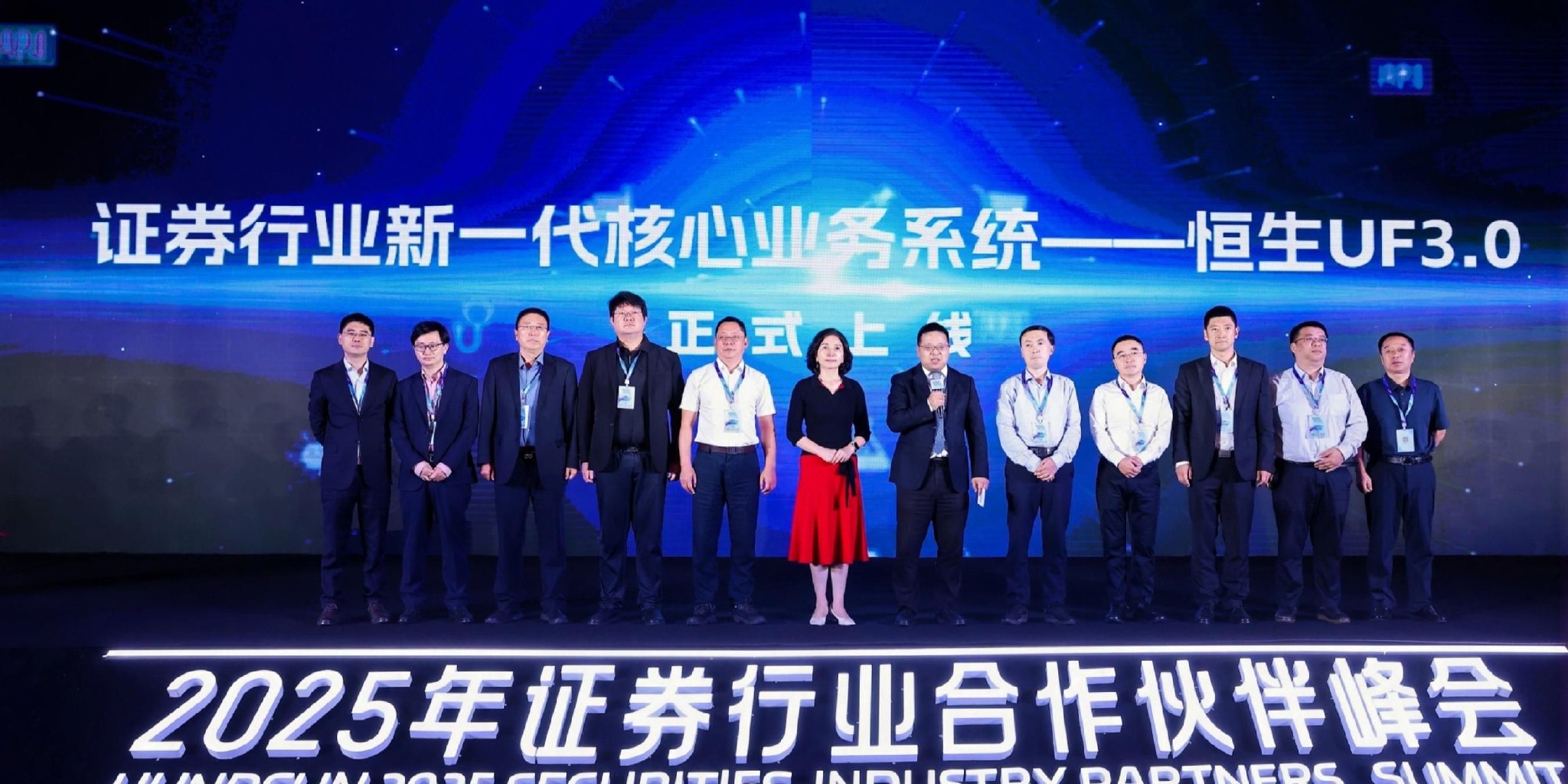
中国证券业迎来“新核时代” 恒生UF3.0落地11家券商
Jing Ji Guan Cha Wang· 2025-09-10 10:45
Core Insights - A significant system upgrade is occurring in the Chinese securities industry, marked by the launch of the new core business system UF3.0 by Hengsheng Electronics [2][3] - UF3.0 represents a shift from a "trading channel" to a "wealth management engine," supporting 24/7 operations with high concurrency and low latency [2][4] - The successful implementation of UF3.0 in 11 securities firms, including major players like China Merchants Securities and Dongfang Securities, sets a benchmark for digital transformation in the industry [2][5] Industry Transformation - The core business system is essential for various operations such as account opening, trading, clearing, risk control, and customer service, serving as a foundational infrastructure for business operations [4] - The transition towards wealth management and internationalization in the securities sector presents challenges to traditional core business systems, necessitating the development of UF3.0 [4][5] - UF3.0 is designed to support comprehensive financial services and modern IT infrastructure, addressing the evolving needs of the securities industry [4][5] Technological Advancements - UF3.0 employs a cloud-native architecture and distributed, full-stack technology to enhance system capabilities, ensuring high performance and flexibility [2][7] - The system features a dual-state architecture that separates stable and agile operations, allowing for rapid iteration and innovation in response to business demands [7][9] - The integration of self-developed technologies and products into UF3.0 is crucial for maintaining financial information security and achieving IT autonomy in the securities industry [8] Implementation and Collaboration - The successful rollout of UF3.0 involved deep collaboration between Hengsheng Electronics and various securities firms, establishing a solid foundation for its implementation [3][9] - The transition to UF3.0 was managed through agile methodologies, automated data migration tools, and comprehensive operational monitoring to ensure a smooth upgrade process [9] - As more firms adopt UF3.0, the Chinese securities industry is poised to build a digital ecosystem based on the new core business system, marking a new phase in wealth management transformation [9]


新股民入市引爆投顾需求 券商深耕财富管理
Zhong Guo Jing Ying Bao· 2025-09-05 19:58
Group 1: Market Overview - The A-share market has seen a structural trend with a significant increase in trading activity and investor engagement, leading to a historic opportunity for investment advisory services [1][2] - In August, 2.65 million new accounts were opened in the A-share market, marking a 34.97% month-on-month increase and a 165% year-on-year increase, with a total of 17.21 million new accounts opened in the first eight months of the year [1] Group 2: Growth in Investment Advisory Services - The number of investment advisors has increased significantly, nearing 90,000, reflecting a strong demand for professional advisory services despite a decrease in overall industry personnel [1] - The brokerage industry has seen a 55% year-on-year increase in commission income from brokerage services, reaching 74.56 billion yuan in the first half of 2025 [2] Group 3: Investor Behavior and Demand - Investors are increasingly seeking professional investment guidance, with many new clients signing up for advisory services to optimize their asset allocation and portfolio structure [3][4] - There is a notable shift in investor inquiries, focusing on specific market conditions, valuation assessments, and investment strategies [3] Group 4: Performance of Wealth Management - The wealth management transformation among brokerages is showing positive results, with a significant increase in client engagement and service offerings [9][11] - The number of signed clients for investment advisory services at Guoxin Securities increased by 63% from the end of 2024 to August 2025, reflecting the growing demand for professional advisory services [7] Group 5: Technology and Client Engagement - Companies are enhancing client engagement through regular communication and interactive platforms, utilizing technology to provide tailored investment solutions [10][11] - The use of AI and technology in advisory services is being emphasized to improve service delivery and meet diverse client needs [11]



上半年银行新增15万高净值客户,“科学家”正在成为新宠?
第一财经· 2025-09-05 05:18
Core Viewpoint - The high-net-worth client segment is a key focus for retail banking, with significant potential for value extraction. The private banking business is seen as a cornerstone for wealth management transformation, showcasing structural differentiation among banks [2][8]. Group 1: Private Banking Growth and Client Statistics - As of June 2025, 15 banks reported private banking data, with a total client base exceeding 1.63 million, an increase of nearly 150,000 clients, representing a growth rate of over 10% [2]. - The four major state-owned banks have crossed the 3 trillion yuan mark in Assets Under Management (AUM), with Agricultural Bank of China leading at 3.5 trillion yuan, followed by China Bank at 3.4 trillion yuan, and Construction Bank at 3.18 trillion yuan, which saw a 14.39% growth [4][5]. - Postal Savings Bank reported a client growth of over 21%, adding 7,200 clients to reach 41,400, marking the highest growth rate among state-owned banks [4]. Group 2: Performance of Joint-Stock Banks - Joint-stock banks displayed a mixed performance, with China Merchants Bank leading in client numbers at 182,700, an increase of 13,600 clients, representing an 8% growth [5]. - Ping An Bank was the only bank to report a decline in AUM, with a slight decrease of 0.5% to 1.97 trillion yuan, although it added 3,100 clients [5][9]. - CITIC Bank and Industrial Bank maintained steady growth, with AUMs of 1.28 trillion yuan and 1.05 trillion yuan, respectively, showing growth rates of 9.33% and 9.59% [6]. Group 3: Regional Banks and Competitive Landscape - Regional banks like Ningbo Bank and Beijing Bank exhibited strong growth, with AUM growth rates of 17.62% and 17.06%, respectively [7]. - The competitive landscape is characterized by a concentration of top-tier banks and differentiated competition, with smaller banks focusing on niche markets or specific industries [7][10]. Group 4: Changing Client Demographics and Service Models - The profile of private banking clients is shifting, with a growing emphasis on new wealth groups such as scientists and entrepreneurs, diverging from the traditional client base of business owners [9][10]. - Banks are redefining their private banking client categories based on their strengths, with a focus on family wealth transfer, pension finance, and enhanced offline services [10][11]. Group 5: Strategic Importance of Private Banking - Private banking is becoming a critical component of retail banking transformation, providing stability in asset scale and high value-added services, essential for optimizing client structures and stabilizing short-term performance [10][11].





上市券商上半年经纪收入增长超50%,行业“马太效应”凸显;国盛金控:总经理陆箴侃因工作调整辞职 | 券商基金早参
Mei Ri Jing Ji Xin Wen· 2025-09-05 02:05
Group 1: Brokerage Firms - The brokerage firms in A-share market reported a significant increase in brokerage income, totaling 74.545 billion yuan, a year-on-year growth of 50.69% [1] - The top brokerage firms leading in income include CITIC Securities with 7.992 billion yuan, followed by Guotai Junan and Huatai Securities with 6.866 billion yuan and 5.094 billion yuan respectively [1] - The top nine brokerage firms accounted for 58.31% of the total brokerage income, highlighting the "Matthew Effect" in the industry [1] Group 2: Guosheng Financial Holdings - Guosheng Financial Holdings announced the resignation of General Manager Lu Zhenkan, who will continue to serve as a director and committee member [2] - The company will be renamed Guosheng Securities, with Zhao Jingliang, the former deputy general manager of Caida Securities, appointed as the new president [2] - This management change reflects a strategic adjustment focusing on specialized business development, which may bring new growth momentum to the company [2] Group 3: Public REITs Market - The public REITs market has shown signs of recovery, with the CSI REITs Total Return Index rising by 0.42% [3] - Recent trends indicate that if investor risk appetite decreases, it could support further recovery in the REITs market, particularly in stable sectors like warehousing and highways [3] - The recovery of the REITs market enhances its attractiveness as an alternative investment, aiding in asset diversification for investors [3] Group 4: Equity Fund Issuance - The issuance of equity funds has rebounded, with 26 new funds established in just four days, totaling 17.587 billion yuan [4] - The total issuance scale for equity funds in September has reached 22.6 billion yuan, indicating a positive market sentiment [4] - This influx of capital is expected to benefit brokerage and asset management sectors, potentially boosting their revenue [4]





中金公司(601995):自营经纪驱动利润高增 国际影响力不断提升
Xin Lang Cai Jing· 2025-09-05 00:27
Core Insights - The company reported a significant increase in revenue and profit for the first half of 2025, with operating income reaching 12.83 billion yuan (up 44.0% year-on-year) and net profit attributable to shareholders at 4.33 billion yuan (up 94.4% year-on-year) [1] - The company maintains a leading position in cross-border influence and actively expands its derivatives business [1] Business Performance - Brokerage, investment banking, asset management, credit, and proprietary trading segments reported net revenues of 2.7 billion yuan, 1.7 billion yuan, 700 million yuan, -900 million yuan, and 7.3 billion yuan respectively, with year-on-year growth rates of +50%, +30%, +22%, -5%, and +71% [1] - The asset management department's business scale reached 586.71 billion yuan, a 6.3% increase from the end of 2024, with a total of 848 managed products [2] - The company achieved a record high in wealth management product holdings, nearing 400 billion yuan, and the number of clients reached 9.39 million [2] Market Position - The company ranked first in the Hong Kong IPO market, serving 21 Chinese enterprises with a total financing scale of 11.144 billion USD in the first half of 2025 [2] - In the bond underwriting segment, the domestic bond underwriting scale was 415.78 billion yuan (up 33.7% year-on-year), while the overseas bond underwriting scale was 2.57 billion USD (up 16.5% year-on-year) [3] Future Outlook - The company is expected to benefit from its position as a leading brokerage in a competitive industry, with projected EPS of 1.26 yuan, 1.51 yuan, and 1.72 yuan for 2025 to 2027 [3]
上半年银行新增15万高净值客户,“科学家”正在成为新宠?
Di Yi Cai Jing· 2025-09-04 13:04
Group 1 - The high-net-worth client segment is a focal point for retail banking, with significant competition among commercial banks to capture this valuable market [1][4] - As of June 2025, 15 banks reported private banking data, with a total client base exceeding 1.63 million, marking a growth of nearly 150,000 clients or over 10% since the beginning of the year [1] - The four major state-owned banks have crossed the 3 trillion yuan mark in assets under management (AUM), with Industrial Bank entering the "trillion club" for the first time [1][2] Group 2 - The four major state-owned banks collectively have 864,000 private banking clients, with Agricultural Bank leading in AUM at 3.5 trillion yuan, and a client base of over 279,000 [2] - China Construction Bank reported a remarkable AUM growth of 14.39% to 3.18 trillion yuan, with a client increase of 34,000, marking a 14.69% rise [2] - Postal Savings Bank, despite not disclosing AUM, saw a client growth of over 21%, reaching 41,400 clients, indicating a strong potential for future AUM increases [2] Group 3 - Joint-stock banks are experiencing a stark contrast in performance, with China Merchants Bank leading in client growth among joint-stock banks, while Ping An Bank reported a slight decline in AUM [3] - The AUM for CITIC Bank and Industrial Bank grew by 9.33% and 9.59%, respectively, indicating steady growth in the joint-stock sector [3] - Regional banks like Ningbo Bank and Beijing Bank demonstrated strong growth, with AUM increases of 17.62% and 17.06%, respectively [3] Group 4 - The private banking sector in China is characterized by a concentration of leading banks and differentiated competition, with smaller banks adopting unique strategies to capture market share [4] - The shift in client demographics is evident, with a growing number of new high-net-worth clients entering the market, while the growth of ultra-high-net-worth clients is slowing [5][6] Group 5 - The focus on new client segments, such as scientists and tech entrepreneurs, is reshaping the private banking landscape, with banks redefining their target client profiles [7] - Private banking is becoming a key driver for retail banking transformation, providing stability and high value-added services amid traditional retail banking challenges [7][8] - The demand for non-financial services among private banking clients is creating new opportunities for banks to enhance customer engagement and service offerings [8]

