
资金流向

Search documents
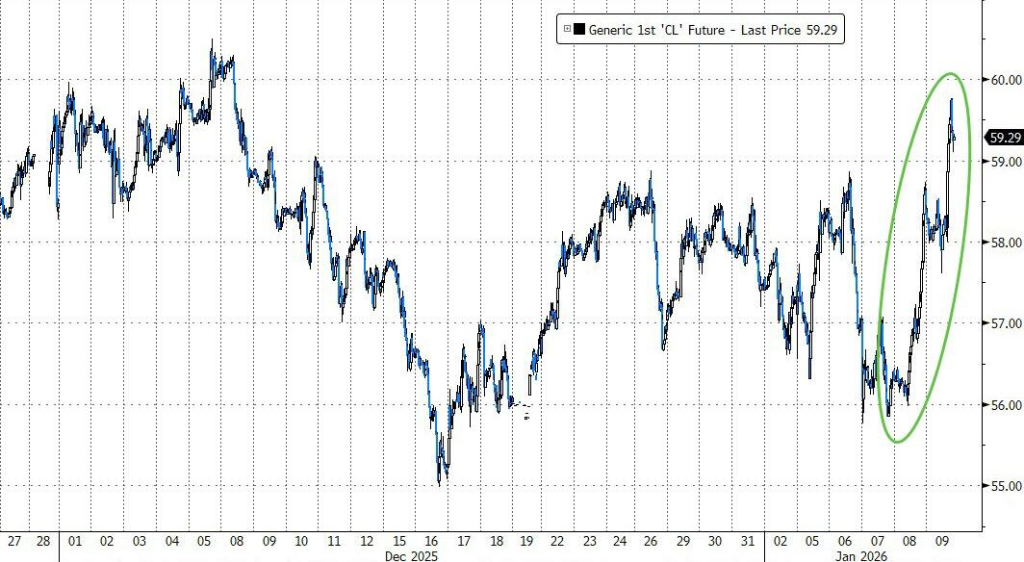
地缘局势微妙,油价连涨3周
Hua Er Jie Jian Wen· 2026-01-10 02:31
Core Viewpoint - Geopolitical risk premium has returned to the energy market, with crude oil prices recording the longest weekly gain since June of last year [1][2]. Group 1: Geopolitical Risks - Protests in Iran have been ongoing, with the Iranian National Security Council accusing the U.S. and Israel of orchestrating the unrest [1]. - U.S. President Trump warned of severe consequences for Iran if they are found responsible for any deaths related to the unrest [1]. - The focus of the market has shifted from Venezuela to Iran, as Iran's potential supply disruptions have a greater impact on oil prices due to its larger production capacity [2][6]. Group 2: Market Reactions - WTI crude oil futures saw a rise of over 3% on Friday, accumulating a gain of over 5% in the past two trading days, marking three consecutive weeks of increases [2][3]. - The options market reflects a shift in risk appetite, with call options skew reaching the highest level since July, indicating traders are paying the highest insurance premiums since the conflict between Israel and Iran began [4]. - Despite rising prices, fundamental pressures remain, with Goldman Sachs noting that clients' bearish sentiment towards oil prices is at a ten-year high [4]. Group 3: Supply and Demand Dynamics - The market is increasingly concerned about the potential for U.S. intervention in Iran if civilian casualties rise, with a 70% likelihood of intervention according to Rapidan Energy Group [7]. - Venezuela's role as a supplier has diminished significantly due to U.S. sanctions and aging infrastructure, while Iran continues to produce over 3 million barrels per day [6]. - The market is currently focused on Iran as the primary source of supply risk, overshadowing concerns about Venezuela [6]. Group 4: Financial Flows and Positioning - The amplification of risks related to Iran is attributed to traders holding significant bearish positions, which could lead to a sharp market reversal if geopolitical tensions force these positions to be unwound [9][10]. - Trend-following commodity trading advisors (CTAs) have been buying crude oil, and if prices stabilize, they are expected to continue purchasing [11]. - Over $6 billion is anticipated to flow into the market in the coming days due to annual rebalancing, primarily from commodity index funds [11]. Group 5: Price Outlook - Despite rising geopolitical risks, macro-level expectations of oversupply are limiting the upside potential for oil prices [12]. - The increase in Venezuelan supply and production rises in other regions may keep oil prices trading around $50 in the first quarter [12]. - Historical trends suggest that price spikes due to geopolitical events may be temporary, as seen when oil prices surged following U.S. bombings of Iranian nuclear facilities but quickly retreated once production was confirmed unaffected [12].

股票行情快报:泰山石油(000554)1月9日主力资金净买入246.08万元
Sou Hu Cai Jing· 2026-01-09 14:19
Core Viewpoint - The stock of Taishan Petroleum (000554) has shown a positive performance with a closing price of 6.81 yuan, reflecting a 3.03% increase as of January 9, 2026, despite a decline in revenue for the first three quarters of 2025 [1][2]. Financial Performance - For the first three quarters of 2025, Taishan Petroleum reported a main operating revenue of 2.395 billion yuan, a year-on-year decrease of 5.6% [2]. - The net profit attributable to shareholders reached 113 million yuan, marking a significant year-on-year increase of 112.32% [2]. - The net profit excluding non-recurring items was 117 million yuan, also showing a substantial year-on-year increase of 111.85% [2]. - In Q3 2025, the company recorded a single-quarter main operating revenue of 807 million yuan, down 5.54% year-on-year [2]. - The single-quarter net profit attributable to shareholders was 21.73 million yuan, up 24.95% year-on-year [2]. - The single-quarter net profit excluding non-recurring items was 24.95 million yuan, reflecting a year-on-year increase of 35.76% [2]. - The company's debt ratio stood at 35.54%, with financial expenses amounting to 2.89 million yuan and a gross profit margin of 16.41% [2]. Market Activity - On January 9, 2026, the stock experienced a trading volume of 482,800 hands and a total transaction value of 331 million yuan [1]. - The net inflow of main funds was 2.4608 million yuan, accounting for 0.74% of the total transaction value [1]. - The net inflow of speculative funds was 6.3174 million yuan, representing 1.91% of the total transaction value [1]. - Retail investors showed a net outflow of 8.7783 million yuan, which constituted 2.65% of the total transaction value [1].


股票行情快报:开创国际(600097)1月9日主力资金净卖出1742.71万元
Sou Hu Cai Jing· 2026-01-09 11:53
Group 1 - The core viewpoint of the article highlights the recent performance of Kaichuang International (600097), noting a stock price increase of 1.28% to 11.85 yuan as of January 9, 2026, with a trading volume of 120,500 hands and a total transaction amount of 142 million yuan [1][2] - The company's financial results for the first three quarters of 2025 show a main revenue of 1.7 billion yuan, a year-on-year decrease of 1.74%, while the net profit attributable to shareholders increased by 269.47% to 60.5 million yuan [2] - The third quarter of 2025 reported a main revenue of 450 million yuan, a significant year-on-year decline of 32.82%, and a net profit attributable to shareholders of 32.9 million yuan, down 22.25% compared to the previous year [2] Group 2 - The company's debt ratio stands at 29.18%, with investment income recorded at 0.66 million yuan and financial expenses amounting to 1.076 billion yuan, resulting in a gross profit margin of 33.42% [2] - The capital flow data indicates a net outflow of 17.43 million yuan from main funds, accounting for 12.28% of the total transaction amount, while retail investors saw a net inflow of 19.22 million yuan, representing 13.54% of the total transaction amount [1][2]

12.41亿元资金今日流出银行股
Zheng Quan Shi Bao Wang· 2026-01-09 09:32
Market Overview - The Shanghai Composite Index rose by 0.92% on January 9, with 29 out of the 31 sectors experiencing gains, led by the media and comprehensive sectors, which increased by 5.31% and 3.60% respectively [1] - The banking and non-bank financial sectors were the biggest losers, declining by 0.44% and 0.20% respectively, with the banking sector at the top of the decline list [1] Capital Flow Analysis - The net outflow of capital from the two markets was 24.126 billion yuan, with 8 sectors seeing net inflows, the media sector leading with a net inflow of 9.703 billion yuan and a daily increase of 5.31% [1] - The non-ferrous metals sector followed with a daily increase of 2.78% and a net inflow of 4.552 billion yuan [1] - A total of 23 sectors experienced net outflows, with the electronics sector seeing the largest outflow of 9.149 billion yuan, followed by the power equipment sector with an outflow of 8.936 billion yuan [1] Banking Sector Performance - The banking sector declined by 0.44% with a total net outflow of 1.241 billion yuan, comprising 42 stocks, of which 13 rose and 23 fell [2] - Among the stocks with net inflows, Hangzhou Bank led with a net inflow of 148 million yuan, followed by Jiangsu Bank and CITIC Bank with inflows of 120 million yuan and 6.873 million yuan respectively [2] - The stocks with the largest net outflows included China Merchants Bank, Industrial Bank, and Bank of China, with outflows of 686 million yuan, 119 million yuan, and 110 million yuan respectively [2] Detailed Banking Sector Capital Flow - The table of capital flow in the banking sector shows various banks' performance, with China Merchants Bank experiencing a decline of 0.67% and a net outflow of 686.29 million yuan, while CITIC Bank had a slight decline of 0.27% with a net inflow of 6.873 million yuan [2][3] - Other notable banks with significant net outflows include Industrial Bank (-0.38%, -119.25 million yuan) and Bank of China (-0.54%, -109.60 million yuan) [2][3]



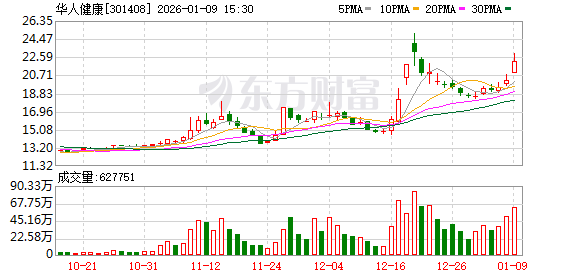
华人健康换手率42.08%,机构龙虎榜净买入1515.22万元
Zheng Quan Shi Bao Wang· 2026-01-09 09:28
Group 1 - The stock of Huaren Health increased by 9.97% with a turnover rate of 42.08%, and a total transaction amount of 1.365 billion yuan, showing a fluctuation of 9.86% [2] - Institutional investors net bought 15.1522 million yuan, while the Shenzhen Stock Connect saw a net purchase of 21.8482 million yuan, with a total net selling by brokerage seats amounting to 6.8363 million yuan [2] - The top five brokerage seats accounted for a total transaction of 293 million yuan, with a net purchase of 30.164 million yuan [2] Group 2 - In the past six months, the stock has appeared on the Dragon and Tiger list seven times, with an average price increase of 0.94% the day after being listed, but an average decline of 7.13% over the following five days [3] - The stock saw a net inflow of 31.3804 million yuan in main funds today, with a significant single net inflow of 42.4256 million yuan, while large single funds experienced a net outflow of 11.0452 million yuan [3] - The latest margin trading data shows a total margin balance of 226 million yuan, with a financing balance of 226 million yuan and a securities lending balance of 100.8 thousand yuan, indicating a recent increase in financing balance by 29.3529 million yuan, a rise of 14.95% [3]
资金行为研究双周报:军工行情底线牢固,传媒或迎布局良机-20260109
ZHONGTAI SECURITIES· 2026-01-09 07:43
Market Overview - Institutional funds show fluctuating behavior, with a reduction in outflow momentum in the Sci-Tech Innovation Board. Although there is a phase of outflow, the net outflow slope for the Sci-Tech Innovation Board is gentler compared to the ChiNext and the entire A-share market. Retail investor inflows remain relatively stable, with significant net inflows into the ChiNext compared to the Sci-Tech Innovation Board [5][9][10] Market Capitalization and Valuation Style - The small-cap style represented by the CSI 2000 has seen synchronized net inflows from both institutional and retail investors, with institutional inflows being more stable. In contrast, institutional funds have continued to experience slight outflows from high-valuation styles, while retail investors have significantly increased their inflows into these high-valuation stocks [9][10][15] Major Industry Style - Institutional funds have shown repeated behavior, with cyclical manufacturing becoming a structural highlight. As of December 26, institutional funds were in a sustained net inflow into cyclical manufacturing, only turning to net outflow on December 30, indicating its relative resilience. Retail investors have also shown consistent net inflows into cyclical manufacturing, further highlighting its short-term structural appeal [15][19] Primary Industry Fund Flow Upstream Resources - Among upstream resources, non-ferrous metals remain a key focus for speculation, with coal receiving cumulative net inflows from both institutional and retail investors. Institutional funds have shown fluctuating behavior towards basic chemicals and non-ferrous metals, with a brief recovery after December 31 before continuing to flow out [23][24] Midstream Materials & Manufacturing - Institutional funds have shown a net inflow trend in midstream manufacturing, resonating with retail investor behavior. The net inflow rate for institutional funds in the defense and military sector is currently greater than that of retail investors, indicating strong institutional support for the military sector in the short term [27][28] Downstream Essential Consumption - In the downstream essential consumption sector, biopharmaceuticals are the focal point for fund allocation. Institutional funds saw a significant inflow on January 5, followed by a short-term outflow, before turning back to inflows after January 7. The net inflow rate for biopharmaceuticals is approaching zero, indicating increasing consensus between institutional and retail investors [31][32] Downstream Discretionary Consumption - In the downstream discretionary consumption sector, both institutional and retail funds have shown continuous net inflows into light industry manufacturing, with institutional investors enhancing their allocation in this area. The net inflow rate for light industry manufacturing is currently in negative territory, indicating strong institutional support [44][45] TMT Sector - In the TMT sector, institutional investment in the media sector has increased, while funds in the electronics and communications sectors have shown significant volatility. Institutional funds significantly increased their allocation to media around December 31, indicating stronger buying power compared to retail investors [48][49] Financial Sector - In the financial sector, both institutional and retail funds have shown net inflows into banks, while the non-bank financial sector has experienced significant volatility. Institutional funds increased their allocation to banks on January 5, but the net outflow from non-bank financials has accelerated [55][56] Support Services - In the support services sector, both institutional and retail funds have accumulated net inflows into comprehensive and public utilities. The latest values for the net inflow rate indicate that retail investor buying power remains stronger than that of institutional investors [66][67] Leverage Fund Overview - The margin financing balance has reached a new high, with the average market guarantee ratio continuing to rise. As of January 7, the margin financing balance was approximately 2.6 trillion yuan, with liquidity remaining ample. The average guarantee ratio is at 286.52%, indicating a tight leverage structure in the short term [69][70]
股市必读:中化国际(600500)1月8日主力资金净流出266.63万元,占总成交额2.59%
Sou Hu Cai Jing· 2026-01-08 18:50
Group 1 - The core viewpoint is that Sinochem International (600500) is expected to report a loss for the entire year of 2025 due to declining prices of chemical products, which has significantly impacted its operating performance [1][2] - As of January 8, 2026, Sinochem International's stock closed at 4.09 yuan, with a 0.99% increase and a trading volume of 252,700 shares, amounting to a total transaction value of 103 million yuan [1] - The company reported a net profit of -1.331 billion yuan attributable to shareholders by the end of Q3 2025, indicating substantial financial challenges ahead [1] Group 2 - On January 8, the main funds experienced a net outflow of 2.66 million yuan, accounting for 2.59% of the total transaction value [2] - Retail investors showed a net inflow of 9.45% of the total transaction value, amounting to 9.7379 million yuan, indicating some level of interest from smaller investors despite the overall negative outlook [1][2]

股票行情快报:联影医疗(688271)1月8日主力资金净买入955.98万元
Sou Hu Cai Jing· 2026-01-08 11:27
Core Viewpoint - The financial performance of United Imaging Healthcare (688271) shows significant growth in revenue and net profit for the first three quarters of 2025, indicating strong operational efficiency and market demand for its medical imaging and treatment solutions [2]. Financial Performance - For the first three quarters of 2025, the company's main revenue reached 8.859 billion yuan, a year-on-year increase of 27.39% [2]. - The net profit attributable to shareholders was 1.12 billion yuan, reflecting a year-on-year growth of 66.91% [2]. - The net profit excluding non-recurring items was 1.053 billion yuan, up 126.94% year-on-year [2]. - In Q3 2025 alone, the company reported a single-quarter revenue of 2.843 billion yuan, a 75.41% increase compared to the same quarter last year [2]. - The single-quarter net profit attributable to shareholders was 122 million yuan, showing a remarkable increase of 143.8% year-on-year [2]. - The single-quarter net profit excluding non-recurring items was 87.6141 million yuan, up 126.24% year-on-year [2]. - The company's debt ratio stands at 30.08%, with investment income of 606.847 million yuan and financial expenses of -438.233 million yuan [2]. - The gross profit margin is reported at 47.02% [2]. Market Activity - As of January 8, 2026, the stock price of United Imaging Healthcare closed at 134.02 yuan, with a slight decline of 0.13% [1]. - The turnover rate was 0.61%, with a trading volume of 50,200 hands and a total transaction amount of 675 million yuan [1]. - On January 8, the net inflow of main funds was 9.5598 million yuan, accounting for 1.42% of the total transaction amount, while retail investors saw a net inflow of 30.9545 million yuan, making up 4.58% of the total [1]. Analyst Ratings - In the last 90 days, 25 institutions have provided ratings for the stock, with 18 buy ratings and 7 hold ratings [2]. - The average target price set by institutions over the past 90 days is 17.312 billion yuan [2].

Mhmarkets迈汇:指数再平衡引发金银高位波动
Xin Lang Cai Jing· 2026-01-08 11:02
Core Insights - Silver prices have recently faced resistance after surpassing the $80 mark, with significant volatility risks anticipated in the short term despite strong macro bullish logic [1][3] - In 2025, both gold and silver exhibited remarkable performance, with silver rising nearly 150% and gold increasing by 64%, marking the most significant gains since 1979 [1][4] - The Bloomberg Commodity Index (BCOM) allocates approximately 11% to silver and gold, necessitating forced "sell high, buy low" operations at the beginning of the year due to substantial price increases [4] Market Dynamics - A predicted net outflow of approximately $5 billion is expected for both gold and silver markets, driven by passive index funds rebalancing their positions rather than a loss of confidence in precious metals [4][5] - The energy market is benefiting from this rebalancing process, with expected inflows of $2.6 billion into Brent crude oil and $1.7 billion into WTI crude oil, as funds shift from overvalued metals to undervalued energy assets [2][4] - The Comex silver market may see about 13% of open contracts sold in the next two weeks, which could trigger a sharp price decline due to large-scale position adjustments [5] Long-term Outlook - Despite short-term volatility driven by technical factors, silver and gold are expected to remain essential cornerstone assets in the global economy for the new year [5] - If the anticipated price corrections are solely driven by technical fund flows rather than fundamental deterioration, this could present strategic investors with an opportunity to optimize their cost basis [5]

创新医疗(002173)1月7日主力资金净买入1.30亿元
Sou Hu Cai Jing· 2026-01-08 01:17
Core Insights - Innovation Medical (002173) has seen a stock price increase of 9.99%, closing at 28.63 yuan, marking three consecutive days of limit-up trading [1] - The company reported a net inflow of 130 million yuan from institutional investors, accounting for 44.76% of the total trading volume on January 7 [1] - The company's main business involves providing medical services [2] Financial Performance - For the first three quarters of 2025, Innovation Medical reported a main revenue of 597 million yuan, a year-on-year decrease of 2.11% [2] - The net profit attributable to shareholders was 4.72 million yuan, showing a significant year-on-year increase of 116.97% [2] - The third quarter of 2025 saw a main revenue of 196 million yuan, down 3.16% year-on-year, while the net profit attributable to shareholders rose by 236.15% to 16.09 million yuan [2] Financing and Margin Trading - On January 7, the company had a financing buy of 8.60 million yuan and a financing repayment of 15.90 million yuan, resulting in a net repayment of 7.29 million yuan [1] - The margin trading balance stood at 290 million yuan, with a short selling balance of 406,500 yuan [1]
