
消费品以旧换新

Search documents
2026国补新政落地 首笔625亿元支持以旧换新
Sou Hu Cai Jing· 2026-01-04 00:24
Group 1 - The core viewpoint of the news is the implementation of a large-scale equipment update and consumer goods trade-in policy starting January 1, 2026, as announced by the National Development and Reform Commission and the Ministry of Finance [1] - The policy includes an allocation of 62.5 billion yuan for the first batch of special long-term bonds to support the trade-in program, aimed at boosting consumption during peak seasons like New Year's and Spring Festival [1][3] Group 2 - The scope of the trade-in policy focuses on key consumer goods, specifically in the automotive, home appliance, and digital/smart product sectors [3] - For automobiles, the subsidy structure has shifted from a fixed amount to a percentage of the new car sales price, with specific rates: 12% for new energy vehicles (up to 20,000 yuan), 10% for qualifying fuel vehicles (up to 15,000 yuan), and various rates for trade-ins [3] - Home appliance subsidies are now limited to products with a 1st-level energy or water efficiency standard, offering 15% of the product price with a cap of 1,500 yuan per item [3] - Digital and smart product subsidies remain at 15% of the selling price, with a maximum cap of 500 yuan for items priced up to 6,000 yuan [3]


2026年“两新”工作优化升级、精准发力首批支持以旧换新资金计划提前下达
Xin Lang Cai Jing· 2026-01-03 23:23
Core Insights - The National Development and Reform Commission and the Ministry of Finance have issued a notice for the implementation of a large-scale equipment update and consumer goods replacement policy for 2026, with a focus on optimizing and upgrading the "Two New" work [1] Group 1: Policy Implementation - A total of 625 billion yuan in special bonds will be allocated to support the consumer goods replacement program, with funds being distributed ahead of the peak consumption seasons [1] - The policy will expand support for equipment updates in various sectors, including public safety, elderly care, and commercial facilities, to better meet public needs [1][2] Group 2: Consumer Subsidies - The policy will provide subsidies for scrapping and replacing vehicles, offering 12% of the purchase price (up to 20,000 yuan) for new energy vehicles and 10% (up to 15,000 yuan) for fuel vehicles with an engine size of 2.0 liters or less [2] - For household appliances, consumers will receive a 15% subsidy on the purchase price (up to 1,500 yuan) for energy-efficient products such as refrigerators, washing machines, and air conditioners [2][3] Group 3: Digital and Smart Products - The policy will also support the purchase of digital and smart products, providing a 15% subsidy (up to 500 yuan) for items like smartphones and smartwatches, with a focus on expanding the range to include smart glasses [3]
视频丨2026“国补”来了 有哪些新变化新趋势
Yang Shi Xin Wen Ke Hu Duan· 2026-01-03 23:22
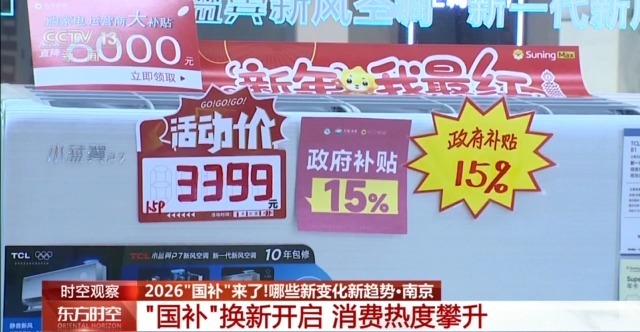
Core Viewpoint - The National Development and Reform Commission and the Ministry of Finance have issued a notice regarding the implementation of a large-scale equipment update and consumer goods replacement policy in 2026, clarifying and optimizing the support scope, subsidy standards, and implementation mechanisms for the "two new" policies [1] Group 1: Policy Overview - The new round of "national subsidies" officially begins on January 1, 2026, with significant changes and trends in the subsidy policy [1] - The policy covers four major areas, including six categories of home appliances and four categories of digital and smart products, with a subsidy of 15% of the transaction price for eligible purchases [5][10][12] Group 2: Subsidy Details - For home appliances, consumers can receive a subsidy of up to 1,500 yuan for each eligible item purchased, limited to one item per category [12] - In the digital and smart products category, consumers can receive a subsidy of up to 500 yuan for each eligible item, also limited to one item per category [10] - The automotive sector continues to support vehicle scrapping and replacement, with subsidies of up to 20,000 yuan for new energy vehicles and 15,000 yuan for fuel vehicles under specific conditions [14] Group 3: New Trends - The new subsidy policy emphasizes improving people's livelihoods and supporting urban development, with a focus on precision in policy implementation [19] - The inclusion of smart glasses in the subsidy scope reflects the growing importance of digital consumption as a new growth point [19] Group 4: Implementation Mechanisms - The new policy enhances standard guidance, increasing support for high-efficiency products while emphasizing the importance of standards for policy effectiveness [22][24] - The implementation mechanism includes optimizing fund allocation and improving the overall implementation process to enhance policy precision and effectiveness [24][26] - The policy also combines uniformity and specificity, allowing local authorities to set specific subsidy standards for smart home products based on local conditions [26]
“国补”继续!买家电、手机等,2026年补贴标准来了
Xin Lang Cai Jing· 2026-01-03 20:20
Core Viewpoint - The National Development and Reform Commission and the Ministry of Finance have released a notice regarding the implementation of large-scale equipment updates and consumer goods replacement policies in 2026, optimizing support scope, subsidy standards, and implementation mechanisms [1] Group 1: Optimization of Support Scope - The support scope for equipment updates will generally continue from 2025, focusing on key consumer goods with strong coverage and driving effects for the consumer goods replacement policy [2] - The policy will enhance support for the installation of elevators in old residential areas, equipment updates in elderly care institutions, and updates for fire rescue and inspection equipment [3] Group 2: Optimization of Subsidy Standards - The subsidy for updating old residential elevators will shift from a fixed amount to a tiered subsidy based on the number of elevator floors [2] - The subsidy for scrapping and updating old operational trucks will prioritize the replacement with electric trucks [3] - The subsidy for household appliances will focus on products with a 1st-level energy efficiency or water efficiency rating, providing 15% of the product price with a maximum subsidy of 1,500 yuan per item [3] Group 3: Optimization of Implementation Mechanism - The project application mechanism and review process for equipment updates will be optimized to lower the investment threshold for applications, increasing support for small and medium-sized enterprises [2] - The notice emphasizes the need for strict enforcement against fraudulent subsidy claims and illegal practices [4] - Local governments are required to organize and implement the policies effectively, enhancing the efficacy of the "Two New" policies [5]
视频丨新一轮“国补”政策落地 各地消费市场热度攀升
Yang Shi Xin Wen Ke Hu Duan· 2026-01-03 12:27
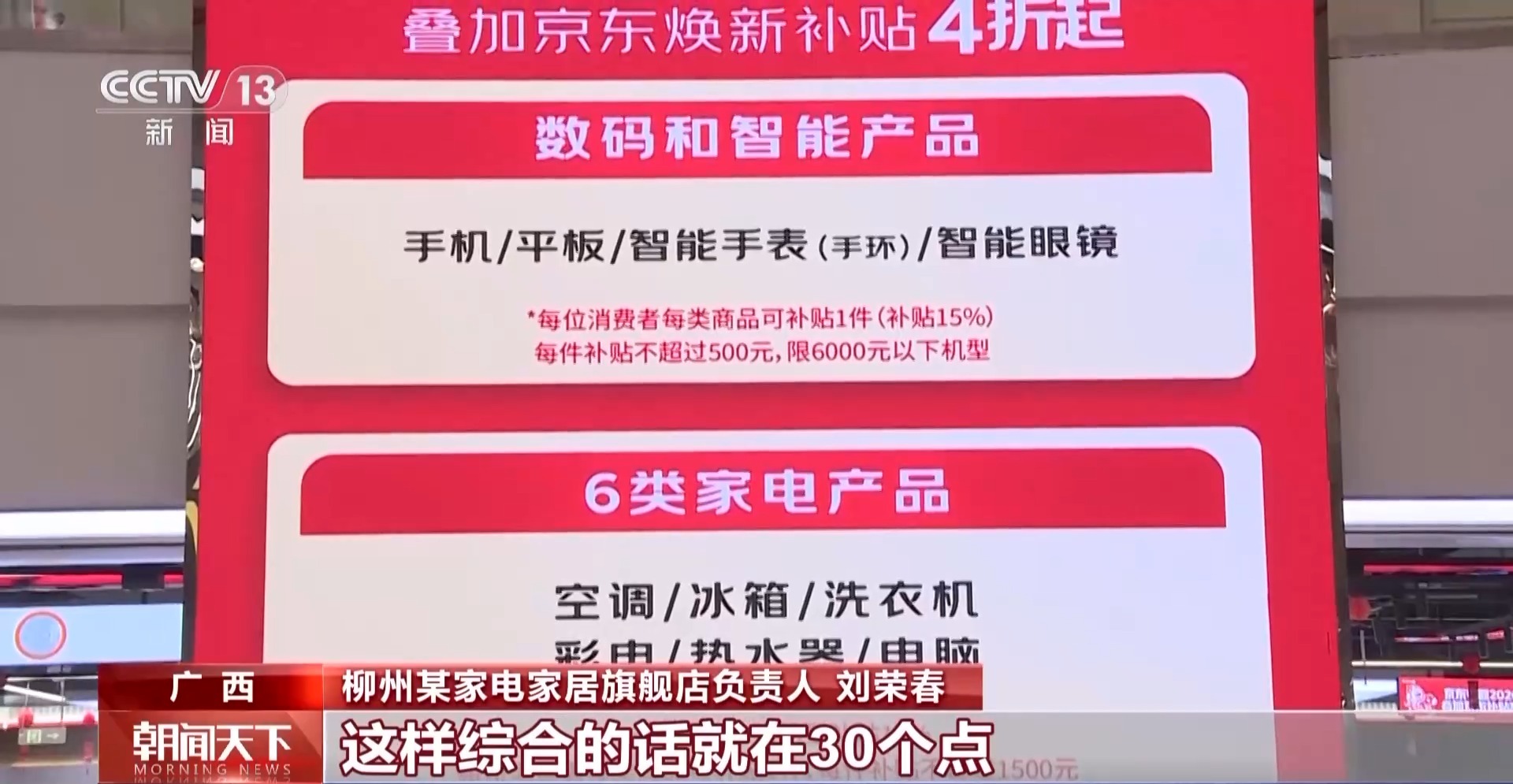
Core Insights - A new round of national subsidies ("Guo Bu") has officially begun, with the first batch of 62.5 billion yuan allocated for 2026, continuing the "trade-in" program for consumer goods and increasing support for equipment upgrades [1] Group 1: National Subsidy Program - The subsidy program covers four major areas: vehicle scrapping and replacement, six categories of home appliances, and four categories of digital and smart products [4] - Consumers purchasing energy-efficient appliances and certain digital products can receive a 15% subsidy on the transaction price, with limits on the number of items and maximum subsidy amounts [4] - For home appliances, the maximum subsidy is 1,500 yuan per item, while for digital and smart products, it is capped at 500 yuan [4] Group 2: Regional Implementation and Consumer Response - In Guangxi, cities like Liuzhou and Guigang have initiated the trade-in subsidy program, leading to increased consumer activity and engagement with the policy [2] - In Sichuan, the new subsidy policy has sparked a surge in consumer interest, particularly during the New Year holiday, with many consumers upgrading their home appliances [7][9] - The Sichuan provincial government has adopted a "subsidy deduction" model, which has been well-received by consumers, leading to a noticeable increase in sales of energy-efficient products [9] Group 3: Market Trends and Consumer Preferences - The new subsidy policy emphasizes the purchase of first-level energy-efficient appliances, effectively phasing out subsidies for lower efficiency products [9] - Retailers report a significant shift in consumer preferences towards high-efficiency products, with a notable increase in sales of first-level energy-efficient air conditioners and refrigerators [11]
625亿元!2026年第一批“国补”资金来了
Sou Hu Cai Jing· 2026-01-03 04:33
为优化实施"两新"政策,做好政策平稳有序衔接,满足元旦、春节等旺季消费需求,近日,国家发展改 革委会同财政部,已向地方提前下达2026年第一批625亿元超长期特别国债支持消费品以旧换新资金计 划。 据悉,下一步,国家发展改革委将会同各有关部门,充分发挥"两新"部际联席会议制度作用,强化统筹 推进和跟踪调度,组织地方合理把握工作节奏,均衡有序使用补贴资金,全链条强化资金监管,平稳有 序实施消费品以旧换新政策,持续释放"两新"政策效能。 |来源:新华社 还有这些值得关注 ...
新一轮“国补”政策落地 各地消费市场热度攀升
Yang Shi Wang· 2026-01-03 02:34
Group 1 - The core viewpoint of the articles highlights the launch of national subsidy programs in Guangxi and Sichuan, aimed at stimulating consumer spending through "trade-in" initiatives for various products [1][2] - In Guangxi, the subsidy program covers four major areas, including the replacement of old cars, six categories of home appliances, and four types of digital and smart products, offering a 15% subsidy on the purchase price for eligible items [1] - The subsidy for home appliances is capped at 1,500 yuan per item, while for digital and smart products, it is limited to 500 yuan, with each consumer allowed to claim one subsidy per category [1] Group 2 - In Sichuan, the new subsidy policy has been implemented, which also provides a 15% subsidy for six categories of home appliances and four types of digital and smart products, utilizing a "subsidy deduction" model [2] - The policy has led to increased consumer enthusiasm, particularly during the New Year holiday, with many consumers taking advantage of the subsidies to upgrade their home appliances [2] - The new policy emphasizes energy efficiency by focusing on first-level energy efficiency or water efficiency products, effectively phasing out subsidies for lower efficiency appliances, which has resulted in a noticeable preference for high-efficiency products among consumers [2]
国家发展改革委解读当前经济热点 优化实施“两新”政策“两重”项目
Xin Lang Cai Jing· 2026-01-02 23:42
2026年提前批"两重"建设项目清单已组织下达 近日,按照党中央、国务院决策部署,为进一步扩大有效投资,国家发展改革委组织下达2026年提前 批"两重"建设项目清单和中央预算内投资计划,共计约2950亿元。 (来源:千龙网) 2026年,如何优化实施"两新"政策?如何以更大力度稳投资?如何纵深推进全国统一大市场建设?国家 发展改革委近日召开新闻发布会,针对当前经济工作部分热点问题,国家发展改革委政策研究室副主 任、委新闻发言人李超作了介绍。 "两新"政策将优化资金分配和支持范围等 近日,国家发展改革委、财政部印发通知,提出从支持范围、补贴标准、实施机制等方面优化实施2026 年"两新"政策。 消费品以旧换新方面,2025年出现了补贴时断时续且难以预期、骗补套补、"先涨后补"等问题。在此基 础上,国家发展改革委会同商务部等部门,进行了集中整治,充分论证、有针对性地完善了2026年的政 策实施机制—— 优化资金分配方式,在原有资金分配标准的基础上,综合考虑前期政策执行情况、审计发现问题等因 素,合理确定各地资金分配规模;同时,对拖欠兑付较严重的地区,将通过适当方式加大督促和惩戒力 度。均衡有序使用资金,国家层面, ...
别错过!2026年湖南以旧换新政策来了
Xin Lang Cai Jing· 2026-01-02 11:14
Core Viewpoint - Hunan Province will continue the "old for new" consumption policy starting January 1, 2026, to enhance the quality of life for consumers, in line with national directives [1]. Group 1: Support for Automobile Scrapping and Replacement - Subsidy Scope and Standards: Consumers can receive a one-time subsidy for scrapping eligible vehicles registered before specific dates and purchasing new energy vehicles or fuel vehicles with specific engine sizes. The subsidy for new energy vehicles is 12% of the new car price, capped at 20,000 yuan, while for fuel vehicles, it is 10%, capped at 15,000 yuan [1]. - Application Process and Documentation: Consumers must apply through designated platforms and provide necessary documents, including proof of scrapping and vehicle registration, obtained after January 1, 2026 [2]. Group 2: Support for Automobile Trade-in - Subsidy Scope and Standards: Consumers trading in their vehicles for new energy or fuel-efficient vehicles can receive a subsidy of 8% of the new car price (up to 15,000 yuan) for new energy vehicles and 6% (up to 13,000 yuan) for fuel vehicles [3]. - Application Process and Documentation: Similar to scrapping, consumers must submit specific documents through the Hunan vehicle trade-in platform, ensuring all documents are dated after January 1, 2026 [4]. Group 3: Support for Home Appliances and Digital Products - Subsidy Objects and Application Process: The subsidy for home appliances and digital products will follow the guidelines from the 2025 policy, with specific categories eligible for a 15% subsidy on the final sales price, capped at 1,500 yuan for appliances and 500 yuan for digital products [5][6]. - Validity of Subsidy Coupons: Coupons for subsidies will be valid for one day, and consumers can choose between online and offline redemption methods [6]. Group 4: Funding Rules - Funding Implementation: The subsidy funds will be managed on an annual basis, with monthly allocations to ensure orderly implementation of the policy [7]. Group 5: Other Matters - Compliance with National Regulations: Any discrepancies with national regulations will defer to national guidelines, and detailed implementation rules will be published later [8]. - Encouragement of Additional Activities: Various platforms and businesses are encouraged to conduct complementary promotional activities to enhance the effectiveness of the policy [8]. - Regulatory Mechanisms: A collaborative regulatory mechanism will be established to oversee the use of subsidy funds and market behavior, aiming to prevent fraud and maintain a fair market environment [8].
2026“国补”继续,能享受哪些实惠?一图看懂
Xin Lang Cai Jing· 2026-01-02 10:13
Group 1 - The new round of "national subsidies" has officially started, with the first batch of 62.5 billion yuan allocated for 2026 [1] - The policy continues to support the replacement of consumer goods and increases support for equipment upgrades [1][3] - Consumers can benefit from various subsidies for vehicle scrapping and purchasing new energy vehicles or fuel vehicles with specific engine sizes [5][7] Group 2 - For scrapping eligible old vehicles, consumers can receive a one-time subsidy of up to 20,000 yuan for new energy vehicles and 15,000 yuan for fuel vehicles with engine sizes of 2.0 liters or below [5][6] - The subsidy for purchasing energy-efficient home appliances, such as refrigerators and air conditioners, is set at 15% of the product price, with a maximum of 1,500 yuan per item [9] - Consumers can also receive subsidies for purchasing digital and smart products, with specific limits on the price of each item [9]
