稳定币

Search documents
比特币 Layer 2 项目 Citrea 宣布主网上线,并推出原生稳定币 ctUSD
Xin Lang Cai Jing· 2026-01-27 14:47
Core Insights - The Bitcoin Layer 2 project Citrea, supported by Founders Fund and Galaxy, has officially launched its mainnet and introduced its native stablecoin ctUSD [1] Group 1: Project Overview - Citrea utilizes zkEVM to process transactions off-chain, generating zero-knowledge proofs that are recorded on the Bitcoin mainnet, enabling native settlement and data availability for Bitcoin [1] - The project will focus on supporting BTC collateralized lending and structured products [1] Group 2: Stablecoin Details - ctUSD is issued by MoonPay and is fully backed by short-term U.S. Treasury bonds and cash, complying with the requirements of the GENIUS Act [1]
Tether 宣布推出 USA₮ 美元稳定币
Xin Lang Cai Jing· 2026-01-27 13:43
吴说获悉,Tether 宣布正式推出 USA₮,一款面向美国市场、符合 GENIUS Act 联邦稳定币监管框架的 美元稳定币。USA₮ 由 Anchorage Digital Bank, N.A.(美国首家联邦监管的加密银行)发行,Cantor Fitzgerald 担任储备资产托管方及首选主交易商。USA₮ 定位为"美国制造"的合规数字美元,服务于机 构级支付与金融基础设施。首批上线平台包括 Bybit、Crypto.com、Kraken、OKX、MoonPay。 (来源:吴说) ...
X @Yuyue
Yuyue· 2026-01-27 08:57
稳定币这个领域没有绝对的忠诚度可言,和 DeFi 挖矿一样,大户们大多跟着利息的变化在协议间迁移资金。World Liberty 的 USD1 补贴活动从 23 号开始只有四天,通过币安的放大,就能靠 40M 的补贴撬动 4B 的稳定币发行量这说明两件事:1. 稳定币的战争远没有到头,市场份额的抢夺很激烈,先来的人护城河并没有这么明显2. 交易所的放大效应在 crypto 圈内仍然非常明显。同样是给出大量补贴的 PYUSD(背靠 Paypal),由于只和链上协议合作的打法,采用仍不温不火Fast is slow (@WinForKakei):#usd1 #circleusd1发行量突破了5b usdc发行量掉了4busd1出补贴活动之后恰好我就是用usdc换了2m出头这让我想起诺基亚如日中天时有人问芒格诺基亚的护城河怎么样 芒格回答护城河不是市占率 取决于人们转换成本有多高目前来看usdc转换成本并不高 circle还得继续观察和思考 https://t.co/zeYQFCA4FN ...
CB Insights:《2026年技术趋势研究报告》
欧米伽未来研究所2025· 2026-01-27 04:02
Core Insights - The report by CB Insights outlines significant technological transformations across various sectors, emphasizing the shift from experimental technologies to commercial applications, with 11 out of 14 trends validated by the market compared to last year's predictions [1] Group 1: Enterprise Operations - The return on investment for AI agents is a moving target, with 63% of executives prioritizing productivity and 58% focusing on time and cost savings, yet quantifying revenue impact remains challenging [2] - New startups are emerging to address measurement challenges, such as Span, which raised $25 million for its AI code detection model, and Workhelix, which secured $15.3 million to help businesses quantify automation impacts [2] Group 2: AI Deployment - Over half of the 1261 AI agent companies have reached the deployment stage, with the financial services sector leading at 21% of AI partnerships in 2025 [3] - Compliance and fraud detection projects in financial services have seen 83% and 81% fully deployed, respectively, indicating a competitive advantage for companies adopting AI-native operations [3] Group 3: Private Markets - Among over 1300 unicorns, 12 have valuations exceeding the S&P 500 median of $39 billion, with notable companies like SpaceX and OpenAI valued at $400 billion and $500 billion, respectively [4] - The average age for tech IPOs has increased from 12.2 years in 2015 to 15.9 years in 2025, with unicorns dominating significant acquisition deals [4] Group 4: Regulatory Changes - The regulatory environment is evolving, with the U.S. government facilitating access to alternative assets for 401(k) investors, prompting Wall Street to enhance its private market infrastructure [6] - AI and data-driven methods are now outperforming traditional venture capital approaches in predicting future unicorns, with CB Insights' Mosaic score proving significantly more effective [6] Group 5: Stablecoins in Finance - The stablecoin ecosystem is maturing, with 49% of funded stablecoin companies in deployment or expansion stages, driven by regulatory clarity from the GENiuS Act [7] - Major banks have begun supporting stablecoin startups, with significant acquisitions reflecting rising interest in integrating stablecoins into corporate finance workflows [7][8] Group 6: Data Centers and Energy - The power consumption of U.S. data centers is projected to more than double by 2030, leading to innovations in infrastructure as companies seek on-site power solutions [9] - Flexibility in demand is becoming essential, with legislation allowing grid operators to disconnect data centers during crises, highlighting the need for responsive energy management [9][10] Group 7: Sovereign AI Initiatives - Governments are prioritizing local AI development, with significant investments from countries like China and Japan, positioning companies like NVIDIA to benefit from sovereign AI strategies [11] - Regional AI leaders are emphasizing data sovereignty and compliance, with companies like Mistral AI and Cohere focusing on partnerships that align with local regulations [12] Group 8: Voice AI in Healthcare - The voice AI development platform is reaching commercial readiness, with a record number of equity transactions in 2025, indicating strong market interest [13] - Voice AI is being integrated into healthcare workflows, addressing staffing shortages and enhancing patient care efficiency [14] Group 9: World Models and Robotics - World models are emerging as the next frontier in AI, with significant investments and developments from major tech companies, indicating a shift towards understanding physical interactions [15][16] - Robotics coordination is advancing, with companies like Amazon deploying new models to optimize robot movements, reflecting a transition from rule-based to learning-based systems [17][18] Group 10: Future Outlook - The report highlights interconnected trends, suggesting that the prosperity of private markets and the acceleration of AI innovation are mutually reinforcing [19] - Companies must adapt to these trends by leveraging data-driven analytics and proactive market tracking to gain a competitive edge in the evolving landscape [19]


渣打:创新和地缘政治重塑资本市场 香港具全球联通优势
Zhi Tong Cai Jing· 2026-01-27 03:22
Core Viewpoint - Innovation and geopolitical factors are reshaping capital markets, with Hong Kong positioned as a globally connected hub [1] Group 1: Market Confidence and Policy Measures - Timely policy measures have enhanced market confidence in a changing environment [1] - The People's Bank of China and the Hong Kong Monetary Authority have expanded the RMB business funding arrangement to 200 billion RMB, laying the foundation for the next phase of connectivity development [1] - Confidence is reflected in economic, capital markets, and business activities, translating into tangible results [1] Group 2: Competition and Product Offerings - The Hong Kong Stock Exchange (HKEX) faces competition not only from traditional exchanges but also from emerging virtual platforms, necessitating deep and broad professional capabilities [1] - Investors are increasing their exposure to the Chinese market, prompting Hong Kong to offer product options beyond stocks [1] Group 3: Future Development of HKEX - The future development of HKEX relies on stablecoins, tokenization, and 24-hour trading [1] - HKEX will continue to invest in technology and is promoting infrastructure reforms, including shortening the new stock settlement cycle [1]

2025年中国第三方支付行业研究报告
艾瑞咨询· 2026-01-27 00:06
Core Insights - The comprehensive payment transaction scale in China is expected to reach 577 trillion yuan by 2025, with a year-on-year growth of 3.0%, driven by a 2.9% increase in personal payment transactions and a 3.2% increase in enterprise payment transactions, indicating that enterprise payment growth has surpassed personal payment growth [1][13]. Group 1: Industry Overview - The third-party payment industry in China has entered a stage of deepening stock competition, with regulatory normalization and compliance requirements becoming the foundation for industry development [1]. - The industry has evolved from a phase of rapid growth and diversification of services (2010-2019) to a more mature phase characterized by stricter regulations and stable development since 2019 [4][5]. Group 2: Market Dynamics - The personal payment market is nearing saturation, with a projected decline in the personal mobile payment market size from 205.2 trillion yuan in 2024 to 197.5 trillion yuan in 2025, a decrease of 3.7% [19]. - In contrast, the enterprise payment market is expected to show resilience, with a projected growth rate of 3.2% due to the ongoing digital transformation of enterprises and the expansion of cross-border e-commerce payment scenarios [13][33]. Group 3: Regulatory Environment - The implementation of the "Non-Bank Payment Institutions Supervision and Administration Regulations" in 2024 has led to a significant transformation in the industry, with a marked increase in compliance and accelerated consolidation [7]. Group 4: Technological Integration - The industry is actively embracing AI technology to enhance internal operational efficiency and external customer service, with AI being utilized for smart risk control, process automation, and personalized services [10][12]. - AI is expected to play a crucial role in reducing operational costs and improving service capabilities, thereby enhancing the overall competitiveness of the payment industry [10]. Group 5: Payment Trends - New payment methods are emerging, such as NFC payments, which simplify the payment process and enhance security, although challenges remain in terms of hardware requirements and user adoption [30][31]. - The promotion of digital currency and stablecoins is expected to create new growth opportunities in the cross-border payment sector, with stablecoins gaining regulatory clarity and becoming integral to global payment infrastructure [67][71]. Group 6: Enterprise Payment Strategies - Payment institutions are shifting from basic payment services to integrated solutions that provide cost reduction and efficiency enhancement tools, reflecting a consensus in the industry to explore deeper service values [35]. - The enterprise payment market is increasingly focusing on providing comprehensive solutions that integrate payment services with financial and operational management tools [41][49]. Group 7: Cross-Border Payment Growth - The cross-border payment market is projected to reach 3.3 trillion yuan by 2025, driven by the expansion of China's cross-border e-commerce market, which is expected to grow at an annual rate of 15.5% [55]. - Cross-border payment service providers are enhancing their offerings by integrating logistics and other essential services to create a comprehensive solution for businesses engaged in international trade [57][60].

全球最大稳定币发行商泰达成购金大户,第四季度增持约27吨黄金
Xin Lang Cai Jing· 2026-01-26 23:20
全球最大的稳定币发行商泰达公司(Tether)周一表示,其在 2025 年第四季度增加了约 27 吨黄金配 置。这一数字与分析师估计的第三季度购买量(约 26 吨)大致持平。 2025年,黄金价格累计上涨了64%,今年开年至今又上涨了18%。受强劲的投资、央行和零售需求以及 全球紧张局势加剧的影响,金价在去年3月份突破了每盎司3000美元的关键心理阻力位,10月份突破了 每盎司 4000 美元,周一突破了每盎司 5000 美元。 随着现货黄金价格的上涨,这家加密货币公司已成为黄金需求的重要来源。这是因为其用于支撑稳定币 泰达USTD的储备资金的购买速度非常快,该稳定币目前的流通市值约为 1870 亿美元,该公司还发行 另一种黄金代币XAUT,市值约27 亿美元。 每个由泰达发行的美元代币都代表一美元储备金。当用户向泰达提供一美元时,该公司会发行一枚 USDT,并持有等值的资产,例如美国国债。这些储备金旨在确保在必要时 USDT 可以兑换成美元。而 泰达XAUT 稳定币则完全由黄金支持。 泰达首席执行官 Paolo Ardoino表示:"我们现在的运营规模已经使泰达黄金投资基金与主权黄金持有者 并驾齐驱,这带来 ...
区块链基础设施公司 Zerohash 正在洽谈以 15 亿美元估值融资 2.5 亿美元
Xin Lang Cai Jing· 2026-01-26 14:55
Core Viewpoint - Zerohash, a blockchain infrastructure company, is negotiating to raise $250 million at a valuation of $1.5 billion, having recently exited acquisition talks with Mastercard while still considering strategic investment from the company [1] Group 1: Company Overview - Zerohash was founded in 2017 and provides APIs and development tools related to crypto assets, stablecoins, and tokenization for financial institutions and fintech companies [1] - Notable clients of Zerohash include Interactive Brokers, Stripe, BlackRock's BUIDL fund, and Franklin Templeton [1] Group 2: Financial Activities - The company is in discussions to secure $250 million in funding at a valuation of $1.5 billion [1] - Zerohash has chosen to remain independent after withdrawing from acquisition negotiations with Mastercard [1]
CLARITY法案卡壳 Coinbase与华尔街“生死博弈”将触发加密货币黑天鹅?
Zhi Tong Cai Jing· 2026-01-23 13:43
Group 1 - Coinbase's CEO Brian Armstrong's actions have caused significant rifts in the cryptocurrency sector, leading to delays in key regulatory legislation [1][2] - The White House has criticized the cryptocurrency industry, emphasizing that political influence should not be taken for granted [1] - The CLARITY Act aims to establish a comprehensive federal regulatory framework for digital assets, which could reduce compliance uncertainty and promote institutional investment [2][3] Group 2 - The withdrawal of support for the CLARITY Act by Armstrong has raised concerns among industry executives about the overreach of political influence [1][3] - The Senate Banking Committee's review of the CLARITY Act has been indefinitely postponed due to Armstrong's opposition to certain provisions, particularly regarding stablecoin rewards [4][5] - The agricultural committee is also working on its version of the market structure bill, complicating the legislative process amid an election year [5] Group 3 - Concerns have emerged that the delay in the CLARITY Act could lead to a "regulatory black swan" event that may trigger a market crash [3] - The cryptocurrency industry has been a significant donor in the 2023-2024 U.S. presidential election cycle, contributing over $133 million to candidates perceived as supportive of their agenda [6] - The stablecoin market is rapidly expanding, with predictions that its size could reach $2 trillion, highlighting its potential impact on the global financial system [7][8] Group 4 - The debate over stablecoin rewards has become a major point of contention between Wall Street banks and the cryptocurrency industry, with banks fearing deposit outflows [8][11] - Armstrong has framed the conflict as a struggle for consumer interests against banking lobbyists, asserting that the proposed restrictions are harmful [11][12] - The cryptocurrency industry is engaged in a "long game" to embed favorable terms into U.S. financial regulations, anticipating future political shifts [12][13]

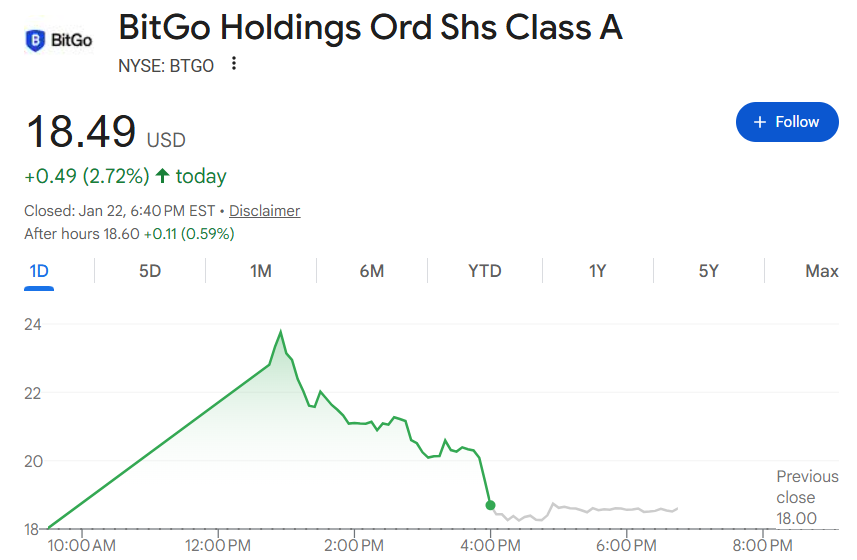
币圈情绪风向标!BitGo上市首日一度大涨25%
Hua Er Jie Jian Wen· 2026-01-23 01:42
Core Viewpoint - BitGo, a cryptocurrency infrastructure company, experienced a significant stock performance on its first day of trading, reflecting investor interest in the crypto sector despite a challenging regulatory environment [1][10]. Group 1: Company Overview - BitGo was founded in 2013 by Silicon Valley entrepreneur Belshe, who introduced multi-signature wallets, enhancing security for digital asset transactions [3]. - The company has expanded its services to include custody, prime brokerage, and institutional trading [3]. - BitGo is currently responsible for holding reserves for the stablecoin USD1, launched by World Liberty Financial, associated with former President Trump [4]. Group 2: Financial Performance - BitGo reported profitability, with projected earnings of $156.6 million in 2024 and $35.3 million in the first nine months of 2025 [6][7]. - Revenue for the first six months of 2025 is expected to reach $4.19 billion, a substantial increase from $1.12 billion in the same period the previous year [7]. Group 3: Market Context - The IPO pricing was set at $18, raising $212.8 million by selling approximately 11.8 million shares, leading to a market capitalization of $2.1 billion at closing [1]. - The IPO is seen as a potential indicator of recovery in the cryptocurrency industry, especially following a downturn in crypto prices and investor sentiment [10]. - The regulatory environment remains a critical factor, with delays in key legislative votes impacting market dynamics [10].