
云计算

Search documents
BTIG警告:AI分化已达“不可持续”极端,半导体若倒下大盘将无险可守
智通财经网· 2026-02-13 07:07
智通财经APP获悉,BTIG 首席市场技术策略师乔纳森·克林斯基(Jonathan Krinsky)表示,人工智能相关 股票的剧烈波动正造成极端的市场分化,这种分化可能正达到不可持续的水平。 软件板块是尤为令人担忧的领域,这位策略师指出。克林斯基进一步解释道:"软件板块确实需要守住 近期低点。"他强调,尽管该板块上周已出现"投降式抛售"特征,但若跌破近期低点,则意味着更深度 的下跌行情正在酝酿。 或许最为关键的是,这位 BTIG 技术分析师警告称,在其他领域动荡不安之际,半导体板块必须继续挑 起大梁。 "鉴于软件股及其他各类个股的大幅下挫,市场确实需要半导体板块继续挑起重担,"他表示。克林斯基 警告称,如果半导体板块也随其他板块一同走软,"指数很可能将无法企稳。" "然而,到了某个时点,我们开始担忧弱势会压倒强势,大盘将变得脆弱,"他表示。 克林斯基指出,标普500指数仍在7000点水平挣扎,而2月下半月通常代表季节性较弱时期,鉴于个股层 面的错位,接下来几周可能颇具挑战。 软件类 ETF: INVESCO AI AND NEXT GEN SOFTWARE ETF (IGPT.US) 在一份报告中,克林斯基着 ...
品高股份股价异动,受华为欧拉等概念催化
Jing Ji Guan Cha Wang· 2026-02-13 03:38
Group 1 - The stock price of Pingao Co. has experienced significant fluctuations, with a notable increase of 10.15% on February 12, closing at 73.03 yuan, and a cumulative rise of 11.05% over the past five days [1][2] - The main capital flow has shown a net inflow of 24.25 million yuan recently, indicating positive investor sentiment [2] - The stock is currently oscillating between a resistance level of 76.33 yuan and a support level of 65.90 yuan, with a weak accumulation of shares [2] Group 2 - The recent price movement on February 12 was primarily driven by catalysts related to Huawei's Euler, cloud computing, smart governance, military industry, and digital economy concepts [3] - The company has established deep collaborations with hardware architectures such as Feiteng and Kunpeng, as well as software vendors like Kirin and Euler on its Pingao Cloud platform [3] - In the smart governance sector, the company is focusing on government cloud platforms and intelligent scheduling, while also achieving military information security certification for its products [3]

AI“军备竞赛”,亚马逊输不起的战争
3 6 Ke· 2026-02-13 03:33
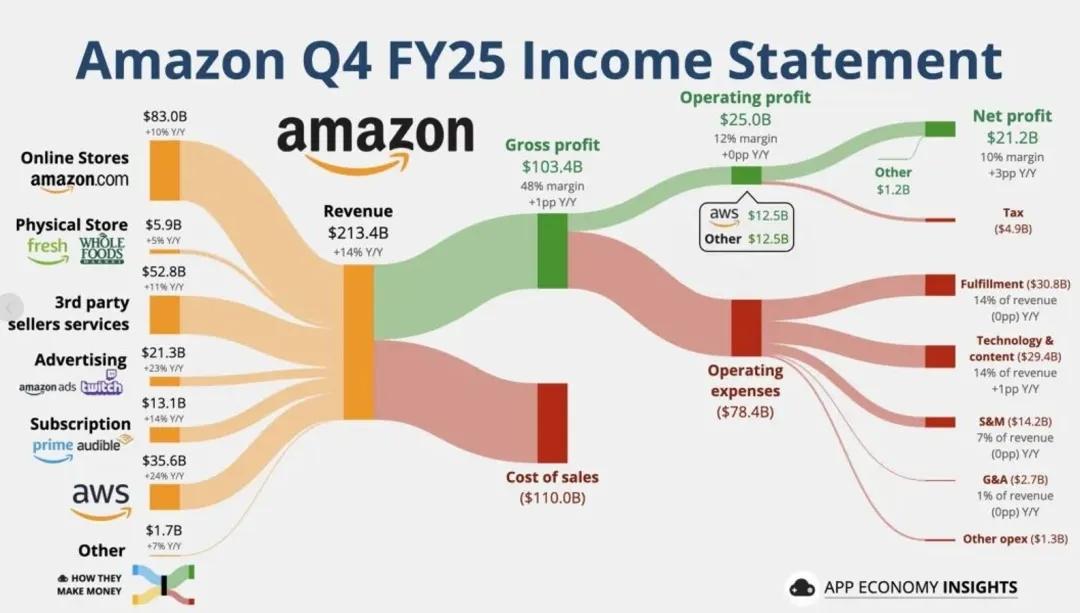
Core Insights - Amazon reported a record revenue of $213.4 billion for Q4 2025, marking a 14% year-over-year increase, and net profit reached $21.2 billion, up 6% [1] - For the full year 2025, Amazon's revenue hit $716.9 billion, a 12% increase, with net profit soaring to $77.7 billion, a 31% rise from 2024 [1] - Amazon's cloud business, AWS, contributed over 60% of the company's operating profit, highlighting its significance as a cash cow [5] Revenue Breakdown - In Q4 2025, Amazon's online store revenue was $82.99 billion, up 10%, while physical stores generated $5.86 billion, a 5% increase [4] - Third-party seller services brought in $42.82 billion, growing 11%, and subscription services earned $13.12 billion, up 14% [4] - Advertising revenue reached $21.32 billion, marking a 23% increase [4] - North America accounted for $127.08 billion in sales, a 10% increase, with operating profit rising 24% to $9.3 billion [4] - International e-commerce revenue was $50.7 billion, up 17%, although operating profit declined 23% to $1 billion due to increased competition and costs [4] Cloud Business Performance - AWS achieved $35.6 billion in revenue for Q4 2025, a 24% increase, marking the highest growth rate in 13 quarters [5] - For the full year, AWS revenue reached $128.7 billion, a 20% increase, representing 18% of total revenue [5] - AWS's operating profit was $12.5 billion, with a profit margin of 35% [5] Capital Expenditure and Future Investments - Amazon plans to invest approximately $200 billion in capital expenditures in 2026, a 52% increase from 2025's $131 billion [14] - The significant capital expenditure includes investments in AI, robotics, and chip development, indicating a strategic focus on enhancing operational efficiency and customer experience [17][21] - Amazon's self-developed AI training chips, Trainium and Graviton, have surpassed $10 billion in annualized revenue, with Trainium 3 already in high demand [17][18] Competitive Landscape - Amazon maintains a leading position in the public cloud market with a 28% market share, followed by Microsoft at 21% and Google at 14% [10] - However, AWS's revenue growth rate is lagging behind competitors like Microsoft Azure and Google Cloud, which are growing at 39% and 48%, respectively [10]

铜牛信息股价上涨21.33%,受板块情绪与国资重组预期推动
Jing Ji Guan Cha Wang· 2026-02-13 02:49
Stock Performance - The stock of Tongniu Information (300895) has shown strong performance, with a cumulative increase of 21.33% over the last 20 trading days [1] - The rise is attributed to increased market attention on sectors related to computing power leasing and data centers, driven by the explosive adoption of AI Agents, which has boosted demand for CDN and data transmission [1] Recent Events - The controlling shareholder of the company is set to change from Beijing Fashion Holdings to Beijing Data Group, aiming to focus on the digital economy [2] - This state-owned restructuring is expected to bring resource synergies, potentially supporting the stock price [2] - The company is advancing the "Fangheng Technology Supercomputing and Financial Cloud Computing Base" project, which is nearing completion and is expected to enhance computing power capacity [2] Financial and Technical Analysis - From a technical analysis perspective, the stock has recently broken through the 20-day moving average resistance, with the MACD indicator showing a positive divergence, indicating strong short-term momentum [3] - On February 13, the stock experienced a trading range of 16.41% and a turnover rate of 5.53%, reflecting high trading activity [3] Current Operating Status - According to the company's earnings forecast, the net profit attributable to the parent company is expected to be a loss of between 65 million to 85 million yuan in 2025, which represents a significant narrowing of losses compared to a loss of 127 million yuan in the same period of 2024 [4] - Although the company has not yet turned profitable, the marginal improvement in profitability may positively influence market sentiment [4]

奥飞数据终止定增计划,前三季度业绩增长超37%
Jing Ji Guan Cha Wang· 2026-02-13 02:12
Group 1 - The core viewpoint is that Aofei Data (300738) has recently experienced significant inflow of main funds, leading to strong stock performance, and has terminated its planned fundraising initiative while maintaining growth in its performance for the first three quarters [1][3][4] Group 2 - Recent stock performance shows that on February 12, 2026, Aofei Data had a net inflow of 360 million yuan, with the stock price increasing by 5.22%, indicating a notable rise in fund activity [2] - As of February 5, 2026, the stock has accumulated a year-to-date increase of 16.71% [2] Group 3 - The company announced on January 22, 2026, that it would terminate its plan to issue A-shares to specific targets for the fiscal year 2025, which was intended to raise no more than 1.695 billion yuan for a new generation cloud computing and artificial intelligence industrial park project [3] - The company stated it would flexibly utilize capital market tools based on future strategic planning [3] Group 4 - For the first three quarters of 2025, Aofei Data achieved an operating revenue of 1.824 billion yuan, representing a year-on-year growth of 15.33%, and a net profit attributable to shareholders of 145 million yuan, which is a year-on-year increase of 37.29% [4]

关于华泰柏瑞中证沪港深云计算产业交易型开放式指数证券投资基金流动性服务商的公告
Zhong Guo Zheng Quan Bao - Zhong Zheng Wang· 2026-02-12 23:04
Group 1 - The core viewpoint of the announcements is the selection of liquidity service providers for two exchange-traded funds (ETFs) managed by Huatai-PB Fund Management Co., Ltd. to enhance market liquidity and ensure stable operation [1][2]. Group 2 - For the Huatai-PB CSI Hong Kong-Shenzhen Cloud Computing Industry ETF (code: 159738), liquidity service providers selected are Guotai Junan Securities Co., Ltd., Industrial Securities Co., Ltd., and CITIC Securities Co., Ltd., effective from February 13, 2026 [1]. - For the Huatai-PB CSI Sci-Tech Innovation and Entrepreneurship Artificial Intelligence ETF (code: 159139), liquidity service providers selected are Industrial Securities Co., Ltd., Zheshang Securities Co., Ltd., and CITIC Securities Co., Ltd., also effective from February 13, 2026 [2]. Group 3 - The Huatai-PB CSI Hong Kong Stock Connect High Dividend Investment ETF (QDII) announced a dividend distribution, with the announcement date being February 13, 2026 [3]. - The fund manager can evaluate the excess return rate of the fund relative to the benchmark index monthly, and if the cumulative return exceeds the benchmark by more than 1%, a distribution can be made [3]. - The cash distribution will be credited to the designated bank account of China Securities Depository and Clearing Co., Ltd. Shanghai Branch on March 3, 2026, with investors able to receive cash dividends starting from March 5, 2026 [3].
花旗:将Cloudflare(NET.N)目标价从260美元上调至265美元,维持买入评级。
Jin Rong Jie· 2026-02-12 18:54
Group 1 - Citigroup has raised the target price for Cloudflare (NET.N) from $260 to $265 while maintaining a buy rating [1]

共建“上海特色”智算云解决方案,上海仪电与阿里巴巴签署战略合作协议
Sou Hu Cai Jing· 2026-02-12 15:20
Core Viewpoint - Shanghai Yidian and Alibaba Group have signed a strategic cooperation agreement to enhance digital transformation in Shanghai, focusing on intelligent computing services, government-enterprise market, and public cloud business [1] Group 1: Strategic Cooperation - The agreement involves deep collaboration in intelligent computing services, government-enterprise market, and public cloud business [1] - The partnership aims to leverage Alibaba's Qianwen large model, self-developed AI chips, and cloud computing capabilities alongside Shanghai Yidian's YiCloud platform for integrated service solutions [1] Group 2: Application Scenarios - The collaboration will support Shanghai in various application scenarios including trusted data space, autonomous driving, intelligent government services, enterprise digitalization, education, and healthcare [1] - The goal is to create "Shanghai characteristic" intelligent computing cloud solutions through this partnership [1] Group 3: Current Status - The cooperation in the intelligent computing field has already begun to take shape [1]


谷歌2026年资本支出翻倍,AI芯片与云业务成增长核心
Jing Ji Guan Cha Wang· 2026-02-12 15:03
Core Insights - Google's capital expenditure is expected to reach between $175 billion and $185 billion in 2026, primarily focused on investing in AI computing capabilities to meet strong cloud customer demand and other strategic projects [1] Company Project Progress - Google is actively promoting the external sales of its self-developed TPU and is in negotiations with Meta for a multi-billion dollar TPU supply, with Meta planning to integrate Google's TPU into its data centers starting in 2027 [2] - The seventh-generation TPU "Ironwood" was released in early November 2025 and is expected to be available in the coming weeks [2] Business Development - The Gemini3 model, released in November 2025, has received positive market feedback, with monthly active users exceeding 750 million by the fourth quarter of 2025 [3] - Google plans to further integrate Gemini into core products such as search and Android, and collaborate with Apple to enhance device penetration, which may drive long-term growth [3] Industry Position - Google Cloud's revenue grew by 48% year-over-year in the fourth quarter of 2025, with a backlog of unfulfilled orders amounting to $240 billion [4] - With the mass production of the TPU v7p chip and collaborations with companies like Anthropic, the cloud business is expected to maintain high growth and become a core engine for the company [4] Institutional Perspectives - Several institutions, including Citigroup and JPMorgan, have identified Google as a key player in the AI sector for 2026, focusing on its capital expenditure efficiency and AI monetization progress [5] - The market is likely to continue monitoring the growth rate and profit performance of the cloud business in quarterly earnings reports [5]

海南千星未来投资有限公司成立,注册资本10000万人民币
Sou Hu Cai Jing· 2026-02-12 11:14
天眼查显示,近日,海南千星未来投资有限公司成立,法定代表人为孟玉涵,注册资本10000万人民 币,由成都星宸未来科技有限责任公司全资持股。 来源:市场资讯 经营范围含一般经营项目:以自有资金从事投资活动;企业管理咨询;软件开发;软件销售;人工智能 公共服务平台技术咨询服务;数据处理和存储支持服务;技术服务、技术开发、技术咨询、技术交流、 技术转让、技术推广;计算机软硬件及辅助设备零售;云计算装备技术服务(经营范围中的一般经营项 目依法自主开展经营活动,通过国家企业信用信息公示系统(海南)向社会公示) 企业名称海南千星未来投资有限公司法定代表人孟玉涵注册资本10000万人民币国标行业科学研究和技 术服务业>科技推广和应用服务业>技术推广服务地址海南省海口市龙华区大同街道海秀中路51-1号9层 D单元A区0423号企业类型有限责任公司(自然人投资或控股的法人独资)营业期限2026-2-11至无固定 期限登记机关海南省市场监督管理局 序号股东名称持股比例1成都星宸未来科技有限责任公司100% ...