液冷技术

Search documents
AI进入“液冷时代”,市场低估了“转变力度”,国产供应链正加速入局
Hua Er Jie Jian Wen· 2025-12-08 03:07
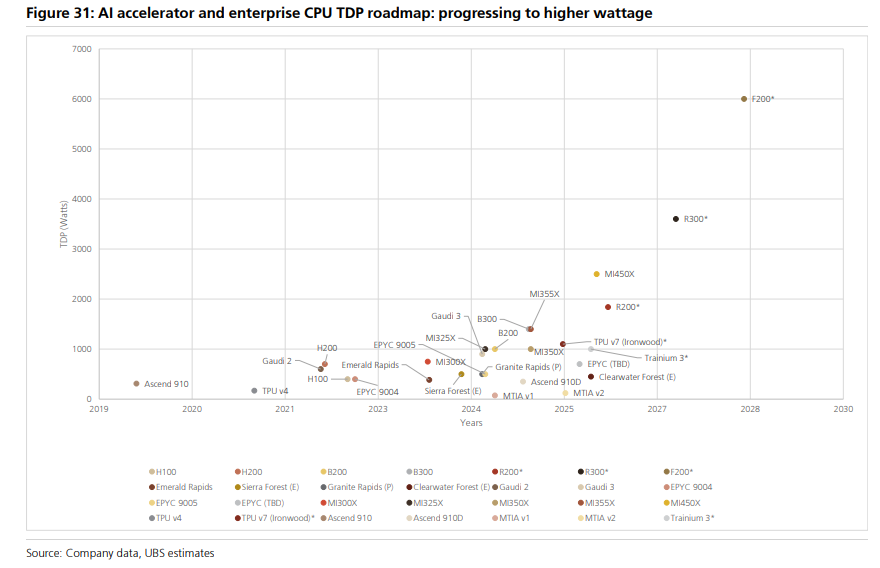
Core Insights - The transition to liquid cooling in data centers is becoming essential due to the rising power consumption of AI chips, marking a significant structural shift in the industry [1][2][4] - The global market for direct liquid cooling (DLC) is projected to grow from $1.138 billion in 2024 to $31.191 billion by 2030, with a compound annual growth rate (CAGR) of 51% [14][16] - The shift towards liquid cooling is driven by the need to meet stringent energy efficiency standards and the increasing power density of server cabinets [7][10] Market Dynamics - AI accelerator thermal design power (TDP) is rapidly increasing, with NVIDIA's GPUs expected to reach power levels between 1,800W to 7,000W in the coming years [2][4] - Traditional air cooling methods are becoming inadequate as cabinet power density exceeds 30-40kW, necessitating a shift to liquid cooling solutions [5][10] - Liquid cooling technology can reduce Power Usage Effectiveness (PUE) to below 1.2, making it a favorable option for meeting regulatory requirements [7] Technology Trends - The liquid cooling market is bifurcating into two main technology segments: Cold Plate technology for applications below 3,500W and Micro-Channel Lid (MCL) technology for higher power applications [10][12] - Cold Plate technology is expected to remain dominant for lower power applications, while MCL technology is anticipated to become mainstream for high-performance chips by 2026 [11][12] - The value of liquid cooling per rack is expected to quadruple by 2030, indicating a significant increase in market value [15] Supply Chain Evolution - NVIDIA is shifting its supply chain strategy from a "closed delivery" model to an "open ecosystem," allowing more suppliers to enter its supply chain [17][19] - This change provides opportunities for domestic suppliers to become either secondary suppliers through ODMs or primary suppliers as their technologies mature [17][19] - The estimated market for liquid cooling systems required for ASIC chips is projected to reach 35.3 billion RMB by 2026, with NVIDIA's platform requiring even more [19]


千亿液冷元年已至,看好国产供应链加速入局 | 投研报告
Zhong Guo Neng Yuan Wang· 2025-12-05 10:13
Group 1 - Liquid cooling technology is essential for addressing the heat dissipation pressure in data centers, offering advantages such as low energy consumption, high heat dissipation, low noise, and low total cost of ownership (TCO) [1][2] - The value of liquid cooling systems is expected to grow significantly alongside chip upgrades, with a projected increase of over 20% for rack liquid cooling modules in GB300-GB200 servers [1][2] - The market for ASIC liquid cooling systems is estimated to reach 35.3 billion yuan by 2026, while the market for NVIDIA liquid cooling systems is projected to reach 69.7 billion yuan [1][2] Group 2 - The domestic supply chain is accelerating its entry into the liquid cooling market, with NVIDIA opening its supplier list to allow more flexibility in supply chain composition [2] - The Rubin architecture requires new liquid cooling solutions due to its high thermal design power (TDP) of 2300W, necessitating alternatives to single-phase cooling plates [2] - Two viable solutions for the Rubin architecture include phase change cooling plates and microchannel plates, with the latter likely becoming the preferred option as power requirements increase [2] Group 3 - The demand for AI server computing power is rapidly increasing, driving the penetration rate of liquid cooling solutions, and leading to an explosive demand for efficient and energy-saving heat exchange solutions in data centers [3] - Companies to watch in this sector include Yingweike, Shenling Environment, Gaolan Co., Hongsheng Co., Zhongke Shuguang, and Jieban Technology [3]
东吴证券:算力需求增长带动液冷渗透率提升 看好国产供应链加速入局
智通财经网· 2025-12-05 06:31
Core Viewpoint - The current mainstream solution for liquid cooling is the cold plate system, while immersion cooling is expected to become a future development direction. The maturity of domestic liquid cooling systems is increasing, and domestic supply chains are likely to enter the NVIDIA ecosystem directly as demand for AI server computing power surges, driving the penetration rate of liquid cooling solutions [1][2]. Group 1: Liquid Cooling Technology - Liquid cooling technology is essential for addressing the heat dissipation pressure in data centers, offering advantages such as low energy consumption, high heat dissipation, low noise, and low total cost of ownership (TCO). It can also reduce the Power Usage Effectiveness (PUE) of data centers, meeting national requirements [1]. - As chip iterations increase power density, the heat dissipation requirements for corresponding chips are growing, making traditional air cooling insufficient and necessitating the introduction of liquid cooling solutions. Currently, cold plate systems dominate the market, while immersion cooling is anticipated to be a future trend [1]. - The liquid cooling system consists of an outdoor side (primary side) and a data center side (secondary side), with the primary side accounting for approximately 30% of the value, including chillers and circulation pipelines, while the secondary side accounts for about 70%, with core components such as CDU, manifold, quick connectors, and water pumps [1]. Group 2: Liquid Cooling Industry - The value of liquid cooling is expected to increase alongside chip upgrades. For example, the value of rack liquid cooling modules is projected to grow by over 20% with the transition to GB300-GB200 servers. By 2026, the market for ASIC liquid cooling systems is estimated to reach 35.3 billion yuan, while the market for NVIDIA liquid cooling systems is expected to reach 69.7 billion yuan [2]. - Domestic supply chains are accelerating their entry into the liquid cooling market. NVIDIA has opened its supplier list, allowing manufacturers to choose their supply chain components independently. This shift from a single certified CDU supplier to multiple suppliers enables domestic chains to indirectly enter the market. As domestic liquid cooling systems mature and end-user CSPs focus more on cost-performance ratios, domestic suppliers are likely to enter NVIDIA's ecosystem directly [2]. Group 3: Rubin Architecture Outlook - Single-phase cold plates are unsuitable for the Rubin architecture due to its thermal design power (TDP) of 2300W and a total cabinet power of approximately 200KW, exceeding the design limit of single-phase cold plates at 150KW per cabinet. Therefore, new liquid cooling solutions must be introduced [3]. - One feasible solution is the phase change cold plate, which utilizes the phase change of a liquid working fluid to absorb heat efficiently, suitable for scenarios exceeding 300KW per cabinet. Another option is the microchannel cold plate (MLCP), which features densely packed micro-scale cooling liquid channels, potentially becoming the preferred choice for the Rubin architecture as future iterations may require even higher power capacities [3].

联想宣布将Neptune液冷技术扩展至全线数据中心产品组合
Zhi Tong Cai Jing· 2025-12-05 04:09
2025年11月27日,联想(00992)正式宣布将其Neptune海神液冷技术扩展至全线数据中心产品组合,以应 对现代数据中心日益增长的计算需求与能耗压力。 就在其宣布这则消息的同一天,美国芝加哥商品交易所(CME)的交易系因数据中心冷却故障而瘫痪,全 球衍生品市场陷入了一场长达逾10小时的交易暂停。 这场巧合背后,是AI算力狂飙下传统数据中心散热体系的全面承压,功耗暴增与能耗失控正将全球数 字基建推向"热失控"边缘,一场大规模的技术迭代迫在眉睫。 数据更能说明困境。国际能源署(IEA)统计显示,全球数据中心年耗电量已占总用电量的1.8%,其中 38%的电力被用于冷却系统——这意味着每产生1度电的计算价值,就有近0.4度电被消耗在"对抗热 量"上。微软首席执行官萨提亚 纳德拉(Satya Nadella)近期在 BG2播客中表示,尽管市场对AI芯片的需 求持续高涨,但微软当前面临的并非算力过剩,而是数据中心的供电和物理空间已接近极限,导致大量 AI芯片只能滞留在库存中,无法"通电运行"。 联想瞄准液冷市场 在风冷逼近物理极限的背景下,液冷技术正成为行业转型的核心方向,而全球数据中心建设的热潮预示 着这一市场 ...

联想(00992)宣布将Neptune液冷技术扩展至全线数据中心产品组合
智通财经网· 2025-12-05 04:01
智通财经APP获悉,2025年11月27日,联想(00992)正式宣布将其Neptune海神液冷技术扩展至全线数据 中心产品组合,以应对现代数据中心日益增长的计算需求与能耗压力。 就在其宣布这则消息的同一天,美国芝加哥商品交易所(CME)的交易系因数据中心冷却故障而瘫痪,全 球衍生品市场陷入了一场长达逾10小时的交易暂停。 这场巧合背后,是AI算力狂飙下传统数据中心散热体系的全面承压,功耗暴增与能耗失控正将全球数 字基建推向"热失控"边缘,一场大规模的技术迭代迫在眉睫。 "冷却"失灵的代价 此次故障因位于伊利诺伊州奥罗拉的数据中心突然触发高温保护机制,服务器集群自动关机。据CME 事后声明,该数据中心故障根源是一台冷水机组突发机械故障,导致机房温度在90分钟内从24℃飙升至 48℃,远超电子元件安全阈值。 造成的代价也相当惨重,数万亿美元合约因此受到影响——亚洲时段的CME期货电子盘完全停摆,欧 洲交易商被迫转向流动性更低的场外市场,标普500指数期货主力合约在恢复交易后短时间内波动幅度 扩大至2.3%,创2025年以来单日最大盘中震荡。 CME宕机事件并非孤例,这不仅是一次交易中断,更是对金融市场基础设施可 ...
联想宣布将 Neptune 液冷技术扩展至全线数据中心产品组合
Ge Long Hui· 2025-12-05 04:01
2025年11月27日, 联想正式宣布将其 Neptune海神液冷技术扩展至全线数据中心产品组合,以应对现代 数据中心日益增长的计算需求与能耗压力。 就在其宣布这则消息的同一天,美国芝加哥商品交易所(CME)的交易系因数据中心冷却故障而瘫痪,全 球衍生品市场陷入了一场长达逾10小时的交易暂停。 数据更能说明困境。国际能源署(IEA)统计显示,全球数据中心年耗电量已占总用电量的1.8%,其中 38%的电力被用于冷却系统 —— 这意味着每产生1度电的计算价值,就有近0.4度电被消耗在 "对抗热 量" 上。微软首席执行官萨提亚・纳德拉(Satya Nadella)近期在 BG2 播客中表示,尽管市场对 AI 芯片的 需求持续高涨,但微软当前面临的并非算力过剩,而是数据中心的供电和物理空间已接近极限,导致大 量 AI 芯片只能滞留在库存中,无法"通电运行"。 联想瞄准液冷市场 这场巧合背后,是AI算力狂飙下传统数据中心散热体系的全面承压,功耗暴增与能耗失控正将全球数 字基建推向"热失控"边缘,一场大规模的技术迭代迫在眉睫。 "冷却"失灵的代价 此次故障因位于伊利诺伊州奥罗拉的数据中心突然触发高温保护机制,服务器集群自 ...
紫光股份:全面布局液冷技术 推出面向AI计算等领域的液冷整机柜产品系列
Xin Lang Cai Jing· 2025-12-04 13:09
Core Viewpoint - The company is fully committed to liquid cooling technology, offering various technical routes such as cold plate, immersion, and spray cooling solutions, aiming to create advanced and high-performance full-stack liquid cooling solutions [1] Group 1: Technology and Product Offerings - The company has launched a series of liquid cooling cabinet products aimed at AI computing and other fields [1] - The company possesses comprehensive self-research and integration capabilities across the entire supply chain, including cold plates, quick connectors, CDU, cabinets, and monitoring systems [1] Group 2: Market Experience and Competitive Advantage - The company has experience in delivering liquid cooling infrastructure for large internet companies, showcasing its capability in large-scale project execution [1] - The company integrates full-stack technical capabilities with extensive engineering experience in large-scale delivery, forming an efficient, reliable, and replicable system-level capability, which constitutes its core competitiveness [1]

华勤技术(603296.SH):已于2021年取得液冷装置及设备的实用新型专利,并在多款液冷AI服务器中落地应用
Ge Long Hui· 2025-12-04 07:49
Core Viewpoint - The company has obtained a utility model patent for liquid cooling devices and equipment in 2021, which has been applied in multiple liquid-cooled AI servers [1] Group 1: Company Developments - The company has implemented liquid cooling technology in AI servers aimed at both internet and industry clients [1] - Future product planning will focus on advancing more new high-efficiency liquid cooling solutions to enhance performance and energy efficiency during data center deployment [1]

中石科技拟收购中石讯冷51%股权 完善液冷业务布局
Zheng Quan Shi Bao Wang· 2025-12-03 14:36
Group 1 - Company plans to use self-owned funds of 35.7 million yuan to acquire 51% equity of Zhongshi Xunleng, making it a controlling subsidiary [1] - Zhongshi Xunleng specializes in the design, manufacturing, and service of thermal module products, particularly focusing on liquid cooling solutions, which account for over 90% of its sales [1] - The acquisition aims to enhance the company's core competitiveness by integrating Zhongshi Xunleng's capabilities with its existing thermal products [2] Group 2 - The acquisition will allow the company to quickly enhance its design, manufacturing, and testing capabilities in liquid cooling products, complementing its existing thermal solutions [2] - Zhongshi Xunleng's location in South China provides rich industrial resources, facilitating rapid response to customer needs and upstream-downstream collaboration [2] - The company reported a revenue of 1.298 billion yuan for the first three quarters of 2025, a year-on-year increase of 18.45%, with net profit rising by 90.59% due to the growing demand for AI server liquid cooling modules [2] Group 3 - The liquid cooling technology is experiencing rapid growth, driven by the increasing power consumption of AI servers and high-density data centers, with market penetration expected to exceed 40% in China by 2025 [3] - The company has prior experience in similar acquisitions, having acquired 51% of Jiangsu Kaiweidi in 2019 to enhance its thermal component layout [3] - Following the acquisition of Kaiweidi, the company established a production line for superconducting heat pipes in Yixing, with a total investment of 300 million yuan, aiming for an annual output exceeding 500 million yuan [3]

江苏利通电子股份有限公司 关于2025年第三季度业绩说明会召开情况的公告
Zhong Guo Zheng Quan Bao - Zhong Zheng Wang· 2025-12-03 01:48
Group 1 - The company held a Q3 2025 performance briefing on December 2, 2025, via the Shanghai Stock Exchange's online roadshow center, allowing for interaction with investors [1][2] - Key executives, including the chairman and general manager, participated in the briefing to discuss the company's operational and financial status [2] Group 2 - Investors raised several questions during the meeting, including inquiries about overseas computing power deployment and future strategic plans [3] - The company confirmed it has overseas computing power operations through a "cloud in, cloud out" rental model and plans to maintain its dual main business strategy with a focus on international expansion [3] - The company is actively exploring AI applications in traditional manufacturing and aims to enhance its product offerings in the consumer electronics sector while seeking opportunities in liquid cooling, renewable energy, and high-end medical fields [3] Group 3 - The company reported a focus on R&D innovations, particularly in metal structural components and intelligent computing cloud platform development [3] - As of November 28, 2025, the company had 29,344 shareholders [4] - The company indicated that as of October 2025, its computing power scale was nearly 33,000 P (including self-owned and rented) [4]