
价值投资

Search documents
ASAIY vs. K: Which Stock Is the Better Value Option?
ZACKS· 2025-07-30 16:41
Core Insights - Investors in the Consumer Products - Discretionary sector should consider Sendas Distribuidora S.A. Sponsored ADR (ASAIY) and Kellanova (K) for potential value opportunities [1] Group 1: Zacks Rank and Analyst Outlook - ASAIY has a Zacks Rank of 1 (Strong Buy), indicating a more favorable earnings estimate revision trend compared to Kellanova, which has a Zacks Rank of 4 (Sell) [3] - The stronger earnings estimate revision activity for ASAIY suggests an improving analyst outlook, making it a more attractive option for investors [3][7] Group 2: Valuation Metrics - ASAIY has a forward P/E ratio of 16.26, while Kellanova has a higher forward P/E of 21.36, indicating ASAIY may be undervalued [5] - The PEG ratio for ASAIY is 0.45, significantly lower than Kellanova's PEG ratio of 4.26, suggesting ASAIY offers better value relative to its expected earnings growth [5] - ASAIY's P/B ratio is 2.55, compared to Kellanova's P/B of 6.91, further supporting the notion that ASAIY is more attractively valued [6] Group 3: Overall Value Assessment - Based on the combination of stronger estimate revision activity and more favorable valuation metrics, ASAIY is concluded to be the superior investment option for value investors at this time [7]



股指创新高,换股不如捂股
Bei Jing Shang Bao· 2025-07-30 16:40
Group 1 - The core strategy in a steadily rising market is to hold onto stocks rather than frequently trading them, as this approach tends to yield better returns during a bullish trend [1][2] - Frequent trading can lead to hidden risks, including accumulated transaction costs and emotional decision-making, which may result in significant losses [1][3] - A successful holding strategy requires investors to choose fundamentally strong stocks with stable growth and reasonable valuations, allowing time for their value to manifest [2][3] Group 2 - Holding stocks is not a blind strategy; it is based on thorough analysis of macroeconomic conditions, industry trends, and company fundamentals [2] - The essence of the holding strategy is to respect the time value of investments and understand the power of compounding returns [3] - Investors should regularly review their portfolios and make adjustments based on research and rational judgment rather than emotional reactions [3]
投资“触礁”之后,我选择一年“躺赚”近30%
雪球· 2025-07-30 13:00
Core Viewpoint - The article emphasizes the importance of asset allocation as a crucial strategy for investors to manage risks and achieve stable returns in fluctuating markets [4][20][46]. Group 1: Understanding Asset Allocation - Asset allocation is described as the art of distributing investment funds across different asset classes, such as stocks, bonds, commodities, and cash, to minimize risk [5][6]. - The concept of "not putting all eggs in one basket" is highlighted, indicating that merely buying multiple funds is insufficient; true diversification requires spreading investments across various asset types [5][6]. - Benjamin Graham's 50-50 investment strategy is introduced, suggesting a balanced approach of allocating 50% to stocks for growth and 50% to bonds for stability, which serves as a safety net during market volatility [6][20]. Group 2: Performance Analysis of Different Strategies - A backtest of three investment strategies shows that the 50-50 allocation outperformed both all-stock and all-bond portfolios over a five-year period, with a cumulative return of +18.38% compared to -4.66% for the stock index [9][18]. - The all-stock portfolio exhibited high volatility, with a maximum drawdown exceeding 35%, while the 50-50 portfolio maintained lower volatility and drawdown levels [13][18]. - The all-bond portfolio, while initially underperforming, eventually surpassed the all-stock strategy due to its lower risk profile and quicker recovery from downturns [15][18]. Group 3: Advanced Asset Allocation Strategies - The article discusses modern asset allocation strategies, such as Ray Dalio's All Weather Portfolio, which aims for consistent performance across various economic conditions by diversifying into low-correlation assets [20][21]. - Harry Browne's Permanent Portfolio is also mentioned, advocating for an equal distribution of assets across stocks, bonds, gold, and cash to ensure stability regardless of economic fluctuations [21][22]. Group 4: Practical Implementation of Asset Allocation - The article outlines a practical approach for constructing a diversified fund portfolio, emphasizing the need to assess risk tolerance and investment goals before allocation [28][29]. - It suggests a three-part allocation strategy, including 15% in bonds, 70% in stocks, and 15% in commodities like gold, to balance growth and stability [25][26]. - Regular rebalancing of the portfolio is recommended to maintain the desired risk-return profile, ensuring that no single asset class dominates the portfolio [29][30]. Group 5: Advantages and Limitations of the Proposed Strategies - The diversified investment approach is praised for its ability to reduce risk and provide resilience during economic downturns, making it suitable for various market conditions [40][41]. - However, limitations such as regulatory constraints on QDII investments and the inherent volatility of A-shares are acknowledged, which may require investors to exercise discipline [41][42]. - The article concludes that while asset allocation may not yield overnight wealth, it serves as a reliable compass in the unpredictable investment landscape, promoting steady growth over time [46][47].

交易的最高境界
集思录· 2025-07-30 12:45
Core Viewpoint - The highest realm of trading is to achieve a state of minimal concern and effort, akin to a strategic approach in warfare, where one seeks to win without direct conflict [3][10]. Group 1: Trading Philosophy - Trading is likened to warfare, where each buy represents a strategic move, and successful traders possess the ability to buy low and sell high, achieving victories through skill [3]. - For most investors, diversification and small position sizes are recommended to mitigate risks, allowing for gradual accumulation of gains [3]. - The ultimate goal is to reach a state of "no desire" in trading, focusing on simplicity and detachment from emotional influences [10][11]. Group 2: Strategies for Success - Successful trading involves waiting for the right opportunities, which can be achieved through global asset allocation or by waiting for market downturns to buy undervalued assets [5]. - The concept of "buy and hold" is emphasized, with the idea that the best investments are those that do not require selling [7]. - Understanding market cycles, participant psychology, and value assessments is crucial for making informed trading decisions [13].

侃股:股指创新高,换股不如捂股
Bei Jing Shang Bao· 2025-07-30 12:27
Group 1 - The core viewpoint emphasizes that in a steadily rising market, holding onto stocks is more beneficial than frequently trading them, as the latter can lead to missed opportunities and increased costs [1][2] - The strategy of holding stocks is based on a thorough analysis of macroeconomic conditions, industry trends, and company fundamentals, focusing on high-quality stocks with stable growth and reasonable valuations [2][3] - Successful implementation of the holding strategy requires investors to have patience and the ability to withstand short-term market fluctuations, aligning with the principle of long-term investment [3] Group 2 - The holding strategy is not static; it requires regular assessment of the investment portfolio based on in-depth research and rational judgment rather than emotional reactions [3] - The current market environment, characterized by rising stock indices, suggests that understanding the essence of investment and maintaining value is crucial for long-term success [3]
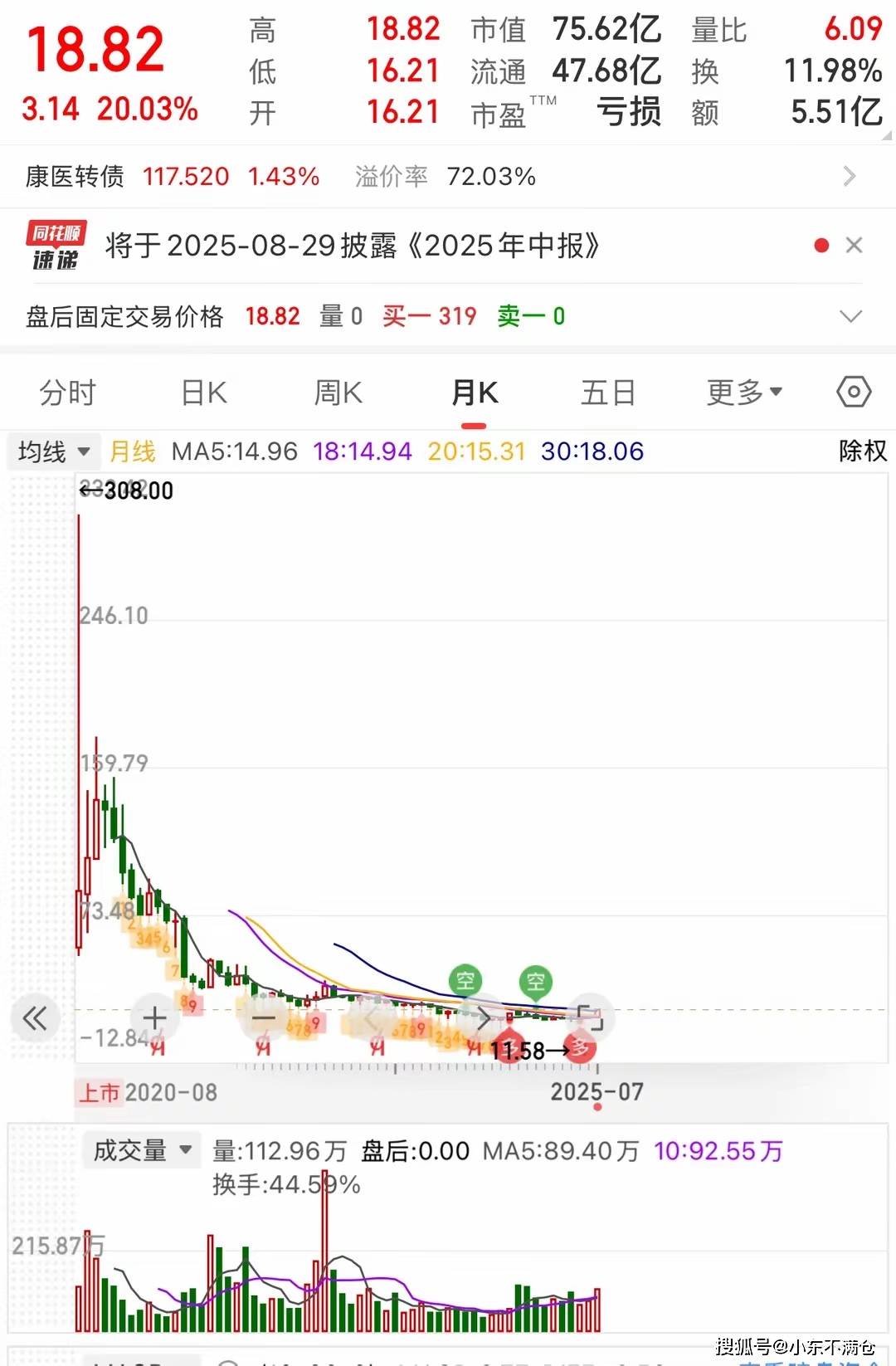
上市5年,股价经过5次腰斩,从308元跌到18,公司终于卖给散户了!
Sou Hu Cai Jing· 2025-07-30 09:49
Core Viewpoint - The stock of Kangtai Medical has experienced a dramatic decline from its peak price of 308 yuan to around 18 yuan, leading to significant losses for retail investors, while the company's owner has been cashing out during this downturn [1][3][8]. Company Overview - Kangtai Medical, listed on the ChiNext board on August 24, 2020, specializes in the research, production, and sales of medical diagnostic and monitoring equipment, with a product range that includes blood oxygen monitors, ECG devices, ultrasound equipment, and digital health services [5][8]. Stock Performance - The stock price surged to 308 yuan on its first trading day, representing a more than 30-fold increase from its initial offering price of 10.16 yuan, but has since plummeted, with the lowest recorded price around 11 yuan [8][10]. - The company's market capitalization has decreased to approximately 7.562 billion yuan, with a current stock price of 18.82 yuan [6][9]. Financial Performance - Kangtai Medical reported a net profit of 3.524 billion yuan in 2021, a decline of 42.56% year-on-year, and further decreased to 1.962 billion yuan in 2022, down 44.32% year-on-year. By 2024, the company reported a net loss of 77.9 million yuan, a decline of 147% year-on-year [8][12]. Management Actions - The owner, Hu Kun, holds 188 million shares and announced plans to sell 12 million shares at the lowest stock price, cashing out over 160 million yuan, which has angered investors [3][10]. - Despite the company's losses, Hu Kun's family received nearly 50 million yuan in dividends from a 100 million yuan distribution, raising concerns among shareholders [12][14]. Investor Sentiment - Retail investors express frustration over the company's management and stock performance, feeling that they have been misled and financially harmed, with many feeling trapped in their investments [16].

企业优质和价格便宜,谁更重要?
雪球· 2025-07-30 08:29
Core Viewpoint - The article emphasizes the importance of both selecting the right company and buying at the right price in investment decisions, with a stronger focus on the reliability of the company first and then the price being reasonable [3]. Group 1: Investment Philosophy - Value investing is fundamentally about finding a price that offers a margin of safety compared to the intrinsic value of a company, making price a critical factor in investment decisions [4][5]. - The concept of "reasonable price" is often misunderstood; it is not about absolute numbers but rather the relationship between current money and future earnings [4][8]. - Buffett's investment decisions are not influenced by short-term market variables like index movements or economic cycles; instead, he focuses on whether the price is attractive relative to the company's intrinsic value [5][6]. Group 2: Historical Examples - Historical investments by Buffett, such as in Washington Post and GEICO, illustrate his strategy of buying when prices are low relative to intrinsic value, regardless of market conditions [6][7]. - Buffett's approach includes revisiting previous investments to determine if they are worth adding to, based on current pricing [6][7]. Group 3: Investment Mindset - The essence of investing is to find opportunities where the price is significantly lower than the intrinsic value, exemplified by the saying "buying $1 for $0.40" [8]. - Many investors focus on short-term price movements rather than the distance between current prices and intrinsic values, which can lead to missed opportunities [8][9]. - Buffett advocates for purchasing high-quality companies at reasonable prices rather than low-quality companies at low prices, as the former will likely appreciate in value over time [9].

这些年对“价值”的理解有很多变化!“安全边际之父”赛思·卡拉曼最新对话:最糟糕的日子能做到这三点,会是一种竞争优势……
聪明投资者· 2025-07-30 07:05
Core Insights - The primary need for investors hiring investment managers is to avoid mistakes and manage emotional impulses rather than solely to maximize returns [3][28] - Long-term investment success requires a unique approach, while excessive differentiation can lead to failure [3] - The concept of "margin of safety" is crucial, allowing for potential errors by purchasing assets at a sufficiently low price [3][8] - Maintaining a calm, open mindset and readiness to act during challenging times can provide a competitive advantage [3][50] Group 1: Investment Philosophy - Seth Klarman emphasizes the importance of risk control over absolute returns, noting that Baupost has only experienced five years of negative returns in its 42-year history, with a maximum drawdown of 12% [5][74] - The investment strategy focuses on constructing a portfolio that effectively protects against downside risks, including cash reserves and prioritizing high-quality debt instruments [10][72] - Klarman's approach to value investing has evolved, now considering not just tangible asset values but also the potential for value realization and market recognition [8][13] Group 2: Decision-Making Process - Baupost's investment decision-making involves multiple team members, including partners and analysts, who rigorously evaluate potential investments [34][39] - Discussions often center around risk assessment, with team members encouraged to challenge assumptions and consider potential pitfalls [41][46] - The culture at Baupost promotes open dialogue, allowing team members to express differing opinions without fear of repercussions [45][46] Group 3: Market Conditions and Opportunities - Klarman notes that the current market environment, characterized by rising interest rates, presents both challenges and opportunities, particularly in the private credit sector [66][68] - The firm is currently focusing on distressed assets and credit opportunities, with a significant portion of its portfolio allocated to these areas [62][63] - The investment strategy remains flexible, adapting to market conditions without adhering to a rigid allocation framework [61][62] Group 4: Psychological Factors in Investing - Baupost places significant emphasis on psychological factors in investment decisions, aiming to avoid panic and emotional reactions during market downturns [47][50] - Klarman believes that maintaining composure and an open mindset during adverse market conditions can lead to advantageous investment opportunities [50][52] - The firm encourages a culture of resilience, where team members are trained to recover from investment setbacks and maintain a long-term perspective [71][72]

如果行情持续向好,你是否做好了准备!
申万宏源证券上海北京西路营业部· 2025-07-30 02:13
Core Viewpoint - The current market shows signs of sector rotation and a potential risk of missing out on opportunities, despite a challenging environment and low trading volume [1][3]. Group 1: Market Characteristics - There is a continuous expansion of sector rotation effects, with increasing attention from funds on various sectors [1]. - Despite a poor market environment, there appears to be a notable profit-making effect, suggesting that the main risk may stem from missing out on opportunities [1]. Group 2: Investment Strategies - Investors often fall into a cycle of chasing hot stocks, getting trapped, cutting losses, and then chasing new hot stocks again, which can lead to missed opportunities [3]. - It is crucial to prioritize companies with strong fundamentals, good performance, and high industry sentiment while avoiding speculative stocks without earnings support [9]. - Maintaining patience and trusting in the power of trends is essential, as is using pullbacks to enter or increase positions in favored stocks at more reasonable prices [9]. - Strictly executing stop-loss and take-profit strategies is vital for preserving profits and controlling risks, especially overcoming greed when taking profits [9]. - Dynamic management of positions is necessary, gradually reducing overall exposure as market risks increase and avoiding concentration in a few stocks [9]. Group 3: Psychological and Systematic Approaches - Investors should not be swayed by market emotions and must adhere to their investment systems and discipline, as steady compound growth is more reliable than short-term wealth fantasies [8]. - A focus on long-term value investing and avoiding frequent trading due to short-term volatility is recommended, with an emphasis on building a diversified portfolio across different sectors [15]. - Investors should operate within their knowledge circles, selecting undervalued stocks with solid cash flow and dividend yields, and be prepared to take advantage of irrational market undervaluations [18].
【私募调研记录】龙航资产调研益方生物
Zheng Quan Zhi Xing· 2025-07-30 00:11
Group 1 - Longhang Asset recently conducted research on Yifang Bio, highlighting the latest progress of several investigational drugs [1] - D-2570 is planned for clinical exploration in multiple autoimmune diseases, with Phase II clinical trials for ulcerative colitis already initiated [1] - The drug Gesorex (brand name Anfangning) received approval from the National Medical Products Administration for the treatment of advanced non-small cell lung cancer (NSCLC) in adults with KRS G12C mutations, with multiple clinical studies ongoing [1] - D-0502 is undergoing Phase III clinical trials both domestically and internationally, showing promising safety and anti-tumor effects [1] - D-0120 has completed Phase IIb clinical trials, while preclinical studies for YF087 and YF550 have made progress [1] Group 2 - Longhang Asset Management Company is a professional asset management firm based in Shanghai, with a core team possessing 18 years of industry investment experience [2] - The company adheres to a value investment philosophy, utilizing various financial tools to manage client assets for sustainable growth [2] - Longhang Asset emphasizes research-driven investment and the importance of a rigorous scientific investment process [2]
