碳中和

Search documents
上海首个本地绿色甲醇项目将于今年年底投产
Jie Fang Ri Bao· 2025-10-11 07:15
Core Viewpoint - The International Maritime Organization is set to review a legally binding framework for net-zero emissions in the global shipping industry by 2050, which will significantly increase the demand for clean energy sources like green methanol [1] Group 1: Green Methanol Development - Shanghai is actively developing the upstream and downstream industrial chain for green methanol, with the first local green methanol project expected to be operational by the end of this year [1] - The project aims to address livestock waste and wet garbage disposal issues while enhancing green fuel supply services at Shanghai Port [1] Group 2: Waste-to-Energy Innovations - The livestock sector contributes 14.6% of global greenhouse gas emissions, with methane from animal waste being a major contributor [2] - A collaboration among several companies has led to the development of a process that converts livestock waste into biogas, which is then purified into pipeline-quality biogas, reducing CO2 emissions by over a thousand tons [2][3] - The byproducts of this process, such as biogas and organic fertilizers, contribute to a circular economy by improving soil fertility and providing feed for livestock [3] Group 3: Strategic Positioning in Shipping - Green methanol is emerging as a mainstream alternative to traditional fuels in the shipping industry, with the International Maritime Organization requiring a 20% reduction in carbon emissions by 2030 compared to 2008 levels [5] - Shanghai Port is one of the few ports capable of supplying green methanol, positioning itself competitively in the international shipping market [5] - The city has established a comprehensive natural gas network that supports the production and transportation of green methanol, ensuring low carbon emissions [5] Group 4: Expansion of Production Capacity - A new integrated project in Jilin Province is expected to produce 50,000 tons of green methanol annually, with plans to expand to 200,000 tons, contributing to Shanghai's supply chain [6] - Shanghai aims to achieve a dual target by 2030, with liquefied natural gas refueling capacity reaching 1 million cubic meters and green methanol capacity reaching 1 million tons [7] Group 5: Technological Advancements - Shanghai is exploring multiple technological routes for green fuel production, including electric synthetic fuels and carbon capture utilization [8] - The city is leveraging its unique advantages in biomass resource utilization to enhance energy security and reduce dependence on imported natural gas [9] Group 6: Sustainable Urban Development - The initiative represents a new path for urban green development, integrating waste resource utilization, bioenergy, green fuel, and low-carbon shipping into a complete ecosystem [9]

“一带一路”俄罗斯工业高温电热元件市场消费结构分析及投资潜力评估预测报告(2025版)
Sou Hu Cai Jing· 2025-10-11 02:25
Core Insights - The industrial high-temperature electric heating elements market is projected to grow steadily, with a global market size expected to reach approximately $750 million by 2025 and $1.0821 billion by 2031, reflecting a compound annual growth rate (CAGR) of 6.3% from 2025 to 2031 [4][6] - The industry is supported by favorable policies promoting energy efficiency and carbon reduction, with significant investments in high-performance materials like silicon carbide and molybdenum disilicide [6][7] - Key trends include material innovation, smart upgrades, energy-saving developments, application expansion in emerging fields, and an optimized competitive landscape [6][7] Market Overview - The industrial high-temperature electric heating elements are specialized devices that convert electrical energy into high-temperature thermal energy, with applications across various sectors including metallurgy, ceramics, and glass processing [3] - The supply chain consists of raw material suppliers, manufacturing processes, and end-user applications, with a focus on high-purity materials and precision manufacturing technologies [3][4] Competitive Landscape - By 2025, the top 10 global manufacturers are expected to dominate the market, leveraging technological and scale advantages, while smaller companies focus on regional markets and niche applications [4][6] - The industry faces challenges such as high material and manufacturing costs, aging and stability issues of components under extreme conditions, and significant technical barriers for small enterprises [7] Future Trends - Five core trends are anticipated: 1. Material innovation with new ceramic composites and high-purity silicon carbide [6] 2. Smart upgrades integrating heating elements with control systems and data platforms [6] 3. Energy efficiency improvements aligning with carbon neutrality goals [6] 4. Rapid growth in demand from semiconductor, photovoltaic, and hydrogen energy sectors [6] 5. A competitive landscape shaped by global and local enterprises through collaborations and acquisitions [6][7]


把握我国碳金融发展的未来方向与政策路径
Zhong Guo Yin Hang· 2025-10-11 01:15
Group 1: Current State of Carbon Finance in China - Carbon finance in China is still in its early development stage, with the national carbon market officially launched in 2021 and local markets starting from 2013[7] - As of August 2022, the Shanghai carbon market had conducted 16 carbon quota pledge financing transactions totaling over 41 million yuan, while the Guangdong market had 31 transactions totaling 93 million yuan[8] - The financing scale of carbon finance is insufficient compared to the over 40 trillion yuan in green loans available in China[8] Group 2: Future Directions for Carbon Finance Development - The national carbon market is expected to cover 8 billion tons of carbon emissions by 2025, making it the largest carbon market globally[10] - The development of financing tools should be prioritized to enhance the role of the carbon market in promoting green finance[11] - It is estimated that achieving carbon neutrality in China may require over 100 trillion yuan in cumulative investment[15] Group 3: Policy Recommendations for Carbon Finance - Emphasizing carbon pledge financing as a key area, with a need to clarify the financing model and extend loan periods beyond the current compliance cycle[26] - Developing a comprehensive financing product system that includes carbon repurchase agreements and carbon bonds to provide both short-term and long-term financing[27] - Establishing a quota reserve and market adjustment mechanism to prevent extreme price fluctuations in the carbon market[30]
MOFs技术荣膺2025诺贝尔化学奖,产业领跑者蓝壳洁能迎来蝶变时刻
DT新材料· 2025-10-10 16:04
Core Viewpoint - The article highlights the significant advancements and commercialization potential of Metal-Organic Frameworks (MOFs) materials, particularly in carbon capture and utilization (CCUS) technologies, positioning the company as a leader in this emerging field [2][4][9]. Group 1: MOFs Materials and Nobel Prize Recognition - MOFs materials have been awarded the 2025 Nobel Prize in Chemistry, recognizing their revolutionary applications in carbon capture, gas separation, and water harvesting [2]. - The recognition signifies a global consensus on the immense potential of MOFs, described as "target function editable" materials that can address major global challenges [2]. Group 2: Industrial Applications and Collaborations - The company has partnered with China National Petroleum Corporation to leverage MOFs technology in industrial gas separation, focusing on decarbonization processes in oil fields [4]. - A significant breakthrough includes the establishment of the world's largest MOFs slurry method carbon capture and utilization project, which has processed 32 million cubic meters of associated gas [6][8]. Group 3: Innovations in Material Synthesis and Gas Separation - The company has developed a hundred-ton MOFs industrial synthesis facility, significantly reducing production costs and overcoming barriers to commercialization [5]. - A novel MOFs slurry method for gas separation has been created, achieving energy consumption for CO₂ capture as low as 0.8-1.0 GJ/t CO₂, which is 50% lower than traditional amine methods [6][7]. Group 4: Commercialization and Strategic Investments - The company has successfully implemented the first domestic MOFs carbon capture project in Xinjiang, utilizing industrial waste heat for gas separation [8]. - Strategic investment from the CCI Fund has accelerated the commercialization of MOFs gas separation technology, reinforcing the company's position in the market [8]. Group 5: Future Directions and Technological Leadership - The company aims to contribute to China's carbon peak goals by innovating in CO₂ capture and methane separation technologies, anticipating rapid growth in the CCUS sector over the next decade [9]. - The development of ethane separation technology using oil-based MOFs is expected to support the petrochemical industry's transition to high-value chemical production [9][10].
【深度】液冷:智算中心散热核心技术(附42页PPT)
材料汇· 2025-10-10 15:43
Core Viewpoint - The article emphasizes that liquid cooling is becoming the mainstream cooling technology for intelligent computing centers due to the increasing power density of AI chips and the limitations of traditional air cooling methods. The global liquid cooling market is expected to experience significant growth, with a projected market size of over $10 billion by 2026 [3][46]. Investment Summary - The rise in AI chip power and cabinet density is driving the adoption of liquid cooling solutions, with leading overseas companies advancing full liquid cooling solutions [4][5]. - The liquid cooling market in North America is projected to reach $10 billion by 2026, driven by the demand for NVIDIA GPUs and the adoption of liquid cooling by CSP cloud manufacturers [5][57]. - In China, the liquid cooling market is expected to reach approximately 21.1 billion yuan by 2027, with a significant increase in penetration rates [52]. Liquid Cooling Technology - Liquid cooling offers advantages over air cooling, including faster temperature transfer, higher heat removal capacity, lower noise, and energy savings [6][12]. - The liquid cooling architecture can be divided into two parts: the room side (including primary and secondary equipment) and the ICT equipment side [8][30]. - The main types of liquid cooling include cold plate, immersion, and spray cooling, with cold plate technology currently being the most widely used [28][30]. Market Drivers - The increasing power density of computing chips necessitates liquid cooling as a primary solution for heat dissipation in intelligent computing centers [15][23]. - Stricter energy efficiency regulations for data centers, such as PUE requirements, are pushing the adoption of liquid cooling to reduce overall energy consumption [23][26]. - Major CSP cloud manufacturers are designing and implementing liquid cooling solutions, further driving market growth [26][27]. Component Analysis - The liquid cooling system consists of primary and secondary components, with significant value attributed to components like CDU, liquid cooling cabinets, and air conditioning systems [53][56]. - The value of liquid cooling components is expected to increase as the market grows, with specific components like CDU accounting for about 30% of the total value [56][57]. Future Outlook - The liquid cooling market is anticipated to grow rapidly, with projections indicating that by 2026, the global market could exceed $10 billion, driven by advancements in AI technology and increasing demand for efficient cooling solutions [46][57]. - The article suggests that companies with system-level understanding and specialized cooling capabilities will benefit the most from this industry development [4].



新能源板块集体调整,储能电池ETF(159566)今日获超5000万份净申购
Mei Ri Jing Ji Xin Wen· 2025-10-10 13:49
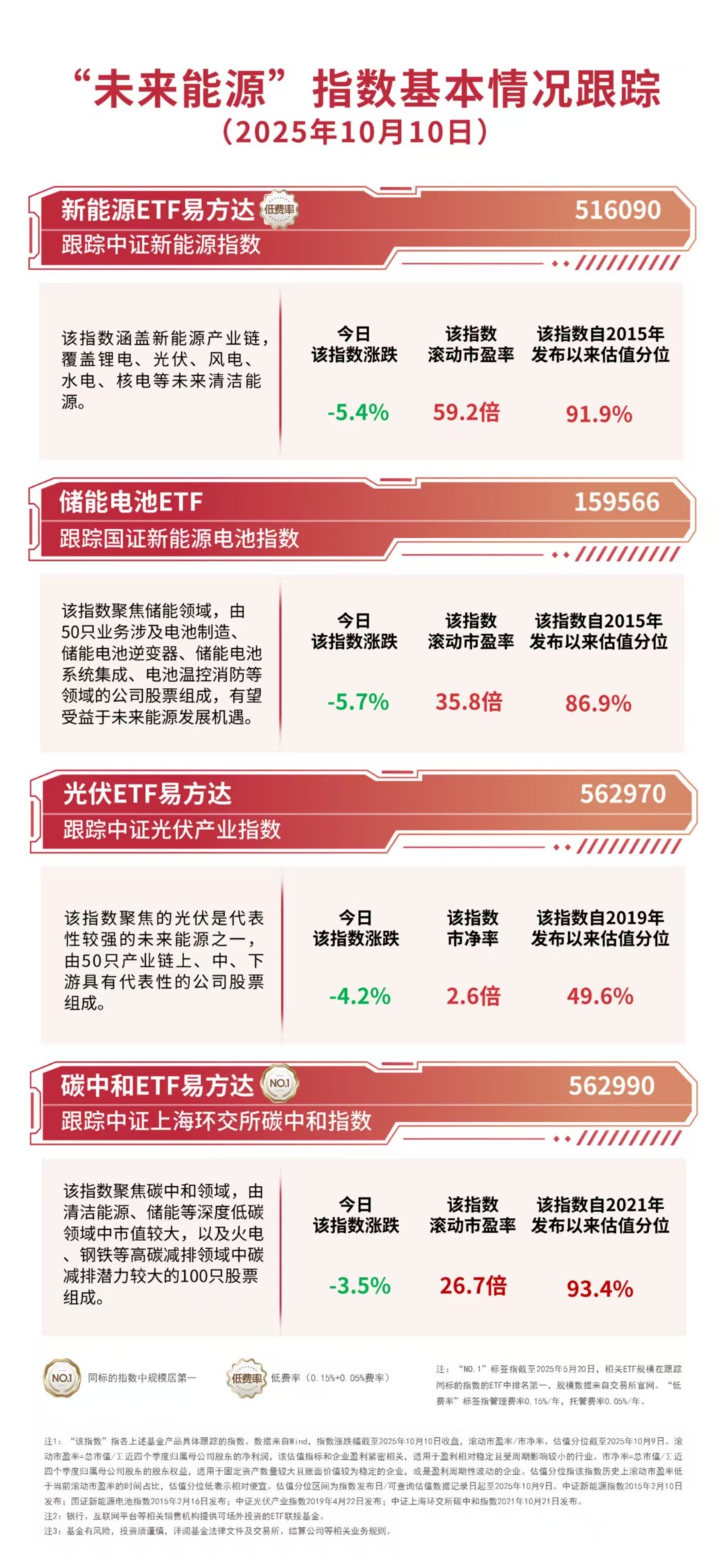
Core Insights - The renewable energy sector experienced a collective adjustment today, with significant declines in various indices, including a 5.7% drop in the National Renewable Battery Index and a 5.4% drop in the China Securities Renewable Energy Index [1][4]. Group 1: Index Performance - The National Renewable Battery Index fell by 5.7%, while the China Securities Renewable Energy Index decreased by 5.4% [1]. - The China Securities Photovoltaic Industry Index saw a decline of 4.2%, and the Shanghai Environmental Exchange Carbon Neutrality Index dropped by 3.5% [1]. Group 2: ETF Activity - The Energy Storage Battery ETF (159566) recorded over 50 million net subscriptions throughout the day, continuing a trend of attracting capital for six consecutive trading days, totaling over 500 million yuan [1]. - The ETF tracking the China Securities Renewable Energy Index has a rolling P/E ratio of 59.2 times, with a valuation percentile of 91.9% since its inception in 2015 [2]. - The ETF focused on energy storage, which tracks the National Renewable Battery Index, has a rolling P/E ratio of 35.8 times and a valuation percentile of 86.9% since its inception [2].
维尔利(300190):引领生物天然气,赋能绿色未来
Changjiang Securities· 2025-10-10 12:52
Investment Rating - The report initiates coverage with a "Buy" rating for the company [9][11]. Core Insights - The company has a strong foundation in environmental protection and is transitioning into the biogas sector, leveraging its existing capabilities to tap into the growing demand for renewable energy [2][5]. - The biogas market is expected to experience rapid growth, driven by policy support and the need for low-carbon energy solutions, with the company's production capacity projected to reach 1 million cubic meters per day by 2027 [2][6]. - The company is well-positioned to benefit from the increasing green premium associated with biogas, which enhances its cost competitiveness against traditional energy sources [7][8]. Summary by Sections Company Overview - The company has a long history in environmental services, focusing on waste treatment and expanding into biogas production as part of its growth strategy [19][21]. - It has established itself as a leader in the domestic leachate treatment market and is diversifying into various segments of municipal and industrial environmental protection [5][19]. Biogas Market Potential - Biogas, derived from organic waste, presents a dual value proposition of environmental protection and energy generation, making it a key area for development under carbon neutrality goals [6][46]. - The global biogas production is projected to grow significantly, with an expected compound annual growth rate of 14% from 2024 to 2040, highlighting the market's potential [6][53]. Financial Performance and Projections - The company faced challenges in its traditional business segments, leading to a decline in revenue; however, operational cash flow is expected to improve in 2024 [26][36]. - Earnings per share (EPS) projections for 2025, 2026, and 2027 are estimated at 0.05, 0.50, and 0.86 yuan, respectively, indicating a recovery trajectory [9][11]. Strategic Initiatives - The company is focusing on resource acquisition and technological innovation to drive its biogas projects, with plans to enhance its operational capabilities through partnerships and research collaborations [8][42]. - The integration of traditional waste management with biogas production creates a synergistic ecosystem that enhances both environmental and economic outcomes [42][43].

维尔利(300190):引领生物天然气 赋能绿色未来
Xin Lang Cai Jing· 2025-10-10 12:33
Core Viewpoint - The company is transitioning from its traditional environmental protection business to the biogas industry, leveraging its existing capabilities in waste treatment to tap into the growing demand for renewable energy sources [1][2]. Group 1: Company Overview - The company started with environmental protection services, focusing on waste treatment, including leachate, kitchen waste, and mixed waste [1]. - It has established a leading position in the domestic leachate treatment sector and is expanding into various municipal and industrial environmental protection niches [1]. - The company has faced performance pressures and losses since 2022 due to intensified competition in the environmental sector, but operational cash flow is expected to improve in 2024 [1]. Group 2: Biogas Market Potential - Biogas, produced from organic waste such as crop residues and kitchen waste, is gaining traction as a dual-purpose solution for both environmental protection and energy generation [2]. - The global biogas production is projected to grow from 9.6 billion cubic meters in 2024 to 74.8 billion cubic meters by 2040, with a compound annual growth rate of 14% [2]. - China has abundant resources for biogas production, which is crucial for energy security and achieving carbon peak goals, indicating a rapid industrialization phase during the 14th Five-Year Plan [2]. Group 3: Technological and Operational Strengths - The company is one of the early entrants in the domestic environmental sector, with a strong track record of successful projects that facilitate rapid resource acquisition [3]. - It aims to scale biogas production to 500,000 cubic meters per day by 2025 and 1 million cubic meters per day by 2027 [3]. - The company emphasizes research and development, maintaining a leading position in patent numbers and R&D expenditure, and is recognized for its innovative projects in high-value biogas utilization [3]. Group 4: Financial Projections - The company projects earnings per share (EPS) of 0.05 yuan, 0.50 yuan, and 0.86 yuan for the years 2025, 2026, and 2027, respectively [4]. - Corresponding price-to-earnings (PE) ratios are expected to be 82.94X, 8.16X, and 4.71X based on the closing price on October 9, 2025 [4].
全线飘红!挚达科技上市首日大涨192.14% 成就新能源板块新旗帜
Jing Ji Guan Cha Wang· 2025-10-10 12:01
Core Viewpoint - Shanghai Zhida Technology Development Co., Ltd. (referred to as "Zhida Technology" or "the company") successfully launched its IPO on the Hong Kong Stock Exchange, with a strong first-day performance, closing at HKD 195.5, a 192.14% increase from the issue price of HKD 66.92 [1] Group 1: Company Overview - Established in 2010, Zhida Technology specializes in home electric vehicle charging solutions, including smart charging hardware, installation services, and digital platforms [2] - The company ranks first in China in terms of sales volume and revenue of home electric vehicle charging piles, with a global market share of 9.0% in sales volume and 5.7% in revenue [2] - Zhida Technology has shipped a total of 1.3 million home electric vehicle charging piles globally and has obtained safety certifications from both European and American standards [2] Group 2: Global Expansion Strategy - The company is accelerating global expansion through a clear strategic layout, focusing on five dimensions: products, services, manufacturing, branding, and channels [2] - Product globalization is the core foundation of Zhida Technology's overseas expansion, with successful entry into markets such as Thailand, Brazil, Australia, Malaysia, and Indonesia [3] - The company plans to establish localized service centers and collaborate with local service providers to enhance global customer support capabilities [3] Group 3: Manufacturing and Brand Development - Zhida Technology's manufacturing facility in Thailand, set to commence operations in April 2024, will have an annual production capacity of 108,000 charging piles, serving as a hub for the Southeast Asian market [3] - The company aims to strengthen brand recognition and reputation through partnerships with domestic automobile manufacturers and by showcasing advanced charging solutions [3] Group 4: Market Trends and Long-term Value - The growth trajectory of Zhida Technology is closely tied to the globalization of China's renewable energy industry and the global "carbon neutrality" trend, presenting long-term development opportunities [4] - As a leading player in the home charging pile market, Zhida Technology is well-positioned to leverage the overseas channels of Chinese electric vehicle manufacturers to accelerate product exports [4] - The company is targeting the significant market demand for home charging piles, which are essential for the global energy transition [4] Group 5: Future Outlook - Zhida Technology is building a global ecosystem covering "products + services + energy management," with expectations for revenue growth as production capacity in Southeast Asia ramps up and market channels in Europe and the U.S. expand [5] - The company is anticipated to optimize its revenue structure, with high-margin products and overseas business growth contributing to profitability in the long term [5]
分布式能源规划员(综合能源服务方向)培训火热报名中
中国能源报· 2025-10-10 10:09
Core Viewpoint - The article emphasizes the importance of developing distributed energy and integrated energy services as a crucial path towards carbon neutrality, highlighting the need for skilled professionals in energy planning and management [1]. Group 1: Training Overview - The training titled "Distributed Energy Planner (Integrated Energy Services Direction)" is organized to address the shortage of interdisciplinary professionals in the energy sector [1]. - The training will be conducted online from October 22 to 25, 2025, and is organized by the Human Resources and Social Security Department [2]. Group 2: Target Audience - The training is aimed at various stakeholders including power companies, energy groups, new energy enterprises, and professionals interested in the integrated energy services sector [2]. Group 3: Course Outline - The course covers a comprehensive overview of integrated energy services, including its development trends and project planning [3]. - It includes modules on the application of distributed photovoltaic projects, natural gas distributed energy, wind energy, hydrogen energy, new energy storage, and near-zero carbon factory assessments [4]. Group 4: Training Costs - The training fee is set at 3,600 yuan per person, which includes training materials and certification costs [4].