
光伏行业反内卷

Search documents
多重利好下供需现改善迹象 硅料价格呈现触底企稳态势
Zheng Quan Ri Bao Wang· 2025-07-10 03:31
Core Viewpoint - The recent trend in the photovoltaic industry indicates a recovery in silicon material prices, driven by industry self-discipline and favorable policies [1][2][4] Group 1: Silicon Material Price Trends - The latest data from the China Nonferrous Metals Industry Association's Silicon Industry Branch shows that silicon material prices have continued to rise, with multi-crystalline silicon N-type raw materials and N-type granular silicon prices increasing by 6.92% and 6.27% respectively [1] - Multi-crystalline silicon prices have been significantly adjusted, with a price increase of 25% to 35%, bringing the price range to 45,000 to 50,000 yuan per ton [1] - The mainstream price for N-type dense materials has reached 39 yuan per kilogram, reflecting a 14.71% increase from the previous week [1] Group 2: Market Dynamics and Sentiment - The photovoltaic sector has seen a positive market response, with several companies' stock prices reaching new highs following a recent industry meeting that addressed low-price competition [2] - Analysts express optimism regarding policy-driven structural optimization and market environment improvements within the industry [2] - Although new orders are limited, the execution of previously signed orders has strengthened, indicating a stabilization in the silicon material market [2][3] Group 3: Supply and Demand Conditions - The supply-demand situation for silicon materials has shown signs of improvement, with June's domestic multi-crystalline silicon production at approximately 102,000 tons, matching demand without new inventory accumulation [3] - The total domestic production for the first half of the year was about 596,000 tons, a significant year-on-year decrease of 44.1% [3] - The forecast for global multi-crystalline silicon demand in 2025 is around 1.4 million tons, with domestic demand expected to be approximately 1.3 million tons [3] Group 4: Industry Outlook - The current policies are focused on market regulation and resource concentration, which may lead to the faster elimination of high-cost production capacities [3] - The industry is expected to undergo a structural transformation towards refined management, with a significant improvement in supply-demand dynamics anticipated post-2026 [3] - The ongoing "anti-involution" movement serves as a test of comprehensive cost strength among companies, with those facing long-term inventory accumulation and cash flow issues at risk of production halts [3][4]




光伏生死局:行业打响“反内卷”保卫战,企业“减产自救”
Nan Fang Du Shi Bao· 2025-07-08 15:51
Core Viewpoint - The photovoltaic industry is facing severe price competition, leading to significant losses for companies, prompting a call for "anti-involution" measures to ensure sustainable development and product quality improvement [1][3][10]. Industry Overview - The Central Economic Committee has mandated the regulation of low-price competition in the photovoltaic sector, aiming to enhance product quality and facilitate the exit of outdated production capacity [1][10]. - The photovoltaic sector has seen a strong rebound in stock prices since early July, with companies like Tongwei Co., Ltd. and Longi Green Energy experiencing significant gains [1]. Financial Performance - Longi Green Energy reported a revenue of 82.58 billion yuan in 2024, a year-on-year decline of 36.23%, with losses exceeding 8.6 billion yuan, marking a staggering drop of 180.15% [3][6]. - The gross margin for Longi's silicon wafer and rod segments was reported at -14.31%, a decline of 30.19%, while the module and battery segments had a gross margin of only 6.27%, down 12.11% [5][6]. Market Dynamics - The photovoltaic industry is experiencing a supply-demand imbalance, leading to excessive competition and price drops that have resulted in many companies operating at a loss [3][7]. - The price of photovoltaic glass has significantly decreased, with a 24% drop for 2.0mm glass and an 18% drop for 3.2mm glass expected in the first half of 2025 [7][10]. Production Adjustments - In response to the ongoing price competition, major photovoltaic glass manufacturers have agreed to collectively reduce production by 30% starting in July [8][10]. - Many silicon wafer manufacturers are also planning to cut their operating rates by approximately 40% to mitigate losses and stabilize prices [10]. Regulatory Response - The manufacturing sector's recent meetings have emphasized the need for comprehensive governance of low-price competition and the promotion of product quality to achieve healthy and sustainable industry growth [1][10].


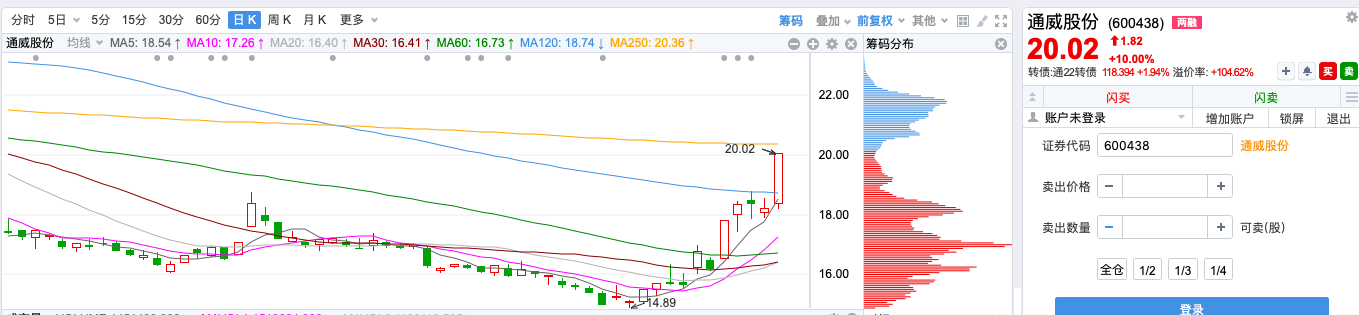
通威股份(600438):公司动态研究报告:硅料龙头地位稳固,关注行业供给侧改善
Huaxin Securities· 2025-07-08 11:43
Investment Rating - The report assigns a "Buy" investment rating for Tongwei Co., Ltd. (600438.SH) [2][11] Core Insights - The company maintains a strong position as a leading player in the silicon material sector, with a focus on the improvement of supply-side dynamics in the industry [6][10] - Recent government policies aimed at curbing "involution" competition in the photovoltaic sector are expected to benefit the industry by promoting higher quality development and reducing price wars [6] - The company is expected to benefit from the ongoing reduction in production across the industry, leading to an increase in silicon material prices [7][10] - The company's comprehensive production capabilities span from industrial silicon to end photovoltaic power stations, with significant market share and leading production efficiency [8][10] Financial Projections - Revenue forecasts for the company are projected at 99.55 billion, 123.65 billion, and 137.35 billion yuan for 2025, 2026, and 2027 respectively, with an expected EPS of -0.51, 0.71, and 1.23 yuan [11][13] - The company is anticipated to recover profitability, with a projected net profit of 3.2 billion yuan in 2026 and 5.54 billion yuan in 2027, reflecting a significant turnaround from previous losses [11][13]
市场传言满天飞 多晶硅期货时隔一周再度涨停!价格还要涨多久?
Jin Shi Shu Ju· 2025-07-08 11:03
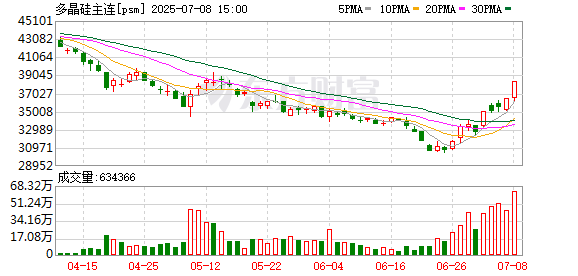
Core Viewpoint - The recent surge in polysilicon futures prices is attributed to various market factors, including government policies aimed at improving industry conditions and rumors regarding potential supply adjustments [2][6][8]. Group 1: Market Dynamics - Polysilicon futures prices hit the daily limit up, closing at 38,385 yuan/ton, with a daily increase of 7% and a trading volume increase of over 5,000 contracts [2]. - The market is experiencing significant speculation, with rumors about cost-based pricing and potential penalties for prices below minimum cost levels [2][3]. - Recent government initiatives encourage the development of high-power charging facilities and the integration of solar power and energy storage, contributing to positive market sentiment [2]. Group 2: Supply and Demand - The current weekly production of polysilicon remains stable at 21,300 tons, but the industry is facing high inventory levels and has been in a loss-making phase since May of the previous year [5][7]. - Demand from the downstream photovoltaic sector is showing signs of improvement, with expectations for increased consumption of polysilicon [5][6]. - Despite the positive price movements, there are concerns about weak downstream demand, which could lead to further declines in consumption if high costs are passed down [7][8]. Group 3: Price Trends - The average market price for N-type polysilicon has risen to 39 yuan/kg, reflecting a 3 yuan/kg increase from the previous period [4][5]. - P-type polysilicon prices remain stable, with no changes reported, while N-type products are experiencing significant price increases [5]. - The overall market sentiment indicates a potential for price recovery, but the lack of substantial support from actual transactions raises concerns about the sustainability of the price increases [5][6].
BC电池概念股集体大涨 八大概念股盘点(名单)
Zheng Quan Zhi Xing· 2025-07-08 07:19
Core Viewpoint - The BC battery sector has seen a collective surge of over 4% as of July 8, with several stocks, including Tongwei Co., Ltd. and Junda Co., Ltd., reaching their daily limit up [1] Industry Summary - BC batteries, or back-contact batteries, integrate both positive and negative metal contacts on the back, allowing for a design that absorbs more sunlight and offers higher efficiency, particularly suitable for distributed photovoltaic and commercial rooftop applications [1] - By April 2025, the mass production efficiency of BC batteries is expected to exceed 27%, with a theoretical efficiency limit of 29.1% [1] - Recent discussions in the photovoltaic industry have focused on "anti-involution," with the Ministry of Industry and Information Technology emphasizing the need for lawful and orderly competition, which is expected to enhance market expectations for the healthy development of the photovoltaic industry [1] - The BC battery technology is positioned as a high-efficiency, high-value photovoltaic technology, offering better performance compared to traditional P-type and TOPCon batteries, and is anticipated to play a significant role in the industry's transformation and upgrade [1] Company Summary - Longi Green Energy (601012) has a BC production capacity of 30GW HPBC (High-efficiency Passivated Back Contact) battery project, which is already in mass production [2] - Junda Co., Ltd. has established an experimental line for BC products based on N-type technology, moving towards pilot testing and mass production of N-type products [2] - Tongwei Co., Ltd. has a comprehensive layout in various technology routes, including TOPCon, HJT, BC batteries, and perovskite/silicon tandem batteries, with ongoing breakthroughs in N-type batteries [2] - Dongcai Technology (601208) focuses on technological innovation and explores differentiated photovoltaic product development strategies, with products already applied to BC batteries [2] - Jiejia Weichuang (300724) is developing XBC battery testing and sorting equipment to address issues related to the positioning accuracy of battery grid lines on the back [3] - Foster (603806) is the largest supplier of packaging materials for Longi and Aiko's BC batteries [4] - Aiko Co., Ltd. (600732) has launched a new generation of N-type back-contact ABC battery technology components and photovoltaic energy solutions [4] - TCL Zhonghuan (002129) is enhancing its product lineup by transforming TOPCon standard component production lines and establishing a 2GW BC component production line [4]


政策“组合拳”,光伏企业密集发声“反内卷
Mei Ri Jing Ji Xin Wen· 2025-07-07 06:25
Group 1 - The Ministry of Industry and Information Technology held the 15th manufacturing enterprise symposium focusing on accelerating the high-quality development of the photovoltaic industry [1] - 14 photovoltaic industry enterprises and association leaders shared insights on production operations, technological innovation, market competition, and industry ecosystem construction [1] - Longi Green Energy emphasized the importance of addressing low-price competition and optimizing capacity, creating structural opportunities for technologically advanced companies [1] Group 2 - Trina Solar highlighted the need for capacity integration to leverage the leading role of major enterprises and avoid disorderly competition [1] - JinkoSolar pointed out the urgency of addressing "involution" competition, reflecting the government's commitment to managing disorderly competition in the photovoltaic industry [1] - Minsheng Securities noted that the photovoltaic industry is currently at the bottom in terms of prices and profitability, with expectations for a rebound through policy and industry self-discipline [2]

光伏行业内卷68家公司年亏257亿 工信部出手治理推动减产创新寻出路
Chang Jiang Shang Bao· 2025-07-06 22:33
Core Viewpoint - The article highlights the urgent need for the photovoltaic (PV) industry to combat "involution," characterized by excessive competition leading to low prices and reduced profitability, as emphasized by recent government meetings and industry responses [1][18]. Industry Overview - The PV industry has experienced a dramatic shift from profitability in 2023 to significant losses in 2024, with 68 PV equipment companies collectively losing approximately 257 billion yuan, compared to a profit of 993 billion yuan in 2023 [3][9]. - Major companies like Tongwei Co., Longi Green Energy, and JinkoSolar reported substantial revenues exceeding 100 billion yuan in 2023, but faced severe losses in 2024, with Longi Green Energy and TCL Zhonghuan losing 98.18 billion yuan and 86.18 billion yuan respectively [7][8]. Competitive Landscape - The industry has seen a split performance, with some segments like PV processing equipment and inverters thriving, while others, particularly silicon wafer and module manufacturers, are struggling with massive losses [3][8]. - The aggressive expansion strategies adopted by leading firms during the high-demand years of 2022 and 2023 have contributed to structural overcapacity and price declines in 2024, leading to a situation where companies are losing money even as they increase sales [10][13]. Policy and Industry Response - The government has initiated measures to regulate low-price competition and promote product quality, with the Central Financial Committee emphasizing the need for orderly market practices [1][18]. - Industry associations and companies are advocating for self-regulation and collaboration to foster a healthier market environment, with initiatives like the "Photovoltaic Industry Cooperation Initiative" signed by nine companies in 2023 [15][16]. Technological Innovation - Companies are increasingly focusing on technological advancements and innovation to improve product quality and operational efficiency, as seen with JinkoSolar's recent achievement in achieving a record conversion efficiency for its N-type solar cells [17][18].

光伏产业出清落后产能需打破地方保护壁垒
Zheng Quan Shi Bao· 2025-07-06 18:14
Core Viewpoint - The photovoltaic industry is facing significant challenges, including continuous losses over multiple quarters, prompting a consensus among industry players to combat "involution" and seek market-driven capacity clearance solutions [2][4][10]. Group 1: Industry Challenges - The photovoltaic industry has been experiencing severe supply-demand mismatches, leading to consecutive quarterly losses [2]. - In 2024, the total revenue of 64 listed photovoltaic companies is projected to be 931.1 billion yuan, a decrease of 22.4% year-on-year, with total net profit dropping from a profit of 104.96 billion yuan in 2023 to a loss of 29.76 billion yuan in 2024 [4]. - The industry is currently in a painful transition period, with many companies understanding the regulatory push against low-price competition and the need for capacity optimization [4][9]. Group 2: Industry Consensus and Actions - A consensus on combating "involution" is forming within the industry, with various segments, including silicon materials and photovoltaic glass, exploring market-driven capacity clearance paths [2][4]. - The Ministry of Industry and Information Technology held a meeting with 14 photovoltaic companies to discuss production, innovation, and market competition, which provided significant confidence to the industry [3][9]. - Industry leaders advocate for a combination of market-driven mergers, technological elimination mechanisms, and policy enforcement to clear outdated capacity [4][10]. Group 3: Market and Policy Dynamics - Companies are exploring market-driven capacity clearance strategies, such as larger firms acquiring smaller ones to stabilize silicon material prices and restore profitability [6][7]. - The photovoltaic glass sector is also expected to reduce production by 30%, with ongoing discussions about capacity clearance [7]. - There is a strong emphasis on the need for policy measures to control new capacity and guide prices back to rational levels, while also promoting technological innovation to facilitate the exit of outdated capacity [9][10].
光伏行业上市公司积极投身“反内卷”行动
Zheng Quan Ri Bao· 2025-07-04 16:13
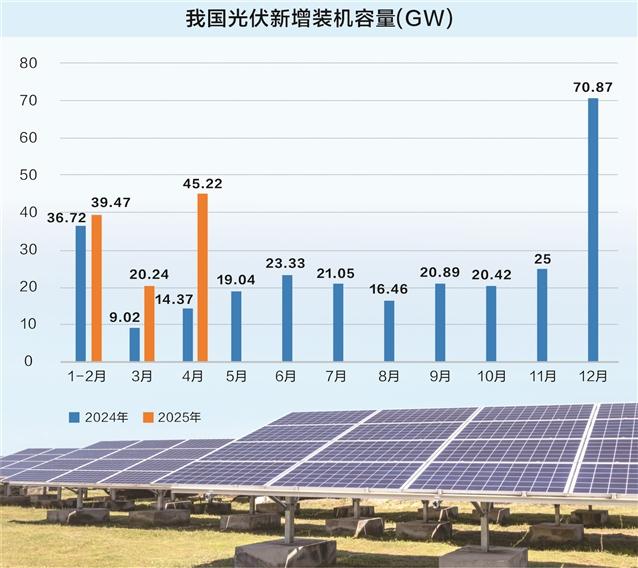
7月3日,工业和信息化部党组书记、部长李乐成主持召开第十五次制造业企业座谈会,聚焦光伏产业高 质量发展。李乐成强调,要依法依规、综合治理光伏行业低价无序竞争,引导企业提升产品品质,推动 落后产能有序退出,实现产业健康、可持续发展。 广州瑞锋企业管理有限公司董事长朱锐铿在接受《证券日报》记者采访时表示,这一举措为处于"内 卷"困境中的光伏企业进一步指明了方向。众多企业已经行动起来,积极投身"反内卷"行动。 政策面指明方向 产业链积极响应 在工信部以及行业协会的引导下,光伏产业链上市公司积极响应"反内卷"号召,从技术研发、海外拓展 等方面着手,共同推动行业高质量发展。 在硅料环节,龙头公司通威股份(600438)有限公司通过优化产能结构和提升技术水平,在行业内带头 推动硅料环节整合。此外,协鑫集团公开表示,公司正与通威股份有限公司联手,全力以赴加快行业供 给侧结构性改革,推动行业整合产能去化。 近年来,虽然我国光伏产业发展迅猛,在全球占据领先地位,但也面临着严重的"内卷"问题。据 Infolink数据,截至2024年末,中国厂商的硅料、硅片、电池、组件四大主产业链产能分别为1360GW、 1154GW、1056G ...
光伏行业“反内卷”可从三方面入手
Zheng Quan Ri Bao· 2025-07-04 16:10
Core Viewpoint - Leading photovoltaic glass companies are proactively reducing production to practice industry self-discipline and address "involution" competition, aiming to stabilize market order and adapt supply and demand [1][2] Industry Overview - Global photovoltaic supply-demand mismatch has led to component prices falling below cost, resulting in continued losses for leading companies in 2024. Proactive production cuts are expected to help restore supply-demand balance [1] - Domestic policies promoting the exit of outdated production capacity are expected to support the industry's efforts to adjust supply [1] Strategic Approaches - Photovoltaic companies should focus on technological iteration to build differentiated competitiveness. The rapid evolution of technology is key to breaking the current deadlock, with three main technology routes competing intensely: TOPCon, BC technology, and perovskite tandem technology [1][2] - Companies need to optimize capacity layout, balancing "capacity reduction" with "shortboard supplementation." Expanding production overseas can help avoid trade barriers and capture incremental demand in emerging markets [2] - Deepening industry chain collaboration is essential, transitioning from mere product suppliers to comprehensive energy service providers. Companies can adopt a "vertical integration" model to reduce costs and explore new application scenarios such as "distributed photovoltaics," "photovoltaics + energy storage," and "photovoltaic hydrogen production" [2]