万物互联

Search documents
重庆、武汉发力开源鸿蒙生态,计划培育聚集超15万开发者
Guan Cha Zhe Wang· 2026-01-29 03:45
Core Insights - Chongqing aims to establish an open-source HarmonyOS application innovation ecosystem with a two-step plan, targeting the creation of key platforms and the cultivation of developers by 2030 [1][2] - The open-source HarmonyOS, supported by Huawei and the OpenAtom Foundation, is rapidly growing, with nearly 1.2 billion devices currently utilizing it [1] Group 1: Development Goals - The plan includes building three core platforms: an open-source Harmony community, an application innovation center, and a pilot verification platform by next year [1] - By 2030, the goal is to cultivate 50,000 developers and establish a concentrated area for open-source Harmony application innovation [1] Group 2: Key Tasks - Five key tasks are outlined to support the ecosystem, including establishing an industrial ecosystem alliance, enhancing technical innovation, and promoting application scenarios [2] - The initiative aims to create a comprehensive ecosystem that supports platform development, technical breakthroughs, application scenarios, and talent retention [2] Group 3: Application Cases - In the healthcare sector, Chongqing has implemented a smart ward using open-source HarmonyOS, featuring over 3,000 devices to enhance nursing efficiency [2] - The industrial control sector is focusing on advanced sensors and automation, showcasing the "hardcore empowerment" capabilities of open-source HarmonyOS [3] - In smart transportation, applications like "Yuzhixing" provide comprehensive services, and a digital control system for highways has been developed, demonstrating the technology's adaptability [3] Group 4: Broader Initiatives - Wuhan is also advancing its open-source Harmony ecosystem, aiming to establish 100 demonstration scenarios and cultivate over 100,000 developers by 2027 [4] - The Ministry of Industry and Information Technology is promoting high-quality development of industrial internet platforms, encouraging collaboration with open-source HarmonyOS [4]


健康机器人为社区空巢老人提供24小时智能看护
Nan Fang Du Shi Bao· 2026-01-28 23:12
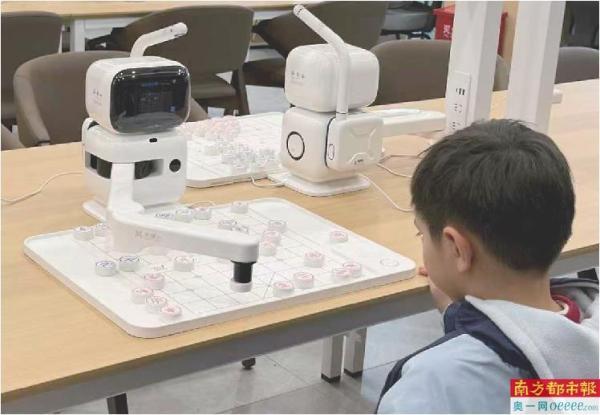
Group 1 - The "Harmony Home·Neighborhood Center" in Longgang District, Shenzhen, aims to create a smart community model that integrates technology into daily life, focusing on "empowering people's livelihoods through technology" [2][5] - The center features a whole-home smart hub that allows residents to control various smart devices through a unified interface, enhancing their experience of smart living [3] - The center will host educational initiatives such as "Harmony Small Classroom" and AI tutoring sessions, providing residents with opportunities for learning and skill development [3] Group 2 - The reading room is integrated with the "City of Libraries" system, enabling convenient book borrowing and returning services for residents [4] - Health services include a 24-hour intelligent care robot for elderly residents and various health-related smart products, enhancing community health support [4] - The center will serve as a model for replicable smart community practices, promoting the benefits of digital transformation and improving residents' quality of life [5]

优克联亮相CES 2026:加码宠物AI手机赛道 展现数字连接新布局
Zheng Quan Ri Bao Wang· 2026-01-09 07:24
Core Insights - The article highlights the growing importance of bridging the digital divide in the context of AI integration into the economy, with a focus on digital infrastructure development [1] - UCL's PetPhone, an AI smart device for pets, has gained significant attention at CES2026, reflecting the company's latest strategies in global connectivity and the pet industry [1] Industry Overview - The global pet industry is projected to reach approximately $207 billion by 2024, with mature markets in Europe and North America leading the way [2] - In the U.S., the estimated number of pet dogs is 65 million and pet cats is 46.5 million for the 2024-2025 period, while Europe is expected to have over 100 million pet dogs and 129 million pet cats in 2024 [2] - China is identified as one of the fastest-growing and most promising markets, with over 50 million pet dogs and nearly 70 million pet cats [2] Product Launch and Market Strategy - UCL's PetPhone features two-way voice and video calling capabilities, designed to alleviate pet separation anxiety and enhance emotional connections between pets and their owners [3] - The product is set to launch in October 2025, with approximately 50,000 units ordered in the first quarter, indicating strong market interest [3] - The U.S. is currently the largest market for PetPhone, followed by China and Europe [3] Technological Advancements - UCL is focusing on a core technology system that supports a diverse product line, including IoT solutions for businesses, which is the fastest-growing segment for the company [5] - The company aims to address the challenges faced by IoT products entering overseas markets by providing global mobile connectivity solutions [5][6] - UCL's technology framework includes CloudSIM, AIHyperConn, and a six-fold precise positioning system to optimize connectivity across different countries and networks [6] Future Outlook - UCL's CEO expressed a long-term optimistic view on the pet AI smart terminal market, with plans for potential independent financing to scale and platformize the PetPhone business [3] - The emergence of PetPhone signifies a shift in pet smart hardware from basic functionality to emotional interaction, opening new possibilities for cross-species digital connections [4]

华为2025:三线出击,崛起势不可挡
Xin Lang Cai Jing· 2026-01-05 11:50
Core Insights - Huawei continues to play a crucial role in the global technology sector, with a brand value of nearly $64.7 billion, ranking 39th globally according to Kantar BrandZ [1][18] - The year 2025 marks a significant period for Huawei as it deepens its strategic layout and achieves explosive growth in core business areas, particularly in consumer electronics and automotive sectors [1][18] Mobile Market Dynamics - In the Chinese smartphone market, Huawei secured the top position with market shares of 27.81% and 22.89% in weeks 48 and 49 of 2025, reaffirming its leadership in both high-end and mainstream segments [2][18] - The Huawei Mate 80 series has emerged as a key player in this market resurgence, with the Mate 80 model ranking second in sales, just behind the iPhone 17 Pro Max, indicating a competitive landscape between Huawei and Apple [2][19] Product Innovations - The Mate 80 series features a competitive pricing strategy, with a starting price 800 yuan lower than its predecessor, while introducing flagship features such as satellite communication and a 1440Hz high-frequency dimming screen [2][19] - The Mate 80 Pro Max showcases significant performance improvements, with a 42% increase in overall performance and the introduction of real-time ray tracing capabilities, alongside advanced imaging technology [3][20] Technological Advancements - The Mate 80 series is equipped with HarmonyOS 6, enhancing user experience with improved security, fluidity, and intelligence, marking a generational leap in operating system capabilities [3][20] - The series also includes outdoor exploration features, such as 700M emergency communication and satellite weather queries, elevating the smartphone's utility in extreme conditions [3][20] Automotive Sector Growth - Huawei's automotive division, represented by the "Five Realms" (问界, 智界, 享界, 尊界, 尚界), is undergoing a strategic upgrade to unify key capabilities and improve operational efficiency [6][24] - The AITO brand, particularly the AITO M9 model, has become a leader in the luxury SUV segment, achieving over 100,000 sales in 2025 and setting new standards for safety and technology in the automotive industry [7][25] Ecosystem Development - The HarmonyOS ecosystem is experiencing robust growth, with over 32 million devices running HarmonyOS 5 and 6, and a developer community exceeding 10 million [12][29] - The ecosystem's adaptability across various sectors, including finance, education, and entertainment, demonstrates its comprehensive coverage and user engagement [12][29] Strategic Positioning - Huawei's advancements in the HarmonyOS system represent a strategic breakthrough against foreign technology monopolies, enhancing China's voice in global tech competition [16][32] - The company's commitment to long-term technological investment and innovation is expected to solidify its market position and drive future growth [33]
美的集团:“上海星闪开放实验室”正式揭牌
Bei Jing Shang Bao· 2026-01-04 13:24
Core Viewpoint - Midea Group has launched the "Shanghai Star Flash Open Laboratory," the first open innovation platform in China focusing on the application of Star Flash technology in the smart home sector [1] Group 1: Technology Overview - Star Flash is a new generation of wireless short-range communication technology developed in China, designed to overcome the limitations of traditional Bluetooth and Wi-Fi [1] - The technology combines the advantages of both Bluetooth and Wi-Fi, featuring ultra-low latency, high reliability, and anti-interference capabilities [1] Group 2: Industry Impact - Star Flash is a key connectivity foundation for the HarmonyOS ecosystem, facilitating its penetration from smart cars and smart manufacturing into the smart home sector [1] - The technology aims to enhance the connectivity experience for the Internet of Things (IoT) [1]

鸿蒙实战开发系列课程
Sou Hu Cai Jing· 2026-01-03 11:37
Core Insights - HarmonyOS, developed by Huawei, represents a significant shift in operating systems, emphasizing a distributed architecture that enables seamless interaction across devices [2][3] - The "Harmony Practical Development Series Courses" aim to provide developers with a systematic understanding of future interaction models and the skills necessary for creating innovative applications [2][8] Group 1: Understanding HarmonyOS - The first step in HarmonyOS development is a paradigm shift from single-device optimization to a "super terminal" mindset, focusing on distributed soft bus and atomic services [3] - Developers must grasp the philosophy behind "one-time development, multi-end deployment" to fully leverage the capabilities of HarmonyOS [3] Group 2: Foundational Skills - ArkTS, the primary programming language for HarmonyOS, is based on TypeScript and incorporates ArkUI's declarative UI paradigm, forming the foundation for application development [4] - Mastery of ArkTS language features, such as static typing and asynchronous concurrency, is crucial for building robust and maintainable applications [6] Group 3: Core Competencies - Practical exercises in the courses focus on distributed capabilities and hardware collaboration, allowing developers to experience the unique features of HarmonyOS [5][6] - Understanding atomic services enables developers to create lightweight, independent service units that enhance user experience through high-density information and convenient interactions [6] Group 4: Advanced Optimization - After establishing basic functionalities, developers are encouraged to focus on performance, user experience, and ecosystem integration [7] Group 5: Future Outlook - The Harmony ecosystem is rapidly evolving, and the courses aim to equip developers with the ability to adapt to new capabilities and hardware forms [8] - Developers will transition from being platform-specific to becoming experience designers and architects, capable of creating exceptional digital services that connect users and devices [8][9] Group 6: Cross-Device Collaboration - Developers will learn to manage distributed tasks and ensure seamless transitions between devices, enhancing user experience in tasks like video playback and document editing [10] - Understanding how to leverage hardware capabilities across devices will enable the creation of complex functionalities that a single device cannot achieve [10] Group 7: User Experience Design - Mastery of universal card development will enhance user engagement by providing rich information and quick actions at the application entry points [10] - Developers must also focus on performance optimization in distributed environments to ensure smooth collaborative experiences and device longevity [10]

数据加冕!华为智慧屏 MateTV霸榜高端市场TOP3,灵犀交互重构客厅体验
Cai Jing Wang· 2025-12-30 14:03
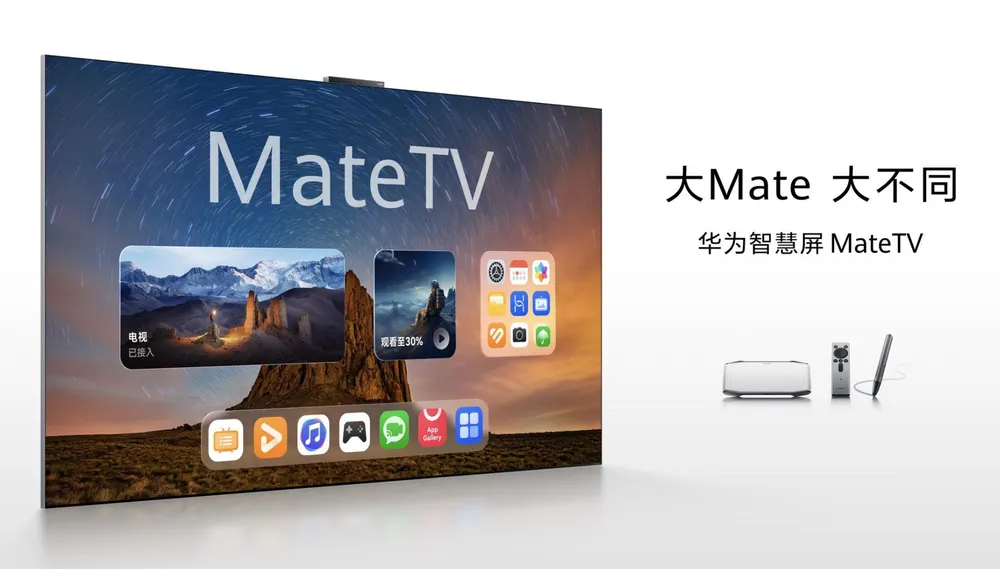
Core Insights - Huawei's MateTV series has established itself in the high-end television market, ranking among the top three, showcasing strong market competitiveness [1][3] - The success of MateTV is attributed to its alignment with consumer upgrade trends, leveraging flagship smartphone technology to enhance performance and user experience [3][4] Market Position - Huawei's MateTV has captured a significant share in the high-end market, particularly in the growing segment of large-screen televisions (85 inches and above), creating barriers in high-value niches [3][4] - The brand's strategy of applying smartphone capabilities to television has disrupted traditional industry dynamics and shifted the focus from hardware to user experience [4][13] Product Recognition - The MateTV series has received multiple industry awards, including the "Annual Smart Product" from PConline and "Best Recommended Product" from First Home Appliances Network, reflecting its strong product capabilities [4] - Recognition from professional media underscores MateTV's excellence in performance, interaction, picture quality, and sound quality, affirming its position at the industry forefront [4] Technological Advancements - MateTV features flagship smartphone-level chips that ensure smooth playback of 4K content and seamless multitasking, addressing traditional television issues like lag and delay [6][10] - The integration of the Huawei Lingxi ecosystem enhances user interaction, making the experience intuitive and accessible, akin to smartphone usage [10][11] User Experience and Feedback - Analysts note that the popularity of MateTV signifies a shift in the television industry from hardware competition to experience competition, expanding its application scenarios [13] - Positive user feedback on social media highlights the convenience and effectiveness of the MateTV features, reinforcing its innovative value and market appeal [13]
为什么鸿蒙能成?
虎嗅APP· 2025-12-29 13:33
Core Viewpoint - The article discusses the evolution and success of Huawei's HarmonyOS, highlighting its growth in device numbers and developer engagement, while addressing the challenges faced in establishing a robust application ecosystem [2][11]. Group 1: HarmonyOS Development and Challenges - HarmonyOS has surpassed 32 million devices, adding over 150,000 daily, marking a significant achievement since its inception [2]. - The initial skepticism surrounding HarmonyOS stemmed from the historical challenges faced by other operating systems in building a mature application ecosystem [6]. - Huawei's strategy to initially support Android applications was a pragmatic approach to ensure survival, but it raised concerns about long-term developer commitment to creating native HarmonyOS applications [7][8]. Group 2: Strategic Decisions and Ecosystem Building - In 2023, Huawei announced a significant shift by removing the Linux kernel from HarmonyOS, aiming to encourage developers to create native applications [8]. - The investment in research and development for HarmonyOS 5 is unprecedented, with a workforce of 40,000 per month, surpassing all previous versions combined [8]. - Collaboration with the Chinese Academy of Sciences has led to substantial contributions to the open-source HarmonyOS codebase, enhancing its adaptability and ecosystem potential [8]. Group 3: User Experience and Performance - The success of HarmonyOS is attributed to its distributed computing architecture, which allows seamless collaboration across devices, enhancing user experience beyond traditional smartphone applications [13]. - The launch of HarmonyOS 6 integrates AI deeply into the system, resulting in significant performance improvements, including a 15% increase in device performance and enhanced battery life [15][20]. - Security features in HarmonyOS 6, including end-to-end encryption and a robust platform-level security system, address user concerns about privacy and data protection [20]. Group 4: Developer Engagement and Ecosystem Growth - Huawei's commitment to fostering a healthy application ecosystem includes strategic partnerships and talent development initiatives across multiple regions [22][24]. - The alignment of developer interests with HarmonyOS's growth trajectory has encouraged sustained investment and collaboration, as seen with major developers like Tencent and miHoYo [22][24]. - The rapid increase in application installations, such as QQ Music and WPS, demonstrates the growing demand for native HarmonyOS applications and the ecosystem's potential [30][31]. Group 5: Future Outlook and Competitive Position - HarmonyOS is positioned as a third alternative in the operating system landscape, focusing on user experience and mutual benefits for ecosystem partners [32]. - The ongoing evolution of HarmonyOS reflects a commitment to creating a cohesive smart service experience and expanding market opportunities for developers [32].

未来,星闪能“上天入海”吗
Xin Lang Cai Jing· 2025-12-26 16:58
Group 1 - The Star Flash Alliance has over 1,200 members, covering the entire industry chain including chips, terminals, and applications, with major international chip companies like Qualcomm and MediaTek joining the alliance [2] - Huawei's HarmonyOS integrates Star Flash with Bluetooth functionality, enabling point-to-point message transmission between devices in environments without public network coverage, providing new possibilities for emergency communication [2] Group 2 - The application range of Star Flash is expected to continuously expand, with the Aerospace Science and Technology Corporation completing flight tests of the "Aerospace Star Flash" module in January 2025, verifying its reliability in rocket networking and satellite communication [3] - The technology can replace 500 kilograms of cabling on rockets, enhancing their lightness and payload capacity [3] - Star Flash sensors can operate in high-pressure and complex electromagnetic environments, supporting deep-sea ecological monitoring and resource exploration [3] - According to predictions by an academician from the Chinese Academy of Engineering, global short-range communication chip shipments are expected to reach 12 billion units annually by 2032, with Star Flash likely to capture 30% of the market share [3] - Star Flash is reshaping the Internet of Things landscape with its core technology originating from China, applicable in everyday devices like headphones and watches, as well as in rockets and deep-sea probes [3]
星闪:让万物互联“飙”进未来
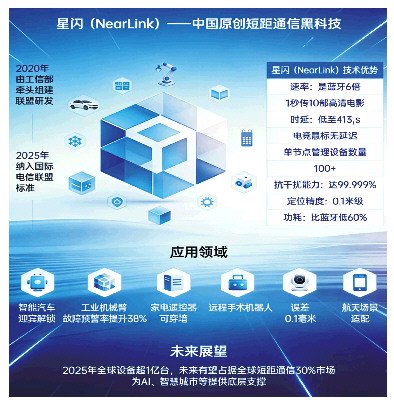
Xin Lang Cai Jing· 2025-12-26 16:58
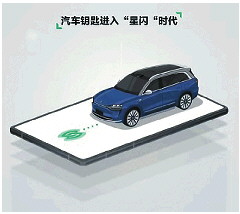
Core Viewpoint - The article highlights the emergence of "NearLink," a Chinese-developed short-range wireless communication technology that significantly enhances connectivity and performance for smart devices, addressing the limitations of existing technologies like Bluetooth and Wi-Fi [2][3]. Group 1: Technology Development - NearLink was initiated in 2020 by the Ministry of Industry and Information Technology, gathering over 400 organizations, including Huawei and China Mobile, to develop a faster, more responsive, energy-efficient, and stable short-range communication technology [2]. - The first technical standard for NearLink was published in 2022, and in 2023, Huawei launched the first terminal product supporting NearLink, enabling high-quality lossless audio transmission [3]. Group 2: Performance Metrics - NearLink operates in two modes: one for low-power scenarios with transmission speeds six times faster than traditional Bluetooth, and another for high-speed needs capable of transmitting 8K ultra-high-definition video [4]. - The latency of NearLink can reach as low as 20 microseconds, making it 1500 times faster than traditional Bluetooth and 500 times faster than Wi-Fi, surpassing human neural response speed [4]. Group 3: Application Scenarios - NearLink can connect up to 4096 devices simultaneously, significantly outperforming traditional Wi-Fi routers, which can only handle 32 devices [6]. - In smart home applications, devices using NearLink can operate seamlessly without interference, even in environments with many connected devices [6]. Group 4: Energy Efficiency - NearLink is designed to be energy-efficient, consuming 60% less power than traditional Bluetooth and 80% less than Wi-Fi, leading to extended battery life for devices [8]. - For instance, smartwatches equipped with NearLink can have their battery life extended by 30%, and industrial sensors can see battery life increase from three months to eight months [8]. Group 5: Industry Impact - In the automotive sector, NearLink enhances vehicle key functionalities, improving accuracy and responsiveness for features like automatic unlocking and guest welcome [10]. - In industrial applications, NearLink facilitates real-time data transmission, significantly reducing operational delays and improving efficiency in manufacturing and healthcare settings [11]. Group 6: Future Prospects - To achieve widespread adoption comparable to Bluetooth and Wi-Fi, NearLink needs to expand its ecosystem and reduce costs, as the current chip price is approximately 15 yuan, nearly double that of traditional Bluetooth chips [12]. - The anticipated reduction in chip costs by 30% by 2026 is expected to make NearLink more accessible to consumers and encourage broader adoption across various device categories [12].