
中国品牌全球化

Search documents
2025年中国品牌全球影响力报告
Sou Hu Cai Jing· 2025-07-08 01:06
Core Insights - The report highlights the accelerating global influence of Chinese brands, particularly in emerging markets, with significant growth in online traffic, engagement, and strategic globalization from 2024 to 2025 [1][10]. Group 1: Key Changes in Globalization - Chinese brands are transitioning from a "go out" strategy to a "go in" approach, focusing on localized operations and user experience [2]. - The electronics sector remains dominant, with 54 out of the top 100 brands, including realme, Huawei, and Xiaomi, leading in innovation and market positioning [2][18]. - The automotive sector is also gaining recognition, with brands like MG Motors and BYD making strides, especially in the electric vehicle market [2]. Group 2: Emerging Market Focus - The strategy emphasizes targeting emerging markets while deepening presence in developed markets, with the Middle East showing the fastest growth at a 69.8% increase in digital scores [4]. - North America and Europe remain key targets, with 67.4% of Chinese brands having a digital presence in North America, despite challenges like tariffs [4]. - Southeast Asia, Africa, and South America are highlighted as strong performers in emerging markets, with significant digital score increases [4]. Group 3: Digital Channels as Growth Engines - Social media, particularly TikTok, is crucial for growth, with 91% of the top 100 brands active on the platform, leading to increased user engagement [5]. - The shift from reliance on third-party platforms to a "platform + independent site" model is evident, with 75% of top brands having Amazon stores and many establishing DTC websites [5]. Group 4: Characteristics of Successful Brands - Successful Chinese brands share three traits: clear value propositions, flexible growth strategies, and sensitivity to user needs [6]. - New entrants like Insta360 and Zeelool are gaining traction by focusing on niche markets and leveraging social marketing [6]. Group 5: Future Trends in Brand Globalization - The report suggests a shift from "product export" to "brand export," emphasizing brand recognition and user loyalty as key competitive factors [7]. - Localization efforts are evolving beyond language translation to cultural integration, enhancing brand relevance in local markets [7]. - The overall trend indicates a move towards quality enhancement and comprehensive output of "products + services + brands" [7].

《2025中国品牌全球化增长力洞察》完整版
3 6 Ke· 2025-07-02 11:37
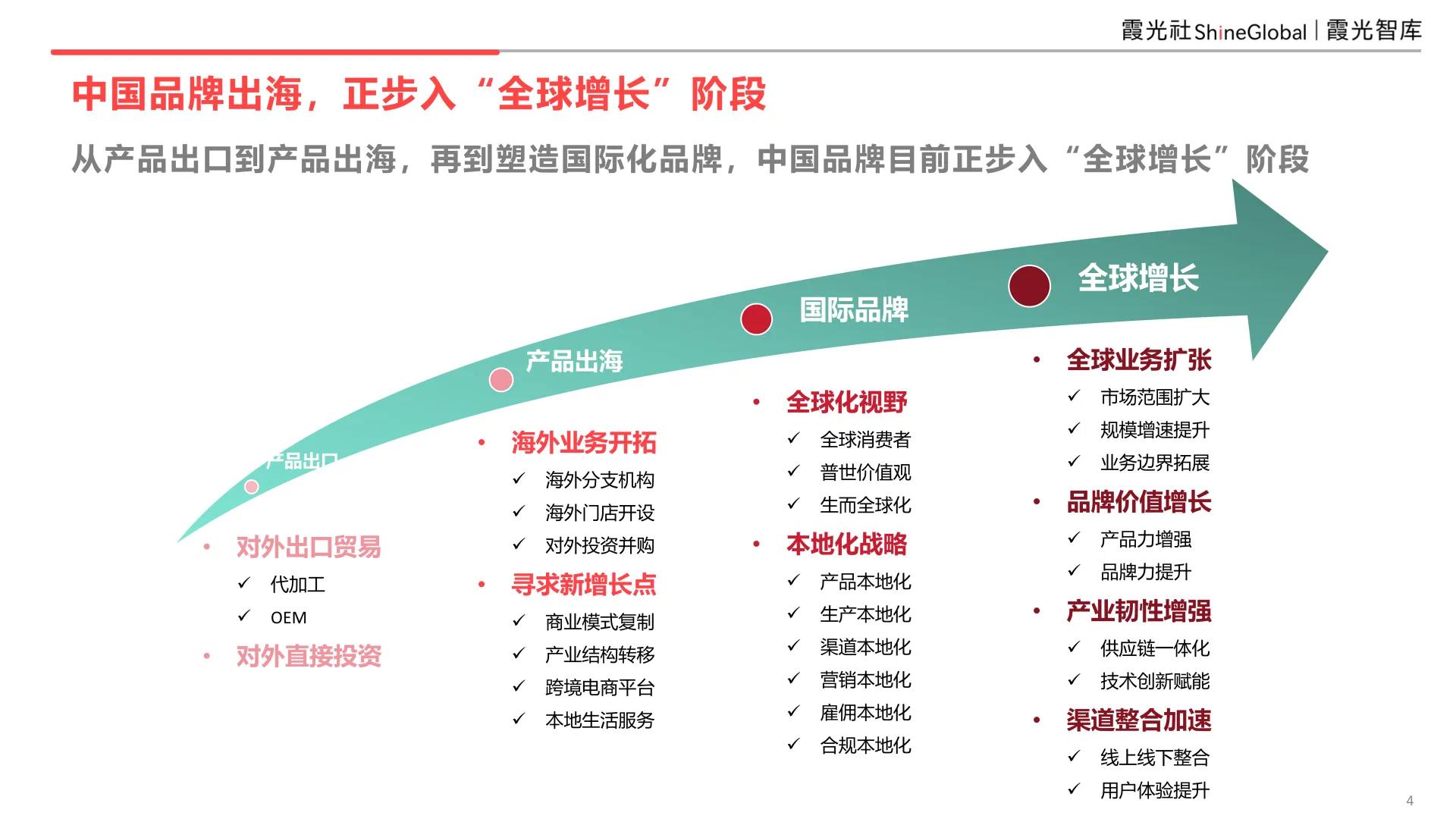
Group 1 - The core viewpoint is that Chinese brands are entering a "global growth" phase, transitioning from initial export through processing to establishing brand awareness and localizing in overseas markets [1][3][4] - The growth of Chinese brands is driven by both internal and external factors, including international policy uncertainties and changing global consumer demands [4][7] - Chinese companies need to innovate products, upgrade technology, and enhance brand resilience to achieve global value growth [7][10] Group 2 - External factors affecting global growth include international policy uncertainties and changes in global supply and demand relationships [9][10] - Recent events, such as anti-dumping investigations by the EU and reciprocal tariff demands from the US, highlight the need for Chinese brands to strengthen their influence and pricing power in international markets [9][10] - The global consumer market is evolving, with increasing demands for personalization and scenario-based needs, requiring Chinese companies to enhance their brand awareness and consumer service capabilities [10][21] Group 3 - Internal drivers for global growth include national initiatives and self-driven efforts by enterprises, such as the "China Manufacturing 2025" initiative promoting digital and intelligent transformation [12][53] - Chinese companies are achieving technological breakthroughs and innovations in certain sectors, which need to be translated into brand premium through global expansion [12][53] - The global expansion paths for Chinese companies vary, with strategies including price advantages in Southeast Asia, entering North America first, and gradually expanding to other regions [19][21] Group 4 - The integration of the entire industry chain is essential for efficiency and resilience, as seen in the Chinese electric vehicle sector, which is moving from "selling globally" to "rooting globally" [52][60] - Localized production bases are being established in regions like Thailand, Indonesia, and Europe, enhancing the collaboration of the entire supply chain [60][61] - The ability to control the supply chain is crucial for brand success in the global market, as companies must adapt to diverse and complex market conditions [66][67] Group 5 - The rise of content e-commerce, exemplified by platforms like TikTok, is reshaping how brands engage with consumers, emphasizing social connections and community-driven marketing [67][72] - "Omni-channel management" is becoming a core competitive advantage, allowing companies to integrate data across platforms for better marketing and operational decisions [72][73] - Emerging technologies like AI are driving significant improvements in product capabilities and supply chain optimization, enhancing the overall competitiveness of Chinese brands [73][76] Group 6 - Service ecosystems are increasingly important for Chinese companies going global, as they require specialized capabilities in areas like cloud services, logistics, and digital marketing [81][85] - Payment systems, influencer marketing, and cloud services are critical components of the global expansion strategy for Chinese brands [85][87][92] - The collaboration between service providers and brands is expected to deepen, leading to enhanced growth effects for both parties [81][84]


2025年中国品牌⾛向全球
Sou Hu Cai Jing· 2025-06-08 09:50
Overall Growth Trends and Key Changes - Since 2020/21, Chinese brands have shown significant growth on the global stage, particularly in social channels, e-commerce platforms, and official websites. Three key changes have been observed since 2024: enhancing market access through specific country/region websites and strategic e-commerce platforms; increasing presence on social media (especially Douyin) and optimizing content quality; and strengthening DTC website functionality and customer support [1][12][17]. Industry Performance and Leading Brands - Electronics remain the dominant category on the international stage, with 54 out of the top 100 brands being in this sector. The electric vehicle segment also holds substantial potential globally [2][23]. Emerging Champions in Niche Markets - Numerous "potential champions" have emerged in specific fields, such as Anker and Ecoflow in mobile power, Roborock and Ecovacs in robotic vacuums, and DJI in drones [3]. Impact of Digital Platforms - Brands like SHEIN, Temu, and TikTok have significant influence, not only achieving success themselves but also serving as launch channels for other emerging brands [4]. Success Factors and Challenges - Successful brands focus on clear value propositions, target customer segments, and localized content and sales channels. "Hidden champions" like Tuya stand out by concentrating on specific functions and providing quality service. Challenges include brands lacking unique value or local adaptation struggling to grow, while mature brands pursue growth through acquisitions, facing impacts from brand equity and geopolitical factors [5][18]. Ranking and Evaluation Methodology - The sample covers 664 brands, focusing on consumer and retail brands while excluding media and IT types. Brand scores are derived from website traffic (40%) and social media presence (60%), with varying weights for platforms like Douyin and Facebook [6][21]. Ranking Changes - The top three brands are realme, SheIn, and Huawei, with new entrants like Insta360 and Halara making the list. Brands such as FAW and Geely have seen notable ranking improvements, while some brands have declined [7]. Regional Expansion and Strategies - Target markets include mature regions like North America, Europe, and Asia, with rapid growth in emerging markets such as the Middle East and Africa, where digitalization scores have increased by 69.8% [8][46]. Localization and Channel Strategies - Brands are enhancing localized website content and services, leveraging e-commerce platforms alongside offline networks, though there remains room for improvement in brand engagement [9][45]. Future Recommendations - Focus on core markets to enhance engagement and avoid blind expansion. Leverage digital advantages by integrating Chinese experiences with global strategies. Strengthen local partnerships, listen to customer needs, and improve brand marketing capabilities to move beyond reliance on acquisitions [10][11]. Chinese Brands' Global Expansion - Chinese brands are demonstrating strong growth momentum in a complex global environment, with optimized strategies and enhanced brand value potentially leading to breakthroughs in more sectors [12].






“硬本领”“软实力”已成中国品牌全球化的底色
Zheng Quan Ri Bao· 2025-05-18 16:03
Core Insights - The article highlights the transformation of Chinese brands from "manufacturing" to "branding," showcasing their increasing competitiveness in the global market through innovation and cultural outreach [1][2][3] Group 1: Trade and Economic Performance - In 2024, China's total goods trade export value is projected to reach 25.45 trillion yuan, reflecting a year-on-year growth of 7.1% [1] - The structure of export products is continuously optimizing, with high-tech products showing strong growth and self-owned brands achieving record-high exports [1] Group 2: Innovation and Market Position - The global success of the Insta360X5 camera exemplifies how Chinese tech companies leverage innovation to meet market demand, maintaining a leading market share of 81.7% in the panoramic camera segment by 2024 [2] - Companies like Insta360, DJI, and Roborock are creating technological moats by deeply focusing on niche markets and gradually expanding into related fields like AI gimbals and video conferencing equipment [2] Group 3: Cultural Expansion and Brand Development - New consumer brands are leading the "IP going global" trend, with companies like Pop Mart and Nezha showcasing a shift from product export to cultural export [2][3] - Pop Mart has focused on overseas markets since 2022, employing strategies like offline store expansion and localized design to attract global fans, achieving significant success in markets like Thailand [3] - The emotional resonance of IP is crucial for cultural export, as demonstrated by Pop Mart's LABUBU brand gaining popularity and recognition in international markets [3]
【新全球化】TTD:以“品牌塑造”助中国企业穿越全球化新周期
Jing Ji Guan Cha Bao· 2025-05-13 09:21
Core Viewpoint - The Trade Desk (TTD) reported a revenue of $616 million for Q1 2025, a 25% increase year-over-year, with a customer retention rate of over 95% [1] - TTD emphasizes the importance of brand marketing in a changing economic landscape, particularly for Chinese brands seeking global presence [1] Group 1: Company Performance - TTD's Q1 2025 revenue reached $616 million, reflecting a 25% growth compared to the same period last year [1] - The company maintains a customer retention rate of over 95%, consistent over the past 11 years [1] Group 2: Brand Globalization - Chinese brands have surpassed U.S. brands in global industrial value share, with Chinese manufacturing accounting for 30% of the global total, while U.S. brands still hold a higher share of brand value at 18% [2] - The shift in Chinese brands' approach from sales conversion to long-term brand building is evident, focusing on brand value transmission and strategic planning [2][3] Group 3: Market Strategy - TTD assists Chinese brands in adapting their products and marketing strategies to different market ecosystems and consumer habits for better localization [3][4] - The ongoing trade war has prompted many companies to reassess their international strategies, recognizing the importance of brand resilience in uncertain environments [3][4] Group 4: Long-term Brand Strategy - Companies are increasingly investing in long-term brand strategies to enhance their resilience against market fluctuations, moving beyond short-term sales tactics [5] - The emphasis on brand as a core competitive advantage is crucial for maintaining consumer loyalty and market share in international markets [5]
从“赤水河”到“太平洋”:茅台借力海南自贸港加速全球化布局
Zhong Guo Xin Wen Wang· 2025-04-14 02:56
Group 1 - The fifth China International Consumer Products Expo (CICPE) has commenced in Haikou, showcasing Moutai's global strategy and the unique charm of Chinese national brands [1] - Moutai's exhibition at the CICPE emphasizes its internationalization strategy, with a theme of "Chinese Moutai, Fragrance Around the World," creating an immersive experience for global visitors [2] - The expo serves as a hub connecting ASEAN and RCEP markets, providing valuable opportunities for Chinese companies, including Moutai, to integrate into the global consumer market [2] Group 2 - The Hainan Free Trade Port's "zero tariff, low tax rate" policy supports Moutai in optimizing its global supply chain and reducing operational costs in overseas markets [3] - Under the free trade port policy, imported alcoholic beverages can enjoy exemptions from tariffs, consumption taxes, and value-added taxes, lowering Moutai's logistics costs [3] - Moutai aims to leverage Hainan as a logistics hub to efficiently distribute products to Southeast Asia and RCEP markets, enhancing its global resource allocation capabilities [3] Group 3 - Moutai's overseas business achieved significant growth in 2024, with export revenue reaching 5.189 billion yuan, a year-on-year increase of 19.27%, and high-value product sales exceeding 100 tons, up over 40% [4] - The company is transitioning from "product export" to "cultural export," promoting Moutai culture in 64 countries and regions, attracting international clients to experience its brewing process [4] - Moutai's social media presence has grown, with over 4 million followers, and it has received international accolades, enhancing its global brand influence [4] Group 4 - Zhang Deqin, Moutai's chairman, emphasizes the company's commitment to embracing global market opportunities and contributing to high-level openness in international trade [5] - Moutai plans to integrate its supply chain, cultural chain, and value chain by 2025, utilizing the benefits of the Hainan Free Trade Port to lower costs and enhance market access [5] - The shift from "product output" to "cultural resonance" marks a milestone in the internationalization of Chinese liquor and reflects the contribution of Chinese brands to global governance [5]
