
中央银行独立性

Search documents
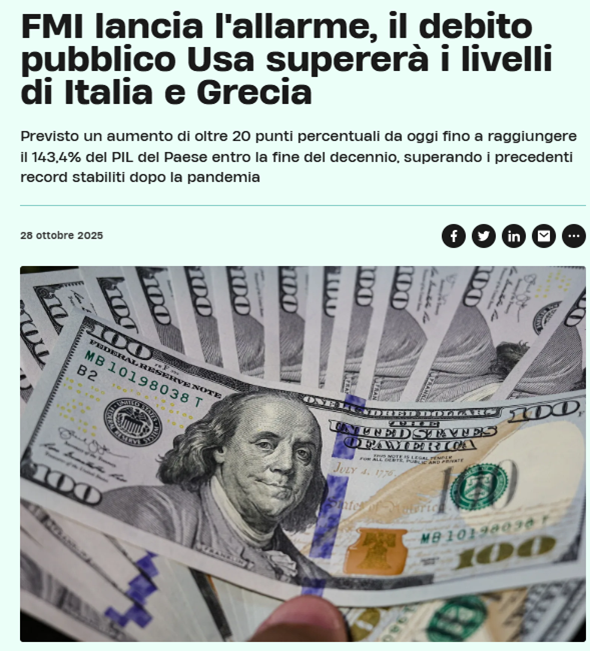
IMF预计美国政府债务负担率将超过意大利和希腊
Huan Qiu Wang· 2025-10-29 01:09
Group 1 - The International Monetary Fund (IMF) predicts that the U.S. government debt-to-GDP ratio will reach 143.4% by 2030, surpassing Italy and Greece for the first time this century [1] - The IMF also forecasts that the U.S. budget deficit will exceed 7% of GDP annually, the highest among all wealthy countries monitored by the fund this year and throughout the decade [1] - Despite the U.S. having a higher borrowing capacity due to the dollar being the global reserve currency, there is a shift in sentiment among U.S. politicians and investors regarding Europe's economic challenges as new data emerges [1] Group 2 - The end of quantitative tightening (QE) by the Federal Reserve may provide a smoother short-term debt financing strategy for the U.S. Treasury, potentially aligning the Fed's balance sheet with Treasury actions [3] - The focus will shift to the composition of the Fed's future balance sheet, with discussions on reducing the proportion of long-term bonds [3] - This change may open up the possibility for the Fed to purchase short-term securities, raising questions about the independence of the central bank [3]

海外专家:警惕独立运营的中央银行
Sou Hu Cai Jing· 2025-09-23 12:53
Core Viewpoint - The independence of central banks is being questioned as they increasingly serve powerful financial interests, leading to slow and uneven economic growth [1][2]. Group 1: Central Bank Independence - Central banks were established to shape financial environments and achieve national economic goals, but they are often influenced by strong financial interests, particularly in smaller, open developing countries [2]. - The shift towards central bank independence has led to a focus on inflation targeting, equating financial stability with price stability, which can exacerbate economic contraction during inflationary periods [2][4]. Group 2: Economic Inequality - The policies of central banks, particularly through interest rate hikes to combat inflation, have disproportionately affected low-income families, leading to increased unemployment and reduced income levels [4][6]. - The negative impacts of rising interest rates have not been offset by any positive effects, as banks benefit from higher interest income while the broader population suffers [4][6]. Group 3: Quantitative Easing - Quantitative easing (QE) emerged as a response to the limitations of traditional monetary policy, aiming to stimulate the economy by purchasing financial assets [5][6]. - QE has led to increased asset prices, benefiting wealthier individuals and exacerbating wealth inequality, as the richest segments of society see their asset values rise significantly [7][8].

近代中国财政对中央银行独立性的影响|金融人文
清华金融评论· 2025-09-21 11:02
Core Viewpoint - The independence of the central bank is crucial for its effective functioning, and excessive influence from government finances can lead to significant issues, as evidenced by historical precedents in modern Chinese history [3][4]. Group 1: Historical Context of Central Bank Independence - The establishment of the central bank in late Qing Dynasty was influenced by a fiscal crisis, leading to the creation of the Daqing Bank in 1905, which aimed to stabilize the financial market and manage fiscal revenues [6]. - During the Beiyang government, the central government's fiscal income heavily relied on local contributions, leading to a dependency on external and public debts, which posed risks to the central banks involved [7]. - The Nanjing National Government faced severe fiscal deficits due to military expenditures and debts, with military and debt expenses accounting for 67.6% of fiscal expenditures in 1934, prompting the need for monetary expansion [8]. Group 2: Consequences of Fiscal Dependency - The reliance on the central bank for financing government deficits led to hyperinflation, with price indices increasing approximately tenfold from 1937 to 1945, and by 1948, the price index surged by tens of thousands of times [8]. - The Nanjing National Government's central bank, established in 1928, initially had a lower issuance of currency compared to other banks, but by 1936-1937, it became the dominant issuer of currency due to the implementation of the fiat currency policy [8].

【UNFX课堂】政治干预的阴影:美联储独立性保卫战与全球经济的潜在震荡
Sou Hu Cai Jing· 2025-09-02 02:22
Core Viewpoint - The warning from European Central Bank President Christine Lagarde regarding U.S. President Donald Trump's interference with the Federal Reserve's independence highlights a growing tension between U.S. politics and monetary policy, which could have profound implications for both the U.S. and global economies [1][2]. Group 1: Federal Reserve Independence - The independence of the Federal Reserve is crucial for the effectiveness and credibility of monetary policy, as historical instances of political interference have led to inflation spikes, currency devaluation, and stock market declines [1][2]. - Trump's attempts to exert control over the Federal Reserve, including threats against Chairman Powell and legal actions against Governor Lisa Cook, reflect a desire for direct influence over monetary policy, particularly in terms of interest rate cuts [1][2]. Group 2: Economic Context - The Federal Reserve is currently navigating a delicate balance in its monetary policy decisions, with inflation data remaining above the 2% target and concerns about a weakening labor market following a disappointing July employment report [2]. - Market expectations for a rate cut in September are high, with nearly 90% probability, indicating concerns over economic slowdown and a potential shift towards more accommodative policies [2]. Group 3: Global Financial Implications - Erosion of the Federal Reserve's independence could lead to significant uncertainty in global financial markets, as the dollar's status as the primary reserve currency is partly based on the strength and independence of its monetary policy [3]. - A loss of confidence in U.S. dollar assets could result in capital outflows, dollar depreciation, and potential ripple effects across global financial markets, impacting borrowing costs, financial stability, and the global trade and investment landscape [3].
美联储主席鲍威尔:(谈特朗普施压)拥有独立的中央银行对公众有益,只要有利于公众利益,独立性就应得到尊重并继续下去。
news flash· 2025-07-30 19:07
Core Points - Federal Reserve Chairman Jerome Powell emphasized the importance of an independent central bank for the benefit of the public, stating that its independence should be respected as long as it serves the public interest [1] Group 1 - The independence of the central bank is beneficial to the public [1] - Respect for the central bank's independence is crucial [1] - The continuation of this independence is necessary for public interest [1]
美联储古尔斯比:看到关于中央银行独立性的争论让我感到痛心。
news flash· 2025-07-18 15:10
Core Viewpoint - The discussion surrounding the independence of central banks is causing concern within the financial community, particularly highlighted by comments from Federal Reserve official Goolsbee [1] Group 1 - Goolsbee expresses disappointment regarding the ongoing debates about central bank independence [1]
日本财务省官员:二十国集团支持中央银行独立性具有重要意义。
news flash· 2025-07-18 14:27
Group 1 - The importance of supporting central bank independence by the G20 is emphasized by Japanese finance ministry officials [1]
G20财长和央行行长会议公报:承诺推进财政可持续性,提高生产力改革
news flash· 2025-07-18 13:25
Group 1 - The G20 finance ministers and central bank governors meeting emphasized the commitment to promote fiscal sustainability and enhance productivity reforms [1] - The meeting addressed the debt issues faced by low-income countries and supported global minimum tax cooperation [1] - There was a focus on the importance of central bank independence and the international trade system [1] Group 2 - The meeting highlighted the need for collaboration with Africa and improving the efficiency of health spending [1] - Strengthening pandemic prevention and response measures was also a key point of discussion [1]

G20财长和央行行长会议公报:中央银行的独立性对于实现价格稳定目标至关重要。
news flash· 2025-07-18 12:59
Group 1 - The core message emphasizes the importance of central bank independence in achieving price stability goals [1]
德国央行行长:(就特朗普攻击美联储主席鲍威尔表示)独立性是中央银行的基因,随意干预非常危险。
news flash· 2025-07-17 10:49
Core Viewpoint - The independence of central banks is fundamental, and arbitrary interference is considered very dangerous [1] Group 1 - The President of the German Central Bank emphasized the importance of central bank independence in response to attacks on Federal Reserve Chairman Jerome Powell [1]